

A single missed certification step can halt a Singapore construction project for weeks, trigger additional compliance costs, and delay TOP clearance well beyond the original program. Many property developers and construction firms treat certification as a secondary administrative task, something to address once construction is underway or nearing completion. That assumption is incorrect, and it is costly. Building certification in Singapore is a structured, multi-stage regulatory obligation embedded at every major project milestone, from initial design through to statutory clearance, governed by legislation, enforced by multiple agencies, and managed through a digital submission platform that leaves no room for procedural shortcuts.
Table of Contents
-
The lifecycle of building certification: Step-by-step process
-
A developer’s perspective: Certification as operational strategy, not paperwork
-
How Aman Engineering helps you navigate certification requirements
Key Takeaways
|
Point |
Details |
|---|---|
|
Framework governs compliance |
Singapore’s certification requirements flow directly from the Building Control Act and BCA guidelines. |
|
Certification is a lifecycle |
Approvals span design, construction, and completion phases—planning ahead avoids delays. |
|
Lodgment Scheme streamlines |
Lower-risk projects can use simplified pathways but must meet strict eligibility rules. |
|
Green Mark is mandatory |
Environmental sustainability certification is required for most new builds and major renovations. |
|
Qualified Persons are key |
QPs handle all submissions and declarations, ensuring legal compliance throughout the project. |
Understanding the regulatory framework for certification by the Building and Construction Authority
Singapore’s building certification framework is anchored in the Building Control Act and supported by a suite of subsidiary legislation and agency-specific regulations within the wider construction industry. In Singapore, construction certifications cover both company licensing and workforce skills, and the Building Control Act updates reflect an evolving regulatory environment where non-compliance carries real financial and schedule consequences.
The primary agencies overseeing certification requirements include:
-
Building and Construction Authority (BCA): Structural safety, building plan approval, TOP/CSC clearance, Green Mark certification
-
Fire Safety and Shelter Department (FSSD): Fire safety plans and clearances
-
National Environment Agency (NEA): Environmental health compliance
-
Public Utilities Board (PUB): Drainage, sewerage, and watercourse clearances
-
National Parks Board (NParks): Tree conservation and green buffer requirements
-
Land Transport Authority (LTA): Road and transport interface submissions
-
Urban Redevelopment Authority (URA): Planning permissions and development control
BCA’s accreditation schemes help raise industry standards and strengthen companies’ reputations, and CONQUAS is the national benchmark for evaluating construction quality.
The legal foundation for environmental sustainability certification specifically is the Building Control (Environmental Sustainability) Regulations, which establishes definitions, scope provisions, and the requirement for a Green Mark certificate or minimum Green Mark score where applicable building works fall within the regulation’s scope. These regulations are not guidelines but enforceable legal requirements.
|
Regulatory instrument |
Governing agency |
Certification scope |
|---|---|---|
|
Building Control Act |
BCA |
Structural safety, plan submission |
|
Building Control (Environmental Sustainability) Regulations |
BCA |
Green Mark, sustainability submissions |
|
Fire Safety Act |
FSSD |
Fire safety plans and inspections |
|
Environmental Public Health Act |
NEA |
Health and environmental compliance |
|
Sewerage and Drainage Act |
PUB |
Drainage and utility clearances |
Accreditation also supports fair competition among construction firms in Singapore, with SAC and other certification bodies providing oversight that helps keep compliance standards consistent.
Certification requirements apply at defined stages of a project and are not triggered only by project completion. Developers who understand this regulatory matrix early can structure their procurement, design, and construction programs to align with each submission gateway rather than reacting to them.
The submission guide for temporary works further illustrates how even works that appear ancillary carry their own certification obligations. Failing to account for those requirements in the project schedule creates compounding delays.
The lifecycle of building certification in the construction industry: Step-by-step process
Having outlined the regulations, let’s explore how the certification requirements play out through major project milestones.
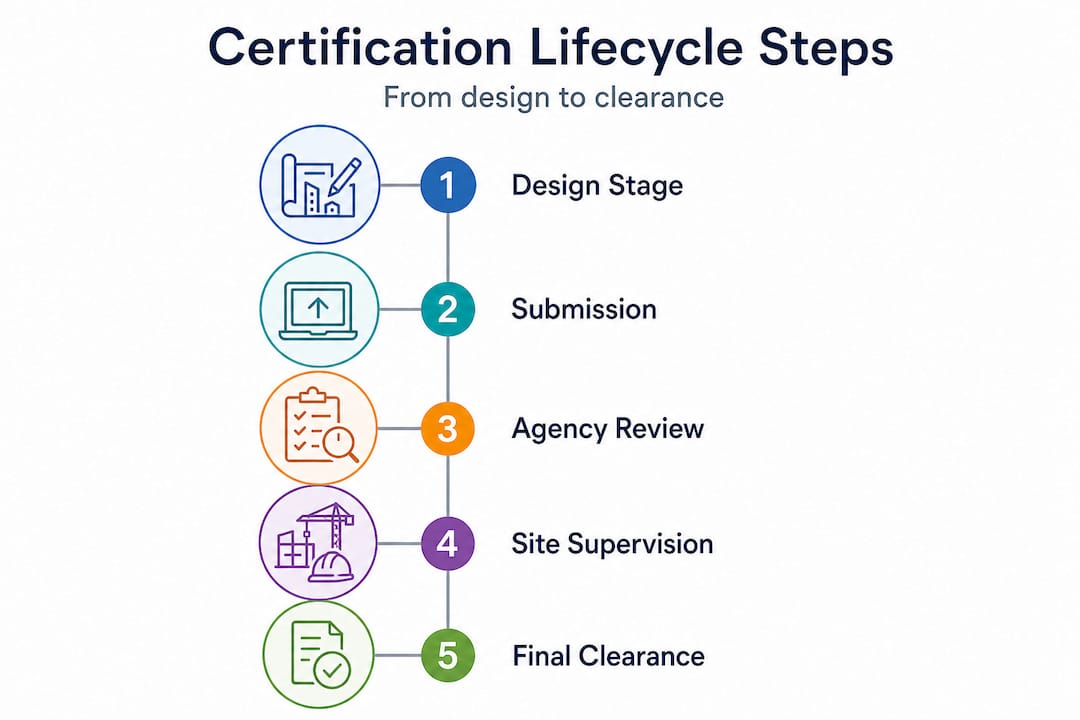
Building certification is not a single event. It is a sequence of regulated actions that runs from the design stage through construction monitoring and into final statutory clearance. Each phase involves specific forms, declarations, and responsible Qualified Persons (QPs) who carry statutory accountability.
The key stages are as follows:
-
Pre-design and design stage: QPs prepare and submit building plans to BCA for approval. Environmental sustainability declarations and supporting documentation, including Green Mark submissions, must accompany the building plan application at this stage. Sustainability requirements are integrated into the building plan submission requirements rather than treated as a separate post-design exercise.
-
Structural plan submission: Structural drawings are submitted by the Qualified Person (Structural) for BCA’s review and approval. Amendments require resubmission, and unauthorized deviations from approved plans constitute building control violations.
-
Construction phase compliance: QPs carry out site supervision, and specialist contractors execute work per approved plans, with certain materials and works, including concrete and structural steelworks, subject to mandatory certification in Singapore for construction projects. Site inspections, key construction stage notifications, and structural supervision records must be maintained and submitted as prescribed. In the construction sector, safety training is tailored to different responsibility levels, including workers and supervisors on construction sites, so they are prepared to respond to site risks, hazards, and emergencies while supporting compliance with local safety standards. Some required site safety training is especially relevant for migrant workers entering the Singapore construction sector.
-
Environmental sustainability as-built declarations: Before applying for TOP, the QP must submit as-built environmental sustainability forms confirming that the completed building meets the required Green Mark score or certification level. This requirement is explicitly integrated into the TOP process, with no provision for retrospective compliance.
-
TOP/CSC application: The developer applies for Temporary Occupation Permit (TOP) or Certificate of Statutory Completion (CSC) through CORENET X. BCA coordinates clearances across multiple technical departments, including FSSD, PUB, NEA, and NParks. Each agency reviews its scope independently, and clearance from all is required before TOP is granted.
-
Post-TOP obligations: Certain certifications, particularly for structural elements and specialized systems, carry periodic inspection and renewal obligations after occupation commences, and BS EN 13369 certification for precast concrete became mandatory by 2024.
Ready-Mix Concrete suppliers have required third-party certification since 2010.
The TOP/CSC clearance process spans multiple technical departments, and the CORENET X platform tracks each clearance in real time. Developers should review the construction compliance checklist to map each certification obligation against the project timeline.
Comparison: Standard submission process vs. Lodgment Scheme
|
Factor |
Standard submission |
Lodgment Scheme |
|---|---|---|
|
Approval mechanism |
BCA reviews and approves |
Deemed approved on lodgment |
|
Project type |
All regulated building works |
Ninth Schedule lower-risk works only |
|
Turnaround time |
Variable, subject to review |
Immediate (acknowledgment via CORENET X) |
|
QP declaration |
Required |
Required, plus eligibility declaration |
|
Post-lodgment inspections |
Standard inspection regime |
May still apply |
Pro Tip: Schedule your QP appointments and sustainability consultant engagements during the design development stage, not after design is finalized. Delays in QP appointment are one of the most common causes of building plan submission holdups in Singapore.
Lodgment Scheme: Deemed approval for lower-risk projects
Even within rigorous certification procedures, there are exceptions for certain project types. Let’s clarify when and how these simplified pathways apply.
The Lodgment Scheme offers a streamlined submission pathway for building works that fall within the Ninth Schedule of the Building Control Regulations. Under this scheme, Qualified Persons lodge prescribed plans directly with the Commissioner of Building Control, and the plans are deemed approved upon lodgment, with an acknowledgment issued automatically through CORENET X.
This pathway is designed to reduce administrative burden for lower-risk, less complex works without compromising the underlying compliance requirements. The QP must still declare that the works comply with all applicable regulations and that the project falls within the Ninth Schedule scope.
Works commonly falling within the Lodgment Scheme include:
-
Single-story additions not exceeding specific height and floor area thresholds
-
Minor internal structural alterations within defined parameters
-
Certain category of light steel structures and prefabricated systems
-
Works classified as lower-risk under the prescribed schedule criteria
What the Lodgment Scheme does not do is eliminate compliance obligations. The deemed approval is conditional on the QP’s declaration being accurate, and misrepresentation carries statutory consequences. The QP supervision details clarify the scope of QP responsibilities under both standard and lodgment pathways, including what cannot be delegated.
|
Lodgment Scheme factor |
Implication for developers |
|---|---|
|
Deemed approval |
Faster project commencement for eligible works |
|
QP eligibility declaration |
QP bears statutory responsibility; developer must verify QP’s assessment |
|
Ninth Schedule scope |
Not all “simple” works qualify; detailed schedule review required |
|
CORENET X acknowledgment |
Serves as the formal approval record; must be retained |
|
Ongoing compliance |
Inspections and supervision requirements still apply |
Pro Tip: Do not assume that a project is eligible for the Lodgment Scheme without a formal Ninth Schedule assessment by your QP. Incorrectly lodged works are treated as unapproved works under the Building Control Act, exposing both the developer and the QP to enforcement action.
Referencing the structural certification guide provides additional detail on how structural compliance obligations interact with the lodgment pathway and where the standard full-submission process remains mandatory regardless of perceived project complexity.
Environmental sustainability and Green Mark certification
Environmental sustainability isn’t just a regulatory checkbox. It is a core component of compliance, and the practical application options carry real project consequences.

The Building Control (Environmental Sustainability) Regulations require that new buildings and existing buildings undergoing major additions and alterations (A&A) obtain a Green Mark certificate or meet a minimum Green Mark score. This requirement is mandatory, not discretionary, where the building works fall within the regulation’s defined scope.
Key requirements under the sustainability regulations:
-
Design stage: Green Mark documentation and sustainability declarations must be submitted as part of the building plan application. The QP or Green Mark Professional must certify that the design meets the applicable minimum Green Mark standard.
-
As-built stage: Before TOP application, as-built sustainability forms must be submitted confirming that the completed building achieves the required performance level. This is a hard gateway; TOP will not be granted without this clearance.
-
Minimum Green Mark score: BCA periodically revises the minimum Green Mark standards. Current thresholds vary by building type and GFA, and developers must verify the applicable standard at the time of design submission.
-
Third-party assessors: For certain projects, independent third-party Green Mark assessors may be required to verify performance claims.
WELS certification is mandatory for certain water-related products and ensures compliance with water efficiency standards.
“Environmental-sustainability requirements for building works are integrated into the Building Plan and TOP processes, and qualified practitioners must submit declarations and submission forms with the Building Plan for approval; at completion they must submit declarations and as-built forms before applying for TOP.” BCA Sustainability Legislation
The practical implication is that sustainability is a compliance issue with hard submission deadlines tied to project milestones. Developers who engage their Green Mark Professional late in the design cycle risk having to redesign building systems to meet compliance thresholds, adding cost and program delays.
Major A&A projects that trigger the sustainability regulations include those where the affected gross floor area exceeds the thresholds defined in the subsidiary legislation. Developers undertaking phased refurbishments should verify, through their QP, whether the cumulative works trigger the sustainability submission requirement. The renovation planning guide details how to assess this threshold for existing buildings in Singapore.
Green Mark certification is also increasingly relevant to asset valuation, institutional investment criteria, and tenant leasing requirements in Singapore’s commercial sector, reinforcing its significance beyond regulatory compliance alone and shaping sustainability practices across the built environment.
A developer’s perspective: Certification as operational strategy, not paperwork
With all these technical requirements in play, here is how expert developers stay ahead.
The most significant risk in building certification is not a lack of knowledge about the regulations. Most experienced developers and their QPs understand the framework. The risk is organizational. Certification requirements get fragmented across project teams, design consultants, and contractors, each managing their slice of the process without an integrated view of how each element is connected to the broader project approval timeline, including regulatory approvals and workplace safety obligations.
Delays at the TOP stage, in particular, are almost never the result of a single missed document. They result from a chain of small, uncoordinated failures. A sustainability form that was not updated to reflect late-stage design changes. A FSSD clearance that was not tracked in the project program. A minor structural amendment that required resubmission but was not flagged by the QP until the TOP application was already lodged. Workforce safety certifications also help reduce on-site incidents, protect the workplace, and help candidates demonstrate professionalism and readiness to uphold safety standards.
The developers who consistently achieve clean, on-schedule TOP clearances treat certification as an operational system, not an administrative function. They build certification milestones into the master project program at the outset. They assign accountability for each certification stream to a named team member. And they conduct internal certification readiness reviews before lodging each major submission, using tools like the compliance checklist insights to verify that every required document, declaration, and clearance is in order. Mandatory safety courses such as CSOC improve worker safety awareness and support local site readiness, especially for migrant workers who need baseline safety awareness before entering construction sites.
This systems-thinking approach is not bureaucratic overhead. It is the most effective risk management strategy available to a developer in Singapore’s regulatory environment. The cost of a two-week TOP delay on a commercial project, in terms of foregone rental income, loan interest, and contractual penalties, routinely exceeds the total professional fees for rigorous compliance planning. That math should inform every project governance decision from design inception, especially for employers committed to stronger workplace safety and better career prospects for construction professionals.
How Aman Engineering helps you navigate certification services and requirements
If you’re ready to streamline your certification process, here’s how professional support can make all the difference.
Aman Engineering Consultancy provides end-to-end support for building certification requirements across all project types in Singapore, from initial plan submission through TOP/CSC clearance. Clients often need certification services tied to both project approvals and regulated materials compliance. Our team coordinates with BCA, FSSD, PUB, NEA, and other technical agencies on behalf of developers and construction firms, managing submission timelines, resolving technical queries, and tracking clearance status through CORENET X.
Our authority approval support covers the full range of statutory submissions, including structural plan approvals, environmental sustainability declarations, and fire safety coordination. Common certifications relevant to the sector include ISO 9001 and ISO 45001. For Green Mark compliance, our Green Mark Professional services integrate sustainability into your design and construction program from the earliest planning stage, eliminating the late-stage redesign risk that delays so many project timelines. These services may also involve testing and compliance support for regulated construction materials to help maintain quality across approvals and supply chains. In the regional supply-chain landscape, 148 concrete plants are certified across Singapore, Johor, and Batam. We can also advise on a suitable course pathway so training support matches different responsibility levels, from workers to supervisors and construction management teams, while reinforcing practical safety skills. Contact Aman Engineering to align your next project’s certification obligations with a structured, accountable compliance program.
Frequently asked questions
What are the main stages where building certification is required in Singapore?
Certification is required at building plan approval, during construction through QP supervision and compliance checks, and again for TOP/CSC clearance, where sustainability declarations and as-built forms must be lodged before occupancy is permitted.
Who can submit certification documents for a building project? Role of construction professionals
Only Qualified Persons are authorized to prepare and submit the required certification documents, as licensed local construction professionals authorized to submit certification documents, and under the BCA Lodgment Scheme, the QP must also declare eligibility and statutory compliance before plans are accepted.
What types of projects qualify for the Lodgment Scheme?
Only lower-risk works specified in the Ninth Schedule of the Building Control Regulations are eligible, and developers must obtain a formal eligibility assessment from their QP before proceeding under this pathway.
Is Green Mark certification mandatory for all building projects?
Green Mark certification is mandatory for new buildings and existing buildings undergoing major A&A works where those works fall within the Environmental Sustainability Regulations scope, making it a legal requirement rather than an optional sustainability initiative.
What is the role of CORENET X in building certification submissions?
CORENET X is Singapore’s digital regulatory submission platform used for building plan approvals, lodgment acknowledgments, and TOP/CSC clearance tracking, serving as the authoritative system of record for all certification stages. Digital submissions through CORENET X also help improve productivity by reducing manual follow-up across agencies.
-
Structural certification in Singapore: A compliance guide for developers
-
Singapore Construction Compliance Checklist: Ensure Project Approval
-
What Are The Requirements For Building Plan Submission In Singapore – Aman Engineering Consultancy
-
Singapore Fire Safety Certificate Requirements For Building Owners – Aman Engineering Consultancy