

Property developers and building owners in Singapore who overlook mandated engineering inspections expose themselves to stop-work orders, costly rectification, and potential legal liability under the Building Control Act, which governs periodic inspection requirements under Section 28 and the Building Control (Periodic Inspection of Buildings and Building Façades) Regulations 2021. The risks are not theoretical. Spalling concrete on an uninspected facade, an undetected electrical fault in a commercial tower, or an aging structural element in an industrial plant each represent scenarios that have ended careers, triggered litigation, and placed occupants in harm’s way. This article provides concrete, Singapore-specific examples of the engineering inspections your building requires, when they apply, and how to use them to maintain compliance and protect asset value.
Table of Contents
- Understanding engineering inspections: Compliance, purpose, and when they’re required
- Key engineering inspection examples for Singapore buildings
- Comparison of engineering inspection types and requirements
- How to get the most from your engineering inspections
- Real-world examples: Inspections by building type
- Why most inspection checklists miss what matters
- Partner with engineering experts for worry-free compliance
- Frequently asked questions
Key Takeaways
| Point | Details |
|---|---|
| Inspections are legally required | Singapore regulations mandate periodic engineering inspections to keep buildings safe and compliant. |
| Different types for different risks | Facade, structural, M&E, and fire system inspections each target specific building vulnerabilities. |
| Customized strategies improve results | Proactive planning and scenario-driven checklists help prevent overlooked hazards and compliance gaps. |
| Owners hold responsibility | Building owners must schedule, document, and act on inspection findings under the law. |
| Professional help prevents costly errors | Expert consultants can optimize inspection processes, flag hidden risks, and reduce legal exposure. |
Understanding engineering inspections: Compliance, purpose, and when they’re required
Engineering inspections, in the Singapore context, are systematic technical evaluations conducted by certified professionals to verify that a building’s structural, mechanical, electrical, and envelope systems conform to regulatory standards and remain safe for occupancy. They are not optional assessments. The Building Control Act, alongside subsidiary regulations, mandates specific inspection categories for buildings that meet defined criteria related to age, height, building type, and usage.
Legal triggers for required inspections include the following:
- Building age: Buildings that reach prescribed age thresholds become subject to periodic structural and facade inspection cycles.
- Height and building class: Taller and higher-occupancy buildings face more rigorous and more frequent inspection requirements.
- Renovations and additions/alterations (A&A works): Significant modifications to a structure’s layout or systems often require post-construction inspections before the relevant authority grants reinstatement approval.
- Reported defects: Any complaint or observed defect formally registered with the Building and Construction Authority (BCA) may trigger a mandated inspection and remediation order.
- Change of use: Altering a building’s occupancy category, such as converting industrial space to commercial use, activates new inspection obligations across structural, M&E, and fire safety categories.
Inspections also serve a critical commercial purpose. A building with a current, documented inspection record commands stronger resale and rental value, faces lower insurance premiums, and presents fewer obstacles during due diligence for property transactions.
Pro Tip: Retain all previous inspection reports and rectification records in a centralized file. Engineers conducting new professional building inspections can use historical data to identify trends, flag recurring defects, and prepare more accurate risk assessments for your asset.
It is equally important to note that inspection obligations do not disappear when a building changes ownership. The new owner assumes all existing compliance deadlines. Buyers who fail to conduct pre-acquisition inspection due diligence routinely inherit inspection backlogs alongside the title deed.
Key engineering inspection examples for Singapore buildings
The four primary categories of engineering inspection applicable to Singapore buildings are the Periodic Facade Inspection, the Periodic Structural Inspection, Mechanical and Electrical inspections, and Fire Protection Systems inspections. Each addresses a distinct risk domain, and each carries its own regulatory mandate.
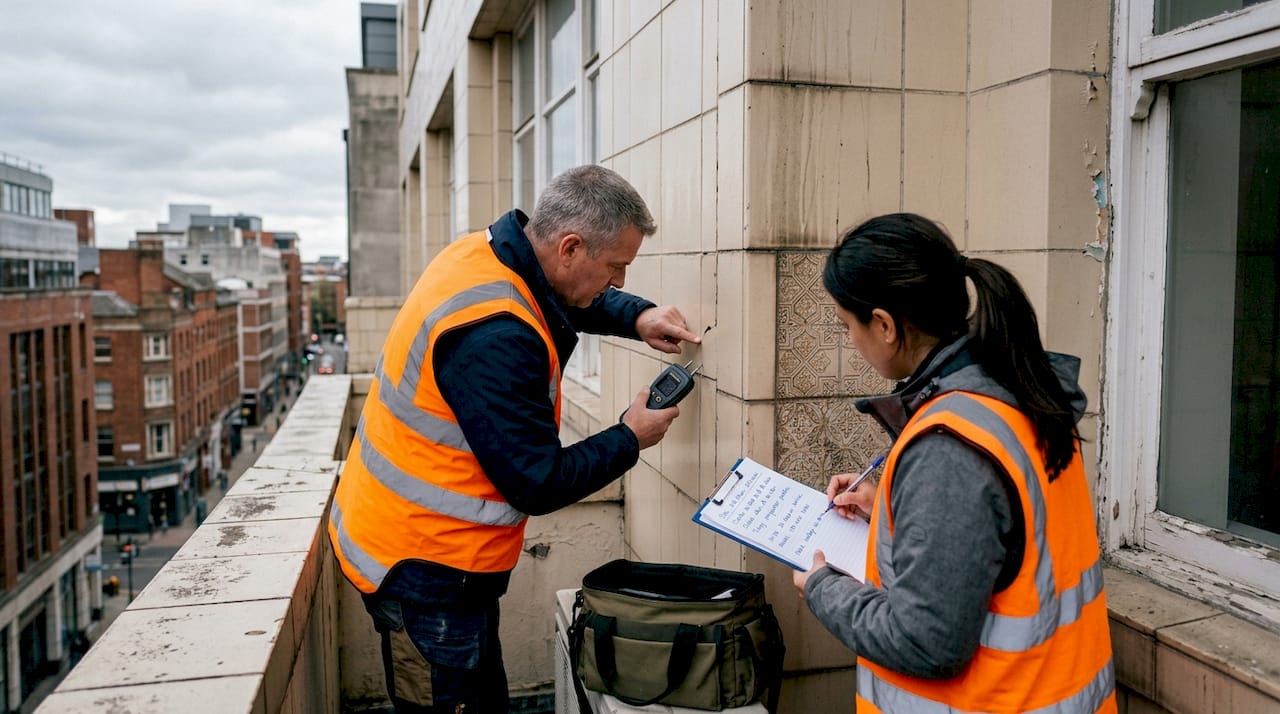
Periodic Facade Inspection (PFI)
The PFI targets the building’s exterior envelope, including cladding, plaster finishes, tiles, curtain walls, sealants, and external attachments such as canopies and sunshades. The driving concern is the prevention of falling hazards caused by material detachment from height. Given Singapore’s tropical climate, with consistent thermal cycling, high humidity, and frequent rainfall, facade deterioration rates are higher than in temperate countries. Understanding the full scope of facade inspection requirements is essential for any building that presents a public-facing exterior above ground level.
Common indicators that a facade inspection is overdue or urgently required include:
- Visible cracks or delamination in external plaster or tiling
- Water ingress through the building envelope
- Rust staining on concrete surfaces indicating rebar corrosion
- Loose or displaced external cladding panels
- Deteriorated sealant joints around windows, louvers, or expansion joints
Periodic Structural Inspection (PSI)
The PSI evaluates the primary load-bearing elements of a building, including foundations, columns, beams, slabs, and transfer structures. The structural inspection process requires a qualified Professional Engineer (PE) to assess whether the structure remains capable of sustaining its design loads. PSI obligations typically activate for buildings that have undergone significant structural modifications, have reached advanced age, or display signs of differential settlement, cracking, or deflection in critical members.
Mechanical and Electrical (M&E) inspections
M&E inspections cover the operational systems that make a building habitable and functional. This includes lifts, escalators, HVAC systems, electrical distribution boards, generators, water supply and plumbing infrastructure, and telecommunications risers. In Singapore, lifts are inspected and certified under the Lifts and Escalators Act, while other M&E components fall under various codes administered by the Energy Market Authority (EMA), PUB, and other agencies.
Fire Protection Systems inspections
These inspections verify that active fire suppression systems (sprinklers, gas suppression), passive fire barriers (fire-rated walls, doors, dampers), escape routes, emergency lighting, and fire detection systems all function as designed and remain compliant with SCDF requirements.
“Failure to maintain and inspect fire protection systems is one of the most frequently cited deficiencies during SCDF audits of commercial and industrial buildings in Singapore. The consequences include prohibition orders, mandatory reinstatement works, and in serious cases, criminal prosecution of responsible parties.”
The Building Control Act and subsidiary regulations collectively establish the legal framework within which all four categories must be managed.
Comparison of engineering inspection types and requirements
The table below provides a structured comparison of the primary engineering inspection categories applicable to Singapore buildings, enabling property developers and building owners to quickly identify their obligations.
| Inspection type | Frequency | Responsible party | Legal basis | Major hazards addressed |
|---|---|---|---|---|
| Periodic Facade Inspection | Every 5 years (buildings 7+ stories) | Building owner (via appointed PE) | Building Control Act, PFI Regulations 2021 | Spalling concrete, detached cladding, water ingress |
| Periodic Structural Inspection | Every 5 years (prescribed buildings) | Building owner (via appointed PE) | Building Control Act Section 28 | Structural failure, settlement, unauthorized load changes |
| M&E (Lifts, Electrical) | Annual to biennial, varies by system | Building owner or facilities manager | Lifts and Escalators Act, EMA regulations | Electrical faults, lift failure, HVAC system failures |
| Fire Protection Systems | Annual (active systems); periodic (passive) | Building owner (coordinated with SCDF) | Fire Safety Act | Sprinkler failure, compromised escape routes, alarm faults |
Buildings that are subject to structural inspection compliance obligations must ensure that appointed PEs hold the relevant practice area registration with BCA. Failure to engage a correctly registered PE invalidates the inspection report, rendering the building non-compliant even if the physical assessment was technically sound.
Buildings in the Central Business District face intensified scrutiny. The high density, mixed occupancy, and public exposure of these assets mean that the consequences of facade failure are significantly more severe. Detailed requirements for facade inspection for CBD buildings reflect this elevated risk profile.
Pro Tip: Consolidate your PFI and PSI into a single site mobilization cycle where regulatory timelines allow. This approach reduces scaffolding costs, minimizes occupant disruption, and allows the appointed PE to identify defects that cross inspection categories, such as a structural crack that also creates a facade water ingress pathway.
A BCA review of inspection outcomes across commercial buildings indicated that facade defects, particularly those related to spalling concrete and failed sealant joints, accounted for the majority of rectification notices issued under the periodic inspection program. This reinforces the case for proactive inspection rather than reactive maintenance.
How to get the most from your engineering inspections
A thorough regulatory inspection requires preparation, active engagement during the site assessment, and systematic follow-through after the report is issued. Each phase carries distinct responsibilities for the building owner or appointed representative.
Before the inspection:
- Compile all available as-built drawings, previous inspection reports, and maintenance logs for review by the appointed PE
- Verify that all inspection areas are accessible, including roof levels, basement plant rooms, external facades, and lift pits
- Notify tenants and occupants in advance to minimize delays during access to individual units or leased spaces
- Identify any recent A&A works, equipment modifications, or reported defects that may influence the inspection scope
- Confirm that the appointed PE’s BCA registration is current and covers the required practice areas
During the inspection:
- Assign a knowledgeable building representative to accompany the PE throughout the assessment
- Document all verbal observations made during the walkthrough, as these may not appear in the preliminary report
- Request that the PE prioritize and risk-rank identified defects so that rectification resources can be allocated appropriately
- Clarify any technical findings on site, particularly those relating to load changes or structural interventions
After the inspection:
- Review the PE’s report and submission to BCA within the prescribed timeframe
- Commission qualified contractors to address all defects in order of risk severity
- Retain all rectification records, photographic evidence, and completion certificates for future inspection cycles
- Integrate inspection findings into the building’s long-term maintenance plan
Applying structured hazard mitigation strategies before defects escalate significantly reduces both rectification cost and liability exposure. Owners who understand what is included in a structural inspection are better positioned to evaluate the adequacy of their appointed PE’s scope.
Pro Tip: Implement a digital compliance tracking platform to monitor inspection deadlines, defect closure status, and contractor certifications. Manual tracking via spreadsheets introduces significant error risk, particularly for portfolios with multiple buildings across different inspection cycles.
Real-world examples: Inspections by building type
Inspection priorities, frequency, and complexity vary materially depending on whether a building is classified as residential, commercial, or industrial. The Building Control Act applies uniformly, but the specific intersection of regulations activated for each building type differs based on occupancy, construction method, and use.
| Building type | Primary inspection focus | Frequency | Key notes |
|---|---|---|---|
| Residential (private, HDB) | Facade, structural integrity, M&E | Every 5 years (facade); condition-based for structural | HDB buildings managed centrally; private strata titles must self-organize |
| Commercial (office, retail) | Facade, structural, M&E, fire protection | Every 5 years (facade and structural); annual (fire/M&E) | High occupancy intensifies fire and M&E compliance demands |
| Industrial (factory, warehouse) | Structural load-bearing, M&E, hazardous materials | 5-year cycles for structure; annual for process systems | Mezzanine floors and heavy equipment platforms require specific PE certification |
Residential buildings must address facade deterioration, particularly in older blocks where external plaster or tiling was applied over aging substrates. Structural inspections for residential buildings typically focus on concrete spalling, rebar corrosion, and the integrity of transfer plates in mixed-use developments.
Commercial buildings, particularly office towers and retail centers, carry the most complex inspection obligations. Fire systems must be tested annually under SCDF requirements, while facade and structural assessments follow 5-year cycles. A high-rise office tower in the CBD, for example, will require rope access or gondola-mounted facade inspection teams, independent M&E auditors for electrical infrastructure, and a structural PE to assess any floor loading changes resulting from tenant fit-out works.
Industrial buildings present unique challenges. Mezzanine floors added to accommodate equipment or storage often receive inadequate structural assessment at the time of construction. Load-bearing columns in warehouses are frequently damaged by forklift impact and may not display visible distress until failure is imminent. Facilities handling hazardous materials must also integrate inspection findings with their workplace safety obligations under the Workplace Safety and Health Act.
Building owners managing properties across all three categories should coordinate with specialists in regular inspection requirements to build a unified, cost-efficient compliance calendar.
Why most inspection checklists miss what matters
Standard inspection checklists, while necessary, are inherently backward-looking. They codify known failure modes from past incidents and regulatory revisions. What they do not capture is the contextual risk specific to a particular building’s usage pattern, occupant behavior, microclimate exposure, or modification history. This is where rote checklist compliance most frequently fails property owners.
Consider a case where an industrial building underwent a series of incremental A&A works over a decade, each individually below the threshold requiring a BCA structural submission. Taken cumulatively, however, the works altered the building’s load path significantly. A standard periodic inspection checklist, focused on visible defects rather than load analysis, would not flag this condition. Only a scenario-driven assessment, one that traces the cumulative effect of modifications against the original structural design, would identify the risk.
The same logic applies to M&E systems in aged commercial buildings. A checklist item confirming that an electrical panel is labeled and accessible says nothing about the degradation of aging cables, the mismatch between panel rating and actual load, or the risk introduced when tenants independently installed high-draw equipment without informing facilities management.
Owners who maximize inspection value are those who treat inspections as intelligence-gathering exercises rather than box-ticking events. The output of a quality inspection should include not just a defect list but a prioritized risk assessment, a timeline for deterioration projection, and recommendations for system upgrades before the next inspection cycle.
Specialized engineers with deep domain experience in specific building typologies, whether heritage conservation structures, high-rise curtain wall systems, or heavy industrial facilities, bring contextual judgment that generic checklists cannot replicate. Commissioning the right specialist for the right building type is not a luxury. It is a material risk control decision.
Partner with engineering experts for worry-free compliance
Ensuring full regulatory compliance across facade, structural, M&E, and fire protection inspections requires more than scheduling periodic assessments. It demands coordinated expertise, rigorous documentation, and proactive risk management tailored to each building’s specific conditions.

Aman Engineering Consultancy provides the full spectrum of statutory inspection, certification, and consultancy services required by building owners, developers, and construction companies across Singapore. From coordinating BCA submissions to deploying BIM modeling for compliance tracking and documentation, the firm’s multidisciplinary teams bring both regulatory authority and practical site experience to every engagement. Owners seeking to optimize expenditure without compromising safety can benefit directly from value engineering services that align inspection scope with actual risk profiles. Contact Aman Engineering Consultancy before your next inspection cycle to establish a compliance strategy that protects your asset, your occupants, and your business.
Frequently asked questions
What is the difference between facade and structural inspections?
Facade inspections review the building’s exterior envelope for detachment hazards, water ingress, and material deterioration, while structural inspections assess the integrity of primary load-bearing elements such as columns, beams, slabs, and foundations. Both are governed under the Building Control Act but address distinct risk domains.
How often must engineering inspections be conducted in Singapore?
Most commercial buildings require periodic facade and structural inspections every 5 years, though the exact cycle depends on the building’s height, age, and classification under applicable regulations.
Who is responsible for arranging periodic engineering inspections?
Building owners bear full legal responsibility for ensuring that required inspections are conducted, that defects are remediated, and that reports are submitted to BCA within prescribed timeframes, as mandated by the Building Control Act.
What happens if mandated inspections are missed?
Non-compliance with inspection obligations under the Building Control Act can result in financial penalties, stop-work orders, mandatory rectification notices, and in serious cases, criminal prosecution of the responsible building owner or management entity.