
Mechanical and Electrical (M&E) engineering is frequently mischaracterized as a support function relegated to wiring diagrams and pipe routing, but this perception significantly underestimates its strategic importance in Singapore’s construction industry. M&E systems form the operational backbone of every modern building, governing energy performance, occupant safety, regulatory compliance, and long-term asset value. For property developers, construction firms, and building owners operating within Singapore’s stringent regulatory environment, a thorough understanding of M&E engineering is not optional; it is a prerequisite for project success and sustainable returns.
Table of Contents
- Understanding M&E engineering: Core functions and scope
- Why M&E matters: Value for building owners and developers
- Singapore compliance: M&E’s role in construction regulations
- Optimizing for the future: M&E engineering and sustainability
- Our take: Going beyond compliance for long-term value
- Take the next step: Leverage expert M&E engineering
- Frequently asked questions
Key Takeaways
| Point | Details |
|---|---|
| Core of building safety | M&E engineering integrates the essential systems that keep any building operational and compliant. |
| Drives energy savings | Best-in-class M&E delivers measurable energy reductions, saving owners money and supporting green goals. |
| Essential for compliance | Up-to-date M&E design is critical to pass Singapore’s construction regulations without costly delays. |
| Strategic investment | Treating M&E as a value-driver, not a checkbox, yields long-term efficiency and asset value. |
Understanding M&E engineering: Core functions and scope
M&E engineering is the discipline responsible for designing, specifying, installing, and commissioning all mechanical and electrical systems within a building or infrastructure project. In Singapore’s construction context, this spans an exceptionally broad scope that directly affects occupant comfort, operational efficiency, and statutory compliance across multiple government agencies including BCA, SCDF, PUB, and LTA.
The primary systems under M&E engineering include:
- HVAC (Heating, Ventilation, and Air Conditioning): Controls indoor thermal comfort and air quality, critical for Singapore’s tropical climate. Systems must be sized and configured to minimize energy consumption while maintaining prescribed ventilation rates.
- Electrical power systems: Low-voltage switchboards, distribution boards, emergency power supplies, uninterruptible power systems (UPS), and lightning protection. These systems must comply with SS 638 (Singapore Standard for electrical installations) and related codes.
- Plumbing and sanitary systems: Potable water supply, wastewater, and stormwater drainage systems subject to PUB regulations.
- Fire protection systems: Sprinkler systems, fire alarm systems, suppression systems, and smoke control installations governed by SCDF’s Fire Code.
- Vertical transportation: Elevators, escalators, and dumbwaiters regulated under the Building Control Act.
- Building Management Systems (BMS): Automated platforms integrating control and monitoring of HVAC, lighting, power, and other building systems into a unified interface.
M&E engineering does not operate in isolation. Effective project management in construction requires early-stage coordination between structural, architectural, and M&E disciplines to avoid costly design clashes and rework during construction. In Singapore, where site constraints are significant and construction timelines are tightly managed, this coordination is especially consequential.
Energy-performance optimization is a recognized application of M&E engineering in Singapore, with case studies demonstrating how strategic system design and calibration directly translate to reduced operating costs and stronger green building credentials. Additionally, digital transformation in Singapore construction has accelerated M&E integration, with Building Information Modeling (BIM) now enabling clash detection and system coordination at the design stage.
| M&E system | Primary regulatory body | Key standard or code |
|---|---|---|
| HVAC | BCA | SS 553, Green Mark criteria |
| Electrical installations | EMA, BCA | SS 638 |
| Plumbing and drainage | PUB | Code of Practice on Sewerage and Drainage |
| Fire protection | SCDF | Fire Code 2023 |
| Vertical transportation | BCA | Building Control Act |
Pro Tip: Engage your M&E engineers at the concept design stage, not after architectural drawings are finalized. Early M&E input enables better spatial planning for plant rooms, riser shafts, and ceiling voids, reducing the risk of costly variations during construction.
Why M&E matters: Value for building owners and developers
With the basics covered, it is important to see how M&E engineering drives real value for today’s stakeholders. The difference between a project with well-engineered M&E systems and one where M&E is treated as an afterthought manifests clearly across energy bills, maintenance costs, occupant satisfaction, and regulatory inspection outcomes.
A compelling real-world illustration is the SMU Connexion project in Singapore, where advanced M&E optimization achieved 68.8% energy savings through a combination of system retrofits, sensor integration, and data-driven commissioning. This level of reduction is not achievable through generic design practices; it requires deliberate, technically rigorous M&E engineering aligned with measurable performance targets.
Key insight: Buildings that invest in optimized M&E engineering at the design and construction stage consistently outperform those where M&E is treated as a cost line to minimize. The SMU Connexion case demonstrates that measured, data-backed M&E strategies can achieve energy savings of 68.8%, translating directly to reduced operating expenditure and enhanced green certification.
The following comparison illustrates the practical gap between conventional and optimized M&E approaches:
| Factor | Conventional M&E approach | Optimized M&E approach |
|---|---|---|
| Energy consumption | Meets minimum code only | Designed for peak efficiency beyond code |
| BMS integration | Basic or absent | Fully integrated for real-time monitoring |
| Maintenance costs | Higher due to reactive maintenance | Lower through predictive, data-driven scheduling |
| Regulatory compliance | Passes inspections at minimum standard | Exceeds targets; supports Green Mark applications |
| Occupant comfort | Adequate | Consistently high across variable load conditions |
| Asset value | Standard | Premium, with verified performance data |
| Adaptability | Limited | Designed for future upgrades and integration |
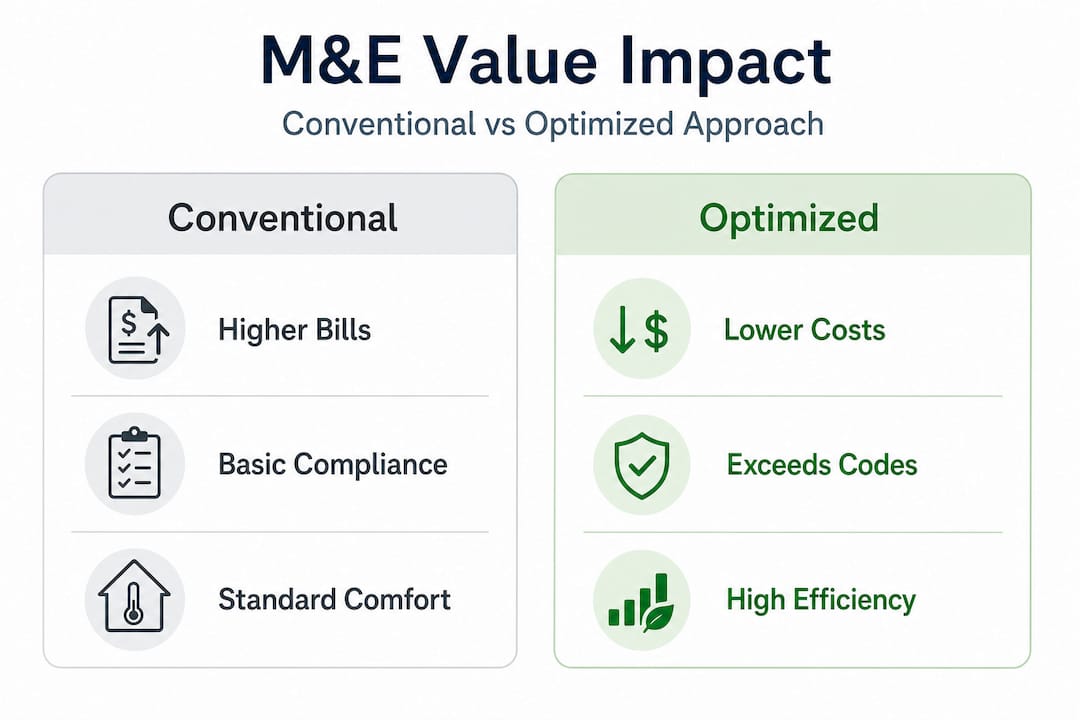
For building owners considering long-term holding strategies, the commercial logic is clear. Optimized M&E systems reduce operating costs, support higher rental premiums for quality tenants, and simplify future compliance inspections. From a sustainability perspective, M&E optimization contributes directly to reducing carbon footprint in construction and supports Singapore’s broader goals under the Green Plan 2030. Projects that incorporate passive cooling strategies alongside efficient M&E systems achieve compound energy savings that significantly improve building performance ratings.
The benefits of strong M&E engineering extend beyond energy efficiency to include:
- Occupant health and safety: Properly designed ventilation and fire protection systems protect building users and reduce liability exposure.
- Operational resilience: Redundant electrical and mechanical systems ensure continuity of critical functions during equipment failures.
- Future-proofing: Scalable M&E infrastructure accommodates tenant fit-out changes and technology upgrades without major disruption.
- Green certification support: Documented M&E performance data is a prerequisite for BCA Green Mark assessments, directly affecting marketability.
Singapore compliance: M&E’s role in construction regulations
Realizing the benefits of M&E hinges on meeting strict local regulations, so let’s break down how compliance works in Singapore. The regulatory framework governing M&E systems in Singapore is administered across several agencies, and non-compliance at any checkpoint can delay project completion, trigger rectification orders, or result in failure to obtain Temporary Occupation Permit (TOP) or Certificate of Statutory Completion (CSC).
M&E systems are validated using sensors and BMS data for both compliance verification and sustainability performance. This data-centric approach is increasingly embedded in Singapore’s regulatory framework, with agencies requiring verifiable, quantified evidence of system performance rather than accepting design documentation alone. Environmental impact assessment tools further support M&E compliance by providing documented baselines for energy and environmental performance throughout the project lifecycle.
The typical compliance checkpoints for M&E systems in a Singapore construction project proceed as follows:
- Design approval: M&E drawings and specifications are submitted to relevant authorities (BCA, SCDF, PUB, EMA) for plan approval. Submissions must demonstrate code compliance and, where applicable, meet Green Mark prerequisites.
- Installation inspections: Qualified Persons (QPs) and Licensed Electrical Workers (LEWs) supervise installation and certify that work conforms to approved drawings and relevant Singapore Standards.
- Testing and commissioning: All M&E systems undergo structured testing against performance criteria stipulated in the approved design. HVAC systems require balanced airflow measurements; electrical systems require insulation resistance and earth fault loop testing.
- BMS verification: Where a BMS is installed, calibration and point-to-point testing confirms that all monitored points are accurately represented. BMS data logs may be reviewed by authorities to confirm energy consumption patterns.
- Energy Audit or Green Mark Assessment: For projects targeting BCA Green Mark certification or subject to the Building Energy Submission Scheme, measured M&E performance data must be submitted and independently verified.
- TOP and CSC inspections: Final statutory inspections confirm that all installed M&E systems match approved plans, are operational, and have been tested by the relevant registered professionals.
Understanding the regulatory submission process in detail is essential for developers who want to avoid costly delays at these critical junctures. Inadequate documentation or incomplete commissioning records are among the most common causes of failed inspections.
Pro Tip: Implement your BMS with a data logging function from day one of commissioning, not just at the point of regulatory inspection. Continuous data capture over weeks or months provides regulators with trend-based evidence of system stability and performance, which carries significantly more weight than a single-day test result.
Optimizing for the future: M&E engineering and sustainability
Meeting today’s standards is just the start; M&E engineering also positions buildings for long-term sustainability and future operational demands. Singapore’s regulatory trajectory is explicitly moving toward more stringent energy performance requirements, with BCA’s Super Low Energy (SLE) building program setting targets for new developments that go substantially beyond current Green Mark Platinum thresholds.
Energy-performance optimization through M&E is achieved using BMS-linked retrofits and targeted system upgrades, as validated by real-world case studies. The practical implication is that buildings designed with intelligent M&E infrastructure are far better positioned to adapt as energy codes tighten, technology evolves, and occupant expectations rise.
Key sustainability-focused M&E technologies currently deployed in Singapore include:
- Variable Speed Drive (VSD) pumps and fans: Reduce energy consumption in HVAC and water systems by matching output precisely to demand, rather than running at fixed full-load capacity.
- LED lighting with daylight-responsive controls: Automated dimming based on occupancy sensors and daylight levels delivers significant lighting energy savings without compromising visual comfort.
- High-efficiency chiller plants: Central chiller systems with coefficient of performance (COP) values exceeding minimum code requirements are a primary driver of energy savings in commercial buildings.
- Heat Recovery Ventilation (HRV): Captures thermal energy from exhaust air to pre-condition incoming fresh air, reducing chiller load in Singapore’s humid climate.
- Smart metering and sub-metering: Granular energy monitoring by zone, tenant, or system type provides actionable data for identifying inefficiencies and targeting retrofits.
- Solar PV integration: Roof-mounted photovoltaic systems reduce net energy consumption; integration with the BMS enables real-time monitoring of generation and consumption.
- Demand-controlled ventilation (DCV): CO2-based sensors modulate fresh air supply to occupied zones, reducing unnecessary ventilation energy in variable-occupancy spaces.
Incorporating renewable energy technologies into M&E system design enhances both energy independence and green certification scoring. Similarly, innovative facade designs that reduce solar heat gain work synergistically with M&E HVAC systems, lowering peak cooling loads and enabling smaller, more efficient plant selections.
Statistic callout: Verified energy savings from advanced M&E optimization not only reduce operational expenditure but also strengthen a building’s case for BCA Green Mark Gold Plus or Platinum ratings, which are increasingly demanded by institutional tenants and real estate investors applying ESG criteria to their portfolios.
Our take: Going beyond compliance for long-term value
The construction industry’s prevailing approach to M&E engineering in Singapore tends to frame it primarily as a compliance obligation, a set of systems that must be designed, installed, and tested to satisfy statutory requirements and obtain occupation permits. This framing is technically accurate but commercially limited. It treats M&E as a cost center rather than a value driver, and the projects built on this assumption consistently underperform relative to those where M&E optimization is treated as a strategic investment.
The evidence from Singapore’s own built environment is instructive. Projects that achieve measurable energy savings well beyond code minimums do so because M&E engineers were given a mandate and a seat at the design table from the earliest stages, not because they were handed a completed architectural scheme and asked to fit systems within the available space. The difference in outcomes is not marginal; it is substantial and quantifiable. Structural design integration across disciplines follows the same logic: when engineers across all specialties collaborate from concept stage, the resulting building performs better and costs less to operate.
The uncomfortable reality is that many developers and building owners in Singapore continue to award M&E scope on price alone, selecting the lowest-cost contractor or consultant without evaluating the long-term performance implications. A slightly higher investment in engineering quality and system optimization at the design stage typically delivers returns through reduced energy bills, lower maintenance expenditure, and stronger asset valuations over a ten-to-twenty year holding period. Treating ensuring regulatory compliance as the ceiling rather than the floor of M&E ambition is a strategic error that compounds over the life of the building.
The practical recommendation is straightforward: appoint M&E consultants concurrently with architectural and structural consultants, define performance targets beyond code minimums, and require that BMS data collection and verification protocols are embedded in the commissioning scope from day one.
Take the next step: Leverage expert M&E engineering
Effective M&E engineering is central to every high-performing building in Singapore, from initial concept design through statutory approvals and long-term operational management. Developers and building owners who want to move beyond minimum compliance and capture the full value of optimized M&E systems need access to experienced consultants who understand both the regulatory landscape and the technical depth required to deliver measurable results.

Aman Engineering Consultancy provides specialized support across the full M&E project lifecycle. Our M&E value engineering services help identify cost-effective design alternatives without compromising system performance or compliance. Our BIM modeling for M&E coordination enables accurate clash detection and integrated system planning before a single piece of equipment is procured. And our professional engineering compliance advisory services ensure that statutory submissions and regulatory inspections are handled with precision. Contact us today to discuss how our engineering expertise can be applied to your next project.
Frequently asked questions
What does M&E stand for in construction?
M&E stands for Mechanical and Electrical engineering, covering all systems that power, heat, cool, and make buildings safe and comfortable, including HVAC, power, water, fire protection, and lifts. These systems collectively determine how a building functions, performs, and complies with statutory requirements.
Why is M&E engineering critical for Singapore’s buildings?
Singapore’s regulatory environment and energy performance targets make advanced M&E systems essential for project approval, energy savings, and sustainability certification. Optimized M&E systems use BMS and metered data to demonstrate compliance with BCA, SCDF, PUB, and EMA requirements.
How do M&E upgrades benefit property owners?
Modern M&E upgrades reduce energy bills, raise building value, and simplify future compliance inspections. SMU Connexion saved 68.8% on energy through targeted M&E optimization, illustrating the scale of financial return that is achievable through strategic upgrades.
What is a BMS and why is it important in M&E engineering?
A Building Management System (BMS) controls and monitors all critical M&E components including HVAC, lighting, and power, making compliance verification and operational efficiency significantly more manageable. BMS-linked sensors and calibration provide the verified performance data that regulators and green certification bodies require.