
Hacking Walls in HDBs: Why You Need a Professional Engineer for Non-Structural Walls
The Modern Architectural Landscape
Space is an absolute premium in Singapore. Consequently, homeowners constantly seek innovative interior design solutions. Hacking internal walls is a highly popular renovation strategy.1
This process fundamentally alters the original architectural layout. It transforms tight rooms into expansive, unified living zones.2 Furthermore, it facilitates contemporary design styles effortlessly.3 Open concepts allow natural light to penetrate deeply.4 Moreover, ventilation improves drastically across the entire flat.5
However, this structural transformation is extremely complex. It extends far beyond simple aesthetic preferences. Removing physical mass alters building load dynamics significantly. Therefore, strict engineering oversight is critically necessary.
The Housing and Development Board (HDB) enforces rigorous protocols.6 Homeowners must navigate a dense bureaucratic and technical landscape. Understanding these requirements prevents costly structural errors. Furthermore, it ensures the absolute safety of all residents.
Categorising Architectural Walls
Understanding wall classifications is the first technical step. Every residential unit features a precise structural grid. Building components behave differently under immense physical stress. Therefore, accurate identification is absolutely paramount.
Structural Load-Bearing Walls
Structural walls act as primary load-bearing pillars.7 They support the massive weight of overlying floors. Consequently, they are integral to the building’s framework.7 Hacking a structural wall is unequivocally prohibited.7
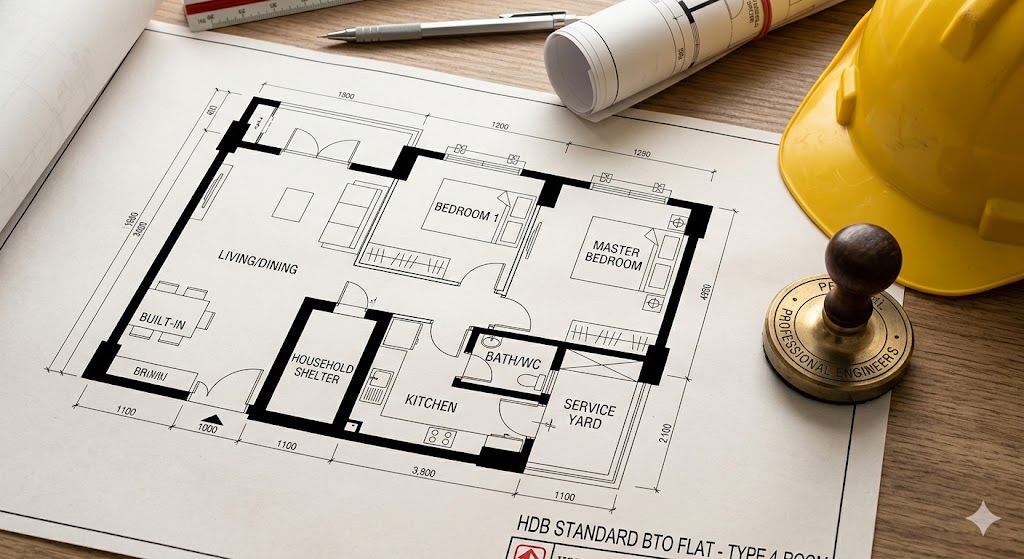
Such actions dangerously compromise global building stability.9 Removing them could cause the entire block to collapse.9 These critical walls are denoted distinctly on floor plans. Thick black lines indicate their load-bearing status.10 Homeowners must never attempt to alter these structures.
Non-Structural Partition Walls
Conversely, non-structural walls merely demarcate internal spatial zones.7 They separate bedrooms or enclose utility areas.7 They do not carry vertical structural loads from above. Therefore, they may be considered for careful demolition.7
However, their removal still demands strict professional oversight.7 Thin lines on official floor plans indicate these partitions.10 Many mistakenly believe these walls require no engineering input. This assumption is dangerously incorrect.
| Wall Classification | Primary Engineering Function | Legal Demolition Status | Floor Plan Visual Indicator |
| Structural Wall | Supports massive vertical building loads | Strictly Prohibited Always | Thick solid black lines |
| Non-Structural Wall | Divides and demarcates internal rooms | Permitted with HDB Approval | Thin solid black lines |
| Household Shelter | Provides emergency blast and shock protection | Strictly Prohibited Always | Specific HS boundary markings |
The Danger of Unauthorised Demolition
Bypassing HDB regulations invites severe punitive actions. Illegal hacking is treated as a major civil offense. Homeowners bear ultimate responsibility for flat renovations.6 Convictions result in substantial and immediate financial penalties.
Fines for unauthorised hacking reach up to $5,000.1 Furthermore, authorities issue mandatory reinstatement orders swiftly.11 The owner must rebuild the wall entirely at their expense.
Beyond finances, illegal modifications severely endanger public safety.6 Structural failures can manifest suddenly and catastrophically. Walls must be demolished systematically to prevent tragedies.13
For instance, a collapsed wall killed a worker recently.13 The 41-year-old was crushed in Serangoon Gardens.13 He was executing an unsystematic hacking procedure.13 Therefore, the Ministry of Manpower enforces strict demolition planning.13
Another terrifying incident involved an unqualified interior designer. The contractor illegally hacked away a structural column.15
The new homeowner discovered this horrific error later.15 The structural column was hidden above a false ceiling.15 This severely compromised the structural integrity of the block.15 These cases highlight the absolute necessity of professional oversight.
The Mandate for Professional Engineers
Homeowners often underestimate non-structural wall modifications. They believe altering partitions poses zero structural risk. However, this is a dangerous and costly misconception. The HDB frequently mandates a Professional Engineer (PE) endorsement.10 This is legally required for extensive spatial modifications.10 The PE provides indispensable structural safety assessments.17
PEs must be registered with the Professional Engineers Board.17 This registration verifies their high technical qualifications and experience.17 Structural safety dictates the entire renovation timeline securely.
Consequently, the PE’s role is absolutely central to success. They prevent catastrophic errors during the physical demolition phase.17 The absence of PE endorsement guarantees immediate legal trouble. It routinely leads to project delays, fines, and demolition orders.17
Engineering Assessment Methodologies
The PE conducts highly rigorous structural evaluations. Initially, they perform a comprehensive physical site inspection.17 They meticulously review original architectural and structural drawings.17
This verifies the exact location of all load-bearing elements. Next, the PE executes detailed load path analyses.17 They calculate dead loads, live loads, and wind loads.17 They must account for Singapore’s specific tropical climate conditions.17
This determines how forces travel through the remaining structure. Furthermore, they identify hidden reinforced concrete (RC) elements. Existing RC structures must never be tampered with.18
If temporary supports are needed, the PE designs them.17 They ensure precise calculations validate the building’s stability.17 Subsequently, the PE develops comprehensive, safe modification plans.17
Technical Nuances: Lintels and Stiffeners
Non-structural walls possess important localised physical properties. They actually contribute minor stiffness to the overall building frame. Furthermore, they contain crucial internal stabilizing elements.
Lintels are critical horizontal structural members.19 They are installed directly over doors and windows.19 Lintels support the heavy masonry loads above openings.19
When creating new wall openings, lintels are absolutely mandatory.20 They distribute weight safely into the adjacent wall sections.20 If omitted, the wall will experience severe structural cracking.19 Lintels can be made of reinforced concrete or steel.19
Additionally, reinforced concrete (RC) stiffeners frame block walls. These stiffeners prevent the wall from buckling laterally. During demolition, these stiffeners must not be damaged. The PE precisely calculates necessary load transfers around them.17
Advanced Non-Destructive Testing Tools
Modern engineering heavily relies on non-destructive testing (NDT). PEs use sophisticated equipment to evaluate concrete structures safely. The Profometer is an industry-standard diagnostic instrument.21
It operates using advanced eddy current pulse induction technology.22 The device generates a highly targeted electromagnetic field.22 Consequently, it detects hidden steel rebars within solid concrete.22
It operates effectively regardless of non-conductive surface materials.22 Wood, plastics, and bricks do not hinder the scan.22 Furthermore, the Profometer precisely measures concrete cover depth.21 It also accurately estimates the diameter of embedded rebars.21
The Profometer 600 features visual assistance for precise control.22 The PM8000 series offers superior precision in rebar mapping.23
Another essential tool is the MetalliScanner MT 7.21 It locates rebar and pipes up to six inches deep.21 This technology allows engineers to literally “see” inside walls.21
Therefore, contractors avoid damaging critical reinforcement during hacking.21 Ground-penetrating radar is another frequently utilised NDT tool.23 These tools guarantee that demolitions proceed with absolute safety.
The HDB Regulatory Framework
Singapore maintains world-class residential safety standards. Homeowners must secure prior written approval for any demolition.6
This applies to both partial and complete wall removals.6 Furthermore, owners must hire HDB-registered renovation contractors.8 These professionals understand the complex regulatory environment perfectly. They are listed in the Directory of Renovation Contractors (DRC).8
Renovation works are restricted to specific operational hours. Hacking is permitted only on weekdays.10
Approved hours are strictly between 9 AM and 5 PM.10 This drastically minimises noise disruption for neighbouring residents.10 Moreover, weekend and public holiday demolition is entirely illegal.10
| Permit Application Type | Authority Requirement | Special Operational Conditions |
| Hacking Non-Structural Walls | Yes – Special Approval | PE endorsement required; Debris disposal permit |
| Bathroom Waterproofing | Yes – Mandatory for Resale | Professional waterproofing certificate required |
| Electrical Rewiring | Yes – Mandatory | Licensed LEW electrician with EMA registration |
| Window Modifications | Yes – Special Approval | BCA-approved contractor; Strict facade compliance |
The Demolition Execution Process
The physical demolition phase is inherently hazardous. Therefore, continuous professional supervision is frequently mandated.
The PE closely monitors the actual hacking process onsite.17 They identify emerging hazards and mitigate immediate risks.17 Furthermore, strict operational protocols must be followed diligently.
Demolition must always commence from the top down.18 This prevents the sudden collapse of large wall segments.13
If steel bars are discovered, hacking ceases instantly.18 The PE must evaluate the unexpected reinforcement immediately. Subsequently, the HDB is notified of the structural anomaly.18
Furthermore, hacking tools must be carefully calibrated. Excessive vibration can induce micro-cracks in adjacent structures. Dust barriers must be erected to protect common corridors.
The noise generated by heavy concrete breakers is extreme. Contractors must manage the logistical challenge of debris haulage. Elevators must be protected with heavy-duty padding during transport.
The Household Shelter Mandate
The household shelter (HS) serves a critical civil defence function. It protects residents during extreme national emergencies.24
Therefore, HS modifications face the strictest possible regulations. The walls, ceiling, and floor are heavily reinforced. Hacking or removing HS walls is completely forbidden.24
Even minor aesthetic modifications are heavily restricted here. Power-driven nails cannot be installed into internal HS walls.25
Furthermore, the heavy steel door must not be tampered with.24 It must open and close properly at all times.24 The HS door notice must never be removed or covered.25
Drilling for removable screws is permitted, but tightly regulated. The insertion depth must never exceed exactly 50mm.25
Tiling the external face requires specific, non-destructive surface preparation.25 Consequently, the structural integrity of the shelter remains absolute.
The BTO Three-Year Restriction Period
New Build-To-Order (BTO) flats feature unique regulatory conditions. The most prominent is the three-year bathroom restriction.26 Homeowners cannot hack bathroom walls or floors initially.26
This strict rule enforces a mandatory 36-month waiting period.26 The countdown begins from the block’s official completion date.26
This regulation protects the original waterproofing membrane perfectly.26 The membrane prevents subsurface water seepage between concrete floors.27
New buildings experience microscopic settlement shifts initially. Therefore, preserving the membrane ensures long-term structural dryness.26
Homeowners must use tile overlay methods instead.27 Overlaying avoids destructive power tools entirely.27 Contractors use high-grade polymer or epoxy adhesives safely.26 Furthermore, it maintains full compliance with HDB rules.27 The new surface must maintain a precise drainage slope.26
Alternatively, freestanding bathtubs present a highly legal workaround.26 They require absolutely no hacking or permanent structural changes.26
They connect directly into the existing floor traps easily.26 After three years, replacement of finishes is legally permitted.18 However, this still requires official HDB approval beforehand.18
| Bathroom Renovation Method | Cost Estimate (2 Toilets) | HDB Compliance Status (BTO < 3 Years) |
| Tile Overlay Method | $10,290 to $11,690 | 100% Compliant and Permitted |
| Wall and Floor Hacking | $12,290 to $36,990 | Strictly Prohibited and Illegal |
| Freestanding Bathtub | Varies by Tub Model | 100% Compliant (No hacking required) |
Financial Analysis of Endorsements
Renovation budgets must incorporate professional engineering fees accurately. PE endorsement costs vary based on project complexity.28
Simple non-structural assessments are relatively affordable for homeowners. They generally range from $800 to $1,800.28
However, complex structural evaluations demand higher professional fees. These intricate assessments cost between $2,000 and $5,000+.28 SCDF fire safety layouts require $1,200 to $2,500.28
M&E systems endorsements cost between $1,000 and $2,000.28 Temporary works like scaffolding endorsements range up to $3,000+.28
Some firms offer incredibly cheap endorsements under $1,000.28 However, homeowners must beware of these suspiciously low prices.28
They often lack proper liability coverage and professional indemnity.28 Securing regulatory compliance requires legitimate, fully insured engineering professionals.28
| Type of PE Endorsement | Estimated Cost Range (SGD) | Project Complexity Level |
| Structural works (simple) | $800 – $1,800 | Removal of standard partition walls |
| Structural works (complex) | $2,000 – $5,000+ | Alterations near load-bearing elements |
| SCDF fire safety layout | $1,200 – $2,500 | Commercial or major residential changes |
| M&E systems endorsement | $1,000 – $2,000 | Complex utility routing and safety |
The True Cost of Demolition
The physical hacking labour carries significant associated costs. Basic non-load-bearing wall demolition is reasonably priced. It costs between $300 and $1,000 per wall typically.30 Conversely, complex hacking scenarios escalate expenses rapidly. These range from $1,000 to $2,000 per room.30
Furthermore, debris haulage and disposal require distinct permits. Disposal fees typically add $100 to $200.29
The HDB hacking permit itself incurs a small $20 fee.30 Labour costs fluctuate based on required operational complexity.30 Therefore, accurate budgeting requires detailed preliminary contractor quotes.31
Average full flat renovations run considerably high overall. A 3-room flat averages around $32,000 for basic renovations.32 A 4-room flat renovation averages $42,600.32 Meanwhile, a 5-room flat averages approximately $52,100.32 Hacking heavily influences these final budget calculations.
Uncovering Hidden Renovation Costs
Wall hacking initiates a massive cascade of secondary expenses. The initial demolition is merely the first financial phase. Electrical systems are fundamentally disrupted during wall removal. Embedded conduits and wiring are completely destroyed immediately.
Consequently, extensive electrical rewiring is absolutely mandatory.33 This requires a Licensed Electrical Worker (LEW).12 HDB flats utilize single-phase electrical units predominantly.33 Load assessments are often required for higher capacity appliances.33 Concealing wiring inside structural walls is highly illegal.33
Furthermore, floor surfaces present a major aesthetic challenge. Removing a wall exposes a long strip of bare concrete.34 Patching this ugly gap requires identical floor tiles.34 However, matching aged or discontinued tiles is nearly impossible. Therefore, homeowners often must replace the entire floor.
This drastically inflates the overall renovation budget exponentially. Similarly, ceiling plastering is necessary to hide overhead scars.16 Carpenters must fabricate new skirting boards to match existing ones. These hidden finishing costs frequently exceed the demolition itself. Proper planning is vital to prevent budget overruns.
Acoustic Implications of Open Layouts
Removing physical barriers fundamentally degrades indoor acoustics. Solid walls provide essential sound isolation between adjoining rooms. This acoustic separation relies entirely on dense physical mass. Mass physically blocks airborne sound wave transmission effectively.35
Hacking a wall completely destroys this dense acoustic barrier. Consequently, noise travels freely across the newly opened space. This severely diminishes privacy and general ambient comfort. Furthermore, sound reflects aggressively off hard parallel surfaces. To mitigate this, advanced soundproofing strategies are urgently required.
Homeowners must deploy alternative acoustic absorption solutions immediately. Adding dense mass to remaining walls is highly effective.36 Acoustic plasterboard features a specially engineered high-density core.35 This dense core effectively blocks voices and television frequencies.35 Sealing tiny gaps with acoustic sealant is also crucial.36
Advanced Acoustic Mitigation Strategies
Merely adding soft materials provides insufficient acoustic privacy. Decoupling structural layers prevents direct vibration transfer entirely.35 Building a separate stud frame accomplishes this decoupling effectively.35 Resilient channels isolate drywall from the rigid framing.37
This breaks the mechanical path of the sound wave. Furthermore, mass-loaded vinyl provides flexible, dense sound blocking.37 It is highly effective against low-frequency bass noises. Additionally, heavy acoustic curtains absorb high-frequency sound reflections.36 Thick carpets and rugs reduce impact noise on floors.36
Constructing a staggered stud wall offers ultimate quiet.37 However, this advanced technique consumes valuable interior floor space. Therefore, homeowners must balance openness with acoustic comfort carefully. The PE can evaluate the structural limits of acoustic additions.
| Advanced Acoustic Strategy | Mechanism of Sound Attenuation Action | Primary Application Area |
| High-Density Acoustic Plasterboard | Adds massive density to block airborne noise | Remaining internal partition walls |
| Flexible Mass-Loaded Vinyl | Blocks low-frequency bass and vibrations | Inside hollow wall cavities |
| Resilient Decoupling Channels | Mechanically decouples structures to stop waves | Drywall framing and ceiling mounts |
| Heavy Acoustic Curtains | Absorbs high-frequency sound reflections | Large windows and open doorways |
Property Valuation and Market Dynamics
Extensive structural modifications significantly influence future property valuations. Wall hacking yields highly polarizing real estate market results. Certain buyers highly prize modern open-concept floor plans.38 They appreciate the enhanced spatial flow and natural light.38
For these specific buyers, hacked walls increase flat desirability. Conversely, many traditional buyers demand maximum bedroom counts. Growing families require dedicated, separated, and private sleeping spaces. Consequently, missing partitions deter a massive buyer demographic.
Real estate experts note hacking can reduce overall value.39 The depreciation margin generally hovers around 5% roughly.39 This reduction reflects the future cost of wall reinstatement.38 Prospective buyers factor wall rebuilding into their purchase offers.38 Therefore, homeowners must consider long-term financial consequences carefully.
The Economics of Wall Reinstatement
Reinstating a demolished wall is a highly complex process. It demands fresh HDB permits and extensive masonry work.40 Reinstatement costs range from $400 to $1,200 per wall.30 This price fluctuates based on material choices and dimensions.30
Furthermore, matching new paint to existing walls is difficult. HDB regulations mandate proper structural integration during reinstatement.17 A PE must ensure connection details meet current codes.17 They assess fire safety, acoustic, and thermal performance requirements.17
Irreversible architectural changes permanently limit the property’s market appeal.34 Strategic partial hacking offers a highly effective compromise sometimes. Half-walls preserve visual sightlines while maintaining room definitions.41 However, finishing a half-wall is surprisingly labor-intensive and expensive.41 Ultimately, layout flexibility is the key to preserving resale value.
Contemporary Design Trends in 2026
Interior design philosophies in 2026 embrace high spatial fluidity. Singaporean homeowners increasingly favour warm minimalism and Japandi styles.3 Cool grey interiors are completely falling out of favour.42 Instead, warm neutrals define the current modern aesthetic.42
These aesthetics demand uncluttered, continuous architectural volumes.42 Consequently, non-structural wall hacking remains immensely popular today.1 Standard HDB layouts are frequently reconfigured for modern workflows. In 4-room flats, hacking significantly enhances communal living areas.43
A common bedroom is often merged with the living room.38 This creates an expansive, multi-functional entertainment and dining space.4 Natural light penetrates much deeper into the core floor plan.4 Furthermore, kitchens are seamlessly integrated into adjacent dining zones.5 This fosters familial connectivity during daily meal preparation.5
Layout Adaptations for Larger Flats
For 5-room flats, spatial possibilities are even more expansive.2 Massive open concepts blur functional boundaries almost entirely.2 However, visual zoning remains incredibly important for spatial coherence. Area rugs and varied lighting effectively define specific usage zones.2
Biophilic design elements also heavily define modern luxury spaces.3 Bringing nature indoors is now a mainstream design necessity.3 Indoor plants thrive exceptionally well in newly sunlit areas.44 Built-in storage solutions are expertly integrated into remaining walls.4
This ensures the open space remains immaculately clutter-free.4 Full-height cabinets and hidden compartments are highly requested.4 Furthermore, curved architectural details are making a strong subtle comeback.42 Arches soften the harsh geometric lines of typical HDB units.42
However, creating these arches still requires PE-approved hacking works.45 Even minor archways demand structural integrity appraisals by authorities.45 Therefore, engaging a competent interior designer and PE is crucial. They translate aesthetic visions into legally compliant realities.
Overcoming Common Renovation Myths
Many dangerous myths surround HDB renovation and wall hacking. One massive misconception is that any wall can be removed.46 As previously established, load-bearing walls are strictly off-limits.46 Another myth concerns the cost of partial demolitions.
People assume hacking a half-wall is significantly cheaper.41 However, this approach is often more expensive ultimately.41 Creating a half-wall requires extensive, precise finishing work.41 The exposed edge must be capped, plastered, and painted perfectly.
Furthermore, homeowners believe simple arches require absolutely no permits. This is completely false under HDB regulations.45 Creating a hollow or arch involves significant structural hacking.45 Therefore, an engineering report must be submitted for evaluation.45 Finally, many believe unapproved works will simply go unnoticed. HDB conducts regular inspections and relies on neighbour reports.1
Authority Approvals and Submissions
The bureaucratic submission process is intricate and highly demanding. The PE manages multiple critical authority approvals seamlessly. Building Plan (BP) submissions are routed through the BCA.17 Structural (ST) submissions detail the rigorous engineering calculations.17
Furthermore, Permit to Work (PTW) applications are mandatory.17 The contractor logs into the HDB portal to submit APEX applications.12 They must upload scaled floor plans showing proposed changes.12 Colour-coded plans are required for visual clarity.12 Red indicates demolished elements, while blue signifies new elements.12
An Acknowledgement Form signed by all flat owners is necessary.12 A detailed method statement outlines the work sequence.12 HDB typically takes up to three weeks to process applications.12 Complex structural changes requiring PE review may take longer.12 Approval must be explicitly granted before any work commences.
Insurance and Liability Considerations
Structural modifications fundamentally alter building risk profiles. Therefore, comprehensive insurance coverage is absolutely essential during renovations. The designated contractor must possess valid BizSafe certification.12 This certification verifies strict workplace safety compliance protocols.12
Furthermore, they must carry substantial public liability insurance policies.12 This protects against accidental damage to adjacent HDB units. Workmen compensation insurance is also a strict legal requirement.12 Demolition works carry high risks of severe physical injury.13
If a worker is injured, proper insurance prevents devastating lawsuits. Furthermore, homeowners should inform their personal home insurance providers. Significant structural alterations might temporarily affect existing policy coverage terms. The PE’s professional indemnity insurance also provides a layer of protection.28 This covers any unlikely errors in their highly technical calculations.
Search Intent and Digital Planning
In 2026, planning a renovation begins entirely online. Understanding digital search intent is crucial for navigating resources.47 Search engines now prioritize content showcasing genuine experience and expertise.47 E-E-A-T principles dominate how renovation information is evaluated.47
Therefore, homeowners must seek information from highly authoritative sources. Relying on outdated blogs or unverified forums is dangerous. Guidelines change rapidly, especially concerning BTO restrictions and PE requirements. Consulting official HDB portals and licensed PE websites is imperative.
Keyword stuffing is an obsolete digital marketing tactic.48 Today, quality information addresses specific homeowner questions thoroughly.48 For example, queries about “hacking structural columns” require definitive, expert answers. By researching intelligently, homeowners avoid illegal renovation pitfalls.48
Strategic Conclusions
Hacking HDB walls is a remarkably complex architectural undertaking. It requires meticulous planning and strict, unwavering regulatory compliance. The Professional Engineer is an absolutely indispensable project asset. They safeguard the building’s vital, underlying structural integrity flawlessly.
Furthermore, they protect the homeowner from severe legal and financial liabilities. Unauthorised demolition carries unacceptable physical hazards and extreme monetary risks. Navigating the rigorous HDB permit process is strictly mandatory. Advanced NDT tools ensure precise, safe structural assessments.
The resulting open-concept spaces offer tremendous, modern lifestyle benefits. They align perfectly with 2026 design trends like Japandi.42 However, acoustic degradation and resale valuation impacts require careful consideration. By engaging qualified experts, homeowners can achieve their aesthetic visions safely. Ultimately, a balanced, legally compliant approach ensures a highly successful renovation.
Works cited
- 10 Illegal HDB Renovations You May Not Be Aware Of (Beware A $5,000 Fine), accessed May 2, 2026, https://stackedhomes.com/10-illegal-hdb-renovations-you-may-not-be-aware-of-beware-a-5000-fine/
- 6 Creative Interior Design Ideas for 5-Room HDBs in Singapore – Renozone, accessed May 2, 2026, https://renozone.com.sg/5-room-hdb-interior-design-ideas/
- HDB Renovation Trends 2026: Warm Minimalism, Costs & Design Ideas for Singapore Homes – Little Big Red Dot, accessed May 2, 2026, https://littlebigreddot.com/hdb-renovation-trends-2026-warm-minimalism-curved-designs-and-what-your-next-home-makeover-should-look-like/
- Best HDB Renovation Ideas in 2026 – Starry Homestead, accessed May 2, 2026, https://starryhomestead.com/articles/best-hdb-renovation-ideas-in-2026/
- 7 Best HDB Open-Concept Floor Plans To Make Your Flat Look Big – Uchify, accessed May 2, 2026, https://uchify.com/best-open-concept-floor-plans/
- Important Information on Renovations – HDB, accessed May 2, 2026, https://www.hdb.gov.sg/managing-my-home/renovation-and-maintenance/renovation/important-information-on-renovations
- Hacking Walls in HDB Renovation Singapore: What’s Permitted & What’s Not, accessed May 2, 2026, https://www.theinteriorlab.com.sg/hacking-hdb-renovation-singapore-dos-and-donts/
- Open-Concept Living in Your HDB: Should You Hack Walls or Not?, accessed May 2, 2026, https://www.carpenters.com.sg/blog/open-concept-living-in-your-hdb-should-you-hack-walls-or-not/
- Breaking Walls, Breaking Rules: Illegal HDB Renovations That Could Cost You – PropNex, accessed May 2, 2026, https://www.propnex.com/picks-details/1096/breaking-walls-breaking-rules-illegal-hdb-renovations-that-could-cost-you
- HDB Hacking Guidelines & Costs in Singapore: Direct Contractor Guide (2026), accessed May 2, 2026, https://hockstar.sg/hdb-hacking-guidelines-costs-in-singapore-direct-contractor-guide-2026/
- Can We Hack An HDB Wall? | Home Renovation Guide – Dream Vinyl Flooring, accessed May 2, 2026, https://thevinylflooring.sg/can-we-hack-an-hdb-wall/
- HDB & Condo Wall Hacking Permit Guide Singapore 2025, accessed May 2, 2026, https://renovationcontractorsingapore.com/blogs/news/hdb-condo-wall-hacking-permit-singapore-2025
- Worker, 41, dies after wall he was hacking collapses on him, Singapore News – AsiaOne, accessed May 2, 2026, https://www.asiaone.com/singapore/worker-41-dies-after-wall-he-was-hacking-collapses-him
- Worker dies after wall he was hacking at Serangoon Gardens home collapses on him : r/singapore – Reddit, accessed May 2, 2026, https://www.reddit.com/r/singapore/comments/ve1aif/worker_dies_after_wall_he_was_hacking_at/
- ID & Contractor hacked away this owner’s structural column!!!! – Renovation Forum, accessed May 2, 2026, https://www.hometrust.sg/forum/posts/renovation-contractors/id-contractor-hacked-away-this-owner-s-structural-column
- The Complete Guide to Hacking: On Permits, Potential Hiccups and More | Qanvast, accessed May 2, 2026, https://qanvast.com/sg/articles/the-complete-guide-to-hacking-on-permits-potential-hiccups-and-more-3294
- PE endorsement for renovation works in residential and commercial properties such as hacking of non load bearing walls – Aman Engineering Consultancy, accessed May 2, 2026, https://www.amanengineering.com.sg/pe-endorsement-for-renovation-works-in-residential-and-commercial-properties-such-as-hacking-of-non-load-bearing-walls/
- Renovation Guidelines for Building Works – Singapore – HDB, accessed May 2, 2026, https://www.hdb.gov.sg/managing-my-home/renovation-and-maintenance/renovation/renovation-guidelines/building-works
- STRUCTURAL STEEL LINTELS | Brick Industry Association, accessed May 2, 2026, https://www.gobrick.com/media/file/31b-structural-steel-lintels.pdf
- What is a Lintel in Construction? Types, Uses, and Importance – MyBuilder, accessed May 2, 2026, https://www.mybuilder.com/bricklaying-repointing/articles/what-is-a-lintel-in-construction
- Rebar Cover Meter from CSS – component sales & services, accessed May 2, 2026, http://compsas.com/ct10.html
- Profometers – MYERS Construction Materials Testing Equipment, accessed May 2, 2026, https://myerstest.com/wp-content/uploads/2016/11/Profometers.pdf
- Profometer and Profoscope rebar locators and concrete cover meters. – Screening Eagle Technologies, accessed May 2, 2026, https://www.screeningeagle.com/en/product-family/profometer-and-profoscope
- How to Renovate Your HDB Flat | MyNiceHome, accessed May 2, 2026, https://www.mynicehome.gov.sg/get-settled-in/hdb-renovation-guide/
- Guidelines for Renovation Works – HDB, accessed May 2, 2026, https://www.hdb.gov.sg/-/media/managing-my-home/renovation-and-maintenance/renovation/renovation-guidelines/design-build-and-sell-scheme-dbss-flats/parkland-hougang-reno-guidelines.pdf
- HDB 3-Year Renovation Restriction: How to Style Your BTO Bathroom Now, accessed May 2, 2026, https://www.herabathroom.com/blogs/bathroom-ideas-renovation-guides-in-singapore-hera/hdb-3-year-renovation-restriction-how-to-style-your-bto-bathroom-now
- Overlay vs Hacking: HDB Bathroom Renovation Guide 2026 – RCS Renovation Contractor Singapore, accessed May 2, 2026, https://renovationcontractorsingapore.com/blogs/news/overlay-vs-hacking-hdb-bathroom-renovation-singapore
- PE Endorsement Cost in Singapore | Pricing Guide 2025, accessed May 2, 2026, https://www.aectechnicalsg.com/how-much-does-pe-endorsement-cost-in-singapore/
- 2026 Singapore HDB Renovation Guide: Costs, Tips & Contractors, accessed May 2, 2026, https://renovationcontractorsingapore.com/blogs/news/singapore-hdb-renovation-guide-costs-contractors-2025
- [Full Breakdown] Cost Of Hacking Walls In Singapore | Hackstage Builders, accessed May 2, 2026, https://hackstagebuilders.com/blog/cost-of-hacking-walls-in-singapore/
- #1 Free Guide on Cost of Hacking Walls in Singapore, accessed May 2, 2026, https://hackingsingapore.com/blog/cost-of-hacking-walls-in-singapore/
- Home Renovation Cost 2023: How much does HDB reno cost? | Home & Decor Singapore, accessed May 2, 2026, https://www.homeanddecor.com.sg/renovation/hdb-home-renovation-cost
- Electrical rewiring cost 2025/2026 : r/askSingapore – Reddit, accessed May 2, 2026, https://www.reddit.com/r/askSingapore/comments/1rrtfxb/electrical_rewiring_cost_20252026/
- Why I Decided Against Hacking My Room Wall: Honest Home Renovation Insights – Lemon8, accessed May 2, 2026, https://www.lemon8-app.com/@lainchuahh/7257893270527771137?region=sg
- 9 ways to soundproof an existing internal wall, accessed May 2, 2026, https://www.soundproofingstore.co.uk/9-ways-to-soundproof-an-existing-internal-wall
- Stop Outside Noise: 7 Proven Ways to Soundproof Your Home – Acoustic Supplies, accessed May 2, 2026, https://www.acoustic-supplies.com/how-to-soundproof-against-external-sounds/
- Ultimate Soundproof Wall: Step-by-Step Guide for CHEAP DIY! – YouTube, accessed May 2, 2026, https://www.youtube.com/watch?v=JWPzTtaFXWU
- Hacking of BTO rooms : r/askSingapore – Reddit, accessed May 2, 2026, https://www.reddit.com/r/askSingapore/comments/1g8er1x/hacking_of_bto_rooms/
- Investigating the misconceptions behind home renovations – Renonation.sg, accessed May 2, 2026, https://www.renonation.sg/articles/investigating-the-misconceptions-behind-home-renovations
- How Much Does It Cost to Reinstate an HDB Wall – SlideServe, accessed May 2, 2026, https://www.slideserve.com/Reinstatement/how-much-does-it-cost-to-reinstate-an-hdb-wall
- 7 Common Renovation Myths, Debunked – Hometrust, accessed May 2, 2026, https://www.hometrust.sg/articles/7-common-renovation-myths-debunked/
- Trending Interior Design Ideas for Your BTO in 2026 – EZiD, accessed May 2, 2026, https://www.ezid.sg/article/trending-interior-design-ideas-for-your-bto-in-2026
- 5 Interesting 4-Room HDB Layout Ideas To Utilise Your Space Better – Stacked Homes, accessed May 2, 2026, https://stackedhomes.com/5-interesting-4-room-hdb-layout-ideas-to-utilise-your-space-better/
- Interior Design Trends Singapore 2026: What’s Actually Worth Doing – Renonation.sg, accessed May 2, 2026, https://www.renonation.sg/articles/interior-design-trends-singapore-2026-whats-actually-worth-doing
- Things to know before hacking your HDB walls – RenoTalk.com, accessed May 2, 2026, https://www.renotalk.com/article/hack-hdb-wall
- Expert Guide to HDB Renovation Success Navigating Guidelines and Maximizing Space, accessed May 2, 2026, https://www.prestige-affairs.com/blogs/how-to/navigating-hdb-renovation-rules
- 10 SEO Strategies That Still Work in 2026 | AIPro.PH, accessed May 2, 2026, https://www.aipro.ph/post/10-seo-strategies-that-still-work-in-2026-and-what-to-stop-doing
Are Keywords Dead? SEO Content in 2026 – FatCat Strategies, accessed May 2, 2026, https://fatcatstrategies.com/marketing/2026-seo-content-are-keywords-dead/