

Digital engineering in Singapore’s construction sector has moved from a strategic aspiration to an operational standard, with the Building and Construction Authority’s Integrated Digital Delivery framework integrating BIM, digital twins, and common data environments across the entire project lifecycle. Property developers, main contractors, and government agencies are now expected to adopt these tools not merely for competitive advantage, but to meet regulatory requirements and deliver projects with measurably better outcomes. This article defines digital engineering in Singapore’s context, quantifies its project impact, addresses implementation challenges, and provides actionable adoption strategies for construction stakeholders.
Table of Contents
- Defining digital engineering in Singapore’s construction context
- How digital engineering drives project outcomes
- Key challenges of implementing digital engineering
- Strategies for successful digital engineering adoption
- A pragmatic perspective: what many overlook about digital engineering in Singapore
- Accelerate digital engineering success with proven partners
- Frequently asked questions
Key Takeaways
| Point | Details |
|---|---|
| End-to-end digitalization | Digital engineering integrates technology into every project stage for better outcomes. |
| Tangible business benefits | Projects see less rework, quicker approvals, and long-term lifecycle savings. |
| Adoption requires readiness | Success depends on upskilling and careful planning, not just buying new technology. |
| Incremental rollout works | Starting small and scaling up digital engineering efforts reduces risk and maximizes return. |
Defining digital engineering in Singapore’s construction context
Digital engineering, as applied in Singapore’s built environment, refers to the structured use of digital technologies from project inception through design, construction, and long-term operations. It is not a single platform or tool. Rather, it is a coordinated methodology that connects multiple technologies through standardized data protocols and shared workflows.
The BCA’s IDD framework provides the governing structure for this methodology. IDD mandates the integration of BIM, digital twins, common data environments, and related simulation tools to enable virtual planning, construction simulation, and operational optimization across all project phases. This framework applies to public sector projects above defined contract value thresholds and is increasingly expected on larger private developments as well.
The core technologies within Singapore’s digital engineering ecosystem include the following:
- Building Information Modeling (BIM): Three-dimensional parametric modeling that encodes geometry, material properties, structural data, and lifecycle costs into a single coordinated model. 3D BIM in construction enables design coordination, clash detection, and quantity takeoffs within one environment.
- Digital twins: Real-time virtual replicas of physical assets, updated with sensor data and operational inputs to support performance monitoring, predictive maintenance, and energy optimization throughout a building’s operational life.
- Common Data Environments (CDE): Centralized cloud-based platforms that serve as the single source of truth for all project documents, models, and communications, ensuring version control and audit traceability.
- Construction simulation and 4D/5D BIM: Time-linked and cost-linked models that allow project teams to simulate construction sequences, identify scheduling conflicts, and validate budget assumptions before work begins on site.
The following table summarizes the primary digital engineering components and their respective project phase applications:
| Technology | Primary phase | Key function |
|---|---|---|
| BIM (3D) | Design and documentation | Clash detection, coordination, quantity takeoffs |
| 4D BIM | Pre-construction | Schedule simulation and sequencing |
| 5D BIM | Pre-construction and procurement | Cost integration and budget validation |
| Digital twin | Operations | Real-time monitoring and predictive maintenance |
| CDE platform | All phases | Data management, version control, collaboration |
| CORENET X | Regulatory submission | Automated plan checking and approval processing |
Facade engineering is one discipline where digital engineering delivers particularly significant value. Facade engineering teams use BIM to model complex envelope geometries, simulate thermal and wind loading, and coordinate with structural and M&E systems before fabrication, reducing costly field modifications.
Singapore’s construction sector has historically faced productivity constraints relative to other advanced economies. Digital engineering directly addresses those constraints by reducing information silos, enabling concurrent design disciplines, and providing a single coordinated data environment that all project stakeholders can access and interrogate.

How digital engineering drives project outcomes
After understanding the building blocks of digital engineering, it is crucial to see what results stakeholders in Singapore are already experiencing. The performance improvements are not theoretical. They are documented, measurable, and directly relevant to project economics.
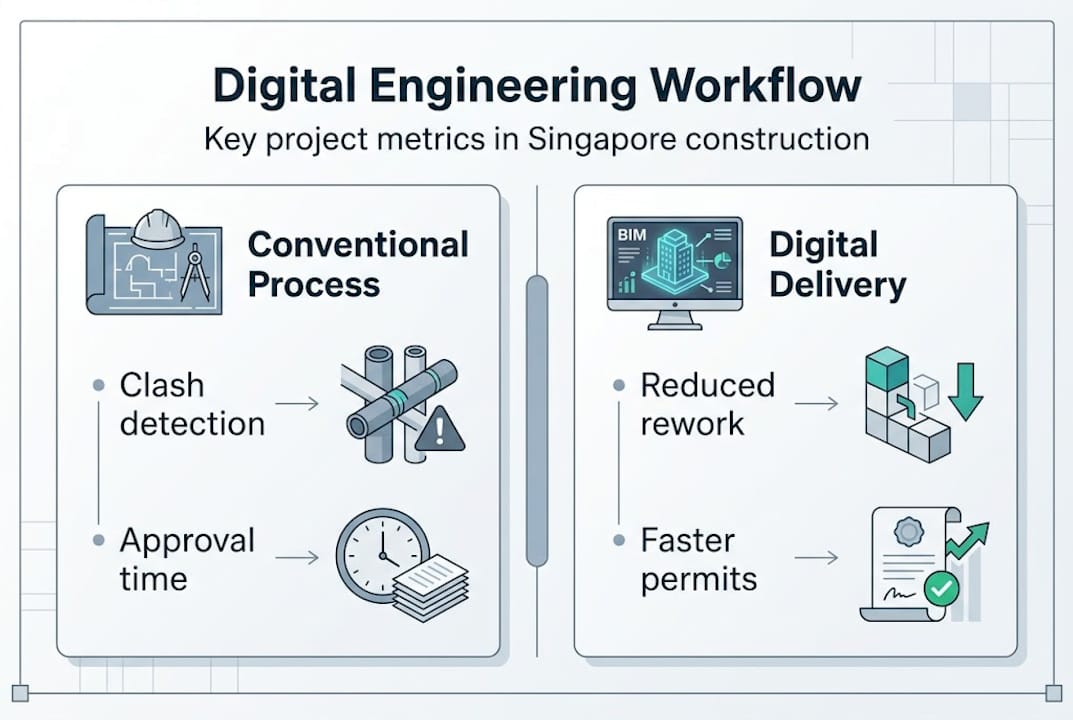
The most significant near-term benefit is the reduction of clash-related rework. When structural, architectural, M&E, and facade systems are modeled in a coordinated BIM environment, conflicts are identified and resolved during design rather than during construction. IDD implementation has demonstrated rework reductions of 20 to 60 percent, depending on project complexity and the maturity of the BIM execution plan applied.
The second major outcome is accelerated regulatory approval. Singapore’s CORENET X platform, which processes BCA, SCDF, and URA submissions through an integrated digital workflow, has reduced approval processing times by up to 20 percent compared to conventional paper-based or fragmented electronic submissions. Accelerated design approvals translate directly into earlier construction start dates and reduced holding costs for developers.
The following comparison illustrates the difference between conventional and digital delivery approaches across key project metrics:
| Project metric | Conventional process | Digital delivery (IDD) |
|---|---|---|
| Clash detection | Site-based, reactive | Model-based, pre-construction |
| Regulatory submission | Sequential, manual | Concurrent, automated via CORENET X |
| Rework rate | High, 10-20% of contract value | Reduced by 20-60% |
| Approval timeline | Standard processing | Up to 20% faster |
| Asset data handover | Paper-based O&M manuals | Digital twin with live data |
| Lifecycle cost visibility | Limited | Full lifecycle cost modeling |
Digital project management practices supported by IDD also enable better lifecycle planning. When a project’s BIM model is maintained and enriched through construction and handed over as a digital twin, facilities managers gain access to as-built geometry, equipment specifications, maintenance schedules, and energy performance benchmarks from day one of operations. This reduces the time and cost of reactive maintenance and supports evidence-based capital planning.
The quantified benefits of digital engineering adoption can be summarized as follows:
- Rework reduction: Coordinated BIM models resolve 20 to 60 percent of clash-related conflicts before construction commences, directly reducing variation orders and delay claims.
- Approval acceleration: CORENET X integration reduces regulatory processing time by up to 20 percent, shortening pre-construction timelines.
- Schedule reliability: 4D simulation identifies sequencing conflicts and resource bottlenecks before mobilization, improving program certainty.
- Procurement efficiency: 5D BIM provides accurate quantity takeoffs that reduce tender pricing uncertainty and post-contract variations.
- Operational savings: Digital twins enable predictive maintenance, reducing unplanned downtime and extending asset service life.
These outcomes are not limited to large-scale infrastructure projects. Medium-sized commercial and residential developments in Singapore have demonstrated comparable improvements when BIM execution plans are properly scoped and implemented from project inception.
Key challenges of implementing digital engineering
With those benefits in mind, here are the challenges Singapore stakeholders must plan for when rolling out digital engineering. The barriers are real, and underestimating them is one of the most common reasons implementation programs fail to deliver their projected returns.
The first and most immediate challenge is the upfront investment required. Successful IDD adoption demands investment in CDE platform licensing, BIM authoring software, hardware infrastructure, and workforce training before a single project benefit is realized. For smaller developers and contractors, this capital outlay can be a significant barrier without grant support from BCA’s IDD adoption programs.
The second challenge is change management. Many organizations underestimate the organizational disruption that digital engineering introduces. Established workflows, reporting hierarchies, and approval processes must be restructured to align with digital delivery protocols. Teams that have operated with conventional drawing-based workflows for years frequently resist the transition, and without sustained leadership commitment, adoption stalls at the pilot stage.
“The technology itself is rarely the limiting factor. The limiting factor is whether the organization’s leadership has genuinely committed to changing how work gets done, not just the tools used to do it.”
The third challenge is over-customization of digital systems. Feasibility studies conducted before platform selection frequently reveal that organizations attempt to replicate their existing manual workflows within digital systems rather than adopting the standardized processes that make those systems efficient. Over-customization increases implementation costs, reduces interoperability with subcontractors and consultants, and creates maintenance burdens that erode long-term ROI.
Common implementation pitfalls include:
- Selecting CDE platforms without assessing interoperability with key supply chain partners
- Failing to define BIM execution plan requirements in contract documents, leading to inconsistent model quality
- Underinvesting in training for site-based teams who must use digital tools for daily reporting and inspections
- Treating digital engineering as a design-phase activity rather than a whole-lifecycle commitment
- Neglecting to establish clear data ownership and model authoring responsibilities from project outset
Building inspections conducted during construction also benefit from digital engineering when inspection findings are recorded against the BIM model rather than paper-based checklists, enabling traceability and faster defect resolution. However, this requires site teams to be trained and equipped to use mobile BIM platforms in field conditions.
Pro Tip: Before selecting a CDE platform, map your existing supply chain’s current digital capabilities. A platform your subcontractors cannot effectively use will create data silos rather than eliminate them.
Strategies for successful digital engineering adoption
After considering the pitfalls, here are the practical steps organizations can take to make digital engineering a sustainable success rather than a costly experiment.
Careful scoping is the foundation of any successful implementation. Organizations that define precisely what digital engineering will and will not cover on a given project, and document those boundaries in a BIM execution plan, consistently outperform those that attempt broad adoption without clear parameters.
The following sequence provides a structured adoption pathway for Singapore construction stakeholders:
- Conduct a digital readiness assessment. Evaluate current workflows, software capabilities, staff competencies, and supply chain digital maturity before committing to a platform or implementation timeline.
- Define scope and BIM execution plan requirements. Specify model authoring responsibilities, level of development standards, CDE protocols, and data handover requirements in all project contracts.
- Select platforms based on interoperability. Prioritize CDE and BIM platforms that are compatible with CORENET X submission requirements and widely used by Singapore’s consultant and contractor community.
- Invest in structured upskilling. Allocate training budgets for both design office staff and site-based teams. BCA’s CITREP+ funding scheme supports workforce training costs for Singapore-registered firms.
- Execute a pilot project. Apply digital engineering to a bounded, lower-risk project before full organizational rollout. Use the pilot to identify process gaps, refine workflows, and build internal confidence.
- Establish KPIs and monitor continuously. Define measurable targets for rework rates, approval timelines, model quality scores, and training completion rates. Review these metrics at project milestones and adjust processes accordingly.
Professional engineer endorsement requirements must also be factored into digital engineering workflows. In Singapore, structural, geotechnical, and M&E submissions require PE endorsement, and digital engineering processes must be designed to accommodate these regulatory checkpoints without creating bottlenecks in the digital approval workflow.
Pro Tip: Assign a dedicated BIM manager or digital engineering coordinator on every project. This role ensures model quality, manages CDE access, and serves as the primary interface between design teams and regulatory submission requirements.
Vendor selection is another critical decision point. Technology partners with documented implementation records on Singapore projects, familiarity with CORENET X requirements, and established relationships with BCA’s IDD support programs will reduce implementation risk significantly compared to vendors without local regulatory knowledge.
A pragmatic perspective: what many overlook about digital engineering in Singapore
Organizations that have navigated multiple digital engineering implementations in Singapore share a consistent observation: the projects that succeed are not necessarily those with the most sophisticated technology stacks. They are the ones where leadership made a sustained, visible commitment to changing organizational behavior alongside the technology investment.
Real-world project management experience consistently shows that the gap between pilot success and full organizational adoption is almost always a change management problem, not a technology problem. Teams that receive adequate training, clear process documentation, and leadership support during the transition period achieve adoption. Teams that receive software licenses and minimal guidance do not.
There is also a tendency in Singapore’s market to equate digital engineering sophistication with value. In practice, a well-executed BIM Level 2 implementation on a medium-complexity project delivers more measurable return than an over-engineered digital twin deployment that the operations team lacks the capacity to maintain. Value engineering in a digital context means matching the technology investment to the project’s actual lifecycle requirements, not maximizing technological complexity for its own sake. Organizations that internalize this principle make better platform decisions, allocate training resources more effectively, and sustain digital engineering practices across multiple project cycles.
Accelerate digital engineering success with proven partners
Bridging the gap between digital engineering strategy and on-the-ground implementation requires partners who understand both Singapore’s regulatory environment and the practical demands of construction project delivery. Aman Engineering Consultancy provides integrated consultancy support spanning BIM coordination, statutory submissions, and project optimization for developers, contractors, and agencies operating across Singapore’s construction sector.
Whether your organization is preparing its first BIM execution plan or scaling digital delivery across a project portfolio, our team brings direct experience with CORENET X submissions, IDD compliance, and multi-disciplinary coordination. Explore our BIM solutions and BIM modeling services to understand how structured digital engineering support can reduce risk and improve outcomes on your next project.
Frequently asked questions
What is the Integrated Digital Delivery (IDD) framework in Singapore?
IDD is the Building and Construction Authority’s governing framework for digitizing construction projects by integrating BIM, digital twins, CDE platforms, and other digital tools throughout the entire project lifecycle, from design through operations.
How does digital engineering help reduce project delays and costs?
By applying BIM and IDD protocols, stakeholders can reduce rework by 20 to 60 percent and accelerate regulatory approvals by up to 20 percent through CORENET X, producing direct savings in both construction cost and project timeline.
What are the biggest hurdles when adopting digital engineering?
The primary barriers are upfront investment in CDE platforms and workforce training, followed closely by the organizational change management required to restructure established workflows around digital delivery protocols.
Is digital engineering relevant for small or medium-sized projects?
Yes. Digital engineering scales across all project sizes and delivers cost, schedule, and operational benefits proportionate to the project’s scope, provided the BIM execution plan is appropriately calibrated to the project’s complexity and lifecycle requirements.