
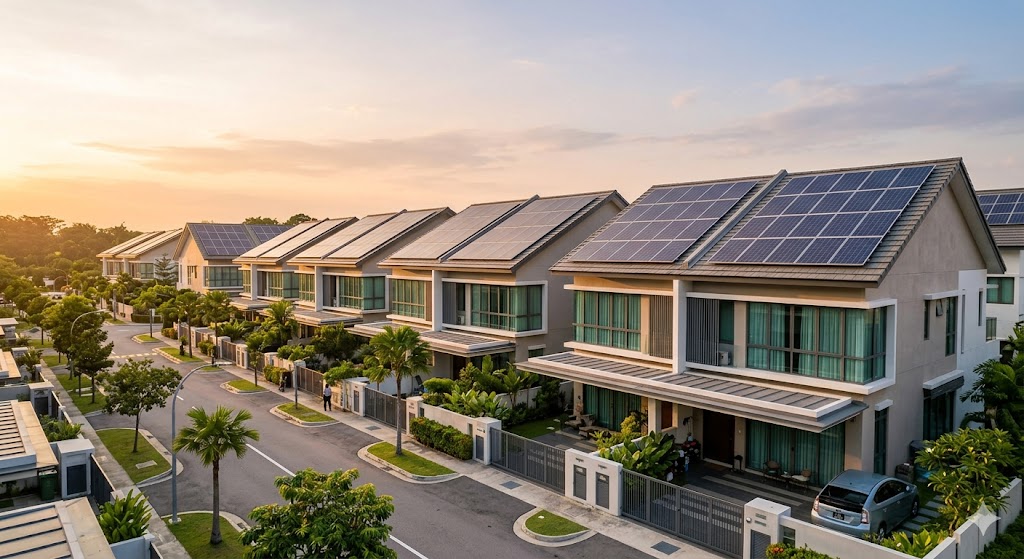
Introduction: Renewable Energy and Urban Fire Safety
Singapore aggressively pursues advanced renewable energy generation targets. The nation operates under the ambitious Singapore Green Plan 2030. Consequently, rooftops rapidly transform into distributed power plants.
Singapore aims to achieve 3 GWp of solar capacity.1 This goal must be reached by the year 2030.1 This immense capacity can power roughly 500,000 households annually.1 By late 2025, grid-connected solar installations reached 14,625.2
The residential sector accounted for 47.3% of these installations.2 Furthermore, rooftop solar completely dominates the local energy market. It constitutes more than 80% of total solar capacity.3
However, this rapid deployment introduces substantial urban fire risks. High-voltage electrical infrastructure now sits atop high-density buildings.4 Therefore, rigorous regulatory oversight is absolutely essential for safety.
The Singapore Civil Defence Force (SCDF) manages this framework.4 SCDF strictly enforces fire codes across the entire city-state.4 They ensure sustainability initiatives do not compromise fundamental safety.4
This exhaustive research report explores the SCDF regulatory landscape. It decodes the complex rules governing photovoltaic (PV) installations. Furthermore, it clarifies the often-misunderstood 50% roof coverage rules.
It details mandatory fire access paths and tactical corridors. The report contrasts different administrative approval pathways like MAA. It also analyzes recent case studies involving solar panel fires. Finally, it explores global supply chain compliance and SEO metrics.
The SCDF Fire Safety Requirements and Regulatory Framework
The foundational regulations reside within the SCDF Fire Code. Specifically, Chapter 10 dictates requirements for special electrical installations.5 Earlier guidelines were established under FSR 13:2015.6 These historic requirements took effect on July 1, 2016.6 Later, the Fire Code 2018 introduced crucial updated amendments.6 Today, the Fire Code 2023 sets definitive operational standards.4
These modern codes establish strict baseline criteria for components. Module safety is paramount for urban fire prevention. All PV modules must pass rigorous standardized laboratory testing.
Specifically, they must comply with the standard IEC 61730-2.6 This standard outlines mandatory safety qualifications for photovoltaic modules.6 Furthermore, roof-mounted modules demand a specific fire resistance rating. They must achieve a minimum rating of Class C.5 This rating applies to both flame spread and burning brand tests.5
System components face similarly stringent and detailed regulations. Wirings and switchboard assemblies cannot be overlooked during installation. They must comply with the Singapore Standard SS 638.4
This specific standard supersedes the older SS CP5 Code.6 Additionally, solar PV components require formal SCDF regulatory listing. They fall under Class 2 of the Product Listing Scheme.6 This scheme mandates rigorous and mandatory annual surveillance tests.6 Consequently, substandard materials are effectively barred from local markets.
Supply Chain Sanctions and the OFAC 50% Rule
Global supply chain dynamics significantly impact local solar installations. Procuring solar panels involves navigating complex international trade laws.
Specifically, developers must understand the OFAC 50% Rule.8 The United States Treasury enforces strict global economic sanctions.8 They maintain a list of Specially Designated Nationals (SDNs).9
The 50% rule creates profound compliance challenges for developers. An entity might not be explicitly listed as sanctioned.8 However, it becomes blocked if owned by sanctioned individuals.9
The sanctioned ownership interest must be 50% or greater.8 Consequently, Singaporean developers must audit their solar supply chains.
They must verify the ultimate ownership of their panel manufacturers. Ignorance of this 50% rule is not a legal defense. Furthermore, international trade wars exacerbate these procurement difficulties.10
The US previously imposed additional tariffs on imported solar cells.8 These tariffs complicate the financial viability of massive solar projects. Developers must source high-efficiency panels while strictly avoiding sanctioned entities.
Decoding the 50% Rules in Solar Deployment
The term “50% rule” causes frequent confusion among stakeholders. It appears across multiple zoning, planning, and fire contexts. Understanding the specific applications of this threshold is critical.
URA Additions and Alterations (A&A) Limits
The Urban Redevelopment Authority (URA) strictly monitors property modifications. Homeowners frequently undertake Additions and Alterations (A&A) works.11 A&A works enjoy relaxed regulatory requirements compared to reconstructions.11
For instance, A&A projects avoid mandatory household shelter installations.11 This makes living areas feel significantly more spacious.11
However, strict criteria define what constitutes an A&A project. The proposed additional Gross Floor Area (GFA) is restricted. It must be less than 50% of existing approved GFA.11 Furthermore, structural changes must not exceed 50%.11 This structural limit includes new columns, beams, and slabs.11
External wall demolition is also capped at 50%.11 If solar installations involve structural roof replacements, limits apply. Exceeding the 50% threshold triggers a complete project reclassification.11 This mandates entirely new, complex planning approvals from URA.
URA Gross Floor Area (GFA) Exemptions
Developers constantly seek to maximize usable commercial building space. The URA provides specific incentives regarding solar PV installations. Generally, covered rooftop structures count toward a building’s GFA. However, the URA exempts certain green features from computation.12
Solar panels represent one of these critical GFA exemptions. The shadow area cast by a solar panel is excluded.13 This exclusion applies strictly unless the area is enclosed.14 If the space becomes an outdoor refreshment area, it counts.12
Similarly, storage uses beneath panels trigger immediate GFA inclusion.14 Therefore, careful architectural design is highly necessary for developers. They must leave spaces beneath panels open and unenclosed.
|
Feature Type |
GFA Status |
Regulatory Condition |
|
Shadow Area (Solar Panel) |
Excluded |
Must remain completely unenclosed without commercial activities. |
|
Private Roof Terrace |
Included |
Generally counted towards GFA unless specific exemptions apply. |
|
Covered Swimming Pool |
Included |
Constitutes usable space under standard URA planning guidelines. |
|
Uncovered Staircase to ESS |
Excluded |
Exempted to facilitate essential utility and emergency access. |
SCDF 50% Sprinkler Exemption Rule
The SCDF also utilizes a vital 50% structural metric. Sprinkler systems are mandatory for many large commercial buildings.15 However, specific architectural designs can negate this costly requirement. Areas covered with trellises or louvres face different rules.15
These coverings must have 50% or more effective free openings.15 The openings must be evenly distributed across the surface.15
If these conditions are met, specific areas are exempted.15 The high ventilation degree prevents dangerous heat and smoke accumulation. However, an alarm sounder and visual alarm remain mandatory.15 These alarms must sit near the nearest exit staircase.15 They must comply fully with SS 645 safety standards.15
Furthermore, PV sub-arrays enjoy specific sprinkler exemptions.15 The roof in question must be strictly non-habitable.15 Each solar sub-array must not exceed 5 meters wide.15
A maintenance aisle of 400mm is strictly mandated here.15 The sub-arrays must remain completely open-sided.15 No commercial activities or storage are permitted underneath.15
Floating Solar and the 50% Coverage Limit
Land scarcity drives innovative solar deployments across Singapore. Floating Photovoltaic (FPV) systems offer a brilliant geographical solution.
However, FPV systems also face strict surface coverage percentage rules.
For reservoirs used for fish production, limits are strict. FPV installations should not exceed 50% of the surface area.16 Furthermore, they must not reduce fish production excessively.16 The allowable reduction in fish production is capped at 30%.16 For general water bodies, maximum coverage usually hits 60%.16
Singapore already boasts massive floating infrastructure projects. The Sembcorp Jurong Island Solar Farm provides 118 MW.3 It spans an impressive 60 hectares across six distinct plots.3
International Comparisons: The IFC 33% Rule
It is helpful to contrast Singapore’s rules with international standards. In the United States, the International Fire Code (IFC) applies.17
The IFC utilizes a strict 33% roof coverage rule.17 This specific rule is not an absolute cap on installation.17 Instead, it is a threshold where safety requirements escalate.17
If panels cover more than 33%, scrutiny increases drastically.17 This applies to the total plan-view area of the roof.17
Exceeding this threshold triggers additional setbacks and engineering reviews.18 The California Fire Code implements equally stringent spatial dimensions.19
PV arrays cannot have dimensions greater than 150 feet.19 Residential roofs require a 3-foot access pathway along ridges.19 Panels must sit 3 feet below the ridge for ventilation.19
The NFPA also details strict perimeter pathway requirements.20 For buildings with axes of 250 feet or less, pathways apply.20
A 4-foot wide perimeter pathway must surround the roof edges.20 If building axes exceed 250 feet, requirements increase.20 A massive 6-foot wide perimeter pathway becomes completely mandatory.20 Singapore manages these risks via specific dimensional limits instead.
|
Jurisdiction |
Coverage/Dimension Rule |
Primary Fire Tactical Purpose |
|
SCDF (Singapore) |
60m x 40m max sub-array |
Limits continuous fuel load and enables hose reach. |
|
IFC (International) |
33% total roof coverage |
Threshold triggering mandatory engineering reviews and enhanced setbacks. |
|
California Fire Code |
150 feet maximum axis |
Prevents massive, un-navigable continuous electrical fields. |
|
NFPA 1 |
4-foot to 6-foot perimeters |
Ensures firefighters can walk safely along all roof edges. |
Spatial Geometry: SCDF Fire Access Paths
During a structural fire, rapid tactical deployment is vital. Firefighters require safe, unobstructed movement across burning rooftops, and SCDF regulations require clear emergency pathways on rooftops for firefighter access. Solar panels create physical barriers and lethal electrical shock hazards, especially around firefighting equipment. Therefore, the SCDF mandates precise spatial geometry for installations to protect firefighters.
Exit Staircases and Roof Access
Every roof-mounted PV installation requires exceptionally safe vertical access, and the design must account for firefighters carrying equipment. SCDF regulations rigidly mandate at least one exit staircase.6 If the roof area is large, one staircase is insufficient.
SCDF travel distance limits must be strictly observed always.6 If one-way travel distances exceed limits, additional access is required.6 This can be an additional cat ladder or ship ladder.6
Existing buildings frequently face unique historical architectural constraints. Sometimes, retrofitting a new exit staircase is structurally impossible. SCDF provides a pragmatic exemption for these specific scenarios. A portable sturdy ladder may suffice under strict conditions.6
The building must be strictly single-storey in design.6 Its roof height cannot exceed 12 meters vertically.6 Alternatively, it can be an inaccessible pitched roof up to 24m.6 Crucially, adequate fire engine access must front the installation.6
Access hatches represent another potential emergency entry point. If provided, they must be readily accessible from rooftops.5 The hatch opening requires a minimum clear width of 1m.5 Furthermore, a 3-meter clearance must surround these hatches.6
This clearance area must remain completely free of solar infrastructure.6 This ensures firefighters can exit the hatch without obstruction.
Access Aisles and Sub-Array Limitations
Continuous expanses of solar panels are strictly prohibited locally. They prevent firefighters from reaching the center of a blaze. Consequently, SCDF limits the maximum size of any sub-array.
Previously, FSR 13:2015 restricted sub-arrays to 40m by 40m.6 In 2019, SCDF amendments relaxed this specific limitation slightly. Clause 10.2.4 now permits maximum dimensions of 60m by 40m.6
Between these massive sub-arrays, access aisles are absolutely mandatory. A minimum separation of 1.5 meters must exist between arrays.6 These aisles serve as critical tactical movement corridors.4
The 1.5-meter width accommodates fully equipped firefighters and hoses.4 The layout must guarantee swift reach during emergencies. No part of any PV array can exceed 20 meters.6 This distance is measured from the nearest tactical access aisle.6
Perimeter access requires even greater clearance for edge safety. If an access aisle abuts the roof edge, it changes. The minimum width increases significantly to 2.5 meters.4 This perimeter prevents firefighters from accidentally falling off roofs.
Visibility is often completely zero during a severe structural fire. However, there is a helpful exception to this perimeter rule. A continuous perimeter parapet or robust railing can be installed.6 This structural barrier must be at least 900mm high.4 If present, the perimeter aisle width reduces to 1.5 meters.6
|
Feature |
SCDF Requirement |
Tactical Reasoning |
|
Max Sub-Array Size |
Limits the continuous fuel load and restricts fire spread. |
|
|
Standard Access Aisle |
Minimum 1.5 meters |
Provides a standard tactical movement corridor for emergency personnel. |
|
Perimeter Aisle (No Parapet) |
Minimum 2.5 meters |
Prevents firefighters from accidentally falling off the roof edge. |
|
Perimeter Aisle (With Parapet) |
Minimum 1.5 meters |
Parapet ensures edge safety, allowing a narrower access pathway. |
|
Distance to Aisle |
Maximum 20 meters |
Ensures a standard fire hose can reach the array’s center. |
The 1-Hour Fire Separation Rule Evolution
Historically, SCDF mandated strict vertical fire separation for panels. Solar panels required a 1-hour fire-rated separation from roofs.21 This separated electrical infrastructure from the occupied spaces beneath.21
While highly effective for safety, this mandate was incredibly expensive. It required substantial additional construction materials and heavy engineering time.
In March 2024, the SCDF formed a specialized workgroup.21 This group included government agencies, professional institutions, and academia.21
Their objective was to facilitate broader solar adoption across Singapore.21 They comprehensively reviewed the historic 1-hour fire separation requirement.21
Through collaborative research, the workgroup evaluated several practical alternatives.21 First, they considered applying a complex fire engineering approach.21 This would evaluate fire risks on a highly specific basis.21
Second, they analyzed the use of less combustible solar panels.21 This would be combined with an increased physical roof gap.21 Third, they evaluated installing integrated fire alarm systems.21
The resulting regulatory simplifications were highly significant for industry. SCDF officially exempted many installations from the 1-hour rule.21
Specifically, more than half of all metal-roofed installations on metal roofs qualify.21 To achieve this, panels must sit at least 20cm above roofs.21 This physical gap prevents rapid thermal transfer during arc faults. These simplified processes are economically transformative for local businesses. For eligible metal-roof buildings, compliant solar panels can save up to 30% on construction costs.21
Administrative Pathways: MAA vs. Plan Approval
Regulatory compliance requires navigating SCDF’s complex administrative software systems. Building owners must secure formal fire safety approval.22 This rigorous process occurs through the digital CORENET submission platform.6 There are two primary administrative vehicles available to applicants.22 These are Plan Approval and the Minor Additions and Alterations scheme.22
Plan Approval for New Developments
Any solar PV system incorporated into a new building project requires Plan Approval.6 The solar infrastructure must be reflected directly in building plans.6
These master plans encompass all other fire safety works.6 The SCDF reviews the entire building’s fire strategy holistically. This ensures solar panels do not compromise overarching sprinkler systems.6
The MAA Lodgement Scheme
Retrofitting solar panels onto existing buildings is far more common. For these retrofits, the MAA Lodgement Scheme is typically utilized.4
The MAA scheme is a streamlined administrative regulatory vehicle.4 It allows owners to lodge plans without triggering full reviews.6
The submitted MAA plans must be highly detailed regardless. They must clearly indicate manual emergency shut-off system locations.6
Furthermore, a simplified site plan is absolutely mandatory.6 This plan must show PV module positions and circuit diagrams.6 Finally, the locations of all fire extinguishers must be plotted.6
Exemptions for Landed Residential Properties
SCDF adopts a highly pragmatic, risk-based approach to enforcement.4 They determined that single landed homes present lower fire risks.4 Therefore, they do not require heavy MAA submission machinery.4
Fire safety plan submissions are exempted for specific residential classes.4 Detached houses, known locally as bungalows, qualify for exemption.4
Semi-detached houses and standard terrace houses are also exempted.4 This applies if they do not exceed three storeys total.6 Furthermore, they cannot share facilities with other distinct buildings.6
Despite this administrative exemption, fundamental safety standards remain applicable.4 The system must be installed by a Licensed Electrical Worker.4
It must meet all Energy Market Authority (EMA) electrical standards.4 Installers should also practically adhere to baseline safety distances.4 This prevents a localized fire from spreading to neighboring homes.4
The Strata-Landed Cluster Housing Exception
A critical regulatory distinction exists for cluster housing developments.4 Strata-landed developments often resemble traditional terrace homes above ground.
However, they frequently share extensive subterranean structural infrastructure.4 A shared basement car park is extremely common in these developments.4
Due to this shared infrastructure, cluster housing does not qualify.4 A solar fire in one strata unit threatens the basement.4
Consequently, these properties must undergo the full MAA submission process.4 This ensures the shared subterranean facilities remain completely protected.
Professional Accountability: The QP and RI
The SCDF relies heavily on accredited professionals to ensure compliance. The regulatory framework delegates significant legal responsibility to these experts. The two most critical roles are the QP and RI.
The Duties of the Qualified Person (QP)
The Qualified Person (QP) serves as the architect of compliance.6 Typically, solar installation companies engage a QP very early.23 The QP conducts a comprehensive assessment of the existing building.4
They verify that existing fire safety measures remain fully functional.4 For example, panels cannot block existing hydrants or rising mains.4
The QP is directly responsible for the spatial design layout.4 They must guarantee the layout meets Fire Code 2023 setbacks.4 Once finalized, the QP digitally endorses the engineering plans.4
They certify that the drawings comply with all SCDF codes.4 Subsequently, the QP applies for fire safety approval through CORENET.6 During construction, the QP heavily supervises the ongoing works.4 They ensure physical installations perfectly match approved digital designs.4
The Certification by the Registered Inspector (RI)
SCDF mandates a robust, independent verification mechanism for safety. The QP cannot legally inspect their own supervised construction work. Once the installation is fully completed, owners engage an RI.4
An RI is a professional with extensive, verified experience. They typically possess a strong architecture or engineering background.25 Furthermore, they must demonstrate ten years of relevant industry experience.25 The RI physically inspects the completed solar PV installation.25 They meticulously check fire safety works against the approved plans.25
The RI utilizes rigorous, standardized inspection checklists during site visits.26 They verify the 1.5-meter tactical access aisles and perimeter setbacks. They confirm the presence of Class C rated PV modules. The owner must make all test reports available to them.27 If flawless, the RI issues an official Inspection Certificate.24 Armed with this certificate, the QP applies for final approval.24
|
Professional Role |
Primary Responsibilities |
Regulatory Phase |
|
Qualified Person (QP) |
Assesses building, designs layout, submits CORENET plans, supervises installation. |
Pre-installation and Construction |
|
Licensed Electrical Worker |
Ensures compliance with EMA standards and SS 638 electrical codes. |
Construction Phase |
|
Registered Inspector (RI) |
Independently physically inspects the completed works and verifies plan compliance. |
Post-installation Phase |
Emergency Disconnection and Signage Requirements
Firefighters must neutralize electrical hazards before spraying water onto roofs. A live solar array poses severe electrocution risks to responders. Therefore, emergency disconnection systems are strictly mandated by the SCDF.6
A manual emergency shut-off system must be prominently provided.6 This system ensures the rapid disconnection of the PV modules.6 It must be located on the AC side of installations.6 Typically, this is exactly where the power inverters are placed.6 Furthermore, an additional shut-off must exist within switch rooms.6
Signage and instructions are equally critical during a chaotic emergency. Clear operating instructions for the emergency shut-off are mandatory.6 SCDF specifies the exact height for these crucial instructional displays. They must sit between 1.5 meters and 2 meters high.6 Smoke naturally rises and fills the upper building ceiling layers.
Firefighters typically crawl or stay low during structural fire attacks. Signage placed too high becomes completely invisible in heavy smoke. The 1.5m to 2m height offers optimal operational visibility safely.
Additionally, a simplified site plan must be prominently displayed onsite.6 This diagram must show the precise positions of PV modules.6 It must also display the comprehensive systems circuit diagrams.6
This map is usually positioned near roof access openings.6 Like the shut-off instructions, it resides at 1.5 to 2 meters.6 This spatial awareness allows commanders to formulate safe attack strategies.
Real-World Validation: The August 2024 Case Study
Theoretical regulations find their ultimate justification in real-world crises. Solar panel fires are statistically rare, but highly destructive.7 They usually result from preventable issues like poor installation practices.7
When inferior components fail, high-voltage electricity can arc dangerously.7 This arcing creates intense sparks, rapidly leading to severe fires.7
A highly notable incident occurred in Singapore on August 14, 2024.7 A fire broke out atop an industrial factory roof.28 This factory was located precisely at 11 Kian Teck Road.28
The blaze originated within a dense cluster of solar panels.28 The burning array measured approximately 15 meters by 10 meters.28 Crucially, the factory featured a corrugated metal zinc roof.28
The SCDF responded with rapid, overwhelming force to the scene.28 Emergency personnel swiftly evacuated 76 workers from the industrial premises.28 Utilizing tactical access paths, firefighters successfully extinguished the intense blaze.28
Fortunately, no injuries were reported during this highly dangerous operation.28
This incident provided profound validation for SCDF’s stringent framework. It demonstrated exactly why the Class C rating is non-negotiable.28 Without fire-resistant modules, the blaze would have spread exponentially.
Furthermore, it highlighted the necessity of the 20cm air gap.21 This gap prevents direct thermal conduction from burning panels downwards. Following the incident, SCDF forcefully reiterated strict compliance importance.28 They emphasized that SS 638 wiring codes prevent arcing faults.7
The Emergence of Energy Storage Systems (ESS)
The rapid proliferation of solar power introduces local grid instability. Solar energy is inherently intermittent by nature and weather dependent.24
Its output drops dramatically during heavy cloud cover or nighttime.24 To overcome this challenge, Singapore actively deploys Energy Storage Systems.24
These systems are commonly known in the industry as ESS.24 ESS technology stores excess solar energy for later peak use.24 It actively manages mismatches between electricity supply and grid demand.24
Consequently, it significantly enhances overall grid resilience and stability.24 However, battery-based ESS installations introduce entirely new fire dynamics. Lithium-ion batteries possess immense chemical energy density within small footprints. A battery failure can trigger a catastrophic thermal runaway event.
Therefore, SCDF heavily regulates these associated energy storage systems.24 The Fire Code dedicates specific clauses to Energy Storage Systems.29 Uncovered staircases leading to ESS facilities are carefully scrutinized.14 The appointed QP must seek separate SCDF approval for BESS.24 They must secure this approval prior to any physical installation.24
Once ESS works are completed, the rigorous inspection protocol repeats. The owner must engage a Registered Inspector to certify works.24 The RI verifies that battery enclosures possess adequate blast relief.
With the RI’s Certificate, the QP applies for final approval.24 International regulations also influence the battery storage market heavily. The EU Battery Regulation mandates 50% recycling for Li-ion batteries.30 This ensures sustainable end-of-life management for massive storage infrastructure arrays.30
Technological Advancements Mitigating Risk
The global solar industry continuously invests in aggressive research.28 Manufacturers rapidly deploy new technologies that exceed baseline safety expectations.28 These advancements structurally reduce the fire risks SCDF manages.
Modern inverters increasingly feature advanced arc-fault circuit interrupter technology.28 These sophisticated systems monitor the electrical waveform continuously during operation. If they detect the unique signature of an arc fault, they react. The system immediately cuts off power generation within milliseconds.28 This rapid shutdown prevents potential thermal hazards from escalating.28
Furthermore, the physical efficiency of modern panels continues rising rapidly. A decade ago, panels converted roughly 15% of sunlight.31
Today, modern panels boast conversion efficiencies exceeding 22% regularly.31 High-efficiency panels alter the spatial dynamics of rooftop design.18
If panels are highly efficient, fewer modules are required.18 A smaller array occupies less total roof space overall.18
This makes it exponentially easier to maintain 1.5-meter access aisles.6 It allows designers to stay below 60m by 40m limits.6 Technological efficiency directly simplifies regulatory compliance for property developers.
Market Dynamics and Financial Incentives
The SCDF regulatory landscape directly influences local market economics. Initially, strict fire codes sparked deep concern among solar contractors. Industry leaders warned mandatory staircases would sound a death knell.32
They argued retrofitting staircases onto maximized buildings was structurally unfeasible.32 They feared increased investment costs and endless bureaucratic paperwork.32
However, the SCDF demonstrated vital regulatory flexibility and economic awareness. They clarified that new rules applied only prospectively for buildings.32 Furthermore, the 2024 workgroup initiatives directly addressed pressing industry anxieties.21
Offering alternatives to 1-hour fire separations alleviated immense financial pressure.21 The simplified 20cm gap saved commercial owners up to 30%.21
These pragmatic adjustments catalyzed continued market expansion across Singapore. Solar’s cost-competitiveness remains the primary market driver today.3 The payback period for commercial installations has plummeted significantly.3
It currently sits at a highly attractive five-year mark.3 Moreover, consumers can lucratively sell excess power to the grid.3
Government support programs also fuel this unprecedented growth trajectory. The SolarNova program drives deployment across public HDB housing blocks.3 By late 2025, SolarNova had installed panels on 5,300 blocks.3
Industrial development utilizes the successful SolarRoof and SolarLand initiatives.3 JTC lessees can enjoy discounted rates through solar leasing models.33 In these zero-capital models, vendors install panels and export energy.33
Solar Industry SEO and Digital Marketing
The solar panel installation market is highly competitive digitally. Companies rely heavily on Search Engine Optimization (SEO) to acquire leads. Understanding keyword search volumes is crucial for digital marketing strategies.
Broad keywords attract massive traffic but lack distinct buyer intent. The term “solar system” generates 1,500,000 monthly searches globally.34
“Solar panels” generates 823,000 monthly searches across search engines.34 However, these terms often attract users seeking basic educational information. Solar companies must target specific, high-intent long-tail keywords instead.
The keyword “solar panel cost” is incredibly valuable for installers.34 It generates 135,000 monthly searches and addresses major customer concerns.35
Technical terms like “photovoltaic system design” attract commercial leads.35 This specific term generates an impressive 60,500 monthly searches.35 Localized searches like “solar installation near me” possess high buyer intent.35
|
SEO Keyword Phrase |
Monthly Search Volume |
Marketing Intent |
|
Solar System |
1,500,000 |
Broad Educational |
|
Solar Panels |
823,000 |
Broad Educational |
|
Solar Panel Cost |
135,000 |
High Buyer Intent |
|
Photovoltaic System Design |
60,500 |
Commercial/Technical Lead |
Conclusion
The deployment of solar infrastructure across Singapore is monumental. Achieving the 3 GWp target requires blanketing roofs with technology. However, this dense deployment undeniably alters the fire risk profile. High-voltage arrays present unique challenges for emergency responders.
The SCDF has constructed a robust, highly logical regulatory framework. Installing SCDF-compliant solar systems also helps ensure regulatory compliance during safety inspections, especially where requirements intersect with the Building and Construction Authority and other agencies. The Fire Code 2023 balances green energy with public safety.
Mandating Class C fire-resistant modules and SS 638 compliance prevents ignition. Enforcing strict spatial geometry ensures tactical dominance during emergencies. The 1.5-meter access aisles are lifelines for responding firefighters.
Furthermore, the framework utilizes deep pragmatic nuance throughout. Exemptions for landed residential homes streamline deployment where risks remain contained. Proper fire precautions remain essential even in these lower-risk settings.
Conversely, strict MAA requirements for cluster housing reflect shared infrastructure dangers. The 2024 workgroup reforms highlight a dynamic, responsive regulatory posture. Replacing the 1-hour fire separation with a 20cm gap demonstrates agility. It lowered construction costs significantly without sacrificing systemic safety, while preserving coordination with the relevant construction authority.
The August 2024 factory fire serves as an enduring reminder. The rules are not arbitrary bureaucratic hurdles to be ignored. They are fundamental engineering necessities for urban survival.
The successful firefighting operation validated the entire SCDF spatial philosophy. As Energy Storage Systems proliferate, strict regulatory vigilance must continue. Ultimately, transitioning to renewable energy relies entirely on uncompromised urban safety.
Works cited
-
Singapore installs 504 MW of solar in 2025 – Reddit, accessed April 25, 2026, https://www.reddit.com/r/singapore/comments/1sho04l/singapore_installs_504_mw_of_solar_in_2025/
-
Number of Grid-Connected Solar Photovoltaic (PV) Installations by User Type, accessed April 25, 2026, https://www.ema.gov.sg/resources/statistics/number-of-grid-connected-solar-photovoltaic-installations
-
Singapore installs 504 MW of solar in 2025 – PV Magazine, accessed April 25, 2026, https://www.pv-magazine.com/2026/04/09/singapore-installs-504-mw-of-solar-in-2025/
-
SCDF MAA Application for Solar Panel Installatio – Stellar Structures, accessed April 25, 2026, https://structures.com.sg/scdf-maa-solar-pv-installation/
-
Clause 10.2 Solar Photo-Voltaic (PV) Installation – SCDF, accessed April 25, 2026, https://www.scdf.gov.sg/fire-safety-services-listing/fire-code-2023/table-of-content/chapter-10-requirements-for-special-installations/clause-10.2-solar-photo-voltaic-pv-installation
-
Submission requirements for Solar PV installations on Roof – SCDF – A member of the Home Team, accessed April 25, 2026, https://www.scdf.gov.sg/docs/default-source/fire-safety-docs/downloads/circulars/submission-requirements-for-solar-pv-system-on-roof.pdf?sfvrsn=e5045ede_1
-
Solar Panel Fire: Causes, Prevention, and Safety Tips – GetSolar, accessed April 25, 2026, https://www.getsolar.ai/en-sg/blog/solar-panel-fire-safety
-
Trade Compliance Handbook | Thompson Coburn LLP, accessed April 25, 2026, https://www.thompsoncoburn.com/wp-content/uploads/2024/10/trade-compliance-handbook.pdf
-
International Trade Compliance Update – Baker McKenzie, accessed April 25, 2026, https://www.bakermckenzie.com/en/-/media/files/insight/publications/2021/06/june_2021_international_trade_compliance.pdf
-
China–United States trade war – Wikipedia, accessed April 25, 2026, https://en.wikipedia.org/wiki/China%E2%80%93United_States_trade_war
-
Types Of Works For Landed House Properties in Singapore – READ Architecture, accessed April 25, 2026, https://www.readarchitecture.com/blog-insight/2021/12/13/4-types-of-works-for-landed-house-properties-non-conservation-in-singapore
-
Handbook on Gross Floor Area Guidelines | PDF | Building Technology – Scribd, accessed April 25, 2026, https://www.scribd.com/document/380705340/Gfa-Handbook
-
RIDERS DIGEST – RLB, accessed April 25, 2026, https://www.rlb.com/wp-content/uploads/sites/5/2025/07/RLB-Riders-Digest-2025_Singapore_ecopy-20250715.pdf
-
GFA Inclusion Criteria Explained | PDF | Parking – Scribd, accessed April 25, 2026, https://www.scribd.com/document/714374472/CountedintoGFA
-
Clause 6.4 Fire Sprinkler Installation – SCDF, accessed April 25, 2026, https://www.scdf.gov.sg/fire-safety-services-listing/fire-code-2023/table-of-content/chapter-6-firefighting-systems/clause-6.4-fire-sprinkler-installation
-
Where the Sun Meets Water: Floating Solar Handbook For Practitioners – Documents & Reports, accessed April 25, 2026, https://documents1.worldbank.org/curated/en/418961572293438109/pdf/Where-Sun-Meets-Water-Floating-Solar-Handbook-for-Practitioners.pdf
-
What is the 33% Rule in Solar Panels? Everything You Need to Know – BLUETTI, accessed April 25, 2026, https://www.bluettipower.com/blogs/knowledge/what-is-33-percent-rule-in-solar-panels
-
What Is The 33% Rule In Solar Panels? – OUPES, accessed April 25, 2026, https://oupes.com/a/blog/post/what-is-the-33-rule-in-solar-panels
-
7.6 California Fire Code Solar Access Requirements – Energy Code Ace, accessed April 25, 2026, https://energycodeace.com/site/custom/public/reference-ace-2016/Documents/76californiafirecodesolaraccessrequirements.htm
-
Providing Access to Roofs with a PV System | NFPA, accessed April 25, 2026, https://www.nfpa.org/news-blogs-and-articles/blogs/2020/07/24/accessways-for-roof-mounted-photovoltaic-installations
-
Roof solar panel fire safety requirement – Enterprise Singapore, accessed April 25, 2026, https://www.enterprisesg.gov.sg/smepeo/roof-solar-panel-fire-safety-requirement
-
Submission Requirements to SCDF for Rooftop Solar PV Installation | Licence &