
Fire Safety in Structural Steel: How to Choose Between Intumescent Paint and Vermiculite Spray for SCDF Compliance
The Critical Imperative of Structural Steel Fire Protection
In the densely urbanized, vertically ambitious landscape of the modern built environment, structural fire safety transcends basic building design to become an uncompromising pillar of national resilience, public security, and infrastructural longevity.1
Structural steel is universally celebrated for its exceptional strength-to-weight ratio, allowing for expansive column-free spaces and soaring architectural geometries.
However, while inherently non-combustible, structural steel possesses a devastating vulnerability to elevated thermal loads.
The yield strength of structural steel remains relatively stable up to approximately 427°C (800°F), maintaining at least 85 percent of its normal operational capacity.2
However, as temperatures escalate beyond this critical thermal threshold, the material experiences a rapid, non-linear, and catastrophic degradation in both strength and stiffness.2
Under standard load conditions, an unprotected steel structure will typically reach a state of critical mechanical failure and subsequent collapse when internal steel temperatures reach between 500°C and 600°C.3
To prevent premature structural failure and avert catastrophic building collapse, the implementation of passive fire protection (PFP) is legally and practically mandated across the globe.
Unlike active fire protection systems—such as automated sprinkler networks, smoke extraction fans, and digital fire alarms that require mechanical activation and continuous power or water supplies—passive fire protection systems operate silently and continuously.2
Their primary function is to contain the thermal event, delay the degradation of structural elements, and prevent localized fires from escalating into total progressive building collapse.
This provides the precious, highly calculated time required for occupant evacuation, emergency responder intervention, and the preservation of irreplaceable assets.2
In the context of contemporary commercial, industrial, and residential construction, the two most dominant and highly engineered passive fireproofing methodologies for structural steel are intumescent coatings (reactive chemical paints) and cementitious vermiculite sprays (dense insulating barriers).5
The decision matrix for selecting between these two revolutionary systems is highly complex and deeply nuanced. It demands a rigorous, multi-disciplinary evaluation of initial capital expenditures, total lifecycle costs, architectural aesthetics, functional space requirements, harsh environmental exposures, and, most critically, strict adherence to the local regulatory frameworks.7
Within Singapore, this regulatory framework is defined by the Singapore Civil Defence Force (SCDF) Fire Code.
This report provides an exhaustive, highly technical analysis of both intumescent paint and vermiculite spray systems, dissecting their underlying chemical and physical mechanisms, their application prerequisites, their long-term economic profiles, and their distinct compliance pathways within the rigorous parameters of the SCDF Fire Code 2023.
The Regulatory Framework: SCDF Fire Code 2023 Compliance
The primary legislation governing all fire safety matters in Singapore is the Fire Safety Act (FSA), a robust legal framework that establishes a stringent mandate for fire prevention and places an absolute, non-negotiable obligation on developers, architects, qualified persons, and facility engineers.1
Contravention of the FSA carries severe penalties that reflect the gravity of fire safety, including substantial financial fines, prolonged imprisonment, business closure orders, and criminal liability in cases of severe negligence leading to harm.1
The technical execution and engineering interpretation of the FSA are codified within the SCDF Code of Practice for Fire Precautions in Buildings, currently updated and enforced as the Fire Code 2023.7
Chapter 3 of the Fire Code specifically governs “Structural Fire Precautions,” detailing the uncompromising requirements for compartmentation, the restriction of fire spread, and the mandatory fire resistance periods of various elements of structure.7
Purpose Groups and Table 3.3A Minimum Fire Resistance Periods
The requisite fire resistance rating for any structural steel element is not arbitrary; it is meticulously determined by the building’s designated Purpose Group (classified from PG I for residential through PG VIII for heavy storage), its habitable height, floor area, and the cubical extent of its compartments.1
These parameters are rigorously defined in Fire Code Table 3.3A, which dictates the minimum periods of fire resistance required for structural integrity.9
Depending on the scale, occupancy load, and hazard classification of the building, structural elements must achieve certified minimum periods of fire resistance, typically categorized into 30, 60, 90, 120, 180, or 240-minute intervals.3
The Fire Code explicitly establishes that any separating wall or compartment floor segregating specific purpose groups must possess a baseline fire resistance rating of at least one hour.7
For instance, in complex mixed-use developments where a commercial podium interfaces with a high-rise residential or office tower, the fire resistance of the structural elements at the interface—crucially including the steel columns penetrating the podium to support the structural frame of the tower—must stringently adhere to the higher requirement of the two overlapping purpose groups.7
Furthermore, the Fire Code stipulates that performance for the fire resistance of structural elements must be determined by reference to the methods specified in internationally recognized standards, predominantly BS 476: Parts 20 to 23, which dictate specific, rigorous testing protocols for structural stability, flame integrity, and thermal insulation.12
The Product Listing Scheme (PLS) and Declaration of Compliance
The SCDF strictly regulates all fire safety materials deployed within the nation through the comprehensive Product Listing Scheme (PLS).
This scheme is designed to ensure that materials applied to structural steel meet exceptional, verifiable standards of safety, long-term reliability, and thermal performance.7
Independent Certification Bodies (CBs), such as TÜV SÜD PSB, which are formally accredited by the Singapore Accreditation Council (SAC), audit, test, and certify these critical products.13
For a fireproofing material to be legally applied to structural steel in a building project, the supplier must secure a Declaration of Compliance (DoC) and the product must fall under the appropriate PLS classification.14
The acceptable testing standards for demonstrating fire resistance include BS 476 Part 21, AS 1530 Part 4, ISO 834, EN 13381-1, and EN 16623.12
Table 1 delineates the specific PLS regulatory requirements for the two primary steel protection systems currently dominating the market.
| Fireproofing System | PLS Category | Acceptable Fire Resistance Standards | Weathering / Durability Standards | PLS Class |
| Intumescent Coating System | Item 27 | BS 476 Pt 21, AS 1530 Pt 4, ISO 834, EN 13381-1, EN 16623 | BS 8202 Pt 2, EN 16623 | 1A or 1B |
| Vermiculite Spraying Material | Item 6.1 | BS 476 Pt 4/11, EN 13501-1, BS 476 Pt 21, AS 1530 Pt 4, ISO 834 | Standard compliance required | 1A |
Data synthesized from SCDF and TÜV SÜD PLS Requirements framework.14
It is vital to underscore that under PLS guidelines, prototype designs subjected to initial testing cannot be modified during field application.
If on-site constraints or architectural redesigns force a deviation from the tested prototype, a supplementary test or a comprehensive expert assessment report must be submitted to the Certification Body for rigorous verification and re-approval.14
Furthermore, performance criteria for advanced chemical coatings are not solely based on initial furnace fire tests.
Intumescent coatings must undergo rigorous, accelerated weathering protocols—including cyclical heating tests, high-pressure washing tests, highly corrosive sulphur dioxide tests, and extreme humidity tests—to unequivocally prove their long-term chemical efficacy before they are subjected to the final fire resistance test.14
To pass certification, the fire resistance rating of the intumescent specimen after undergoing these brutal weathering tests must not be less than 75% of the original un-weathered prototype.15
Regulatory Limitations on Intumescent Paint (Clause 3.15.2)
A critical, often misunderstood regulatory caveat exists regarding the deployment of intumescent paint in heavy industrial environments.
Under Clause 3.15.2 of the Fire Code 2023, while intumescent paint is broadly permissible as a passive fire protection system on structural steel, it is explicitly restricted from standard application in industrial buildings classified under Purpose Group VI (Factories) and Purpose Group VIII (Storage Facilities).13
The engineering rationale underpinning this severe restriction is the inherent vulnerability of reactive chemical coatings to the harsh, abrasive, and highly corrosive atmospheric conditions frequently present in heavy industrial operations.
The continuous presence of chemical fumes, extreme airborne salinity, and high humidity can severely degrade the sensitive chemical integrity of the intumescent binder matrix over time, effectively neutralizing its ability to expand and form an insulating char barrier during a thermal event.13
If a consulting engineer proposes the use of intumescent coatings in PG VI or VIII buildings—perhaps to save space or reduce dead load—the proposal cannot proceed as a standard plan submission.
Instead, it must be subjected to a specialized, rigorous evaluation by the SCDF to conclusively prove that the specific, localized environment of the factory or warehouse will not compromise the coating’s delicate chemistry.13
Additionally, where intumescent paint is successfully approved and applied, strict ongoing signage mandates apply to ensure long-term safety.
A highly conspicuous, permanent notice must be affixed near the protected steel detailing the supplier’s name, the specific fire resistance rating achieved, the exact date of painting, the expected future date of re-painting, and a critical caution note explicitly stating: “Caution – No other paint/coating shall be applied to the surfaces of the structural steel members protected by the intumescent paint system”.13
Applying an unapproved, rigid topcoat over an intumescent system can fatally suppress its ability to expand during a fire, rendering the protection void.
The Chemical and Physical Mechanisms of Protection
To make an informed, defensible engineering decision between intumescent paint and vermiculite spray, one must thoroughly comprehend the radically different physical and chemical mechanisms through which these materials achieve thermal insulation under extreme stress.
Intumescent Coatings: Reactive Chemical Engineering
Intumescent paint is a sophisticated, highly engineered reactive coating system.
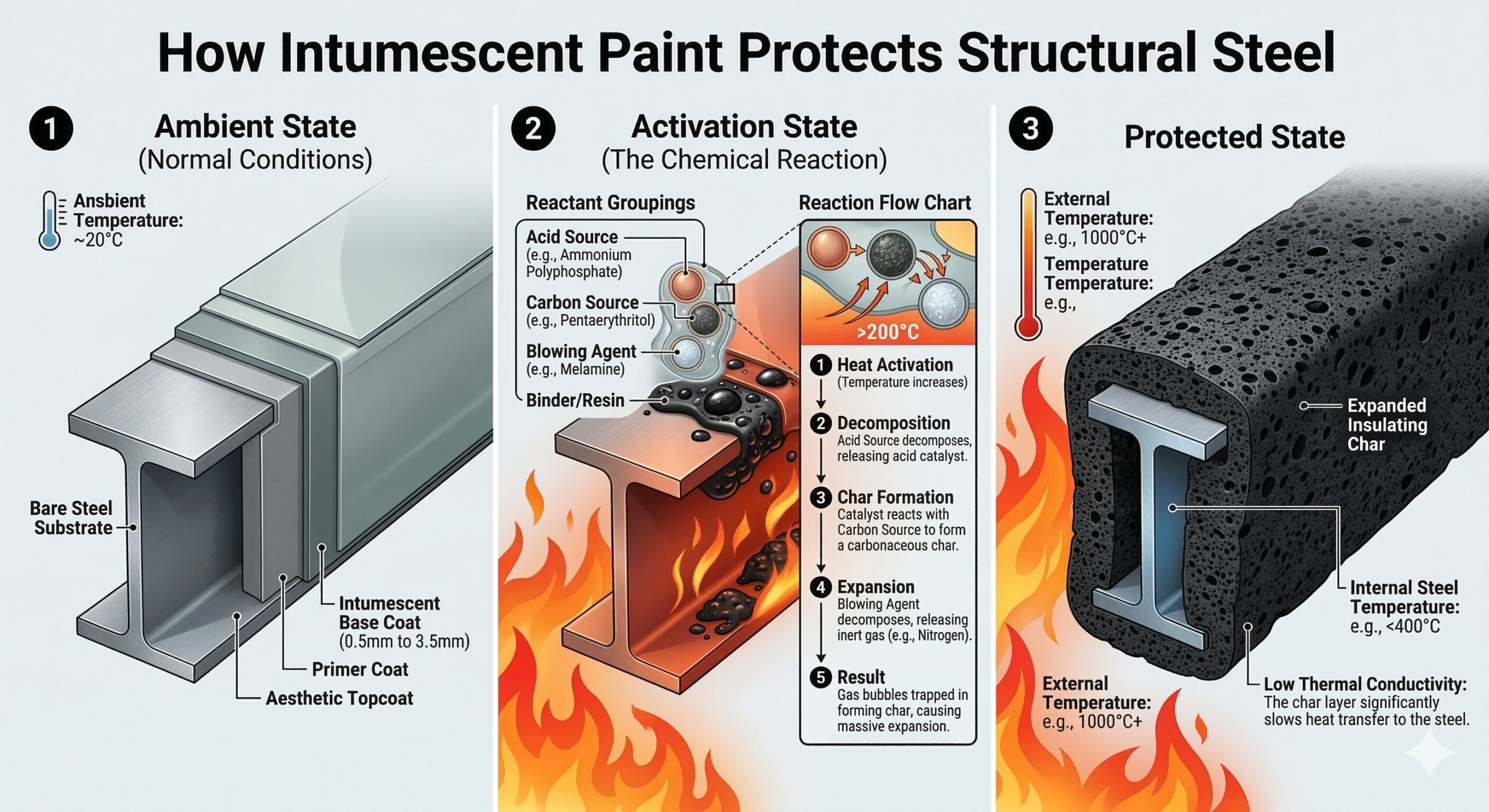
In its ambient state, it closely resembles conventional architectural paint, applied as a relatively thin film (typically ranging between 0.5mm and 3.5mm thick, depending on the required fire rating and steel mass).18
This thin profile allows architects to leave structural steel exposed as a primary design feature. However, upon exposure to thermal radiation and temperatures generally ranging from 150°C to 200°C, the coating undergoes a profound, rapid, and endothermic chemical transformation.
The paint expands violently—up to 50 times its original dry film thickness—to form a highly insulating, multi-cellular carbonaceous foam, commonly referred to within the industry as a “char barrier”.5
This expanding char acts as an exceptional thermal barrier, effectively disrupting the flow of heat transfer to the underlying steel substrate and extending the structural survival time up to 120 minutes or more.5
The intricate formulation of modern intumescent paint relies on a delicate orchestration of three primary active chemical components meticulously embedded within a specialized, physically drying binder matrix.20
- The Acid Donor (e.g., Ammonium Polyphosphate – APP): This is the catalyst of the system. Upon reaching the critical activation temperature well below the failure point of steel, the acid donor thermally decomposes to yield a strong inorganic acid, typically polyphosphoric acid.20 The creation of this acid is the vital first step that initiates the entire intumescent cycle.
- The Carbon Donor (e.g., Pentaerythritol – PER or specialized micronized polyalcohols like Charmor™): The carbon donor is a polyhydroxyl compound. It reacts aggressively with the newly formed polyphosphoric acid in a process of dehydration and esterification to form complex inorganic/organic polyphosphoric esters.20 As ambient fire temperatures continue to climb rapidly, these esters begin to decompose through a process of carbonization, ultimately forming the dense, tough carbon matrix that constitutes the physical structure of the protective char.20 The particle size of the carbon donor (often less than 40 µm) is heavily controlled by manufacturers to optimize the density and configuration of the resulting foam, ensuring it possesses the physical strength to withstand turbulent fire drafts.20
- The Blowing Agent (e.g., Melamine or Expandable Graphite): For the system to provide insulation, the carbon matrix must expand. It is absolutely vital that the blowing agent is engineered to decompose at the precise thermal moment after the ester melt forms but before complete gelation of the carbon matrix occurs.25 Compounds like melamine undergo rapid thermal degradation, releasing large volumes of non-flammable, inert gases, primarily nitrogen and water vapor.24 This massive gas release violently inflates the softening carbon matrix, expanding it perpendicularly away from the steel surface into a thick, highly cellular protective foam.25 Furthermore, the sudden release of these inert gases actively dilutes the oxygen concentration in the immediate boundary layer surrounding the steel, acting as a secondary, localized flame retardant.25
The binder itself (often based on acrylics, short/medium oil alkyds, or advanced two-component epoxies) serves a dual purpose: it holds the unreacted chemicals tightly to the steel substrate during decades of normal operations.
It strategically melts during the initial stages of the fire to provide a soft, viscous matrix that facilitates the intricate, chaotic chemical reactions taking place within the intumescent front.20
Vermiculite Spray: The Robust Thermal Insulator
In stark contrast to the highly reactive, expanding nature of intumescent paints, cementitious vermiculite spray achieves fire resistance through passive, massive thermal insulation.
Vermiculite is a naturally occurring earth mineral, specifically located within the phyllosilicate group, and is characterized by a unique layered crystalline structure that inherently traps moisture.27
Its superior fireproofing properties are unlocked through a specialized industrial exfoliation process prior to packaging.
When raw vermiculite ore is subjected to rapid, extreme heating in processing plants, the interlayer water of crystallization trapped deep within its mineral structure vaporizes almost instantly.27
The immense internal pressure generated by this trapped steam forces the silicate layers to separate and expand aggressively, causing the mineral to grow up to 30 times its original volume.27
This expanded, or exfoliated, vermiculite is remarkably lightweight, highly porous, and, most importantly, completely non-combustible.27
For application in structural fireproofing, this exfoliated vermiculite is blended with heat-absorbing cementitious binders—such as robust Portland cement for external grades exposed to weather, or lighter gypsum for internal grades—along with specific rheological dispersing agents.5
The resulting dry mix is hydrated on-site and applied to the structural steel via heavy-duty spray equipment in relatively thick layers.5
Unlike intumescent paint, vermiculite spray does not react, expand, or chemically alter during a fire. It simply sits on the steel as a dense, thick physical barrier, often applied in thicknesses up to 50mm depending on the required fire rating.19
The mechanism of protection it offers is powerful and dual-faceted:
- Exceptionally Low Thermal Conductivity: Vermiculite possesses an incredibly low thermal conductivity profile (approximately 0.062 to 0.065 W/mK).4 This physical property severely impedes the rate of heat transfer from the extreme temperatures of the fire environment to the structural steel beneath, creating a highly effective thermal bottleneck that dramatically slows the heating curve of the metal.4
- The Massive Heat Sink Effect: The sheer mass of the cementitious matrix applied to the steel, combined with the endothermic release of any residual moisture trapped within the binders, acts as a massive thermal sink. It absorbs and dissipates significant quantities of thermal energy before the underlying steel is permitted to reach its critical mechanical failure temperature of 550°C.4
Prominent, widely utilized vermiculite systems in the Singaporean market, such as Promat’s CAFCO® 300, have been extensively tested under standard fire curves to consistently provide fire resistance levels of up to 4 hours (240 minutes), making them exceptionally reliable in high-hazard structural applications.5
Application Dynamics and Section Factor (Hp/A) Calculations
A fundamental engineering principle in specifying the exact thickness of either intumescent paint or vermiculite spray is the highly precise calculation of the specific steel member’s Section Factor.
This is traditionally denoted in structural fire engineering as Hp/A (Heated Perimeter divided by Cross-Sectional Area), and is increasingly referred to in European design standards as A/V (Area over Volume).32
The Section Factor is a mathematical representation of the steel’s inherent heating rate during a fire.32
A slender steel member with a large heated surface area exposed to the flames (a high Hp) but a relatively small mass or cross-sectional area to absorb the heat (a low A) will possess a very high Hp/A value.34
Such members heat up exceedingly fast during a thermal event, thereby requiring substantially thicker layers of applied fire protection to maintain structural stability for the mandated time period.32
Conversely, massive, blocky steel columns with low Hp/A values heat up much more slowly and subsequently require thinner coats of protection.34
The calculation methodology for Hp/A values differs significantly depending on the method of construction for the protection materials, generally categorized into “box protection” and “profile protection”.32
- Profile Protection: The fireproofing material follows the exact contours of the steel beam (e.g., painting an I-beam so it still looks like an I-beam). This exposes a larger perimeter to the fire.
- Box Protection: The fireproofing material encases the steel member in a rectangular or square box (e.g., building a fire-rated board enclosure around an I-beam). This reduces the exposed perimeter.
For example, calculating the heated perimeter (Hp) for an exposed Universal Beam (I-beam) using Profile Protection on all four sides requires measuring the entire outer boundary of the flanges and the web, whereas calculating Hp for Box Protection on all four sides simplifies to 2B + 2D (where B is the width and D is the depth of the section).36
Understanding and accurately calculating these A/V values is the absolute foundation of ensuring that the applied fireproofing meets the SCDF requirements without over-specifying and wasting expensive materials.
Prescriptive Thickness Requirements from Annex 3A
To aid engineers, the SCDF Fire Code 2023 provides highly specific, prescriptive tables detailing the minimum thickness of non-combustible protection required to achieve desired fire resistance ratings without necessitating complex, bespoke fire engineering models for every single beam.
According to Chapter 3 Annex 3A, the required thicknesses for various encased structural steel columns and beams are meticulously defined.11
Table 2 illustrates the stark variations in required material thickness derived directly from Annex 3A for providing fire resistance to encased steel stanchions using sprayed cementitious materials versus solid masonry protection.
| Fire Resistance Period | Sprayed Vermiculite-Cement (Density 300 to 600 kg/m³) | Concrete Protection (Minimum density 2300 kg/m³) | Solid Brickwork Protection |
| 30 Minutes (½ hr) | 10 mm | 25 mm | 50 mm |
| 60 Minutes (1 hr) | 15 mm | 25 mm | 50 mm |
| 90 Minutes (1½ hrs) | 25 mm | 25 mm | 50 mm |
| 120 Minutes (2 hrs) | 30 mm | 25 mm | 75 mm |
| 180 Minutes (3 hrs) | 45 mm | 50 mm | 100 mm |
| 240 Minutes (4 hrs) | 55 mm | 50 mm | 100 mm |
Data accurately transcribed from SCDF Fire Code 2023, Chapter 3, Annex 3A.11
As demonstrated by the regulatory data, achieving a 4-hour (240-minute) fire rating utilizing vermiculite-cement spray requires a massive 55mm application thickness.11
While highly effective at insulating the steel, this immense thickness consumes significant spatial volume around the structural framework, a critical factor when designing tight mechanical and electrical routing in modern buildings.
Surface Preparation Parity and Application Constraints
The application prerequisites for intumescent coatings versus vermiculite sprays differ monumentally, fundamentally impacting project timelines, labor costs, and site logistics.
Intumescent Paint Application: Intumescent coatings are highly sensitive chemicals that are completely intolerant of surface contamination.
To ensure that the coating does not catastrophically delaminate or detach from the steel during its violent expansion phase in a fire, the steel substrate must undergo rigorous, expensive surface preparation.
The global industry standard mandates abrasive blast cleaning to the Swedish Standard SA 2.5 (Near White Metal Blast Cleaning), as formally defined by ISO 8501-1.26
SA 2.5 specifies that the surface must be meticulously blasted until it is completely free from visible oil, grease, dirt, mill scale, and loose rust.
The standard strictly dictates that no more than 5% of the total surface area may exhibit faint shadows, streaks, or slight discoloration.37
Achieving SA 2.5 requires heavy-duty abrasive blasting equipment, massive containment structures to manage the abrasive dust, and significant labor hours.
Furthermore, following SA 2.5 preparation, a highly compatible primer—such as a zinc-rich epoxy or short-oil alkyd—must be immediately applied to the raw steel to prevent flash rusting.26
Only then can the intumescent base coat be applied, often requiring multiple passes to achieve the necessary dry film thickness, followed finally by an aesthetically pleasing topcoat.18
Vermiculite Spray Application: Cementitious vermiculite is considerably more robust and forgiving in its application requirements.
While the steel surface must undoubtedly be clean, dry, and free of loose mill scale, flaking architectural paint, dirt, and heavy grease, it does not typically require the extreme, highly expensive SA 2.5 abrasive blasting mandated by intumescent paints.29
The wet vermiculite slurry is pumped and sprayed directly onto the structural steel, adhering robustly through strong mechanical bonding.5
However, the application process is notoriously messy. It requires significant masking and protection of adjacent architectural areas, and the thick cementitious mass demands extended drying and curing times.
During this critical curing phase, the highly porous vermiculite coating must be rigorously protected from moisture ingress and accidental mechanical impacts by other trades working on site.5
Comparative Analysis: Economics, Aesthetics, and Performance
When lead architects, facility managers, and cost consultants evaluate vermiculite spray against intumescent coatings during the value engineering phase, the decision matrix rarely yields a simple, universally applicable answer.
Table 3 provides a comprehensive performance and economic benchmarking of the two methodologies.
| Evaluation Metric | Intumescent Coatings (Reactive) | Vermiculite Spray (Cementitious) |
| Aesthetics / Architectural Finish | Exceptional. Provides a smooth, highly refined paint-like finish. Can be top-coated in virtually any architectural color to deliberately showcase the steel skeleton.6 | Extremely poor. Features a very rough, lumpy, “popcorn” texture. Typically concrete grey and visually unappealing for exposed spaces.6 |
| Thickness & Spatial Requirements | Very thin profile (0.5mm to 3.5mm). Does not encroach on critical functional space or tight mechanical pipe routing.19 | Very thick application (up to 55mm). Consumes functional space; can heavily interfere with tight architectural tolerances.11 |
| Initial Capital Cost (CAPEX) | High. Premium pricing for proprietary chemical materials and high reliance on specialized, meticulous labor and SA 2.5 surface preparation.40 | Low. Highly cost-effective bulk materials and rapid, efficient application processes over massive structural areas.6 |
| Total Cost of Ownership (TCO) | Higher. The coating system may require periodic maintenance or re-application of protective topcoats to preserve both aesthetic value and chemical protection over decades.41 | Very Low. Once fully cured, the mineral matrix is highly stable, requires almost zero maintenance, and provides robust protection for the building’s entire lifecycle.41 |
| Durability & Impact Resistance | Moderate. While chemically stable, the thin film is susceptible to localized mechanical damage, gouging, and scratching from equipment.5 | High. Exceptional resistance to physical wear, impact, harsh weather, and the brutal industrial abrasions common in heavy facilities.6 |
| Weight Load on Superstructure | Minimal. Adds entirely negligible dead load to the structural frame.35 | Moderate to High. The thick cementitious mass adds significant dead load, which must be engineered into the primary foundation calculations.18 |
| Repairability | Complex. Requires careful localized surface prep, precise thickness matching, and topcoat blending to maintain visual and chemical continuity.6 | Simple. Damaged or spalled sections can be quickly re-sprayed or manually hand-troweled with minimal technical difficulty.6 |
The Hybrid Strategy Paradigm
Leading structural engineers and high-tier fire safety consultancies in Singapore increasingly advocate for a sophisticated hybridized fireproofing strategy to optimize both financial expenditure and architectural design outcomes.30
By 2026, the industry standard has firmly shifted away from dogmatic reliance on a single, uniform protection system across an entire building.
Instead, project managers allocate PFP resources spatially based on visibility and environmental risk.41
In highly visible, premium front-of-house areas—such as commercial lobbies, luxury retail atriums, museums, and architecturally exposed roof structures—intumescent paint is the undisputed choice.5
It grants architects the freedom to utilize the raw, industrial elegance of the structural steel skeleton as a primary visual design feature without compromising the strict Fire Code mandate for structural stability.6
Conversely, in functional back-of-house environments where aesthetic appeal is entirely irrelevant—such as subterranean car parks, heavy mechanical plant rooms, hidden ceiling voids, server data centers, and industrial warehouses—vermiculite spray reigns absolute.5
Deploying vermiculite in these non-visible, high-traffic sectors dramatically slashes the overall project budget while simultaneously providing superior, rugged durability against the mechanical impacts and abrasions that are commonplace in operational zones.6
Sustainability and The Singapore Green Building Masterplan (SGBMP)
The built environment in Singapore is currently undergoing a profound, systemic transformation driven by the ambitious Singapore Green Building Masterplan (SGBMP) 2030.43
Spearheaded by the Building and Construction Authority (BCA) and the Singapore Green Building Council (SGBC), the SGBMP establishes the aggressive “80-80-80” national targets: 80% of all buildings by gross floor area to be certified green by 2030, 80% of all new developments to be Super Low Energy (SLE) buildings, and an 80% improvement in energy efficiency for best-in-class buildings compared to 2005 baselines.43
Within this new sustainability paradigm, the selection of structural fireproofing materials is no longer based solely on cost and fire resistance; materials must now align with stringent ecological criteria.
Both vermiculite and intumescent systems face heavy scrutiny regarding their environmental footprint, specifically concerning the emission of Volatile Organic Compounds (VOCs) and their overall lifecycle impact from manufacturing to eventual disposal.
Vermiculite: The Eco-Friendly Mineral Alternative
Vermiculite spray is inherently advantageous in the sustainability assessment. Composed primarily of naturally occurring earth minerals (aluminum-iron-magnesium silicates) and common binders like gypsum or Portland cement, vermiculite is non-toxic, completely halogen-free, and boasts exceptionally low, or zero, VOC emissions.30
Because it relies on basic physical processes like thermal exfoliation rather than complex, energy-intensive petrochemical synthesis, its manufacturing carbon footprint is relatively low.
From a Green Mark certification perspective, utilizing locally processed, natural cementitious sprays aligns seamlessly with the SGBMP’s mandate for healthy indoor environments and sustainable supply chains.40
Intumescent Coatings: Revolutionary Advancements in Waterborne Technology
Historically, high-performance intumescent paints relied heavily on solvent-borne chemical formulations.
These solvent-based paints emitted high levels of toxic VOCs during both application and the extended curing phase, presenting a direct conflict with modern indoor air quality standards and green building initiatives.
However, driven by tightening regulations and the rigorous SGBC certification process, global paint manufacturers have heavily invested in engineering revolutionary water-based (waterborne) intumescent technologies.5
Leading manufacturers—such as Promat, Sherwin-Williams, and those utilizing Perstorp’s advanced Charmor™ carbon donors—now offer high-performance waterborne intumescent coatings that successfully achieve demanding 120-minute fire resistance ratings while maintaining near-zero VOC profiles.20
Products that undergo comprehensive scientific life-cycle evaluations and successfully achieve the Singapore Green Building Product (SGBP) certification—which is widely recognized by the BCA, the Housing and Development Board (HDB), and other government agencies—are actively prioritized in procurement.47
Utilizing SGBP-certified intumescent coatings allows developers to secure crucial additional points under the BCA Green Mark scoring scheme, facilitating the transition towards the SGBMP targets.48
Furthermore, recent innovations emerging from institutions like Nanyang Technological University (NTU) in Singapore have led to the development of next-generation coatings, such as FiroShield, which combine fire and corrosion protection into a single application that does not require extensive SA 2.5 sandblasting, potentially halving application times and massively reducing the environmental footprint of the application process.50
Inspection, Certification, and the Maintenance Lifecycle
Fire protection is categorically not a static, “install and forget” component of building construction; it requires rigorous oversight from the point of architectural conception through the entire functional lifespan of the building.
In Singapore, this compliance continuum is governed by strict, legally mandated inspection protocols to ensure that degradation does not compromise safety.
The Registered Inspector (RI) Framework
Under the Fire Safety Act, building owners and developers are legally mandated to engage an independent Registered Inspector (RI) before occupying any new building or concluding major alteration works.51
The RI must be a highly qualified architect or professional engineer with at least ten years of specialized experience in the design and inspection of fire safety works.51
The RI serves as the critical, independent technical bridge between the contractor’s physical installation and the SCDF’s ultimate regulatory approval.51
During the final construction phases, the RI utilizes an exhaustive, multi-point checklist to physically verify that the structural steel fireproofing aligns perfectly with the approved Fire Safety Plans, the Product Listing Scheme (PLS) Certificates of Conformity, and the specific thickness parameters calculated for the Hp/A of the various steel members.54
The RI physically inspects the application of fire-rated spray-on materials and intumescent paints for correct thickness, adherence, and continuity.54
Upon successful and exhaustive evaluation, the RI issues one of two crucial statutory documents:
- Certificate of Inspection Form 1: This form conclusively certifies that all fire safety works, including the intumescent or vermiculite applications, have been fully completed in absolute compliance with the Fire Code and approved plans. The submission of Form 1 triggers the SCDF to issue the definitive Fire Safety Certificate (FSC), allowing full occupation.51
- Certificate of Inspection Form 2: This form is issued when the fire safety works are satisfactorily completed but exhibit minor, non-critical deviations or non-compliance issues that do not immediately render the building unsafe. The submission of Form 2 allows the SCDF to grant a Temporary Fire Permit (TFP) for a strictly limited period, permitting occupancy while the contractor rectifies the outstanding minor defects.51
Periodic Structural Inspection (PSI) and Long-Term Maintenance
To proactively combat the inevitable physical degradation of building materials over time, the Building Control Act mandates strict Periodic Structural Inspections (PSI) for all existing structures.
Commercial, industrial, and institutional buildings must undergo a comprehensive PSI every 5 years, while residential buildings are inspected every 10 years (with the inspection cycle triggered after the building reaches 20 years of age).55
During a PSI, a specially appointed Professional Engineer (PE) conducts comprehensive visual and structural investigations of the building’s integrity.57
For structural steel fireproofing, this is a highly critical juncture. Vermiculite sprays, while exceptionally durable against general wear, can suffer from localized spalling, cracking, or detachment due to subtle structural vibrations over decades, occult water leakage from roofing systems, or careless modifications made during Mechanical and Electrical (M&E) routing upgrades.55
The PE will perform targeted physical testing, such as tapping the cementitious coating with a specialized hammer, to detect auditory signs of hollowness that indicate delamination from the steel substrate.55
Any detected hollowness mandates immediate localized patching, spraying, or hand-troweling to restore the fire rating.29
Intumescent coatings face entirely different lifecycle challenges. While they do not spall like heavy cement, the aesthetic topcoat can rapidly degrade due to ultraviolet (UV) exposure, high humidity, or localized mechanical scratching.
The PSI ensures that the topcoat remains perfectly intact to protect the highly reactive, moisture-sensitive base layers from ingress.41
Furthermore, under the strict requirements of Fire Code Clause 3.15, building management and appointed Fire Safety Managers (FSM) must rigorously adhere to the repainting schedule dictated on the mandatory SCDF signage affixed near the intumescent-treated steel, keeping meticulous records of all inspections and touch-ups.13
Landmark Case Studies: Execution in High-Stakes Environments
To fully contextualize the theoretical parameters of these contrasting fireproofing systems, it is highly instructive to analyze their real-world deployment in several of Singapore’s most complex, recognizable, and structurally demanding architectural marvels.
1. Marina Bay Sands (MBS) Integrated Resort
The construction of the Marina Bay Sands resort remains one of the most formidable structural engineering feats in modern history, costing over US $6 billion.60
The iconic design features three massive 55-storey hotel towers that slope aggressively, requiring unprecedented temporary structural steel struts and high-tensile tendons to prop the towers up like a suspension bridge until they were permanently connected by massive trusses at the 23rd floor.60
The integration of fire safety within this immense, heavily loaded steel and concrete hybrid structure required an unprecedented level of rigorous compartmentation and advanced fire engineering.61
The protection of the critical structural steel elements utilized a highly strategic mix of passive protection systems.
While the massive primary structural columns hidden deep within the hotel’s core infrastructure and subterranean levels were shielded using highly durable, cost-effective cementitious sprays and solid concrete encasement, the highly exposed, aesthetically vital steel elements within the expansive glass atriums and retail malls required sophisticated intumescent coatings.
The fire engineering strategy at MBS perfectly exemplifies the necessity of strict compartmentation combined with hybrid PFP allocation to balance extreme load-bearing safety requirements with unparalleled architectural grandeur.60
2. Jewel Changi Airport and Terminal 4
Aviation infrastructure demands the absolute zenith of fire safety, coupled with the functional necessity to handle monumental volumes of human traffic safely.
In the construction of Changi Airport’s Terminal 4 and the globally acclaimed Jewel Changi, structural steel was deployed extensively to create vast, column-free concourses and the iconic, light-filled geometric glass dome structures.22
Covering the intricate, highly visible geometric steel web of Jewel’s magnificent dome with thick, lumpy, grey vermiculite spray was architecturally inconceivable.
Instead, highly advanced intumescent coating technologies were exclusively utilized for the exposed framework.22
High-performance epoxy-based intumescent materials, utilizing formulations originally derived from extreme-heat petrochemical applications, provided the necessary 120-minute fire resistance while allowing the steel to be painted and visually celebrated as part of the architecture.22
Furthermore, performance-based fire engineering models, such as advanced traveling fire methodologies and Computational Fluid Dynamics (CFD), were utilized in the airport’s design.65
These complex structural fire models (utilizing software like SAFIR) proved that localized smoke and heat extraction systems could effectively mitigate upper-level temperatures, thereby scientifically justifying highly optimized thicknesses for the expensive intumescent coatings on the primary beams without compromising the safety margin.65
3. The National Library Building
The National Library is a landmark 16-storey, two-block complex interconnected by link bridges, housing irreplaceable historical archives and high volumes of public visitors.68
It stands as one of the very first major structures in Singapore to successfully champion a comprehensive Performance-Based Fire Safety Design approach for its structural steel frame.68
Rather than blindly adhering to prescriptive, blanket thickness requirements for passive fire protection across every beam and column, the engineering team utilized highly advanced fire engineering methodologies.69
By utilizing multi-dimensional integrations of fire engineering simulation, emergency evacuation modeling, and precise structural resistance calculations under elevated temperatures, the engineers accurately predicted localized heat profiles throughout the building.69
This allowed for a highly optimized, targeted application of fire protection. Some structural elements were encased in robust concrete or deliberately hidden above fire-rated suspended ceilings (provided no combustible ducting was present in the ceiling void, per regulations), while other exposed architectural elements utilized targeted intumescent applications.68
This sophisticated performance-based approach drastically reduced the dead load of the building and minimized redundant material costs, all while exceeding the strict safety mandates of the SCDF.
Strategic Cost Engineering and Total Cost of Ownership (TCO)
The financial modeling of structural fireproofing cannot be myopically confined to the initial capital expenditure (CAPEX); it requires a holistic, long-term analysis of the Total Cost of Ownership (TCO) across the building’s entire operational lifespan.
Current construction cost reviews in Singapore (Q2/Q3 2024) indicate a continuous upward trajectory in tender price indices, driven by a surge in construction activity, a strong pipeline of public and private sector projects, and ongoing labor constraints.71
Base construction costs for commercial office buildings range from S4,350 per square meter, while 5-star hotel developments command S8,750 per square meter.71 In this high-cost economic climate, the precise optimization of fireproofing materials is paramount to maintaining project viability.
The Intumescent Financial Model: Intumescent systems command a highly significant premium upfront.
The high cost of the proprietary chemical formulations, combined with the extreme labor intensity of the required SA 2.5 blast cleaning, the necessity of multiple coat applications to achieve desired thicknesses, and the strict environmental controls required during curing, drives the initial installation cost per square meter substantially higher than cementitious alternatives.41
However, this heavy upfront investment frequently generates powerful indirect financial returns. Because intumescent coatings are mere millimeters thick, they maximize the highly valuable functional and rentable volume of the building.41
In high-value commercial real estate districts in Singapore, the additional floor space and ceiling height reclaimed by avoiding 55mm of bulky vermiculite encasement can easily financially justify the initial paint premium.41
The Vermiculite Financial Model: Vermiculite spray is the undisputed leader in upfront affordability and bulk cost engineering.6
The raw materials (minerals and standard cementitious binders) are heavily commoditized and extremely inexpensive.5
Application is extraordinarily rapid; highly trained spray crews can cover massive square meterage in a fraction of the time required for a multi-coat intumescent paint system, drastically reducing labor costs.5
Furthermore, the operational lifecycle costs are practically negligible; a well-applied vermiculite installation hidden safely above a ceiling grid in a warehouse or car park will easily last the 50+ year lifespan of the building without requiring aesthetic repainting, delicate topcoat maintenance, or specialized environmental controls.41
Synthesis and Strategic Recommendations
The specification of passive fire protection for structural steel is not a mere regulatory formality or a simple line item on a bill of quantities; it is a profound engineering responsibility that dictates the ultimate survivability of a multi-million dollar structure and its occupants during a catastrophic thermal event.
The Singapore Civil Defence Force, through the rigorous application of the Fire Code 2023 and the Product Listing Scheme, enforces an uncompromising safety baseline that all stakeholders must respect.7
The critical engineering choice between intumescent paint and vermiculite spray requires a nuanced, multi-disciplinary approach that balances chemistry, architecture, economics, and law:
- For High-Visibility and Premium Commercial Spaces: Intumescent coatings provide unparalleled aesthetic flexibility and critical space optimization.18 When protecting architecturally exposed structural steel in commercial lobbies, atriums, or aviation terminals, intumescent paint is the mandatory choice, allowing the structural framework to serve as a stunning design feature without sacrificing the necessary 60 to 120 minutes of fire resistance.5
- For Industrial, Utility, and Subterranean Environments: Vermiculite spray offers superior, rugged durability and unmatched, highly scalable cost-efficiency.6 It is the absolute optimal choice for subterranean car parks, heavy warehouses, plant rooms, and functional spaces where visual aesthetics are secondary to raw structural resilience.6 Furthermore, due to the explicit Fire Code Clause 3.15.2 restrictions, intumescent coatings must be actively avoided in PG VI and VIII industrial/storage buildings unless a highly specialized, SCDF-evaluated corrosion mitigation strategy is implemented to protect the reactive chemicals from airborne degradation.13
- For Sustainable and Green Mark Developments: Both systems have aggressively evolved to meet the vital targets of the Singapore Green Building Masterplan 2030.43 Specifiers and procurement teams must ruthlessly prioritize SGBC-certified waterborne intumescent paints or locally sourced, zero-VOC vermiculite sprays to ensure alignment with national sustainability mandates, preserve indoor air quality, and secure crucial Green Mark certification points for the development.40
Ultimately, the most successful, resilient, and economically viable structural fire engineering designs in modern Singapore leverage a highly calculated hybrid methodology.41
By intelligently compartmentalizing the building and assigning rugged vermiculite to the hidden, heavy-duty zones, and reserving premium intumescent paint for the highly visible, architectural zones, developers can achieve flawless SCDF compliance, optimize their financial models, and guarantee the uncompromising preservation of life and property in the face of devastating fire risks.
Works cited
- Fire Engineering Design & SCDF Compliance in Singapore – Stellar Structures, accessed March 13, 2026, https://structures.com.sg/fire-engineering-design-scdf-compliance-sg/
- Fire Protection – Steel Structure Building Fabricator, accessed March 13, 2026, https://www.novabuildingsasia.com/resource/e-nova/fire-protection/
- Structural Fire Protection Intro – Promat Singapore, accessed March 13, 2026, https://www.promat.com/en-sg/construction/projects/expert-area/62958/structural-protection-of-your-building/
- Vermiculite: Uses in Gardening, Insulation & Fire Protection – Alliance Chemical, accessed March 13, 2026, https://alliancechemical.com/blogs/articles/a-guide-to-vermiculite-benefits-applications-and-safety-tips
- Vermiculite vs Intumescent Coatings | Ceasefire PFP, accessed March 13, 2026, https://ceasefire.com.au/vermiculite-vs-intumescent-coatings/
- Choosing Between Vermiculite vs. Intumescent Coatings – Fire Rated Systems, accessed March 13, 2026, https://www.fireratedsystems.com.au/blog/vermiculite-vs-intumescent-coatings/
- Clause 3.3 Fire Resistance of Elements of Structure – SCDF, accessed March 13, 2026, https://www.scdf.gov.sg/fire-safety-services-listing/fire-code-2023/table-of-content/chapter-3-structural-fire-precautions/clause-3.3-fire-resistance-of-elements-of-structure
- CODE OF PRACTICE FOR FIRE PRECAUTIONS IN BUILDINGS 2023 – SCDF, accessed March 13, 2026, https://www.scdf.gov.sg/docs/default-source/fire-safety-docs/firecode-2023-111220241013.pdf?sfvrsn=b3dc3c15_3
- Related Tables and Diagrams of Chapter 3 – SCDF, accessed March 13, 2026, https://www.scdf.gov.sg/fire-safety-services-listing/fire-code-2023/table-of-content/chapter-3-structural-fire-precautions/related-tables-of-chapter-3
- Singapore Fire Code 2023 Overview | PDF | Fire Safety | Firefighting – Scribd, accessed March 13, 2026, https://www.scribd.com/document/736891674/0-Fire-Code-2023-Binder-Including-Appendix
- Annex 3A – Singapore – SCDF, accessed March 13, 2026, https://www.scdf.gov.sg/fire-safety-services-listing/fire-code-2023/table-of-content/chapter-3-structural-fire-precautions/annex-3a
- Clause 3.4 Tests of Fire Resistance – SCDF, accessed March 13, 2026, https://www.scdf.gov.sg/fire-safety-services-listing/fire-code-2023/table-of-content/chapter-3-structural-fire-precautions/clause-3.4-tests-of-fire-resistance
- Clause 3.15 Materials for Construction – SCDF, accessed March 13, 2026, https://www.scdf.gov.sg/fire-safety-services-listing/fire-code-2023/table-of-content/chapter-3-structural-fire-precautions/clause-3.15-materials-for-construction
- Product Requirements | TÜV SÜD PSB Singapore | TÜV SÜD …, accessed March 13, 2026, https://www.tuvsud.com/en-my/resource/certificate-finder/product-listing-scheme/product-requirements
- Appendix F Appendix to Clause 3.15.1(b) NOTES ON THE USE OF INTUMESCENT PAINTS FOR PROTECTION TO STRUCTURAL STEEL MEMBERS OF BUI – SCDF, accessed March 13, 2026, https://www.scdf.gov.sg/docs/default-source/fire-safety-docs/downloads/fire-code-2007-master-version/appendix_f.pdf?sfvrsn=5dc02786_1
- QCDFSS-3.15.1 – Intumescent Paints | PDF | Fire Safety | Structural Steel – Scribd, accessed March 13, 2026, https://www.scribd.com/document/445150118/QCDFSS-3-15-1-Intumescent-Paints
- Clause 3.15 Materials for construction – SCDF, accessed March 13, 2026, https://www.scdf.gov.sg/fire-safety-services-listing/cpfprts-2022/table-of-content/chapter-3-station-structural-fire-precautions/clause-3.15-materials-for-construction
- Intumescent vs Cementitious Vermiculite Fireproofing – BFT, accessed March 13, 2026, https://www.bftech.com.sg/intumescent-vs-cementatious-vermiculite-fireproofing/
- Intumescent Paint | Singapore Painter | – Painting Services, accessed March 13, 2026, https://painting-services.biz/intumescent-paint/
- Charmor™ PM40 for solvent borne intumescent paint – Tri-iso, accessed March 13, 2026, https://www.tri-iso.com/documents/Perstorp_Charmor_Solventborne_formulation.pdf
- Intumescent Coatings and Their Applications in the Oil and Gas Industry: Formulations and Use of Numerical Models – PMC, accessed March 13, 2026, https://pmc.ncbi.nlm.nih.gov/articles/PMC12298081/
- Raising standards, Protecting Assets and Property – Sherwin-Williams Industrial Coatings, accessed March 13, 2026, https://industrial.sherwin-williams.com/emeai/gb/en/protective-marine/media-center/articles/sustainable-building-design-intumescent-coatings.html
- Intumescent carbon donors – Perstorp, accessed March 13, 2026, https://www.perstorp.com/-/media/files/perstorp/pb/charmor.pdf
- Water-based intumescent coatings with reduced application times – BASF Insights, accessed March 13, 2026, https://insights.basf.com/home/article/read/water-based-intumescent-coatings-with-dramatically-reduced-application-times
- A Comprehensive Review on Intumescent Coatings: Formulation, Manufacturing Methods, Research Development, and Issues – MDPI, accessed March 13, 2026, https://www.mdpi.com/2571-6255/8/4/155
- Intumescent paints – efficient way of protection of steel materials against fire – Promat, accessed March 13, 2026, https://www.promat.com/en-sg/construction/projects/expert-area/39704/intumescent-paints-effective-fire-protection-of-steel-structures/
- Why Vermiculite Coatings Are Essential for Fire Safety – Mid-Mountain, accessed March 13, 2026, https://mid-mountain.com/why-vermiculite-coatings-are-essential-for-fire-safety/
- Vermiculite Fire-Resistant Construction · Dicalite Management Group, accessed March 13, 2026, https://www.dicalite.com/2025/01/vermiculite-fire-resistant-construction/
- Vermiculite Fireproofing Spray | FLEXTEC, accessed March 13, 2026, https://www.flextecsg.com/fireproofing-for-structural-steel
- Vermiculite Spray vs Intumescent Coating – Progressive Materials, accessed March 13, 2026, https://www.progressivematerials.com.au/vermiculite-spray-vs-intumescent-coating/
- The Importance of Vermiculite Fire Spray – Bowsers – Fire Protection Experts, accessed March 13, 2026, https://bowsers.com.au/wp-content/uploads/2024/03/231018-Bowsers-Vermiculite-Fire-Spray-DPS.pdf
- Structural Steel Fire Protection – Promat, accessed March 13, 2026, https://media.promat.com/pi10301/original/288272370/promat-paph-02-steelwork-en.pdf
- Passive Fire Protection – Structural Steel Protection – Promat, accessed March 13, 2026, https://media.promat.com/pi665944/original/260291005/promat-passive-fire-protection-structural-steel-handbook-en-hk-2023-05.pdf
- Steel section factor in intumescent paint coating specification, accessed March 13, 2026, https://www.intumescentcoatingsystems.com.au/learning-centre/steel-section-factor
- The Passive Fire Protection Handbook – Building Centre, accessed March 13, 2026, https://buildingcentre.co.uk/media/_file/pdf/5132_pdf3.pdf
- STRUCTURAL STEEL SECTION FACTOR General Guidelines, accessed March 13, 2026, https://cdn.prod.website-files.com/5eba0483f897f9efd845e083/5ee860fd3df55c50bf823ff6_Structural%20steel%20section%20factor%20guidelines.pdf
- Surface Preparation Standards Explained – SSPC/NACE & ISO 8501 – Graco Inc., accessed March 13, 2026, https://www.graco.com/gb/en/contractor/solutions/articles/surface-prep-standards-explained-sspc-nace-iso-8501.html
- Sa 2.5 Blast-Cleaning Standards Guide | PDF | Procedural Knowledge | Paint – Scribd, accessed March 13, 2026, https://www.scribd.com/doc/259896204/SIS-05-59-00
- A headline story for The New York Times building – SteelConstruction.info, accessed March 13, 2026, https://www.steelconstruction.info/images/4/4a/New_York_Times_Building_Case_Study.pdf
- Vermiculate Coating vs Intumescent Paint: Which offers better fire protection?, accessed March 13, 2026, https://www.jpscsolutions.com/blog/vermiculate-coating-vs-intumescent-paint-which-offers-better-fire-protection/
- Cost vs. Performance: Vermiculite Spray vs. Intumescent Coatings for Steel Protection by 2026 – Fire Rated Systems, accessed March 13, 2026, https://www.fireratedsystems.com.au/blog/cost-vs-performance-vermiculite-spray-vs-intumescent-coatings-for-steel-protection-by-2026/
- Repairing Damaged Vermiculite Fireproof Cement in Singapore |, accessed March 13, 2026, https://fireproofingsys.com/repairing-damaged-vermiculite-fireproof-cement-in-singapore/
- Buildings – National Climate Change Secretariat, accessed March 13, 2026, https://www.nccs.gov.sg/singapores-climate-action/mitigation-efforts/buildings/
- Singapore Green Building Masterplan, accessed March 13, 2026, https://www.sgbc.sg/sgbmp/
- Green Building Masterplans | Building and Construction Authority (BCA), accessed March 13, 2026, https://www1.bca.gov.sg/buildsg/sustainability/green-building-masterplans
- SGBC Product Directory, accessed March 13, 2026, https://web.sgbc.online/public/product/certificate/1/7/18/5132/1876
- Singapore Green Building Product – Knauf, accessed March 13, 2026, https://knauf.com/en-VN/knauf-gypsum/sustainability/green-certification
- Sustainability – Saint-Gobain, accessed March 13, 2026, https://www.saint-gobain.sg/sustainability
- Singapore Green Building Product Certification Scheme, accessed March 13, 2026, https://www.sgbc.sg/sgbc-certifications/sgbp-certification/
- New fire-resistant coating to prevent failure in steel building fires | ScienceDaily, accessed March 13, 2026, https://www.sciencedaily.com/releases/2017/10/171031085428.htm
- Registered Inspector – Singapore – SCDF, accessed March 13, 2026, https://www.scdf.gov.sg/fire-safety-services-listing/permits-and-certifications/registered-inspector
- Fire Safety (Registered Inspectors) Regulations CAP. 109A, Rg 2] [2008 Ed. p. 1, accessed March 13, 2026, https://sso.agc.gov.sg/SL/FSA1993-RG2?DocDate=20230707&ViewType=Pdf&_=20230731151053
- Fire Safety (Registered Inspectors) Regulations – Singapore Statutes Online, accessed March 13, 2026, https://sso.agc.gov.sg/SL/FSA1993-RG2?DocDate=20230707
- Ri Inspection Checklist Summary | PDF | Elevator | Wall – Scribd, accessed March 13, 2026, https://www.scribd.com/document/792078939/RI-INSPECTION-CHECKLIST-SUMMARY
- GUIDELINES FOR STRUCTURAL ENGINEERS – Building and Construction Authority (BCA), accessed March 13, 2026, https://www1.bca.gov.sg/docs/default-source/docs-corp-regulatory/building-control/periodic-structural-inspection/psi-guidelines-for-structural-engineers.pdf?sfvrsn=a438e386_6
- Periodic Structural Inspection (PSI) | Building and Construction Authority (BCA), accessed March 13, 2026, https://www1.bca.gov.sg/regulatory-info/building-control/periodic-structural-inspection
- The Ultimate Guide to Structural & Façade Inspections in Singapore: BCA Compliance, Certification, and Rectification for 2025, accessed March 13, 2026, https://structures.com.sg/structural-facade-inspections-singapore/
- Fireproofing Maintenance and Repair – BFT, accessed March 13, 2026, https://www.bftech.com.sg/fireproofing-maintenance-and-repair/
- APPENDIX 6 NOTES ON THE USE OF INTUMESCENT PAINTS FOR PROTECTION TO STRUCTURAL STEEL MEMBERS OF BUILDINGS. Scope 1 Intumescent p, accessed March 13, 2026, https://mfrs.govmu.org/Documents/Downloads/Fire%20Code/Appendix/Appendix%206.pdf
- Building Case Study – CIVE 2009, accessed March 13, 2026, https://19890525.weebly.com/building-case-study.html
- Marina Bay Sands: Fire Safety & Water Management | PDF – Scribd, accessed March 13, 2026, https://www.scribd.com/document/721382811/BSM-IE2
- Case Study: Marina Bay Sands, Singapore – Council on Tall Buildings and Urban Habitat, accessed March 13, 2026, https://global.ctbuh.org/resources/papers/download/26-case-study-marina-bay-sands-singapore.pdf
- The Marina Bay Sands Complex in Singapore: A Modern Marvel of Structure and Technology – ResearchGate, accessed March 13, 2026, https://www.researchgate.net/publication/347540838_The_Marina_Bay_Sands_Complex_in_Singapore_A_Modern_Marvel_of_Structure_and_Technology
- Changi International Airport Terminal 4 baggage area – Promat Singapore, accessed March 13, 2026, https://www.promat.com/en-sg/construction/projects/reference-cases/changi-international-airport-terminal-4/
- Fire Engineering Case Studies Overview | PDF – Scribd, accessed March 13, 2026, https://es.scribd.com/document/680253682/Fire-Engineering-Design-Consultancy-300611
- New Promat study outlines best fire protection for structural steel buildings – IFSJ, accessed March 13, 2026, https://internationalfireandsafetyjournal.com/promat-structural-steel/
- (PDF) Optimising Airport Structural Fire Design with Fire Spread Models: A Case Study on Integrating GoZone with SAFIR – ResearchGate, accessed March 13, 2026, https://www.researchgate.net/publication/384604496_Optimising_Airport_Structural_Fire_Design_with_Fire_Spread_Models_A_Case_Study_on_Integrating_GoZone_with_SAFIR
- Sustainable Construction, accessed March 13, 2026, https://sustainable-fire-engineering.sustainable-design.ie/wp-content/uploads/2015/05/Singapore_Sustainable-Construction_Fire-Protection-Guide_2008.pdf
- Performance based fire safety design of structures – A multi-dimensional integration, accessed March 13, 2026, https://scholarbank.nus.edu.sg/entities/publication/12394d21-1b17-41b9-a19a-88d750a9508f
- 2026 SFPE Fire Safety Conference on Performance-Based Design in Singapore Case Study Building Specification: Existing Historic B, accessed March 13, 2026, https://higherlogicdownload.s3.amazonaws.com/SFPE/4a17145a-1a33-4eec-bea9-d08e20b8049f/UploadedImages/2025_PBD/SFPE_Case_Study_Heritage_Building_Adaptive_Reuse_HH_CJ.pdf
- ISSUE 6 | SECOND QUARTER 2024 – Asia Infrastructure Solutions, accessed March 13, 2026, https://www.asiainfrasolutions.com/wp-content/uploads/2024/10/AIS-Construction-Cost-Review-2Q2024.pdf
- Construction Cost Review | 3Q2024 – Asia Infrastructure Solutions, accessed March 13, 2026, https://www.asiainfrasolutions.com/wp-content/uploads/2025/02/AIS-Construction-Cost-Review-3Q2024.pdf
Singapore Construction Cost Breakdown | PDF | Fire Sprinkler System | Building – Scribd, accessed March 13, 2026, https://www.scribd.com/document/478734415/Construction-Cost-per-GFA