
Water hammer analysis, also called pipeline surge analysis, is the calculation of the pressure and velocity transients that follow a pump trip, a valve operation or any other sudden change of flow in a closed pipe. For a Singapore developer, contractor or building owner, the value of the analysis lies in its timing: it belongs in the design stage, where the results decide pipe class, support loads, valve selection and surge protection, and where the findings must be consistent with the drawings later submitted to PUB and other authorities. Aman Engineering Consultancy coordinates mechanical engineering design, PE endorsements and authority submissions for building and infrastructure projects, so the analysis can be scoped against the full design and not treated as a stand-alone report.
TL;DR
- Water hammer is a pressure wave created when flow changes faster than the pipe can accommodate. It produces both high pressures and low pressures, and either can damage a system.
- Steady-state design, which uses maximum operating pressure plus a small safety factor, does not capture these events. A qualitative assessment should decide whether a full transient analysis is warranted and at what level.
- A reliable analysis depends on accurate input: pipe layout and elevations, pump curves, valve characteristics, fluid properties and a complete list of operating and failure scenarios.
- Results are judged against design pressure, maximum allowable operating pressure, minimum pressure criteria and the structural capacity of supports. Mitigation is verified by running the analysis again.
- In Singapore, surge results connect directly to PUB requirements, including hydrostatic testing of ductile iron pumping mains at maximum surge pressure when it exceeds the standard test pressure.
Table of Contents
- What water hammer and surge analysis mean
- Why steady-state design is not enough
- When a project should carry out the analysis
- How a surge analysis is carried out
- Reading the results against system limits
- Surge-control measures
- Singapore requirements that connect to surge results
- Perspective
- Engaging engineering support for the analysis
- FAQ
- Sources
What water hammer and surge analysis mean
Water hammer is the simultaneous occurrence of pressure and velocity changes in a closed conduit, and it can occur in both long and short pipes. Pipeline surge analysis is the same phenomenon described at system scale: the term is more common for transmission mains, pumping mains and process pipelines, while water hammer is the usual term for building services and shorter runs. In practice the two keywords describe one engineering task.
The mechanism is straightforward. When a valve closes quickly or a pump trips, two pressure waves are generated: an upstream wave of rising pressure and falling flow, and a downstream wave of falling pressure and falling flow. The consequences range from catastrophic failure of the pipeline and equipment to fatigue failure of supports, instrumentation and other components.
The speed of the wave explains why the events are so abrupt. KSB reports that a pressure wave from rapid valve closure can travel at about 1,100 m/s in a steel pipe. The practical consequence is that “fast” is relative to the pipe itself. Any velocity change completed within one pipe period, the time a wave needs to travel to the end of the pipe and back, can produce the practical maximum Joukowsky pressure, the upper bound of the surge for a given velocity change and wave speed.
Common causes of transients
The same KSB article lists the events that most often trigger transient flow:
- pump cut-out following a power failure;
- pumps starting or stopping while others continue to run;
- opening or closing of shut-off elements;
- changing inlet water levels;
- pump speed adjustment;
- swing check valves slamming shut.
Urban Utilities, an Australian water authority, extends this list for its minimum design scenarios to include hydrant and air valve operation, sudden pipe flow increases such as a rupture, component failure and reservoir valve operation. Sydney Water adds main breaks, pipe filling and draining, and unprotected operation when air valves or surge equipment malfunction. Singapore has no single national surge guideline in the sources reviewed here, but these utility guidelines show the scenario coverage that a competent design review applies.
Why steady-state design is not enough
Most pipelines are first sized on steady-state static head and friction losses, with the maximum operating pressure plus a small safety factor. Flow must nevertheless be started and stopped by pump and valve operations, and these can generate transient pressures well in excess of steady-state pressures. ASCE training material makes the same point: water hammer produces pressures, both high and low, well beyond the normal operating range, and failure to account for these infrequent events can lead to failure of key components.
Two further points matter for owners and contractors.
- Size does not guarantee safety. KSB states that under unfavourable conditions surge pressure can damage pipelines of only about 100 metres with flow rates as low as a few decilitres per second.
- Damage may not appear immediately. The same source notes that damage from impermissibly high surge pressure may not be visible at the time and can become apparent long after the event, for example as pipe rupture or loose flanges. For an owner, this converts a design omission into a latent maintenance and liability issue.
Effects an analysis is meant to prevent
Sydney Water’s guideline lists the damaging effects of unacceptable transients. High pressures cause pipe bursts and damage to fixtures. Low pressures compromise joint integrity and air-valve sealing, and low-pressure intrusion can contaminate drinking water. Other effects are excessive noise, vibration and resonance, reverse flows that loosen deposits, destructive cavitation, and transient forces that damage structures such as valve chamber walls. Each of these maps to a real cost on a building or infrastructure project: rework, outage, claims or loss of water quality.
When a project should carry out the analysis
The disciplined approach is a staged decision, not an automatic full model. Both Sydney Water and Urban Utilities require a qualitative assessment by a competent engineer to determine whether transient analysis is warranted and at what level. Urban Utilities explains the logic: simple, low-head, low-velocity pipelines with minimal likelihood and consequence of failure may be shown by a first-order calculation to have negligible transients, whereas systems with higher flows, greater complexity or greater consequences of failure likely need comprehensive analysis. A decision not to analyze must be documented in the design report with its assumptions, risks and residual-risk controls.
For a Singapore project, the following screening questions indicate that a full analysis should be scoped:
| Screening question | Why it raises the level of analysis |
|---|---|
| Is there a booster, transfer or fire pump that can trip on power failure? | Uncontrolled pump trip is a minimum scenario in utility guidelines. |
| Does the line contain long runs, high points or large elevation changes? | Low pressures and column separation develop at high points. |
| Are flow velocities high or diameters large? | The Joukowsky pressure rises with velocity change. |
| Are quick-closing, motorized or check valves installed? | Valve slam and rapid closure are leading causes. |
| Is the consequence of failure high (occupied basements, potable supply, critical plant)? | Consequence drives the required level of analysis. |
| Does the pipe material have limited fatigue tolerance, such as plastic? | Plastic pipes need a dedicated fatigue analysis. |
KSB’s planning information goes further, noting that under German industry leaflet W 303 a surge analysis to industry standards must be performed for every hydraulic piping system at risk of surge pressure. That is a German rule and not a Singapore requirement, but it indicates the direction of good practice.
How a surge analysis is carried out
The analysis is a numerical model of the pipe network, run first at steady state and then through each transient scenario. The sequence below follows the procedures published by Sydney Water and a surge-modelling paper from Blacoh.
- Define the system. Record the network layout and configuration, adopt the pressure criteria, and enter boundary conditions: reservoirs, pumps, pipe and junction data.
- Collect the input data. The modeler needs fluid properties (specific gravity, viscosity and temperature), piping layouts, pump curves, valve characteristics, suction and discharge pressures, operating scenarios, and high and low design pressure limits.
- Calculate wave speed. The celerity depends on pipe material, wall thickness and fluid, and it sets the pipe period against which closure times are judged.
- List every scenario. Include normal operations, worst-case events and failure of protective devices.
- Set calculation options. These include run time, vapor pressure, output frequency and time steps.
- Verify the steady-state model. Blacoh notes that the model is verified against steady-state operations before transient runs begin.
- Run the transients and review results. Check for cavity formation, air and vapor volumes, maximum and minimum pressures and forces.
- Test mitigation and report. Mitigation options are tested, then the report states qualifications and recommendations.
Where the analysis goes wrong
Input quality limits output quality. Blacoh advises that routing, lengths and elevation changes should not be assumed blindly, and that obtaining accurate valve data is a leading challenge, because assumed data can oversize a solution or make a transient condition worse. Two modelling subjects deserve explicit treatment in the report:
- Air. Air bubbles reduce acoustic wave speed considerably, but the negative consequences of air, particularly in permitting or generating large velocity changes, can greatly exceed this benefit. Free or mobile air should generally be avoided where possible and cost-effective.
- Friction. A slightly more conservative maximum-pressure assessment includes steady friction head loss.
The analysis also does not return the optimum protection directly. KSB describes an iterative procedure: the analyst specifies the type of surge control, estimates parameters such as air vessel size, valve closure characteristics or flywheel dimensions, re-runs the analysis, and repeats until the values approach the technical and economic optimum. KSB also observes that users needing fewer than about ten analyses per year probably should not carry out their own analyses, given software cost and training. For a developer or contractor with occasional need, that argues for engaging a consultancy engineer on the project.
Reading the results against system limits
A surge report is useful only when its outputs are compared with defined criteria. Urban Utilities specifies the results for each scenario: pipe elevation, hydraulic grade line, maximum and minimum head against pipe length, and head or pressure against time. Its acceptance limits are:
| Condition | Limit |
|---|---|
| Frequent transients, metal pipes | Below design pressure |
| Infrequent transients, metal pipes, and all plastic pipes | Below maximum allowable operating pressure (MAOP) |
| Normal water operation, minimum pressure | At least 50 kPa gauge |
| Abnormal water operation, minimum pressure | At least 20 kPa gauge |
These are Australian utility criteria, given here to show how limits are structured. A Singapore project should adopt the criteria set by the relevant authority, the pipe manufacturer and the project specification.
Dynamic loads on pipes and supports
Peak pressure is only half the assessment. As pressure waves travel along each pipe leg and reflect, loads at elbows and on both sides of valves change over time. AFT’s technical paper explains that this makes manual calculation highly suspect, and that a computer-based transient analysis captures pressure forces, hydraulic forces at components, friction and momentum as they change. Urban Utilities states that structural design is addressed separately using the transient results, and that surge control is needed if transient forces exceed the structural capacity of supports or anchors. This is the point at which the hydraulic model hands over to the structural and mechanical design team.
Surge-control measures
Sydney Water lists the principal options:
- route changes that avoid critical high points;
- lower-celerity pipe materials, such as PE or PVC in place of steel or cast iron;
- larger diameters, which reduce velocity;
- slower valve or pump operation, through flywheels or variable speed drives;
- check valves selected to reduce slamming;
- pressure or vacuum relief valves and bursting discs;
- pneumatic or surge tanks.
A “do nothing” approach can be warranted where transients are very rare and insignificant or components are sufficiently robust, provided the decision is documented.
One device is rarely the whole answer
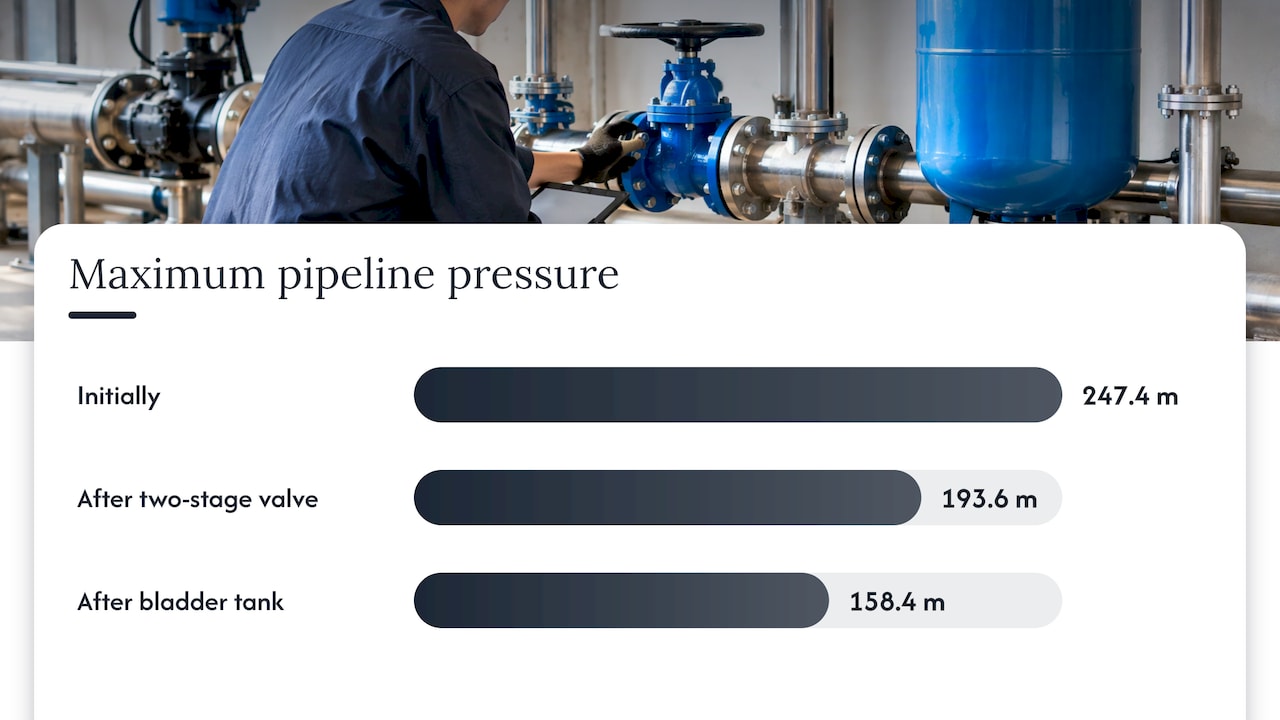
A 2025 peer-reviewed study of a long-distance pumped water transmission line in China shows why re-analysis after each measure matters. A two-stage quick-closing air valve reduced maximum pressure from 247.4 m to 193.6 m, a 7.43% reduction in the authors’ calculation, yet a bursting risk above 1.6 MPa remained in one section. A bladder pressure surge tank reduced the maximum pipeline pressure to 158.4 m, and a one-way surge tank at the line end controlled negative pressure to -4.0 m or less, meeting China’s pumping station design standard.
Emerson’s white paper on a 1,036.4 km network illustrates the opposite lesson: extending block-valve closure from 30 to 120 seconds had minimal effect, while relief valves installed upstream of the block valves completely eliminated the surge. The effective measure depends on the system, and only the model shows which one.
Singapore requirements that connect to surge results
Two PUB documents give the analysis a regulatory anchor.
- Water fittings. PUB requires water fittings in potable water service installations to conform to the Public Utilities (Water Supply) Regulations and SS 636:2018. All clauses of SS 636 are mandatory except those listed as non-mandatory in its Annex A. Component selection and pressure ratings in a design should therefore be reviewed against that standard.
- Pumping mains. PUB’s Code of Practice on Sewerage and Sanitary Works, 3rd Edition (March 2025), requires ductile iron pumping mains to be tested hydrostatically in accordance with ISO 10802, and states that if the surge pressure is higher than the ISO 10802 test pressure, the test is performed at the maximum surge pressure. A surge analysis therefore determines the field test pressure for such a main, and an unanalyzed design leaves the contractor without a defensible figure.
Projects that touch the public water system also pass through PUB submission routes. Our guides on water service approval in Singapore and on the POWS PUB submission set out how those submissions are structured, and the guide to civil design for drainage approval covers the drainage side.
Perspective
Surge analysis fails most often at the interfaces, not in the software. The hydraulic model needs pump curves from the mechanical package, valve data from the supplier, elevations from the civil and architectural drawings, and support details from the structural design. When these sit with separate parties, assumptions are made silently, and Blacoh’s warning about assumed valve data applies in full.
Our approach is to treat the transient question as part of the engineering coordination of the project. A multidisciplinary PE team and single-point statutory coordination allow the pressure limits that come out of the analysis to be carried into the mechanical design, the structural checks on supports and the submissions made to the authorities, so that one set of figures governs all three.
The sequence we recommend to developers and building owners is a qualitative screening at concept stage, a documented decision on the level of analysis, and a re-run of the model after every mitigation measure. That is how a design report remains defensible when an authority, an employer’s representative or an insurer reviews it.
Aman
Engaging engineering support for the analysis
Water hammer findings affect pipe class, valves, supports and test pressures, so they should be settled before drawings are issued for approval. Our mechanical engineering consultancy covers the building services design in which pumped and pressurized systems sit, and our team provides PE endorsements and authority approvals for building and infrastructure projects. Where a project is still at the options stage, our feasibility studies and value engineering services allow route, diameter and material choices to be compared before they are fixed.

Developers, contractors and owners who want a pressurized system reviewed against its authority requirements can start from the Aman Engineering Consultancy services page. For existing pipelines, our article on pipeline inspection protocols describes the inspection side of public safety.
FAQ
Is pipeline surge analysis the same as water hammer analysis?
The two terms describe the same transient phenomenon. Water hammer is the usual term for building services and shorter pipes, while surge analysis is common for pumping and transmission mains. Both calculate how pressure and velocity change over time after a sudden change of flow.
Does every pipe system need a full transient model?
No. A qualitative assessment by a competent engineer decides whether a full model is warranted. Simple, low-head, low-velocity systems with low consequence of failure may be demonstrated by a first-order calculation, and the reasoning is recorded in the design report. Pumped systems, long mains and high-consequence installations normally need the full analysis.
What information is needed to start?
The engineer needs the pipe layout with lengths and elevations, pump curves, valve characteristics, fluid properties, suction and discharge pressures, the operating scenarios and the high and low pressure limits. Complete valve and pump data matter most, because assumed values can produce a misleading result.
What does the analysis produce?
It produces maximum and minimum pressure profiles along the pipe, pressure against time at key points, the formation of vapor cavities, and the transient forces on elbows, valves and supports. The engineer compares these with the design pressure, MAOP, minimum pressure criteria and structural capacity, and recommends surge control where limits are exceeded.
How does surge analysis relate to PUB testing requirements?
PUB’s Code of Practice on Sewerage and Sanitary Works (March 2025) requires a ductile iron pumping main to be tested at the maximum surge pressure when that exceeds the ISO 10802 test pressure. The analysis supplies that figure.
Sources
- Hydraulic and Surge Analysis in a Pipeline Network (Emerson documentation)
- Hydraulic and Surge Analysis in a Pipeline Network (Emerson white paper)
- Guidelines for Transient Analysis in Water Transmission and Distribution Systems
- Transient flow analysis helps avoid risks of surge pressure (KSB)
- KSB Know-how: Planning Information Surge Pressure
- Transient analysis guideline D0002125 (Sydney Water)
- Analysis of pressure transients in pipeline systems (Urban Utilities)
- Water Hammer in Transmission and Distribution Systems (ASCE)
- The process of creating and reviewing a transient surge computer model (Blacoh)
- Evaluating Pipe Dynamic Loads Caused by Waterhammer (AFT)
- Analysis and research on water hammer protection measures (PMC, 2025)
- PUB Stipulation of Standards and Requirements for Water Fittings
- PUB Code of Practice on Sewerage and Sanitary Works, 3rd Edition (March 2025)