
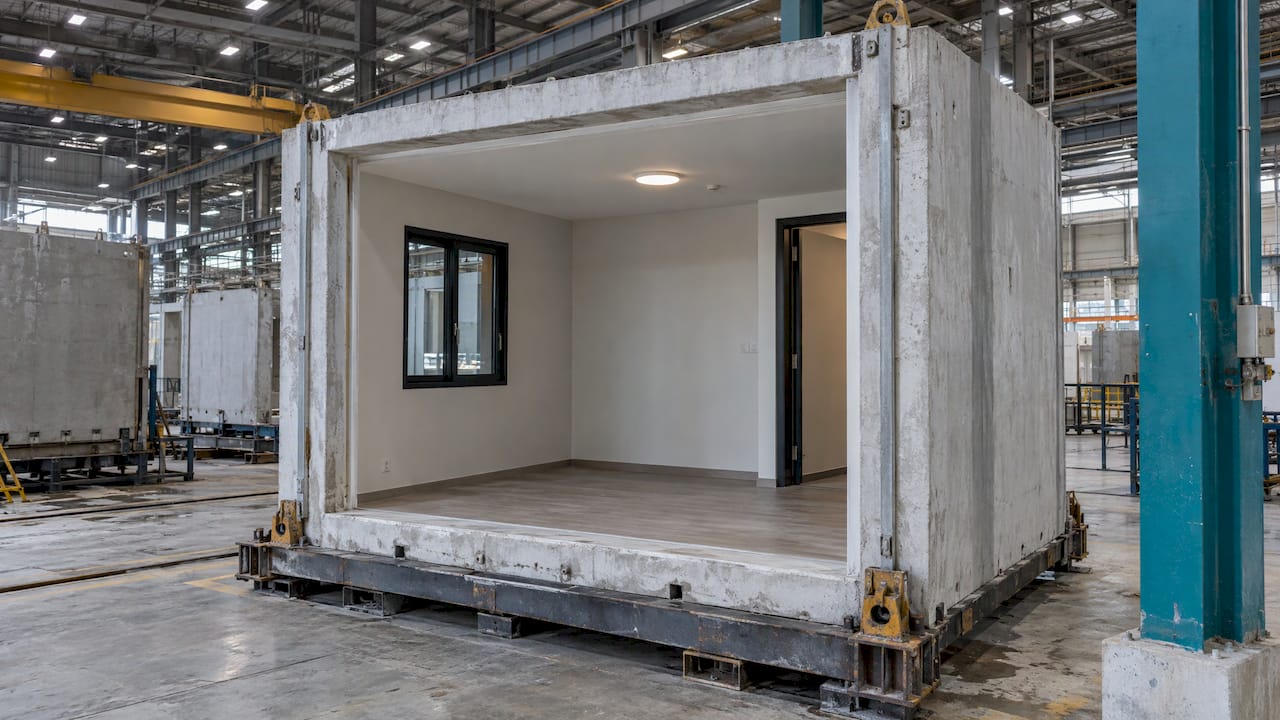
Prefabricated Prefinished Volumetric Construction (PPVC) is mandatory in Singapore for selected non-landed residential developments sold under the Government Land Sales (GLS) programme, and BCA states that this requirement has applied since 1 November 2014. Covered projects must reach prescribed adoption levels, source modules from accredited manufacturing plants, satisfy the Code of Practice on Buildability, and comply with the requirements of every relevant agency. This guide sets out each obligation in the order a project team encounters it.
TL;DR
- PPVC is required for selected non-landed residential GLS sites, and the site’s tender conditions determine whether a given project is covered.
- The official CORENET X buildability material states that GLS residential non-landed projects, including executive condominiums, must achieve at least 65% PPVC, 65% prefabricated MEP and 70% system formwork adoption.
- Modules must come from a plant accredited under the PPVC Manufacturer Accreditation Scheme (PPVC MAS), which is plant-specific and renewed annually.
- Design, construction and installation must comply with the requirements of BCA, LTA, MOM, NEA, PUB, SCDF, URA, HDB and JTC where applicable.
- Early involvement of the PPVC supplier, manufacturer and main contractor during design reduces access, storage, handling and crane-planning problems.
Table of Contents
- What PPVC means
- Which projects must use PPVC
- Minimum adoption levels
- Manufacturer accreditation under PPVC MAS
- Regulatory compliance across agencies
- Design and site constraints to plan for
- Our perspective
- A practical sequence for a covered project
- How Aman supports PPVC projects
- FAQ
- Sources
What PPVC means
PPVC is a construction method in which free-standing volumetric modules, complete with wall, floor and ceiling finishes, are constructed and assembled (or manufactured and assembled) in an accredited fabrication facility and then installed in the building. BCA defines the method in these terms and places it within its Design for Manufacturing and Assembly (DfMA) programme.
The policy rationale was described to Parliament in general terms: prefabricated construction moves onsite activities to factories, with installation following on site, and DfMA technologies are associated with manpower savings, shorter construction time, improved workmanship and reduced disamenity to residents.
For a project team, the practical consequence is that a PPVC building is not designed as a conventional frame with a different finishing sequence. Module dimensions, structural interfaces, services connections and the delivery route are all fixed during design, and the statutory submissions must reflect them.
Which projects must use PPVC
The mandatory scope is defined by land sale conditions rather than by building type alone. BCA states that PPVC is required for selected non-landed residential developments under the GLS programme. Parliament was told in 2016 that selected GLS sites required at least 65% of the applicable floor area to be built using PPVC.
The Singapore Concrete Institute (SCI) likewise records that PPVC MAS is a requirement for selected non-landed residential sites sold under GLS.
Three points follow for developers and their consultants:
- Coverage is site-specific. Not every GLS site carries the requirement. The tender documents for the individual site state whether PPVC applies and at what level.
- Private land is not automatically covered. The mandatory requirement is tied to the GLS programme. A private developer may still choose PPVC, in which case the same technical and agency requirements govern the design.
- The requirement is applied to floor area, not to the number of modules. Adoption is measured against the applicable floor area, so the apportionment of PPVC across towers, podiums and non-residential components must be settled at concept stage.
Minimum adoption levels
The official CORENET X material on buildability requirements sets out the prescribed levels. The figures below are taken from that presentation on buildability requirements and submissions.
| Project type | PPVC | Prefabricated MEP | System formwork |
|---|---|---|---|
| GLS residential non-landed projects, including executive condominiums | At least 65% | At least 65% | At least 70% |
| Large projects (GFA of at least 25,000 m²), deemed-acceptable option A | 60% | Not stated in this option | 70% |
| Large projects (GFA of at least 25,000 m²), deemed-acceptable option B, five storeys or below | 50% | Not stated in this option | 70% |
The large-project options are described in the material as deemed-acceptable solutions for residential non-landed projects. A project team should confirm with the current Code of Practice on Buildability and the site’s tender conditions which route applies, because the code and its addenda are revised from time to time.
Reading the thresholds correctly
The percentages are not interchangeable. PPVC, prefabricated MEP and system formwork are separate buildability measures, and meeting one does not discharge another. A design that reaches 65% PPVC but omits the prefabricated MEP component will not satisfy the GLS requirement as stated above.

The applicable floor area also needs careful definition. Where a development combines residential towers with a commercial podium, communal facilities or a basement, the denominator used for the adoption calculation affects how many modules are needed. This should be agreed in writing with the design team before module layouts are frozen.
Manufacturer accreditation under PPVC MAS
Modules for covered projects must be produced in accredited facilities. The PPVC Manufacturer Accreditation Scheme was launched on 29 March 2016 jointly with BCA and is administered by SCI.
SCI states that the accreditation criteria cover:
- quality management;
- plant and design capabilities;
- human resources;
- production quality control;
- storage and delivery; and
- installation and maintenance.
The scheme’s terms and conditions, revised 31 July 2023, add three operational points that affect procurement:
- Accreditation is plant-specific. A manufacturer’s certificate attaches to a particular plant and not to the company as a whole.
- Certificates are valid for one year. Yearly renewal audits are required, so a certificate sighted at tender may lapse before the last module is delivered.
- Multiple plants are audited separately. A firm operating two or more separate factories must have each plant audited and certified separately.
For a developer, these terms translate into a procurement check list: confirm which plant will produce the modules, confirm that the plant’s certificate is current, and build a renewal-date check into the construction programme so that production schedules do not run past an expiring certificate without a documented renewal.
Regulatory compliance across agencies
Accreditation of the plant is only one layer. BCA states that PPVC adoption must meet the prevailing Code of Practice on Buildability and its addenda, and that PPVC design, construction and installation must comply with the relevant requirements of:
| Agency | Typical area of concern for a PPVC project |
|---|---|
| BCA | Structural design, buildability, building plan and structural plan approvals, fire safety coordination |
| LTA | Road works, heavy vehicle access and delivery routes where applicable |
| MOM | Workplace safety and health during lifting and installation |
| NEA | Environmental and public health requirements |
| PUB | Drainage, sewerage and water supply connections |
| SCDF | Fire safety design and certification |
| URA | Planning parameters and development control |
| HDB | Requirements for HDB-related developments |
| JTC | Requirements for JTC-governed land |
The table lists the agencies named by BCA. The right-hand column is a general indication of the subject matter each agency typically governs, and the scope of review for a given project depends on its location, use and tenure.
Because modules arrive finished, services connections and fire-rated separations are largely embedded before installation. Errors that would ordinarily be corrected on site, such as a misplaced sleeve or an incorrect penetration seal, are costlier to resolve once a module has been fabricated. Statutory submissions for structure, fire safety, drainage and electrical works should therefore be coordinated against the same module model rather than prepared in sequence.

Structural design deserves particular attention. Developers should understand how independent checking operates on such projects, and our note on structural peer review and the accredited checker system describes the process. The analytical side of module design, including finite element analysis for megaprojects, is discussed in our article on FEA applications in PPVC and MET steel modules.
Design and site constraints to plan for
BCA advises that PPVC suppliers, manufacturers and the main contractor be involved during design. The same page identifies several considerations that determine whether a PPVC programme runs smoothly:
- Access. Modules are large and heavy, so site access, turning radii and the approach roads must accommodate them.
- Storage. Space for storing modules is limited on most Singapore sites, which is why BCA recommends just-in-time installation.
- Double handling. Each additional handling movement adds risk and cost, so delivery sequencing should place modules close to their installation point.
- Crane selection and position. Crane capacity, reach and location must be established early, because they constrain module size and the installation sequence.
For residential projects, BCA also advises providing homeowners and the management corporation (MCST) with a user manual, and using trained renovation contractors with suitable tools. This reflects the fact that walls, floors and ceilings in a PPVC unit are part of the module structure, and alterations after handover must be carried out with that in mind.
The common question about disadvantages is best answered as a planning checklist. The items above are the points on which PPVC projects require more advance coordination than conventional cast-in-place construction, and each can be resolved at design stage when the right parties are at the table.
Our perspective
Our experience of statutory submissions is that PPVC projects succeed or fail on the quality of coordination before the first module is fabricated. The adoption percentages are straightforward to state. Demonstrating them consistently across structural, façade, mechanical, electrical and fire safety submissions is where programmes slip.
We therefore treat the module model as the single reference for every submission. Our multidisciplinary Professional Engineer team prepares the structural, M&E and fire safety documentation against one coordinated dataset, and our 3D BIM capability allows clashes between module interfaces and services to be resolved digitally rather than at the factory or on site.
Our approach is designed to give developers a single point of statutory coordination across the agencies named above. We claim a 99% authority clearance rate, and we attribute it to transparent requirements at the outset and to early engagement with the supplier, manufacturer and main contractor, which is the sequence BCA itself recommends.
Developers evaluating a GLS tender should engage their consultants before bid submission. Feasibility, buildability scoring, crane and access planning and value engineering all influence the bid price and the programme, and each is considerably easier to address at concept stage.
Aman
A practical sequence for a covered project
The following sequence reflects how a project team can organise compliance for a GLS site that carries the PPVC requirement. It is an organisational framework, and the tender conditions and the prevailing Code of Practice on Buildability govern the actual obligations.
- Confirm the requirement in the tender documents. Identify the PPVC level, the prefabricated MEP level, the system formwork level and the floor area to which each applies.
- Test feasibility. Compare module layouts against the site footprint, access routes and crane positions. Our feasibility studies address this stage.
- Appoint the supplier, manufacturer and main contractor early. BCA advises their involvement during design.
- Verify plant accreditation. Confirm the specific plant, the certificate’s validity and the renewal date against the production programme.
- Coordinate the models. Structural, MEP, façade and fire safety designs should be developed against a single coordinated model, with 3D BIM and shop drawing production used to resolve interfaces.
- Prepare agency submissions in parallel. Prepare BCA, SCDF, PUB, LTA, NEA, URA and other applicable submissions together so that comments from one agency are reflected in the others. Our overview of Singapore building certification requirements for developers outlines the certification stages.
- Plan installation. Establish just-in-time delivery, storage limits and crane operations with the contractor, and review safety arrangements with the lifting and installation team.
- Prepare handover documentation. Provide the user manual for homeowners and the MCST, as BCA advises for residential projects.
Developers planning a wider residential scheme can also consult our residential project planning guide for Singapore developers, which places PPVC decisions within the overall approval programme.
How Aman supports PPVC projects
Aman Engineering Consultancy provides engineering, architectural and statutory submission services to property developers, construction firms and building owners in Singapore. For PPVC and other DfMA projects, relevant services include authority approvals and statutory submissions, PE endorsements, 3D BIM, shop drawing production, project management, value engineering and feasibility studies. Fees are set per engagement, and no standard price is published.

Developers preparing a GLS tender or a PPVC design submission can contact the team through the Aman Engineering Consultancy website to discuss scope and programme.
FAQ
Is PPVC compulsory for all residential developments in Singapore?
No. BCA states that the requirement applies to selected non-landed residential developments under the GLS programme. The tender conditions for each site state whether PPVC is required and at what level. Developments on private land may adopt PPVC voluntarily.
What is the minimum PPVC percentage for a GLS residential project?
The official CORENET X buildability material states that GLS residential non-landed projects, including executive condominiums, must achieve at least 65% PPVC adoption, together with 65% prefabricated MEP and 70% system formwork. For projects with a GFA of at least 25,000 m², the same material describes deemed-acceptable options at 60% PPVC, or 50% for projects of five storeys or below, each combined with 70% system formwork.
Who accredits PPVC manufacturers?
The PPVC Manufacturer Accreditation Scheme is administered by the Singapore Concrete Institute and was launched jointly with BCA on 29 March 2016. Accreditation is plant-specific, certificates are valid for one year, and yearly renewal audits are required. A firm with several plants must have each one audited and certified separately.
Which agencies must PPVC projects comply with?
BCA states that PPVC design, construction and installation must comply with the relevant requirements of BCA, LTA, MOM, NEA, PUB, SCDF, URA, HDB and JTC, in addition to the prevailing Code of Practice on Buildability and its addenda. Which agencies review a particular project depends on its site, tenure and use.
Sources
- BCA: Prefabricated Prefinished Volumetric Construction (PPVC)
- CORENET X: Sharing on buildability requirements and submissions
- Singapore Concrete Institute: PPVC Manufacturer Accreditation Scheme
- Singapore Concrete Institute: PPVC MAS Terms and Conditions, revision of 31 July 2023
- Singapore Parliament: Popularity of Pre-fabricated Construction in Building Projects