
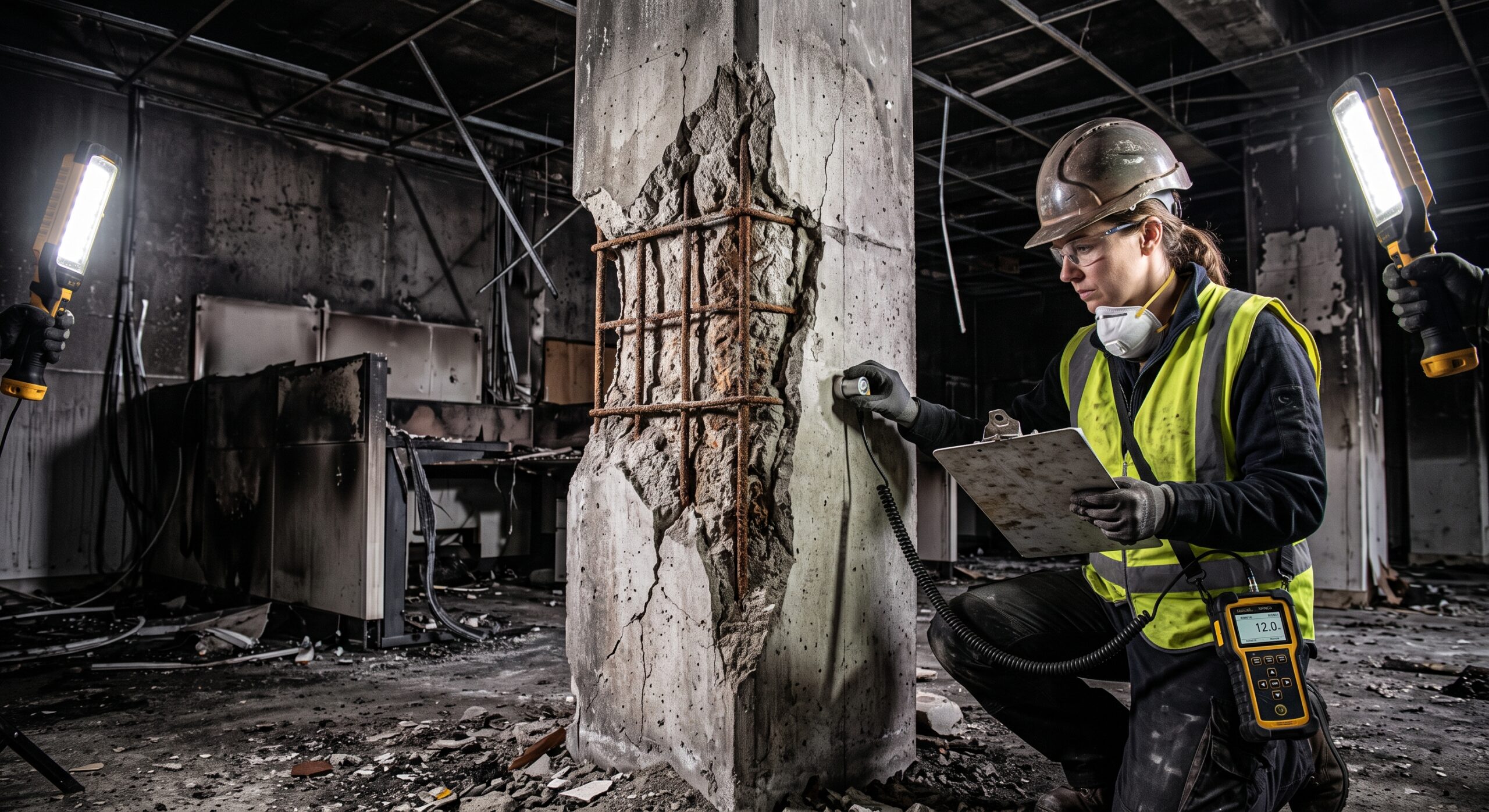
Introduction to Fire Damage Assessment
Building fires cause extreme damage to structural materials. High temperatures compromise the load-bearing capacities of components1. Structural engineers must conduct rigorous post-fire structural assessment techniques. These evaluations ensure overall building safety and stability.
A thorough structural building inspection determines the next steps. Professionals must decide if a structure requires repair or demolition. Visual inspections offer initial estimates of the physical damage2. However, advanced diagnostic tools are necessary for precise evaluations.
Assessing microstructural concrete degradation requires destructive and non-destructive testing. Extreme heat alters the chemical composition of the cement paste3. Furthermore, thermal expansion induces massive internal mechanical stresses.
Steel reinforcements also experience severe yield strength reductions4. The critical bond between steel and concrete can fail entirely. This failure mechanism is widely known as steel debonding.
This exhaustive report analyzes structural fire damage evaluation methodologies. We explore explosive concrete spalling and steel debonding behaviors. We review standard testing methodologies and their practical applications.
International codes, like ACI 562-19, dictate strict assessment rules5. Eurocode 2 also provides detailed structural fire design guidelines6. These frameworks guide the design of subsequent repair strategies.
Explore advanced non-destructive assessment techniques here.
Mechanisms of Structural Fire Damage
Concrete exhibits excellent natural fire resistance compared to timber. However, prolonged exposure to extreme heat causes severe degradation. The primary damage mechanisms include concrete spalling and microstructural decay. Structural steel also loses critical yield strength at elevated temperatures7.
Concrete Spalling Dynamics
Concrete spalling is the violent ejection of surface material. It exposes internal steel reinforcements to direct thermal loads8. This phenomenon significantly reduces the effective cross-sectional area. This reduction compromises the ultimate compressive load limits of members.
Read about microstructural concrete degradation here.
Spalling primarily results from two complex physical processes. The first process involves a rapid internal pore pressure buildup9. Heating vaporizes free moisture contained within the concrete matrix.
High-performance concrete (HPC) possesses a very dense microstructure. This high density traps escaping water vapor internally. Consequently, internal pore pressure increases dramatically during a fire. When pore pressure exceeds tensile strength, explosive spalling occurs.
The second process involves severe thermal stresses. Rapid heating creates steep temperature gradients across the cross-section. The heated surface expands much faster than the cooler interior.
This differential thermal expansion generates massive internal mechanical stresses. Compressive stresses build up near the heated concrete surface. Tensile stresses simultaneously develop within the cooler interior regions. Spalling occurs when compressive stresses exceed the material’s capacity.
Mitigating Spalling with Polymer Fibers
Adding polypropylene (PP) fibers is a proven mitigation strategy10. PP fibers significantly enhance the fire resistance of HPC11. These synthetic fibers typically melt between 160°C and 170°C12.
Upon melting, the fibers volatilize and create microscopic capillary channels13. These interconnected channels drastically increase the concrete matrix permeability. The increased permeability provides an escape route for water vapor14.
This vapor pressure relief mechanism effectively prevents explosive spalling. Research shows that low volumes of PP fibers are effective. Adding 2.0 kg/m³ of PP fibers prevents spalling in UHPC15.
Fibers also induce microcracks during thermal expansion before melting16. These early microcracks assist in releasing internal vapor pressure17. Polyethylene terephthalate (PET) fibers also offer antispalling benefits18. However, PET fibers require higher dosages than PP fibers.
RILEM TC 256-SPF Testing Guidelines
The RILEM TC 256-SPF committee provides standardized testing guidelines19. These guidelines focus on concrete spalling due to fire exposure. The committee defines specific material screening tests for accurate characterization20.
Standardized tests mandate minimum specimen thicknesses to ensure accuracy. Unloaded specimens should have a minimum thickness of 300 mm. Loaded specimens require a minimum thickness of 150 mm. Proper testing protocols allow for consistent international spalling propensity comparisons.
Table: RILEM TC 256-SPF Specimen Requirements
| Specimen Condition | Minimum Thickness Requirement |
| Unloaded Specimen | 300 mm |
| Mechanically Loaded Specimen | 150 mm |
Assessing Microstructural Concrete Degradation
High temperatures initiate complex chemical phase transformations in concrete. These transformations directly reduce residual compressive strength21. Understanding these changes is critical for evaluating structural fire damage.
Between 100°C and 200°C, physically bound water evaporates completely22. This evaporation increases capillary porosity but causes minor strength loss. Significant microstructural damage begins at approximately 300°C17.
At 400°C, portlandite crystals begin to dehydrate rapidly23. Portlandite is a crucial byproduct of normal cement hydration. Its decomposition initiates severe microcracking within the cement paste.
By 600°C, calcium silicate hydrate (C-S-H) gels start decomposing2. The C-S-H gel provides the primary structural strength in concrete. Its destruction drastically reduces the load-bearing capacity of the material.
Temperatures exceeding 800°C cause the decarbonation of calcium carbonate. The concrete matrix becomes highly porous, loose, and friable. Above 900°C, concrete loses nearly all of its structural utility24.
Visual Discoloration and Colorimetry
Concrete color changes significantly as internal temperatures rise. This discoloration results from the oxidation of iron compounds. A pink hue strongly indicates potential structural weakening.
Colorimetry quantifies this characteristic heat-induced discoloration of concrete25. It helps engineers estimate the maximum temperature reached during fires26. However, color changes depend heavily on aggregate mineralogy14. Siliceous aggregates exhibit more marked color changes than calcareous aggregates.
Table: Concrete Discoloration Thresholds
| Temperature Range | Observed Color | Structural Condition |
| 0°C – 290°C | Normal Gray | Unaffected |
| 300°C – 600°C | Pink or Red | Significant strength loss |
| 600°C – 900°C | Whitish-gray | Highly friable matrix |
| > 900°C | Buff | Structurally destroyed |
Steel Debonding and Reinforcement Degradation
Reinforced concrete relies on a strong bond between materials. High temperatures severely compromise this critical steel-concrete bond27. Differential thermal expansion causes massive interfacial shear stresses.
Steel expands significantly faster than the surrounding concrete matrix. This thermal mismatch creates severe microcracking along the reinforcement interface. The concrete cover may eventually spall, fully exposing the rebar.
Once exposed, steel temperatures rise rapidly, accelerating strength loss24. The degradation of the steel-concrete bond is largely irreversible28. Residual yield strength drops dramatically when steel exceeds 500°C29.
Hot-Rolled vs. Cold-Worked Steel Recovery
The method of steel manufacturing dictates its post-fire recovery behavior. Hot-rolled steel generally recovers its original yield strength upon cooling30. It can reach 600°C and still regain most mechanical properties30.
However, cold-worked and heat-treated steels permanently lose strength30. This permanent loss occurs when temperatures exceed 300°C30. Beneficial compressive residual stresses in cold-worked bars are permanently released8.
Post-Fire Cooling Effects on Steel
The cooling regime significantly impacts the final ductility of steel31. Slow air cooling or furnace cooling leads to progressive softening. This slow cooling often enhances the residual ductility of rebars.
Conversely, rapid water quenching induces severe strength hardening. This quenching effect causes a massive loss of ductility. It results in extreme embrittlement of the steel reinforcement. Engineers must investigate extinguishing methods to assess steel viability.
Non-Destructive Testing (NDT) Methods
NDT techniques evaluate residual load-bearing capacity without damaging structures. These methods are essential for rapid, large-scale post-fire assessments32.
Visual Inspection Techniques
Visual inspection is the primary on-site investigation technique. It classifies the initial degree of damage for each member. Engineers look for cracking, spalling, and exposed reinforcement. They must also document significant structural deflections and deformations.
Rebound Hammer Testing Limitations
The rebound hammer measures the surface hardness of concrete33. It provides a fast, localized assessment of potential strength loss. However, its reliability for post-fire assessment is highly questionable.
Fire primarily damages the outermost layers of the concrete cover. This severe surface calcination drastically skews rebound hammer readings34. The test exhibits high scatter and lacks sensitivity to damage. It requires site-specific recalibration against destructive core tests.
Ultrasonic Pulse Velocity (UPV)
UPV testing measures ultrasonic wave travel times through concrete27. Pulse velocity decreases as internal microcracking and porosity increase. UPV is highly sensitive to thermal damage exceeding 400°C.
Unlike the rebound hammer, UPV evaluates the internal concrete volume. It effectively detects deep cracks and severe internal deterioration35. However, UPV requires two accessible surfaces for effective wave transmission33. Interpretation requires assumptions about temperature profiles and velocity decay33.
The SonReb Method
The SonReb method combines UPV and rebound hammer measurements36. This combined approach aims to improve overall concrete strength estimation37. SonReb compensates for the individual limitations of each technique38.
However, applying standard literature formulations to fire-damaged structures fails. The method strictly requires calibration using extracted core samples39. Without site-specific recalibration, the SonReb method yields highly uncertain results.
Acoustic Emission and Digital Image Correlation
Acoustic Emission (AE) monitoring detects internal microcrack growth40. It records elastic waves released during structural material deformation41. AE serves as an excellent early indicator of progressive damage.
Digital Image Correlation (DIC) measures strain evolution without physical contact. It uses image-based systems to track surface displacements under load42. DIC identifies localized damage zones through detailed strain redistribution mapping.
Advanced Microstructural Laboratory Analysis
Assessing microstructural concrete degradation requires advanced laboratory techniques. These methods provide quantitative data on phase transformations and porosity.
Scanning Electron Microscopy (SEM)
SEM provides high-resolution imaging of damaged concrete microstructures. It reveals the extent of internal microcracking and matrix coarsening. Post-fire SEM analysis clearly shows the dehydration of C-S-H gels. It also identifies the physical separation of aggregates from paste.
X-Ray Diffraction (XRD)
XRD is crucial for identifying crystalline phase changes. It measures the depletion of portlandite as temperatures rise2. Diffractograms show reduced portlandite peaks starting around 400°C. XRD detects the decomposition of C-S-H into belite above 700°C.
Thermogravimetric Analysis (TGA)
TGA measures the mass loss of samples during controlled heating. This technique quantifies the decomposition of specific hydration products. TGA curves exhibit distinct mass loss drops at specific temperatures. These drops correspond to free water evaporation and portlandite dehydration. TGA confirms expected decomposition patterns in fire-damaged mortar samples.
Mercury Intrusion Porosimetry (MIP)
MIP accurately measures pore size distributions in damaged concrete43. High temperatures significantly alter the internal porosity of the material. MIP detects increases in total porosity and altered pore diameters. The porosity data correlates directly with observed compressive strength losses.

Measuring Residual Compressive Strength
While NDT provides rapid screening, destructive testing offers definitive data. Extracting and testing concrete cores remains the most reliable method.
Concrete Core Extraction (ASTM C42)
Core sampling must follow strict standards like ASTM C4244. Cores are drilled using hollow barrels tipped with industrial diamonds45. The extraction process provides direct samples for measuring residual compressive strength.
However, mechanical drilling can induce microscopic damage within the core46. The drilling process can cause internal microcracking and weaken samples47. This induced damage often results in lower measured compressive strengths48. The ACI 214.4R guidelines help interpret these complex core strength results49.
L/D Ratio Correction Factors
The length-to-diameter (L/D) ratio of a core affects strength50. Standard compressive strength is measured on cylinders with L/D=2.0. Cores with lower L/D ratios appear artificially stronger during testing.
Friction at the testing machine platens restrains lateral core expansion. ASTM C42 mandates specific strength correction factors for short cores. A correction factor is not required for L/D > 1.7551.
Applying these empirical factors ensures accurate comparisons with standard strengths. Engineers must multiply the measured core strength by the correction factor.
Table: ASTM C42 L/D Correction Factors
| Length-to-Diameter (L/D) Ratio | Strength Correction Factor |
| > 1.75 | 1.00 (No correction needed) |
| 1.75 | 0.98 |
| 1.50 | 0.96 |
| 1.25 | 0.93 |
| 1.00 | 0.87 |
Pullout Testing for Bond Strength
The pullout test measures residual steel-concrete bond strength post-fire52. RILEM RC6 and ASTM C234 provide standard testing protocols52. The test determines the force required to pull a rebar.
Bond strength drops significantly when temperatures exceed 400°C. Testing is critical for determining if existing reinforcements remain viable. If bond strength is lost, the entire structural member fails.
International Assessment Codes and Standards
Evaluating structural fire damage requires adherence to established engineering codes. These frameworks provide necessary strength reduction factors and repair guidelines.
ACI 562-19 Guidelines
ACI 562-19 governs the assessment and repair of concrete structures25. It supplements the International Existing Building Code (IEBC)54. Alternatively, it functions as a comprehensive stand-alone building standard3.
The code defines strict criteria for determining substantial structural damage55. It outlines required load combinations and specific strength reduction factors25. ACI 562-19 establishes the responsibilities of licensed design professionals22.
It mandates thorough preliminary evaluations to determine original design compliance25. The standard focuses heavily on the durability of implemented repairs25. It requires engineers to evaluate cementitious repair material interface bonds22. ACI 562-19 ensures rehabilitated structures meet acceptable life safety requirements25.
Eurocode 2 (EN 1992-1-2)
Eurocode 2 dictates structural fire design rules across Europe. It provides detailed temperature-dependent material models for fire engineering56. The code utilizes specific strength reduction factors at elevated temperatures.
Concrete Strength Reduction (Table 3.1)
EN 1992-1-2 distinguishes between siliceous and calcareous aggregate concretes57. Aggregate type drastically influences thermal conductivity and density decay58. Siliceous aggregates undergo crystalline expansion, causing severe internal microcracking.
Calcareous aggregates exhibit much better thermal stability up to 600°C. Eurocode provides tabulated strength reduction values based on aggregate types59. Compressive strength begins declining rapidly once temperatures surpass 400°C. The standard explicitly defines stress-strain relationships for structural analysis.
Transient Creep Strain Modeling
Heated concrete under sustained load develops significant transient creep strain60. Eurocode 2 handles this transient thermal creep implicitly within frameworks61. Some researchers argue this implicit model overestimates structural deformations significantly.
Implicit models struggle with complex thermal gradients and unloading stiffness62. Advanced models, like the Explicit Transient Creep (ETC) model, exist63. Gernay and Franssen developed the ETC formulation for Eurocode 264.
The ETC model explicitly accounts for transient strain during heating. This explicit formulation often correlates better with physical experimental data. It provides a more accurate representation of transient strain evolution.
Table: Implicit vs. Explicit Transient Creep Models
| Model Type | Strain Handling | Accuracy in Complex Thermal Gradients |
| Implicit (Standard Eurocode 2) | Embedded in mechanical strain | May overestimate total deformations |
| Explicit (Gernay & Franssen ETC) | Separate calculated strain term | Higher accuracy, matches experiments |
Post-Fire Structural Load Redistribution
Fire exposure alters the global structural behavior of continuous frames. Thermal expansion and stiffness degradation cause significant load redistribution mechanics65.
Heated members expand, exerting massive thrust forces on adjacent columns6. This thermal expansion induces concentrated damage in local joint regions6. The stiffness of RC beams decreases severely as fires continue8.
This uneven stiffness degradation alters fundamental seismic failure modes6. A safe “strong-column-weak-beam” frame may become a dangerous system6. It can shift into a vulnerable “strong-beam-weak-column” structural configuration6. Post-fire structural analysis must account for these permanent load shifts6.
Repair and Rehabilitation Strategies
Most fire-damaged concrete structures can be successfully repaired and rehabilitated28. Demolition is usually a last resort due to economic costs28. The assessment dictates the required scope of concrete removal operations. Concrete Society TR68 guidelines provide detailed assessment and repair frameworks28.
Concrete Removal and Surface Preparation
All concrete heated above 300°C is considered structurally compromised28. This weakened material must be meticulously removed via hydro-demolition38. Mechanical chipping is also acceptable for localized concrete surface removal6.
The removal process exposes the existing steel reinforcement for inspection. Severely deformed or weakened rebars must be cut and replaced32. New steel can be spliced or mechanically coupled to bars. The concrete substrate must be thoroughly cleaned before patching commences22.
Epoxy Injection for Structural Cracks
Epoxy injection repairs non-moving microcracks in fire-damaged structural elements66. The epoxy resin restores the structural integrity of cracked concrete67.
The viscosity of the epoxy must match the crack width68. Low-viscosity resins are required for tight cracks under 1/4 inch. Wider cracks require higher viscosity paste materials to prevent leakage69.
The Glass Transition Temperature (Tg) is a critical epoxy property70. Tg marks the temperature where epoxy changes to rubbery states. The service temperature of the structure must not exceed Tg71. If the Tg is exceeded, the repair fails under load.
Jacketing and Fiber Reinforced Polymers (FRP)
Severely damaged columns often require concrete jacketing to restore capacity27. Jacketing involves encasing the damaged member in new reinforced concrete. This increases the cross-sectional area and enhances load-bearing strength significantly.
Fiber Reinforced Polymer (FRP) wrapping is another highly effective technique6. Carbon or glass FRP sheets are bonded to the exterior. FRP provides exceptional confinement and drastically improves shear strength capacities.
However, FRP systems are themselves highly sensitive to elevated temperatures. They require specialized fire-resistant coatings if future fire ratings apply.
Synthesized Insights on Fire Damage Evaluation
Evaluating structural fire damage demands a holistic, multi-tiered engineering approach. Relying on a single assessment technique risks catastrophic structural failure27. It also risks the unnecessary demolition of viable concrete structures27.
Visual assessments provide necessary immediate risk control and damage mapping30. However, visual cues like color change depend on aggregate mineralogy. Not all aggregates turn pink at 300°C, limiting colorimetry’s reliability28.
Non-destructive testing enables rapid spatial mapping of damage severity. UPV effectively detects internal flaws, while rebound hammers evaluate surfaces. The SonReb method theoretically improves accuracy but fails without calibration. Therefore, NDT results must always be anchored by destructive testing.
Microstructural analysis reveals the fundamental causes of macroscopic strength loss. The dehydration of portlandite and C-S-H gels destroys the matrix. This chemical breakdown is irreversible and dictates concrete removal depths.
Explosive spalling remains the most unpredictable and dangerous fire-induced phenomenon. High-performance concrete requires the mandatory inclusion of polypropylene fibers. Understanding the vapor pressure relief mechanism is crucial for design14.
Structural codes like ACI 562-19 and Eurocode 2 provide frameworks. They translate complex material science into actionable engineering design protocols. Proper application of these codes ensures repaired structures achieve safety.
Conclusion
Post-fire structural assessment is a highly complex structural engineering discipline. It requires integrating field observations and advanced microstructural laboratory analysis. Evaluating concrete spalling and steel debonding mechanisms is absolutely critical.
Engineers must rigorously apply standardized codes, such as ACI 562-19. Measuring residual compressive strength through corrected core sampling guarantees reliability. Advanced NDT, like acoustic emission and UPV, maps unseen damage.
Ultimately, combining these exhaustive techniques prevents unnecessary demolition and waste. Proper repair strategies, utilizing controlled epoxy injection and FRP strengthening, succeed. Systematic assessment ensures that fire-damaged buildings can be safely rehabilitated.
Works cited
- Assessing Post-Fire Damage in Concrete Structures – MDPI, https://www.mdpi.com/2075-5309/15/3/485
- Post-fire structural steel evaluation – The Construction Specifier, https://www.constructionspecifier.com/post-fire-structural-steel-evaluation/
- Effect of High Temperatures on the Microstructure of Cement Paste, https://file.scirp.org/Html/4-1740491_80385.htm
- Modeling of a Still Reactor Banana Peels Effect of Heat on, https://jsre.jkuat.ac.ke/index.php/jsre/article/download/11/12/34
- ACI 562-19: Concrete Repair Standards | PDF | Strength Of Materials, https://www.scribd.com/document/542996363/Khaled-Nahlawi-ACI-Assessment-Repair-and-Rehabilitation-of-Existing-Concrete-Structures-March-2020
- EN 1992-1-2: Eurocode 2: Design of concrete structures, https://www.phd.eng.br/wp-content/uploads/2015/12/en.1992.1.2.2004.pdf
- Residual behavior of steel rebars and R/C sections after fire, https://www.researchgate.net/publication/248541747_Residual_behavior_of_steel_rebars_and_RC_sections_after_fire
- Concrete Spalling 101: Why It Is More Than An Aesthetic Issue, https://structures.com.sg/concrete-spalling-101-why-it-is-more-than-an-aesthetic-issue/
- Spalling Prevention of High Performance Concrete at … – IntechOpen, https://www.intechopen.com/chapters/51837
- Role of Polypropylene Fibres in Concrete Spalling Risk Mitigation in, https://pmc.ncbi.nlm.nih.gov/articles/PMC6926942/
- Polypropylene fibres control explosive spalling in high-performance, https://www.researchgate.net/publication/286949339_Polypropylene_fibres_control_explosive_spalling_in_high-performance_concrete
- Explosive spalling and permeability of high performance concrete, https://www.researchgate.net/publication/279381872_Explosive_spalling_and_permeability_of_high_performance_concrete_under_fire
- Assessing Mechanical Properties and Microstructure of Fire, https://search.proquest.com/openview/728ff6a6434b9355927fbe8930c5677f/1?pq-origsite=gscholar&cbl=37076
- Turning up the heat – Full service fire safety engineering for concrete, https://www.researchgate.net/publication/293497162_Turning_up_the_heat_-_Full_service_fire_safety_engineering_for_concrete_structures
- Spalling Resistance of Fiber-Reinforced Ultra-High-Strength … – MDPI, https://www.mdpi.com/1996-1944/13/17/3792
- (PDF) Effect of polymer fibers on pore pressure development and, https://www.researchgate.net/publication/362874329_Effect_of_polymer_fibers_on_pore_pressure_development_and_explosive_spalling_of_ultra-high_performance_concrete_at_elevated_temperature
- Practical Guide for the Assessment and Repair of Fire-Damaged, https://ascelibrary.org/doi/10.1061/%28ASCE%29SC.1943-5576.0000570
- Spalling Prevention of Ultrahigh-Performance Concrete, https://ascelibrary.org/doi/10.1061/%28ASCE%29MT.1943-5533.0003980
- 256-SPF : Spalling of concrete due to fire: testing and modelling, https://www.rilem.net/groupe/256-spf-spalling-of-concrete-due-to-fire-testing-and-modelling-309
- Recommendation of RILEM TC 256-SPF on the method of testing, https://www.researchgate.net/publication/374679376_Recommendation_of_RILEM_TC_256-SPF_on_the_method_of_testing_concrete_spalling_due_to_fire_material_screening_test
- In Situ Study on High-Temperature Performance and Structural, https://www.mdpi.com/2227-9717/14/11/1753
- (PDF) Microstructure of concrete subjected to elevated temperatures, https://www.researchgate.net/publication/318761779_Microstructure_of_concrete_subjected_to_elevated_temperatures_physico-chemical_changes_and_analysis_techniques
- Thermal damage evaluation of full scale concrete columns exposed, https://www.redalyc.org/journal/496/49658894016/html/
- Concrete Structures in Fire, https://mosen.global/wp-content/uploads/2011/01/Concrete-Structures-in-Fire.pdf
- (PDF) Post-Fire Structural Condition Assessment and Remediation, https://www.researchgate.net/publication/413924523_Post-Fire_Structural_Condition_Assessment_and_Remediation_Strategy_for_a_Seven-Storied_Reinforced_Concrete_Industrial_Building_A_Case_Study_from_the_Ready-Made_Garment_Sector_in_Bangladesh
- Session 2 Concrete Structures, https://fire.fsv.cvut.cz/ASFE11/Proceedings/Session-2_Concrete-Structures.pdf
- Experimental Study on Steel-Fiber-Reinforced Scoria Aggregate, https://www.mdpi.com/2571-6255/6/3/119
- Strengthening of reinforced concrete structures with carbon fibre, https://www.smart-edu.ai/examples/budownictwo/strengthening-of-reinforced-concrete-structures-with-carbon-fibre-reinforced-en
- Temperature-Dependent Stress–Strain Response of SD 550, https://ascelibrary.org/doi/10.1061/JMCEE7.MTENG-18145
- How to Assess Concrete Spalling Before Repairs, https://www.amanengineering.com.sg/how-to-assess-concrete-spalling/
- Post-fire mechanical properties of high-strength steel rebars with, https://www.emerald.com/jsfe/article/doi/10.1108/JSFE-01-2026-0001/1363300/Post-fire-mechanical-properties-of-high-strength
- (PDF) Assessing various techniques for the post-fire … – ResearchGate, https://www.researchgate.net/publication/405148177_Assessing_various_techniques_for_the_post-fire_assessment_of_concrete_structures
- Assessment of fire-damaged structures – Concrete Society, https://www.concrete.org.uk/fingertips/assessment-of-fire-damaged-structures/
- Concrete strength by combined nondestructive methods, https://www.researchgate.net/publication/222374651_Concrete_strength_by_combined_nondestructive_methods_-_Simply_and_reliably_predicted
- (PDF) Assessment of fire damage in concrete structures, https://www.researchgate.net/publication/289674330_Assessment_of_fire_damage_in_concrete_structures_new_inspection_tools_and_combined_interpretation_of_results
- The SonReb Method: Critical Review and Practical Aspects, https://www.researchgate.net/publication/324556490_The_SonReb_Method_Critical_Review_and_Practical_Aspects
- Insights from Schmidt Rebound Hammer and Ultrasonic Pulse, https://inz-min.online/index.php/im/en/article/view/1775/3401
- Fire Damage Assessment and Repair Guide | PDF | Concrete – Scribd, https://www.scribd.com/document/520870234/The-Concrete-Society-Fire-damage
- Assessment of SONREB Models’ performance in the in-situ … – SciELO, https://www.scielo.br/j/riem/a/KTGSpc64JZNR8kLXB9hzZ4v/?format=pdf&lang=en
- Acoustic Emission and Digital Image Correlation-Based Study for, https://www.mdpi.com/2076-3417/14/21/9728
- Detection of Destructive Processes and Assessment of Deformations, https://www.mdpi.com/2073-4360/16/8/1161
- Performance of acoustic emission and digital image correlation for, https://lirias.kuleuven.be/retrieve/6f3da29e-eab7-4ac4-bfbf-f8cf5e87bdc2
- A simple method for estimation of permeability of concrete from the, https://www.tandfonline.com/doi/full/10.1080/13467581.2021.2008943
- Post-Fire Assessment in a Precast Concrete Industrial Building – MDPI, https://www.mdpi.com/2075-5309/16/7/1306
- Core testing for compressive strength – Concrete Society, https://www.concrete.org.uk/fingertips/core-testing-for-compressive-strength/
- How to evaluate concrete core strengths – Beton Consulting Engineers, https://www.betonconsultingeng.com/how-to-evaluate-concrete-core-strengths/
- The Hidden Effects of Concrete Coring on Building Structural Integrity, https://primetesteng.com/concrete-coring-impact-the-structural-integrity-of-existing-buildings/
- EXPERIMENTAL STUDY ON CORE STRENGTH OF CONCRETE, http://lib.buet.ac.bd:8080/xmlui/handle/123456789/5727
- Guide for Obtaining Cores and Interpreting Compressive Strength, https://www.slideshare.net/slideshow/2144r-03/46814607
- How to calculate the correction factors | ResearchGate, https://www.researchgate.net/post/How-to-calculate-the-correction-factors
- Obtaining and Testing Drilled Cores and Sawed Beams of Concrete1, https://dl.azmanco.com/standards/ASTM-C/ASTM-C-Series-Full/C/C42.pdf
- The Bond Strength on Over Lapping Bars Using Pullout Test, https://pdfs.semanticscholar.org/67c5/fe2e5496aaf44f8644da06361455fac4febb.pdf
- RC6 Bond test for reinforcement steel. 2. Pull-out test | 157 | RILEM, https://www.taylorfrancis.com/chapters/mono/10.1201/9781482271362-157/rc6-bond-test-reinforcement-steel-2-pull-test-rilem
- ACI releases new repair code for existing structures, https://www.constructionspecifier.com/aci-releases-new-repair-code-for-existing-structures/
- Aci 562-19 | PDF – Scribd, https://www.scribd.com/document/996731279/ACI-562-19
- Structural Concrete – Biblio, https://backoffice.biblio.ugent.be/download/5683577/5947504
- Properties of Concrete for use in Eurocode 2 – SciSpace, https://scispace.com/pdf/properties-of-concrete-for-use-in-eurocode-2-3yf4v1tgvn.pdf
- EVALUATION OF EUROCODE 2 APPROACHES FOR THERMAL, https://d-nb.info/1260890422/34
- Some Highlights on the New Version of EN 1992-1-2 (Eurocode 2, https://www.hormigonyacero.com/index.php/ache/article/download/3096/293
- A Comparison Between Explicit and Implicit Modelling of Transient, https://www.semanticscholar.org/paper/A-Comparison-Between-Explicit-and-Implicit-of-Creep-Gernay-Franssen/fd534b6349b758b46320d4dc9e17f80f575918d6
- A formulation of the Eurocode 2 concrete model at elevated, https://www.researchgate.net/publication/257230434_A_formulation_of_the_Eurocode_2_concrete_model_at_elevated_temperature_that_includes_an_explicit_term_for_transient_creep
- A formulation of the Eurocode 2 concrete model at elevated … – ORBi, https://orbi.uliege.be/bitstream/2268/114050/3/FISJ2012_Gernay_Author_Preprint.pdf
- (PDF) A Comparison Between Explicit and Implicit Modelling of, https://www.researchgate.net/publication/264885820_A_Comparison_Between_Explicit_and_Implicit_Modelling_of_Transient_Creep_Strain_in_Concrete_Uniaxial_Constitutive_Relationships
- A comparison of an explicit and an implicit transient strain, https://publications.iafss.org/publications/fss/11/572/view/fss_11-572.pdf
- Experimental study on seismic performance of post-fire reinforced, https://www.downloadmaghaleh.com/wp-content/uploads/edd/maghaleh/1398/13384-2.pdf
- Structural Repair of Concrete Cracks – Adhesives Technology, https://www.atcepoxy.com/wp-content/uploads/ACIArticle.pdf
- Performance Evaluation of Concrete Structures Using Crack Repair, https://www.mdpi.com/2071-1050/13/6/3217
- Epoxy Crack Injection Specification – ChemCo Systems, https://www.chemcosystems.com/tech_crackinject.php
- Concrete Repair: Epoxy Crack Injection, https://www.wesavestructures.info/epoxy-crack-repair
- Understanding Glass Transition Temperature (Tg) in Epoxy Adhesives, https://meridianadhesives.com/product-information-insights/tech-tip-23-understanding-glass-transition-temperature-tg-in-epoxy-adhesives/
- Chapter 5: Concrete Structure Repair and Rehabilitation – Caltrans, https://dot.ca.gov/-/media/dot-media/programs/engineering/documents/structureconstruction/srrm/202606scsrrmchp05-a11y.pdf