

CORENET X requirements apply to your project if its gross floor area (GFA) reaches 5,000 sqm, which triggers mandatory IFC+SG BIM submission, or if it hits the large-project threshold of 30,000 sqm GFA, which requires mandatory onboarding from October 1, 2025. Submissions flow through three gateways, with a Part-ST option for complex structural phasing. Check your project’s GFA now and start CORPPASS or Singpass for Business onboarding before touching the IFC+SG checklist.
TL;DR:
- Projects over 5,000 sqm GFA must submit IFC+SG BIM models, with mandatory onboarding for large projects exceeding 30,000 sqm GFA starting October 1, 2025.
- Gateway reviews occur at Planning, Structural, and Completion stages, each requiring specific federated BIM models and detailed agency checklists.
- Proper IFC+SG model setup demands adherence to Singapore-specific classification mappings, property sets, and level-of-detail standards, with validation recommended before submission.
- Part-ST structural submissions enable phased approvals for complex or large projects, but the overall load-bearing framework must still undergo a full review at the Construction Gateway.
- Early administrative preparation, including role setup on Corppass or Singpass, and model validation, can prevent most delays and rework during gateway reviews.
Table of Contents
- What Are the CORENET X Gateway Requirements?
- What Are the IFC+SG Technical Prerequisites?
- Who Qualifies for Part-ST Structural Submissions?
- How Do You Schedule DAP Reviews and Waivers?
- What Should You Check Before Your First Submission?
- How Aman Engineering Consultancy Supports CORENET X Submissions
- Get CORENET X Submission Support From Aman Engineering Consultancy
- Where to Verify CORENET X Requirements
- Sources
- FAQ
What Are the CORENET X Gateway Requirements?
CORENET X replaces the old e-Submission model with a phased gateway structure built around when a project actually needs regulatory sign-off, not a single monolithic plan check. Each gateway carries its own deliverables and review scope, and understanding what agencies expect at each stage is the difference between a smooth approval and a resubmission cycle that eats weeks off your schedule.
- Design Gateway (G1): covers planning and design intent review across architecture, structural concept, and M&E schematics, typically reviewed against zoning, fire code, and accessibility requirements before detailed design locks in.
- Piling Gateway (G1.5): optional, and only relevant when foundation works need to start ahead of full structural design completion, common on tight urban sites with basement excavation.
- Construction Gateway (G2): requires a coordinated, federated BIM model spanning architecture, structural, and M&E disciplines, with enough detail for agencies to verify buildability and code compliance before permits release.
- Completion Gateway (G3): covers TOP and CSC processing, requiring as-built models and cleared endorsements from every relevant agency involved in the project.
Independent submissions, meaning agency-specific approvals that do not depend on the full gateway sequence, can run in parallel when the scope is narrow enough. This matters for items like signage permits or minor M&E variations that would otherwise wait behind a full CG review.
What Are the IFC+SG Technical Prerequisites?
IFC+SG BIM submission becomes mandatory once a project’s GFA reaches 5,000 sqm. Below that threshold, teams can still submit 2D drawings or a lightweight BIM alternative, which gives smaller developments room to skip full model federation if the budget or timeline doesn’t support it.
Getting the model itself right takes more than exporting a Revit or ArchiCAD file and hoping the schema holds up. The CORENET X Code of Practice lays out the reference material every modeling team needs before starting:
- Mapping files that translate your authoring software’s classifications into IFC+SG schema.
- Use Dictionary and Use Glossary documents defining what each element type means in a Singapore regulatory context.
- SGPsets, the Singapore-specific property sets that agencies check during automated validation.
Level-of-detail expectations are more forgiving than most first-time submitters assume. Trees can appear as simplified lollipop geometry, and non-structural elements far from the review scope can stay minimal, as long as the disciplines that matter, structural, fire safety, and accessibility, carry full detail.
Pro Tip: Run your federated model through the openBIM viewer and an IFC validator before you ever touch the submission portal. Catching a broken SGPset value or a coordinate mismatch on your own machine costs you an hour; catching it during gateway review costs you a resubmission cycle.
Who Qualifies for Part-ST Structural Submissions?
Part-ST, or part-structural, submissions let eligible large or complex projects submit structural approvals in phases rather than as one complete package. BCA introduced this refinement specifically because large-block developments and long-span infrastructure projects were hitting scheduling walls under a single-submission model.
- Building projects meeting certain multi-block configuration criteria typically qualify.
- Infrastructure projects measured by length, rather than floor area, have their own threshold criteria under the same refinement.
- Eligibility is assessed per project, not automatically granted, so confirm your case against BCA’s published criteria early.
At Construction Gateway, the coordinated structural carcass, meaning the overall load-bearing framework, still needs to be submitted as a complete package. Detailed ST parts, covering individual blocks or zones, can follow afterward. Each part should be sized meaningfully so your Accredited Checker or ACO can endorse it without triggering repeated amendment cycles, and site commencement typically waits on that first coordinated carcass clearing review.
How Do You Schedule DAP Reviews and Waivers?
Design Advisory Panel sessions and gateway review windows follow a predictable rhythm, and building your submission calendar around them saves weeks of avoidable waiting.
- Notify URA sufficiently in advance of a DAP-track submission.
- Expect the DAP session to occur several weeks after submission completion.
- DAP meeting minutes follow within a few weeks of the session.
- Standard gateway reviews typically run within a few weeks, with possible extensions if additional DAP sessions are needed.
- File waiver applications as early as possible in the design phase. Waivers remain agency-specific, and applying after a gateway has already moved forward rarely goes smoothly.
External works coordination with LTA, NParks, or PUB deserves its own line item on your calendar. When road works, tree conservation clearances, or drainage tie-ins threaten to hold up Construction Gateway timing, agencies will often accept key interface details at CG and let the detailed external works proceed as a later independent submission.
What Should You Check Before Your First Submission?
Most submission delays trace back to the same handful of setup mistakes, almost none of which are technical modeling errors. They’re administrative gaps that show up only after the project is already moving.
- Corppass or Singpass for Business: confirm role authorizations for Developer, Builder, and each Qualified Person account well before your first submission window. Delayed account setup is a documented cause of avoidable delay on the CORENET X Industry Portal.
- IFC+SG export configuration: download current mapping files, set export parameters correctly, and geo-reference every model to SVY21 (EPSG:3414) rather than an arbitrary local origin.
- Federation checks: run your combined model through the openBIM viewer and IFC validator to catch discipline misalignment before a reviewer does.
- Digital signing: teams have reported friction with Netrust-based signing in earlier rollout phases; confirm current signed-PDF handling and avoid encrypted attachments that add unnecessary decryption steps for reviewers.
- Top rejection causes remain consistent across projects: missing SGPset values, wrong coordinate systems, and schema validation errors.
Pro Tip: Populate SGPset properties as you model, not after. Retrofitting property values into a finished federated model is one of the more tedious rework tasks a BIM team can face, and it’s entirely avoidable.
How Aman Engineering Consultancy Supports CORENET X Submissions
CORENET X rewards teams who plan model federation and agency coordination from day one, not those who scramble at gateway deadlines. Consultancy firms work with developers, builders, and design teams on statutory submissions across BCA, URA, SCDF, PUB, and LTA, applying coordination discipline to CORENET X onboarding.
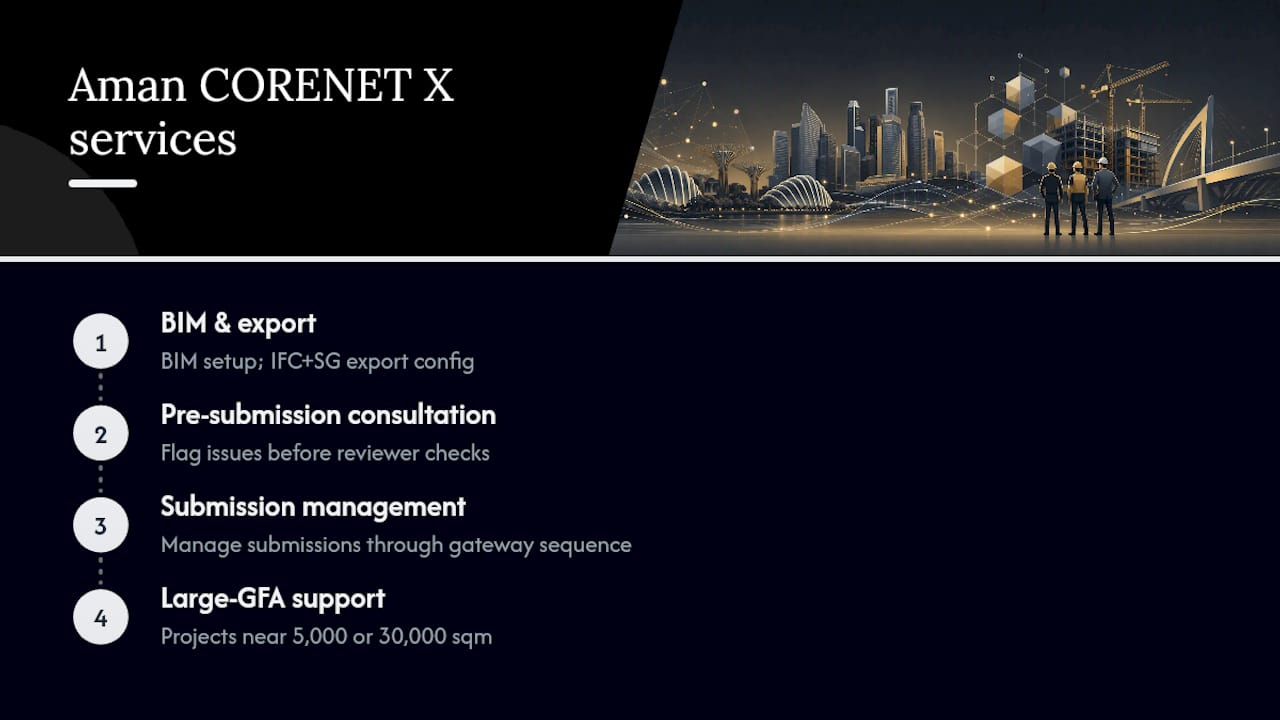
Typical engagements cover BIM setup and IFC+SG export configuration, pre-submission consultation to flag issues before they reach a reviewer’s desk, and submission management through the gateway sequence. This kind of support matters most on large-GFA projects nearing the 5,000 sqm or 30,000 sqm thresholds, where Part-ST planning and Accredited Checker coordination introduce scheduling complexity that a single in-house team can struggle to absorb alongside its regular design workload.
— Aman
Get CORENET X Submission Support From Aman Engineering Consultancy
If your project sits near the 5,000 sqm IFC+SG threshold or the 30,000 sqm mandatory onboarding mark, the fastest way to avoid a rejected first submission is getting your model and paperwork right before you touch the portal. Aman Engineering Consultancy is the alternative to piecing together CORENET X compliance in-house for developers who need federated BIM done right the first time, not after two resubmission cycles.
Consultancy teams may handle:
- CORENET X onboarding, including Corppass and Singpass role setup
- IFC+SG model setup, mapping file configuration, and pre-submission validation
- Coordinated Design, Construction, and Completion Gateway submissions
- Part-ST planning and Accredited Checker or ACO liaison for phased structural approvals
Before reaching out, have your project’s GFA figure, current BIM readiness, and expected gateway path on hand. Aman’s authority approvals team can then scope the specific gateways and technical setup your project needs. Visit the Aman Engineering Consultancy home page to request a consultation and get your CORENET X submission calendar built around your actual project timeline.
Where to Verify CORENET X Requirements
- CORENET X Code of Practice for mapping files and modeling standards
- URA circular on mandatory submissions for onboarding dates
- IFC+SG onboarding checklist and openBIM viewer
Sources
- About the new submission process — CORENET X
- CORENET X Code of Practice
- CORENET X guidance — URA (IFC+SG requirements and submission thresholds)
- CORENET X : MANDATORY SUBMISSIONS STARTING FROM 1 OCTOBER 2025 (FOR NEW PROJECTS ≥ 30,000 SQM GROSS FLOOR AREA) — URA circular
FAQ
What Are the Project Submission Requirements for CORENET X?
Projects need IFC+SG BIM models once GFA reaches 5,000 sqm, submissions move through Design, Construction, and Completion Gateways, and large projects at 30,000 sqm GFA face mandatory onboarding from October 1, 2025.
What Is CORENET X Singapore?
CORENET X is Singapore’s redesigned digital platform for building plan submissions and regulatory approvals, replacing the older e-Submission system with a multi-gateway process spanning BCA, URA, SCDF, and other agencies.
What Is the Maximum Height Limit for Buildings in Singapore?
Height limits vary by planning zone, airport height restriction plans, and URA’s Master Plan controls for each site; there is no single citywide cap, and each project must confirm its specific limit through URA’s development control guidelines.
What Is the CORENET X Code of Practice?
It is the official technical reference for preparing multi-agency submissions, covering IFC+SG mapping files, level-of-detail expectations, and federation practices, published and maintained on the CORENET X regulatory portal.
How Does CORENET X Differ From the Old E-Submission System?
CORENET X replaces single-pass plan checking with sequential gateways tied to project milestones, mandates federated IFC+SG BIM models for larger projects, and allows parallel independent submissions for narrow, agency-specific approvals that the older system handled less flexibly.