
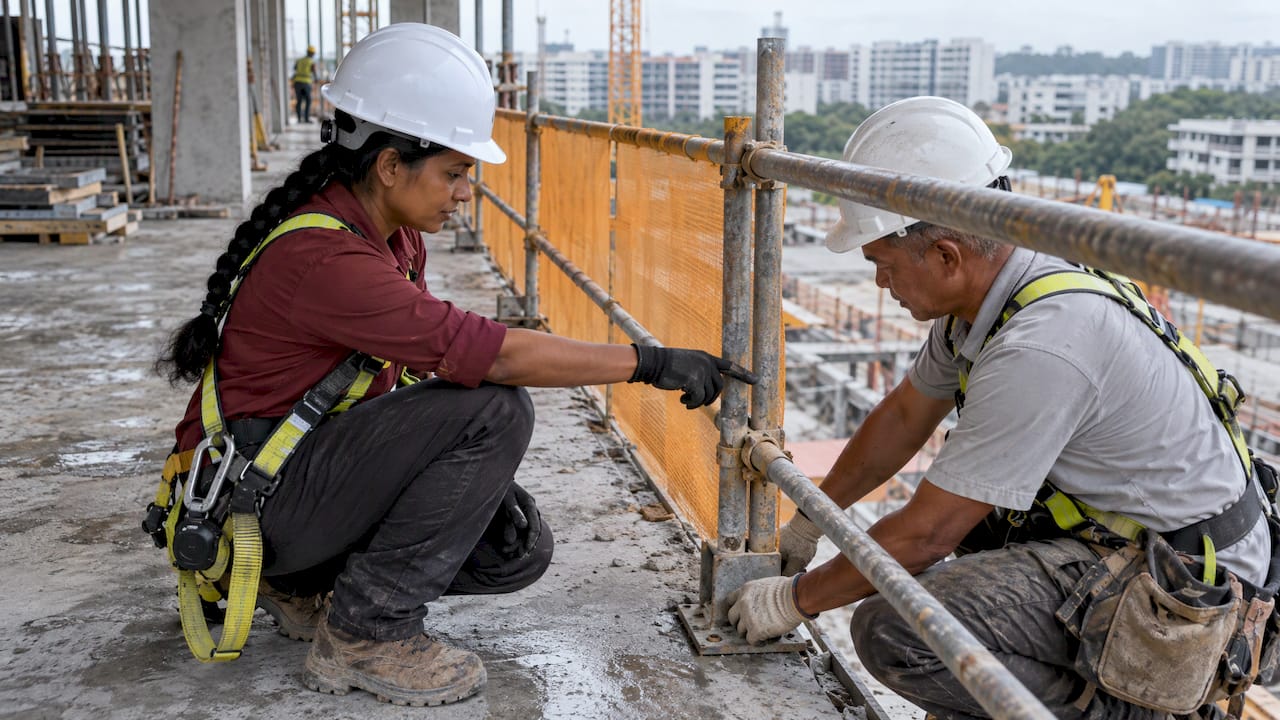
A construction risk assessment in Singapore is a documented evaluation of the injury and illness risks from each work activity, completed before the work starts and followed by controls that are ranked, communicated and reviewed. The obligation arises under the Workplace Safety and Health (Risk Management) Regulations, and it applies to the employer, the self-employed person and the principal on a project. This article sets out the legal basis, the responsible parties, the review triggers, the method and the records that a developer, main contractor or building owner should have in place.
TL;DR
- The Workplace Safety and Health (Risk Management) Regulations require the assessment of risks from work activities, with controls selected to reduce them.
- The assessment must be completed before new work starts and reviewed at least every 3 years, and also after an accident, incident, near miss or dangerous occurrence.
- Employers, self-employed persons and principals (including contractors and subcontractors) are responsible, and a consultant may be engaged to perform the work.
- Controls follow the Hierarchy of Control: elimination, substitution, engineering, administrative, and personal protective equipment last.
- Records must be available to the Commissioner for Workplace Safety and Health on request.
Table of Contents
- What the Regulations Require
- Who Is Responsible for the Assessment
- When to Complete and Review the Assessment
- The Assessment Process
- Hazard Categories Across Project Types
- Recording, Communicating and Monitoring
- Consequences of Non-Compliance
- Our Perspective
- Support for Your Project
- Frequently Asked Questions
- Sources
What the Regulations Require
The Workplace Safety and Health (Risk Management) Regulations define risk assessment as the process of evaluating the probability and consequences of injury or illness arising from identified hazards, and of determining the appropriate measures to control them. The Regulations sit under the Workplace Safety and Health Act framework administered by the Ministry of Manpower (MOM). They do not prescribe a single template. They prescribe an outcome: hazards identified, risks evaluated, controls selected, and the results documented and kept.
For a construction project, the practical consequence is that no work activity of substance should begin on site without an assessment that covers it. This includes activities that appear routine, such as temporary works, lifting, work at height, hot work, excavation and the use of hazardous substances. Each activity carries a distinct hazard profile, and an assessment prepared for one scope does not automatically cover another.
Guidance published by MOM in its guide to the Risk Management Regulations clarifies that risk management extends beyond the assessment itself. It includes the monitoring of risks and the communication of those risks to all personnel who are affected.
Who Is Responsible for the Assessment
Responsibility is not confined to the main contractor. According to MOM’s guide to the Regulations, every employer, self-employed person and principal, including contractors and subcontractors, is responsible for conducting the assessment. A party may engage a consultant to perform the work, although the engagement does not transfer the underlying responsibility.
The Workplace Safety and Health Council guidelines on contractor management encourage contractors to develop risk assessments and health and safety plans in collaboration with their clients and the relevant subcontractors. The same guidelines suggest that contractors and clients should each assess the risks that arise from the other’s work, so that incompatible tasks are not scheduled together at the project site.
This has a direct bearing on how project teams are organised:
| Party | Typical assessment input |
|---|---|
| Developer or building owner (principal) | Project-level hazards, interfaces between contractors, site access and shared facilities |
| Main contractor | Activity-level assessments for each work package, coordination of subcontractor assessments |
| Subcontractor | Task-level assessments for its own scope, aligned to the main contractor’s plan |
| Engineering or safety consultant | Facilitation, scoring consistency, review of controls and documentation |
When to Complete and Review the Assessment
The Workplace Safety and Health Council’s guidance on conducting risk assessments states that assessments must be completed before new work starts and reviewed at least every 3 years. A review is also required after an accident, a significant change in the process, or when new information about a risk emerges. The same guidance requires a review upon the occurrence of an accident, incident, near miss or dangerous occurrence.
For a construction schedule, the following events should be treated as review triggers in the project procedure:
- A change in construction method, such as a switch from cast in place to precast elements.
- The introduction of new plant, a different crane configuration or new temporary works.
- A change of subcontractor, or a change in the number of trades working in the same area.
- Any incident, near miss or dangerous occurrence, however minor the outcome.
- A change in the site condition, including ground, weather exposure, adjacent structures or live operations in an existing building.
The three-year interval is a ceiling for the review cycle, not a target. Most construction activities change well within that period, so the practical review frequency follows the programme rather than the calendar.
The Assessment Process
The MOM guide describes a sequence in which hazards are identified, the risk level is evaluated from likelihood and severity, controls are prioritised using the Hierarchy of Control, and safe work procedures are established. The Land Transport Authority construction safety handbook describes the same logic in terms of identifying hazards and potential accidents, evaluating residual risks, and prioritising the hazards to be controlled.

Step 1: Break the project into activities
List the work by activity, location and phase. An assessment written for “the project” in general rarely identifies the specific hazards that injure workers. An assessment written for “formwork erection at level 4 slab edge” does.
Step 2: Identify hazards
For each activity, identify what can cause harm: the work method, the machines and equipment, the materials and substances, the work environment and the people exposed. Include persons who are not part of the activity, such as other trades, visitors and members of the public near the boundary.
Hazard identification should draw on several inputs: design drawings and the design for safety review, method statements, site walks, previous incident records, and consultation with the workers who will do the task. Our guide on DfS regulations for construction teams explains how hazards identified at the design stage feed into the site assessment.
Step 3: Evaluate the risk
The Council’s guidance on conducting risk assessments states that risk evaluation assesses the risk level of each hazard from the likelihood of harm and the severity of that harm. Most project teams record this in a matrix. The structure below is a common illustration of a 5×5 grid, in which the product of the two scores sets the rating.
| Likelihood Severity | 1 Negligible | 2 Minor | 3 Moderate | 4 Major | 5 Catastrophic |
|---|---|---|---|---|---|
| 5 Almost certain | 5 | 10 | 15 | 20 | 25 |
| 4 Likely | 4 | 8 | 12 | 16 | 20 |
| 3 Possible | 3 | 6 | 9 | 12 | 15 |
| 2 Unlikely | 2 | 4 | 6 | 8 | 10 |
| 1 Rare | 1 | 2 | 3 | 4 | 5 |
The thresholds that separate low, medium and high ratings are set by the organisation and should be written into the project safety plan, so that every assessor applies them in the same way. Consistent scoring is the usual weak point. Our article on how to score likelihood and impact consistently sets out definitions that reduce disagreement between assessors.
The LTA handbook notes that the General Specification requires contractors to identify safety-critical activities using the risk matrix, and to have each activity’s method statement accepted by the Engineer before commencement. Public sector and infrastructure contractors should therefore expect the matrix output to determine which activities need formal acceptance.
Step 4: Select controls by the Hierarchy of Control
The Council’s guidance requires that control measures follow the Hierarchy of Control, in this order:
- Elimination: remove the hazard, for example by prefabricating off site so that work at height is not needed.
- Substitution: replace the hazard with a lower-risk alternative, such as a less hazardous substance.
- Engineering controls: isolate people from the hazard through guarding, edge protection, ventilation or mechanical handling.
- Administrative controls: permits, procedures, training, supervision and scheduling.
- Personal protective equipment: used last, and not as the primary control.
The same guidance directs teams to give priority to upstream controls over PPE, and to consider hazards such as noise or toxic substances, which require hygiene monitoring, alongside the risks from machines, equipment and hazardous substances.
Step 5: Re-evaluate the residual risk
After the controls are chosen, score the risk again. If the residual risk remains high, add controls or change the method. Work should not proceed on the basis of a control that has been listed but not provided on site.
Hazard Categories Across Project Types
The hazards differ by project type, and the assessment should reflect that rather than reuse a generic list.
| Project type | Hazard areas that commonly need a dedicated assessment |
|---|---|
| Residential and mixed development | Work at height, lifting operations, excavation and shoring, temporary works, hot work |
| Industrial buildings | Heavy plant movement, structural steel erection, hazardous substances, interface with live operations |
| Commercial and shophouse works | Alteration and addition works, structural modification, confined access, public interface |
| Infrastructure | Excavation, underground services, traffic management, safety-critical activities requiring method statement acceptance |
| Facade and rectification works | Work at height from gondolas or access platforms, falling objects, public protection |
For facade work, our article on identifying hazards and mitigating risks with periodic facade inspections explains how inspection findings translate into hazards for the rectification phase.
Recording, Communicating and Monitoring
An assessment that is not communicated does not control a risk. MOM’s guidance treats communication to affected personnel as part of risk management, and it describes safe work procedures as step-by-step instructions for carrying out work safely, which must include emergency protocols.
A workable record set for a construction project includes:
- The risk assessment for each activity, with date, assessors, scores and controls.
- The safe work procedure derived from each assessment, including emergency steps.
- Briefing records showing that workers and subcontractors received the controls.
- The review log, with the trigger for each revision.
- Incident and near miss reports linked to the assessments they caused to be reviewed.
A structured register keeps these in one place and makes review triggers visible. See our page on risk assessment registers for the format we use. For a wider view of site obligations, the construction safety checklist for Singapore site managers and the Singapore construction compliance checklist show where the assessment sits among the other requirements for project approval.
Consequences of Non-Compliance
The Regulations require that the records be submitted to the Commissioner for Workplace Safety and Health on request. A project that cannot produce a current, activity-specific assessment is therefore exposed to enforcement action, and the absence of records also weakens its position after any incident. The exact penalties are set in the legislation, and project teams should refer to the current text of the Regulations and the Act for them.
Our Perspective
We treat the risk assessment as a design and coordination tool as much as a compliance document. In our work on statutory submissions, inspections and multidisciplinary engineering, the same pattern recurs: assessments fail not because the method is unknown, but because the scoring is inconsistent, the activities are described too broadly, and the controls are not tied to the people who must implement them.
Our approach is to connect the assessment to the engineering. Structural, facade, mechanical and electrical, and fire safety inputs are reviewed together by our multidisciplinary professional engineer team, so that a hazard recognised in one discipline is not missed in another. Where a project uses BIM, the model can be used to examine access, sequencing and clashes before the work reaches the site.
We also recommend that the register is maintained as a live record. A register that is revisited when the method, the plant or the subcontractor changes serves the Regulations and the project programme at the same time.
Aman
Support for Your Project
Aman Engineering Consultancy supports developers, construction firms and building owners in Singapore with engineering consultancy that includes authority approvals, periodic structural and facade inspections, project management, value engineering and BIM. Our team can assist with the structure of the risk assessment process, the coordination of consultants and the preparation of the documents that accompany statutory submissions. We state our authority clearance rate as 99%, and we aim to give clients clear requirements and regular updates throughout an engagement.
To discuss a project, contact us through our authority approvals and engineering services page, or review our project management service if you need coordination from design through to site delivery.
Frequently Asked Questions
Is a risk assessment mandatory for every construction site in Singapore?
The Workplace Safety and Health (Risk Management) Regulations require the assessment of risks from work activities, and the duty falls on employers, self-employed persons and principals. In practice, this means each construction activity needs an assessment completed before it begins. Refer to the current text of the Regulations for the precise obligations.
How often must a construction risk assessment be reviewed?
The Workplace Safety and Health Council states that assessments must be reviewed at least every 3 years, and also after an accident, incident, near miss or dangerous occurrence, or when there is a significant process change or new risk information. Details are in its guidance on conducting risk assessments. Construction programmes usually require reviews well before the three-year limit.
Can a consultant carry out the risk assessment for us?
Yes, a consultant can be engaged to perform the work, according to MOM’s guidance. The employer, self-employed person or principal remains the party responsible, so the consultant’s output should be reviewed, adopted and communicated by the project team.
What is the difference between a risk assessment and a safe work procedure?
The risk assessment identifies hazards, evaluates the risk and selects controls. The safe work procedure converts those controls into step-by-step instructions for carrying out the work safely, including emergency protocols, as described in MOM’s guide. Each procedure should trace back to its assessment.
Which risk matrix should we use?
The Regulations do not mandate one grid, so the choice is the organisation’s, provided the scoring is applied consistently and recorded. Our article on using a risk matrix step by step compares the common grid sizes.
Sources
- Workplace Safety and Health (Risk Management) Regulations, Singapore Statutes Online
- Conducting Risk Assessments, Workplace Safety and Health Council
- Guide to the Workplace Safety and Health (Risk Management) Regulations, Ministry of Manpower
- WSH Guidelines for Contractor Management, Workplace Safety and Health Council
- Construction Safety Handbook, Land Transport Authority