

BIM for FM is a living asset information model and workflow that gives facility teams one validated source of truth for maintenance, space, and operations. Instead of chasing PDF handover binders and outdated spreadsheets, FM staff pull warranty dates, spare-part numbers, and system locations from a single model. The immediate payoff is fewer diagnostic dead ends, faster preventive maintenance scheduling, and a defensible record for space planning and compliance audits.
TL;DR:
- Implementing BIM for FM requires early definition of clear Asset Information Requirements and a validated Asset Information Model to ensure quality handover data.
- Integration methods like COBie, IFC, and direct links must be chosen carefully, with a focus on maintaining BIM as the single source of truth and linking it to operational systems.
- Starting with a small, high-impact pilot asset class such as HVAC or fire safety optimizes initial investment and builds stakeholder confidence quickly.
- Ensuring data accuracy through contractual standards, automated validation, and targeted audits is essential to prevent handover failures that compromise model usefulness.
- Long-term ROI depends on continuous updates, model validation, and staff training focused on querying and validating data rather than modeling skills.
Table of Contents
- How BIM Improves Operations and Measurable Outcomes for FM
- Core Data Components: AIM, AIR, BEP, and the Common Data Environment
- Standards and Integration: COBie, IFC, and Linking BIM With CAFM/CMMS
- A Staged, Practical Roadmap for FM Teams to Adopt BIM
- Information Quality Pitfalls and Practical Mitigation
- Use Cases and Measurable Results
- A One-Month Starter Checklist: Roles, Quick Tasks, and Governance
- Data Security and Privacy Considerations in BIM for FM
- ROI Measurement and Long-Term Value Tracking of BIM Implementation in FM
- Training and Skill Requirements for FM Staff Using BIM
- Realistic Expectations From the Field
- How Aman Engineering Consultancy Supports Your BIM-for-FM Rollout
- Sources
How BIM Improves Operations and Measurable Outcomes for FM
BIM’s value to facility teams comes from turning static drawings into structured, queryable data. Once asset attributes, warranty terms, and system relationships live in a model instead of scattered folders, maintenance planners stop guessing and start scheduling against real equipment histories.
The operational gains typically show up in three areas:
- Preventive maintenance: technicians pull equipment history, warranty status, and manufacturer specs before a truck rolls, cutting diagnostic time.
- Energy and cost control: linking mechanical system data to actual performance helps FM teams catch underperforming equipment early.
- Space utilization: accurate floor plates and room data support tighter lease audits and occupancy planning.
Data Point: Autodesk notes that BIM gives facility teams a platform to bring lifecycle data into digital twins, unlocking savings across maintenance planning, energy performance, and space optimization.
Sensor and IoT feeds raise the ceiling further. When a digital twin layers live equipment status on top of the model, fault diagnosis shifts from reactive troubleshooting to pattern recognition, and that shift is where most of the long-term ROI actually lives.
Core Data Components: AIM, AIR, BEP, and the Common Data Environment
Four artifacts do the real work in BIM for FM, and confusing them is the fastest way to derail a rollout.
The Asset Information Model (AIM) is the validated dataset FM teams actually operate against once construction ends. It is not the design model. NBS defines the AIM as the central, validated information set used through the operational phase, managed inside a Common Data Environment as the single source of truth for models, documents, and performance records.
The other three pieces feed and govern that model:
- Asset Information Requirements (AIR): the owner’s specification for exactly what data fields, formats, and identifiers the AIM must contain.
- BIM Execution Plan (BEP): the project team’s agreed method for meeting those requirements, including who models what and when.
- Common Data Environment (CDE): the storage and publishing layer that version-controls every update so FM never works from a stale file.
Skip the AIR and you get a beautiful model with none of the fields FM actually needs.
Standards and Integration: COBie, IFC, and Linking BIM With CAFM/CMMS
COBie and IFC solve different problems, and mixing them up wastes implementation time. COBie is a structured spreadsheet format built specifically to hand off asset data (equipment lists, attributes, warranties, spatial locations) to FM systems. IFC carries the full geometric and relational model, useful when a downstream tool needs to understand spatial context, not just a data table.
Integration between BIM and facility systems tends to follow one of three patterns:
- Direct links: software plug-ins sync select fields between the model and the CAFM/CMMS platform in near real time.
- Middleware: a translation layer maps BIM attributes to the operational system’s schema, useful when the two platforms speak different data languages.
- CDE exports: scheduled COBie or IFC exports from the CDE feed the CMMS on a set cadence, the lowest-lift option for smaller portfolios.
The BIM-FM Consortium guide recommends a clear authority split: BIM stays the spatial and asset record of truth, while CAFM/CMMS owns transactional operations like work orders and technician dispatch. Syncing only the fields both systems actually need prevents the two from drifting apart.
A Staged, Practical Roadmap for FM Teams to Adopt BIM
Heavy upfront investment kills more BIM-for-FM programs than bad data does. A staged rollout spreads cost and proves value before the budget conversation gets hard.
- Short term (0 to 3 months): tag priority assets, pick two or three asset classes to pilot, capture as-built conditions, and run one test COBie export.
- Mid term (3 to 12 months): draft the AIR, formalize a BEP with your design and construction partners, stand up a CDE, and validate the AIM against real maintenance workflows.
- Long term (year 2 and beyond): establish continuous model updates, connect IoT sensors for live equipment status, and layer analytics on top for digital twin operations.
Research on asset information frameworks backs this sequencing: owners who define precise FM information requirements early and build incrementally outperform those chasing a single large-scale rollout.
Pro Tip: Pilot with the asset class that causes the most maintenance headaches today, usually HVAC or fire safety systems. A visible win there builds internal buy-in faster than a technically perfect but low-impact pilot.
Information Quality Pitfalls and Practical Mitigation
Most BIM-for-FM disappointments trace back to one root cause: the handover model wasn’t built for FM in the first place. Design teams optimize for construction sequencing and code compliance, not for the fields a maintenance technician needs six years later.
Common failures include:
- Missing or blank asset attributes (serial numbers, warranty end dates, critical spare part codes).
- Inconsistent naming conventions between design disciplines.
- Duplicate or incorrect unique identifiers.
- As-built geometry that no longer matches what was actually installed.
Research Finding: A study published in Frontiers analyzing more than 2,000 compliance issues identified ten distinct information quality criteria, concluding that unclear owner requirements and the absence of validation are the primary drivers of poor handover data.
Mitigation is contractual, not aspirational. Bake modeling standards and required attribute lists into the BEP, run automated validation scripts checking naming conventions and GUIDs before acceptance, spot-audit a sample of assets manually, and make AIM validation a formal deliverable tied to final payment. A lean, FM-focused AIM that captures only what operations teams truly need beats an exhaustive model nobody maintains.
Use Cases and Measurable Results
Preventive maintenance is where BIM for FM earns its keep fastest. Technicians querying the model for equipment age, maintenance history, and manufacturer documentation before a service call typically resolve faults faster, tightening both mean time to repair and mean time between failures over successive maintenance cycles.
Space management benefits show up on the lease side. Accurate, model-derived floor areas and room data let facility teams audit tenant square footage claims and plan reconfigurations without a fresh survey every time.
Retrofits move faster too, and with tighter budgets:
- Model-derived quantities replace manual takeoffs, cutting estimation time for scoping work.
- Existing system data (duct runs, structural constraints, electrical capacity) surfaces early, avoiding costly mid-project surprises.
- Compliance documentation for fire safety and structural systems stays current, easing audit prep.
A One-Month Starter Checklist: Roles, Quick Tasks, and Governance
Getting a pilot moving inside thirty days comes down to assigning ownership and narrowing scope.
- Name a data owner (accountable for AIM accuracy) and a BIM or data manager (responsible for day-to-day model upkeep).
- Select two or three priority asset classes, typically HVAC, fire safety, or vertical transportation.
- Define the required data fields for those classes: critical spare parts, warranty terms, serial numbers, and manufacturer contacts.
- Capture accurate as-built conditions using a 3D scan or field survey.
- Export a test COBie file and connect it to your CAFM or CMMS platform for that single asset class.
- Review results with maintenance staff and adjust the AIR before scaling.
Data Security and Privacy Considerations in BIM for FM
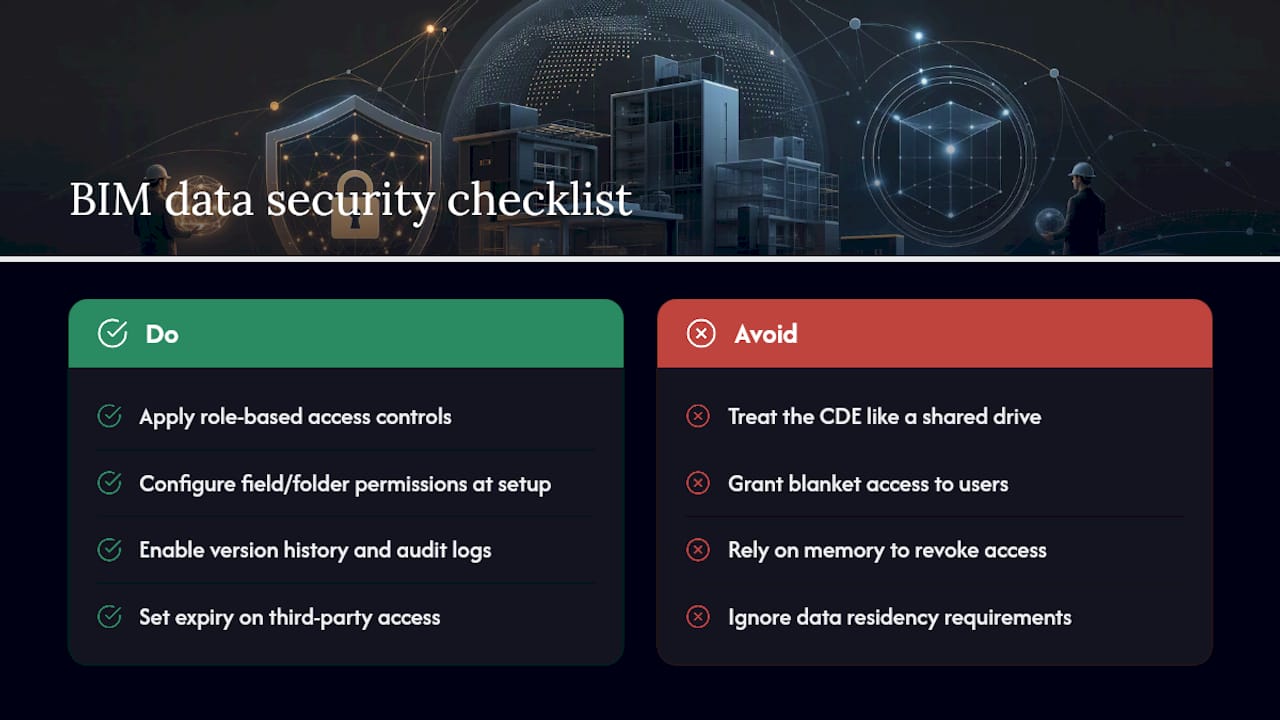
A building’s asset information model contains far more sensitive detail than most FM teams initially recognize: security system layouts, server room locations, access control credentials, and floor plans of executive or research spaces. Treating a CDE like a shared drive is a mistake that gets more expensive the longer it goes unaddressed.
Access control has to be role-based, not blanket. A cleaning contractor doesn’t need visibility into electrical panel schedules, and a leasing agent doesn’t need mechanical system diagrams. Most CDE platforms support field-level and folder-level permissions, and configuring those permissions during setup, not after a data leak, is the only sound sequence.
Version history matters for security as much as for data integrity. A CDE that logs who changed what and when gives FM teams an audit trail if a change turns out to be unauthorized or malicious, which matters more for facilities holding government contracts, healthcare operations, or critical infrastructure roles.
Third-party access deserves its own scrutiny. Contractors, CAFM vendors, and maintenance subcontractors often need model access for a defined project window. Building expiration dates into those permissions, rather than relying on someone remembering to revoke access later, closes a gap that gets exploited more often than most FM teams expect.
Data residency also comes into play for organizations bound by sector-specific compliance rules. Confirming where CDE data physically lives, and whether that location satisfies the reader’s own regulatory obligations, belongs on the vendor evaluation checklist alongside cost and feature comparisons.
ROI Measurement and Long-Term Value Tracking of BIM Implementation in FM
BIM-for-FM ROI rarely shows up as a single dramatic number. It accumulates across several metrics that FM teams should start tracking from day one of a pilot, not retroactively once someone asks for a business case.
Maintenance efficiency is the clearest early signal. Track mean time to repair before and after the AIM goes live for a pilot asset class, along with the number of truck rolls that end without a needed part on hand. Both figures usually improve once technicians can pull equipment history and spare-part data from a validated model instead of hunting through paper files.
Space-related savings take a bit longer to surface but tend to be larger in dollar terms. Accurate floor area data supports leaner space allocation, more defensible lease audits, and fewer disputed square-footage claims from tenants.
Longer term, value tracking should shift from “did the pilot work” to “is the AIM staying accurate.” That means monitoring how often the model gets updated after facility changes, how many data validation failures show up during periodic audits, and whether new capital projects are handing off clean AIM data or reintroducing the same gaps the pilot solved. A model that degrades a year after handover was never really an operational asset. It was a one-time deliverable, and that distinction should shape how FM leadership frames the investment to finance stakeholders from the start.
Training and Skill Requirements for FM Staff Using BIM
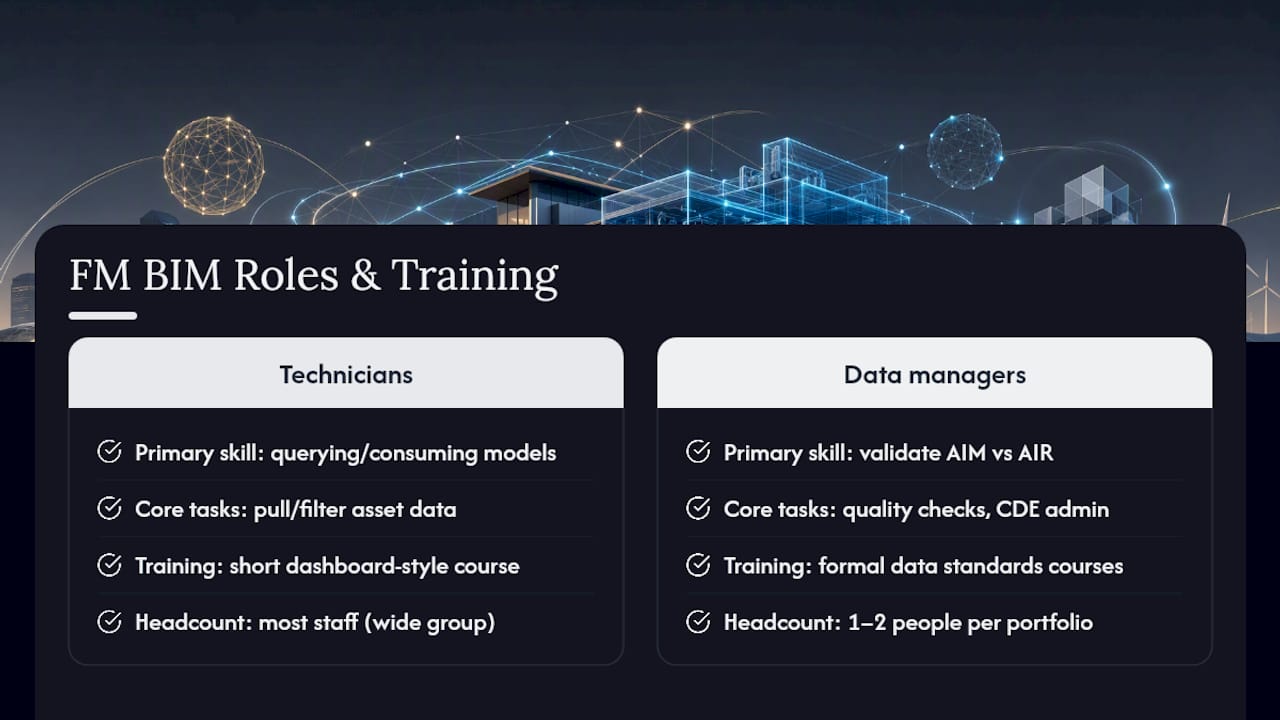
FM staff do not need to become BIM authors. They need to become confident BIM consumers, and that is a much smaller skill gap than most training vendors suggest.
The core competency is querying, not modeling: pulling asset data from a viewer, filtering by system or location, and cross-referencing warranty or maintenance history against a work order. Most CAFM/CMMS platforms with BIM integration handle this through a simplified interface, so the learning curve looks more like mastering a new software dashboard than learning design software.
A second, smaller group, typically one or two people per portfolio, needs deeper skills: validating incoming AIM data against the AIR, running quality checks, and managing the CDE’s permission structure and version control. This is the “data manager” role from the earlier checklist, and it benefits from formal training in data standards and CDE administration.
For organizations building this capability from scratch, SkillsFuture Singapore and similar national skills frameworks offer structured courses covering BIM fundamentals and digital engineering practices, a practical starting point before committing to vendor-specific certification.
The training investment pays off fastest when it is scoped narrowly. Teaching every technician to navigate a model viewer and pull the three or four data fields they use daily beats a generic BIM overview course that covers modeling concepts nobody on the FM side will ever touch.
Realistic Expectations From the Field
Most handover failures trace back to one problem: nobody translated FM’s actual needs into the AIR before modeling started. By the time the gap surfaces, the project team has moved on and the fix falls entirely to the owner.
Year one wins are usually narrow, a clean pilot on one asset class, better fault diagnosis, tighter space data. The bigger returns, digital twin operations and predictive analytics, tend to show up closer to year three, once the AIM has proven stable enough to trust for capital planning.
— Aman
How Aman Engineering Consultancy Supports Your BIM-for-FM Rollout
Getting from pilot to a working operational model is where most FM teams need outside hands, not because the concepts are complicated, but because AIM validation and CDE setup take dedicated time most facility departments don’t have. Aman Engineering Consultancy’s BIM modeling services map directly to the roadmap stages covered here: as-built capture for a pilot asset class, AIM validation against your AIR, and CDE configuration that keeps version control clean from day one.

If you’re drafting an RFP for a BIM-for-FM engagement, specify your AIR, require a documented BEP, and ask for validation checks (naming conventions, GUID integrity, attribute completeness) as contractual deliverables, not optional extras. The digital engineering guide walks through what a properly scoped engagement looks like in more detail. Reach out through the Aman Engineering Consultancy site to discuss a pilot scope for your portfolio.
Sources
- What is the Asset Information Model (AIM)? | NBS
- BIM for Building Lifecycle and Facility Management | Autodesk
- BIM for FM: understanding information quality issues in terms of compliance with owner’s BIM requirements | Frontiers