
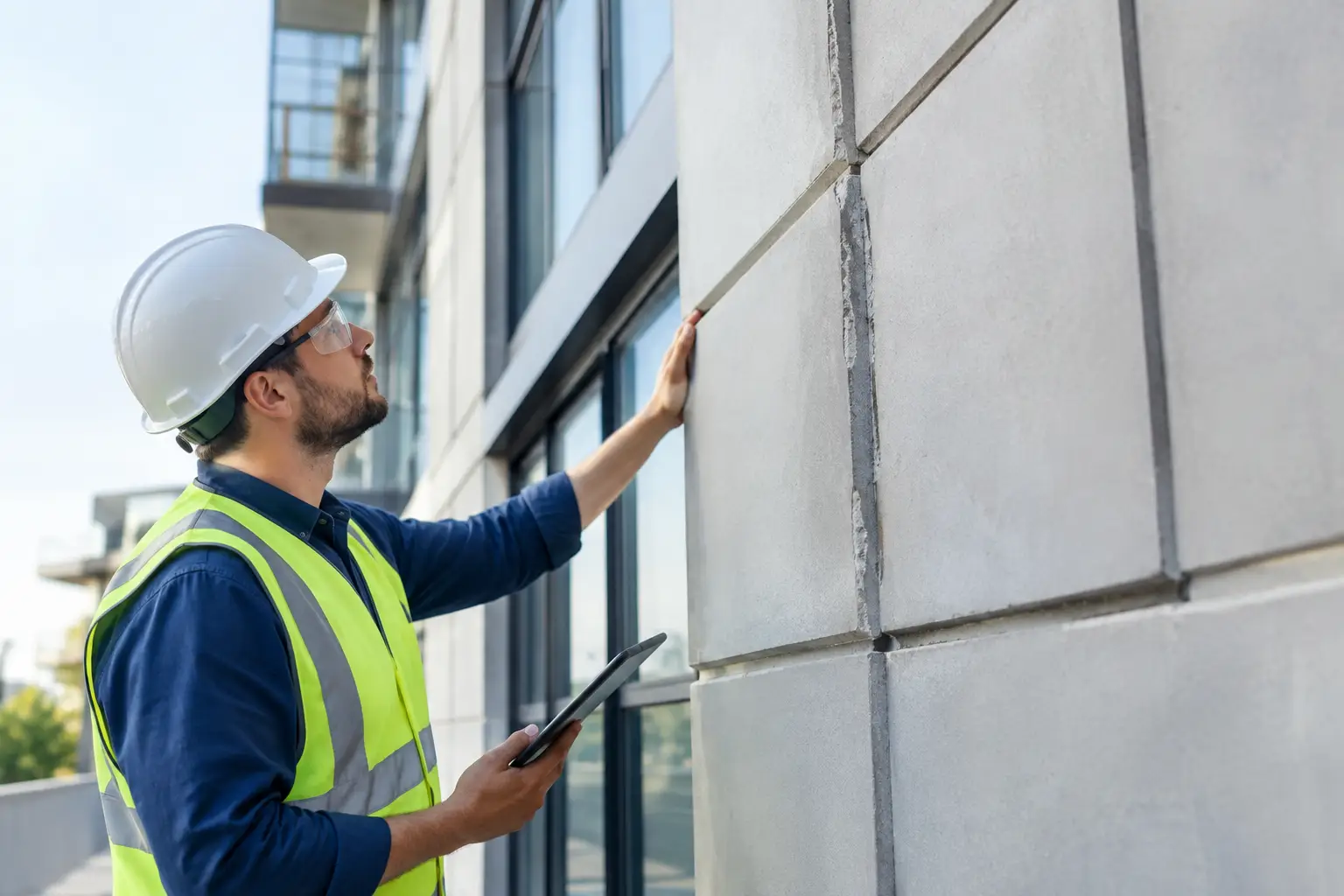
A hairline crack beside a window may be a minor finish defect. The same crack, combined with water staining, rust marks, or hollow-sounding concrete, can signal a developing facade failure. The best facade repair methods begin with diagnosis, not with applying sealant or repainting the visible symptom. For owners, developers, facility managers, and contractors, the objective is to restore safety, weather resistance, appearance, and code compliance without creating a recurring maintenance issue.
Facade repair is rarely a one-method exercise. Concrete, masonry, curtain wall systems, aluminum composite panels, stone veneers, glazing, and external coatings fail in different ways. The repair scope should match the building material, defect mechanism, exposure conditions, access constraints, and any requirements set by the authority having jurisdiction.
Start With a Condition Assessment
A repair specification should be based on a systematic facade inspection. Visual observation from grade is useful for identifying broad patterns, but it cannot confirm the depth of cracking, the condition of concealed anchors, or the extent of moisture behind finishes. A competent inspection team will typically review elevations, previous repair records, water-entry locations, movement joints, drainage paths, and the condition of sealants, flashings, coatings, and attachments.
Close-up inspection from a boom lift, gondola, rope access system, or other safe access arrangement allows engineers to map defects accurately. Depending on the facade system, testing may include hammer sounding for debonded render or concrete, moisture readings, crack monitoring, pull-out testing of anchors, infrared review, water spray testing, or selected opening-up works. For reinforced concrete, cover meter surveys and corrosion assessment can help determine whether steel corrosion is driving spalling.
This investigative stage defines whether a defect is isolated or systemic. It also prevents a common failure: specifying cosmetic patching where water intrusion, structural movement, failed fixings, or corrosion remains active behind the surface.
Best Facade Repair Methods by Defect Type
Concrete spalling and reinforcement corrosion
Spalled concrete is not repaired properly by filling the void alone. Loose and contaminated material must first be removed to sound concrete. Exposed reinforcement is assessed for section loss, cleaned, and treated with an appropriate corrosion protection system where suitable. The repair area is then rebuilt with a compatible repair mortar or micro-concrete, followed by curing and reinstatement of the protective finish.
Where corrosion is widespread, repeated localized patch repairs may not be the most durable option. A consultant may recommend a broader corrosion-management strategy, such as protective coatings, chloride extraction, cathodic protection, or partial replacement of affected components. The right choice depends on the degree of steel loss, concrete contamination, building age, and expected service life. Patching remains cost-effective for limited defects; it becomes less effective when the underlying corrosion mechanism affects an entire elevation.
Cracks in concrete, render, and masonry
Crack repair depends on whether the crack is dormant, active, structural, or caused by surface shrinkage. Fine, stable cracks in a coating or render layer may be prepared and sealed before repainting with an elastomeric coating system. Wider dormant cracks in concrete can be routed and sealed with a compatible flexible or rigid material, depending on the required movement capacity.
Epoxy injection is commonly used where a dry, dormant structural crack must be bonded to restore continuity. It is not the automatic answer for every crack. If the crack is moving because of thermal expansion, settlement, vibration, or inadequate movement joints, a rigid epoxy repair can crack again. Active cracks often require flexible sealants, joint modification, or correction of the source of movement. Crack gauges and monitoring are valuable when the cause is uncertain.
Water leakage around windows, curtain walls, and joints
Facade leaks frequently originate at transitions rather than in the main wall surface. Window perimeters, curtain wall pressure plates, sealant joints, roof-to-wall interfaces, parapets, balcony edges, and service penetrations deserve careful attention. A leak appearing inside a room may travel a considerable distance within the wall assembly before becoming visible.
Effective repair may include removing failed sealant, cleaning and priming joint surfaces, installing backer rod to control joint geometry, and applying a sealant with suitable adhesion and movement capability. Damaged flashings, drainage channels, gaskets, weep holes, or glazing beads may also require repair or replacement. Water testing after the work is often the practical way to confirm that the repaired assembly performs as intended.
Applying a surface coating without correcting failed joints or drainage details can trap moisture or merely redirect the leak. The repair should preserve the facade’s designed drainage path, not block it.
Debonded render, tiles, stone, and other finishes
Hollow render, loose tiles, and displaced stone panels create falling-object risks. Sounding surveys and hands-on checks help identify areas that are no longer adequately bonded. Defective finishes should be removed under controlled conditions, with pedestrian protection and exclusion zones where required, before the substrate is prepared and rebuilt.
For tiled or stone facades, the repair design must consider the substrate, adhesive or mechanical fixing method, panel weight, movement joints, edge restraint, and moisture exposure. Reusing a visually similar material may be desirable, but compatibility and secure attachment matter more than appearance alone. Where a large percentage of finish is debonded, targeted replacement can become inefficient, and a broader recladding strategy may provide a safer long-term result.
Loose cladding panels and failed fixings
Cladding repairs require particular caution because the visible panel may conceal corroded brackets, deteriorated fasteners, failed adhesive, or water-damaged backing materials. Engineers should verify the load path from the panel to the primary structure, including rails, brackets, anchors, and supporting substrate. This is especially relevant for aluminum composite panels, rainscreen systems, precast panels, and stone veneers.
Repair options can include replacement of corroded or inadequate fixings, installation of supplemental mechanical restraints, replacement of damaged panels, and redesign of local support details. Adhesive-only repairs should not be assumed suitable for safety-critical panels without confirming the original system design, substrate condition, environmental exposure, and manufacturer requirements. For assemblies with fire-performance obligations, replacement materials and cavity-barrier details must also be reviewed against applicable fire and building regulations.
Protective coatings and waterproofing systems
Coatings are valuable when the substrate is sound or has been properly repaired and needs protection from carbonation, chlorides, rain penetration, or ultraviolet exposure. Acrylic, elastomeric, silane, siloxane, cementitious, and polyurethane-based systems each perform differently. A breathable water-repellent treatment may suit one masonry wall, while a crack-bridging elastomeric coating may suit a rendered concrete elevation.
Surface preparation controls the outcome. Dirt, algae, chalking paint, trapped moisture, weak render, and incompatible existing coatings can cause early failure. Before specifying a coating, the repair team should confirm substrate moisture, adhesion, vapor permeability, crack movement, and the need for primers or localized repairs. Coatings are protection systems, not substitutes for correcting structural defects or leaking joints.
Repair Design Must Address Access, Safety, and Compliance
Facade work takes place at height and often above occupied public areas. The repair plan should define access methods, temporary works, falling-object controls, work sequencing, material handling, and inspection hold points. A technically correct repair can still create risk if access equipment, suspended loads, or temporary removal of panels is not properly planned.
Permits, professional endorsements, and authority submissions may be required depending on the location, building type, extent of alteration, and repair method. In Singapore, projects may involve coordination with agencies such as BCA, SCDF/FSSD, URA, HDB, JTC, or other relevant authorities. Requirements can extend beyond the facade itself to fire safety, structural adequacy, conservation conditions, drainage, and construction controls.
Aman Engineering Consultancy can coordinate facade inspection findings with repair design, structural assessment, statutory submissions, and rectification support. Centralizing these scopes helps owners avoid gaps between the inspection report, contractor proposal, professional endorsement, and final compliance documentation.
Selecting the Right Repair Strategy
The lowest initial quotation is not always the lowest lifecycle cost. A limited sealant repair may be appropriate for localized aging. It is not appropriate where water has corroded concealed anchors across multiple floors. Similarly, complete replacement is not automatically necessary when testing confirms that defects are isolated and the underlying system remains serviceable.
A practical repair strategy should state the defect locations, repair method, materials, preparation standard, quality-control tests, safety controls, warranty expectations, and post-repair maintenance needs. Mock-ups are useful for major coating, cladding, or stone repair works because they confirm appearance, adhesion, workmanship, and interface detailing before full deployment.
The most durable facade repairs are the ones that solve the mechanism of failure, verify the condition of concealed components, and leave the building with a clear inspection and maintenance plan. That approach protects occupants and the public while preserving the value of the asset long after the access equipment has been removed.