
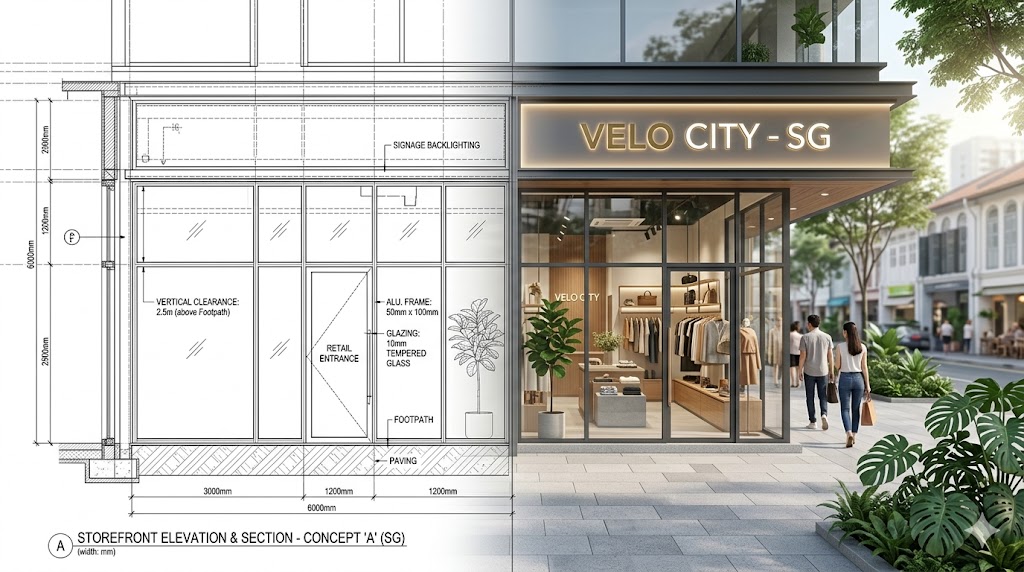
BCA Signage Submission Requirements: Documenting Your Way To A Legal Storefront
Introduction to Statutory Frameworks
A vibrant commercial landscape demands orderly urban planning. Singapore meticulously controls its visual built environment. Consequently, undocumented storefront signage faces severe regulatory penalties. Establishing a legal storefront ensures uninterrupted daily business operations. The Building and Construction Authority (BCA) governs these statutory approvals.1 Therefore, mastering BCA signage submission requirements prevents highly costly delays. This regulatory framework involves multiple powerful government agencies.
Urban Redevelopment Authority (URA) approval is frequently necessary.2 Similarly, the Singapore Civil Defence Force (SCDF) regulates fire safety.3 The Housing and Development Board (HDB) tightly governs residential estates.4 Furthermore, private landlords impose their own rigorous building standards.5 Outdoor advertising significantly impacts public safety and neighborhood streetscapes.1 Therefore, authorities rigorously evaluate every proposed commercial signage installation.1
Transitioning to a legal storefront requires precise documentation. Successful applicants must submit structural plans and visual mockups.6 Additionally, they must secure explicit landlord and agency consent.6 This comprehensive report outlines the optimal submission pathway. It synthesizes current regulations to provide actionable compliance insights. Ultimately, highly compliant signage greatly enhances brand visibility. Furthermore, it strongly protects general public safety.
Defining Outdoor Signage Classifications
Understanding specific regulatory definitions represents the crucial first step. The Building Control Act precisely defines outdoor advertising classifications.7 Consequently, misclassification often leads to immediate formal application rejection. Furthermore, the precise definition dictates the calculated licence fees.7 Properly defining the display rapidly expedites the approval process.
An advertisement actively promotes specific goods or commercial services.7 This explicitly includes commercial logos projected onto building surfaces.7 Conversely, a signboard simply identifies a specific geographical place.7 It details the registered business name or occupation.7 Furthermore, signboards frequently contain operating hours and standard pricing.7 However, signboards cannot contain external third-party brand promotions.7
Advanced signage categories face entirely different regulatory criteria. Animated billboards utilize electrical power for moving visual pictures.7 Balloon signs are physically tethered and visible against the sky.7 Directional signs advise the public on specific facility locations.7 Skysigns prominently extend above the highest roofline of a building.7 The regulations define the term “outdoor” with extreme precision.1 It legally includes any roofed space not fully enclosed.1 Furthermore, the physical space must facilitate public pedestrian traffic.1
Statutory Exemptions from Licensing
Not all outdoor displays require a formal statutory licence. The regulations provide highly specific and targeted exemptions.7 Consequently, understanding these exemptions saves businesses valuable time and money. Religious bodies displaying related signboards are completely exempt.7 Similarly, government-aided schools do not require formal signage licences.7
Hospitals and charitable healthcare clinics also enjoy this legal exemption.7 Furthermore, hospices run by registered charities are completely exempt.7 These institutions provide vital public services to the community. Therefore, reducing their administrative burden remains a core regulatory priority.
Location-based exemptions also exist within the current regulatory framework. Advertisements displayed on indoor hawker centre stalls are exempt.7 Signage inside wet markets also bypasses formal licensing requirements.7 Furthermore, displays inside underground mass rapid transit tunnels are exempt.7 Finally, parliamentary election posters follow entirely different electoral laws.7 Therefore, they are exempt from standard BCA signage submission requirements.7
The Advertising Licensing System Workflow
The primary digital gateway for compliance is the ALS portal. The BCA securely administers this centralized Advertisement Licensing System.1 Consequently, fully mastering its digital workflow expedites the storefront journey.6 Navigating this system flawlessly minimizes extreme administrative friction.
First, applicants must securely log in using Singpass credentials.8 Corporate business entities log in utilizing their registered Corppass profiles.8 Secondly, applicants submit their initial design proposal as a consultation.6 This crucial step requires safely uploading all structural drawings.6 Furthermore, explicit landlord consent letters are uploaded here.6
The standard BCA technical evaluation takes seven to fourteen days.6 However, necessary URA involvement automatically extends this timeline significantly.6 URA evaluation typically adds two additional weeks to the process.6 Therefore, savvy applicants must strategically build in protective schedule buffers.9
If the consultation is positive, it automatically converts to a formal application.10 Alternatively, a formal binding licence application can be manually initiated.11 No physical design changes are permitted during this formal stage.1 Finally, approved applicants must promptly clear the calculated fee payments.1 Once payment is verified, the digital licence is electronically issued.1
Architectural Drawing and Mockup Requirements
The documentation submission checklist is extensive, mandatory, and unforgiving.6 Applicants must carefully prepare a detailed elevational architectural plan.11 This precise plan shows the signage position on the facade.11 Furthermore, it must explicitly include precise physical dimensions in millimetres.1
Secondly, a detailed sectional view drawing is strictly required.1 This specific view illustrates the internal mechanical fixing methods.1 It also details the specific construction materials and substrate weights.5 Therefore, authorities can accurately verify the inherent long-term structural safety.1
Thirdly, a comprehensive spatial layout plan must be submitted.11 This layout plan details relative positions to nearby public roads.11 Additionally, a detailed site plan shows the exact geographic location.1 Consequently, assessing officials completely understand the broader surrounding urban context.1
High-quality visual design mockups are absolutely necessary for successful submissions.6 These specific visuals must clearly show the intended licence number.1 Furthermore, a standardized statutory declaration form is heavily scrutinized.1 It legally determines eligibility for a specific size-based fee exemption.6 Documenting your way to a legal storefront starts with these files.
Structural Safety and Public Projection Limits
Public physical safety remains the absolute paramount concern for authorities. Falling outdoor signage poses severe, life-threatening risks to passing pedestrians. Therefore, physical structural projection limits are strictly and universally enforced.7 Consequently, specific height thresholds exist under the building regulations.7
Signs physically fixed over a public footpath have strict clearances.7 They must permanently sit at least 2.5 metres above ground.7 Furthermore, signs projecting over any public roadside drain are regulated.7 They must clear the physical drain cover by 2.5 metres.7
Additionally, maximum projection distances vary heavily based on installation height.7 Signs projecting between 3.75 metres and 5.0 metres face limits.7 They legally cannot project more than 60 centimetres outwards horizontally.7 Conversely, signs placed 5.0 metres or higher face different restrictions.7 They can legally project up to 1.5 metres outwards.7
| Installation Height Parameter | Maximum Allowed Projection | Vertical Clearance Required |
| Over a public footpath | Not Applicable | Minimum 2.5 metres |
| Over a roadside drain cover | Not Applicable | Minimum 2.5 metres |
| Between 3.75m and 5.0m high | Maximum 60 centimetres | Not Applicable |
| 5.0 metres or higher | Maximum 1.5 metres | Not Applicable |
Designers must mathematically incorporate these exact limits immediately. Ignoring physical projection limits guarantees a swift formal application rejection.12 Furthermore, the total structural weight requires highly secure mechanical anchoring.5 Drilling directly into structural building support beams is widely prohibited.5
The Role of Professional Engineers (PE)
Large physical installations require advanced professional engineering oversight. Therefore, a Professional Engineer must officially endorse specific high-risk designs.6 This mandatory PE endorsement guarantees absolute structural integrity and safety.13 The PE assumes immense civil and criminal liability.14
A PE must hold a valid national practising certificate.15 They register under the stringent Professional Engineers Act 1990.14 Registration requires an approved degree and four years of experience.14 Furthermore, candidates must pass difficult professional practice examinations.14 Consequently, their official certification remains a critical regulatory milestone.
Endorsement is strictly mandatory for structures exceeding 10 square metres.6 It is identically required if the structure exceeds 4 metres high.6 Furthermore, specific large outdoor banners trigger this exact engineering requirement.16 Banners over 10 square metres utilizing rigid internal rods need PEs.16 Giant banners exceeding 30 square metres universally require formal engineering endorsement.16
Independent PE consulting fees vary based on structural complexity.14 They range from several hundreds to tens of thousands of dollars.14 Therefore, commercial businesses must accurately budget for these mandatory costs. Documenting your way to a legal storefront involves seamless engineering collaboration.
Permit to Use (PTU) Regulations
Once triggered legally, the PE must actively apply for a PTU.7 This Permit To Use application flows directly through the CORENET system.7 The PTU is an absolutely critical preliminary statutory requirement.7 Without it, the primary signage licence is instantly denied.7
The PTU legal validity must fully cover the entire display duration.7 If the PTU expires prematurely, the application is rejected.7 For example, a sign displayed from January to June requires coverage.7 A PTU valid only until May is completely unacceptable.7 Therefore, exact calendar alignment is an absolute regulatory necessity.7
The submission requires extensive highly technical structural design calculations.17 The first and last calculation pages must be officially endorsed.17 Furthermore, a copy of valid planning permission must accompany it.17 The PE must carefully evaluate the structural buildability score.17 Consequently, PTU submissions are intensely data-driven and mathematically rigorous.
CORENET X Integration and Digital Transformation
Singapore is radically transforming its built environment digital regulatory processes. CORENET X represents a massive Whole-of-Government digital workflow integration initiative.18 Consequently, it directly impacts future BCA signage submission requirements workflows.19 This transformation aims to create a highly customer-centric experience.18
Historically, the regulatory landscape was deeply fragmented across multiple agencies.18 Private consultants submitted repetitive physical plans to disconnected regulatory touchpoints.18 However, CORENET X creates a unified, one-stop digital shopfront.18 Qualified Persons now collaboratively coordinate complex building designs upfront.18
This advanced system fundamentally reduces expensive abortive on-site reworks.18 From October 2025, exceptionally large commercial projects must use CORENET X.2 This strict mandate applies to developments exceeding 30,000 gross square metres.2 By October 2026, all new national building projects will transition completely.14
Furthermore, electronic fee payments are efficiently supported digitally.20 This newly unified digital gateway drastically accelerates historically slow approval timelines.18 Recent updates indicate almost instant approvals for recurring standard events.21 Consequently, compliant businesses save massive waiting time and administrative overhead.21
URA Commercial Guidelines and Zoning
Aesthetic architectural harmony dictates sophisticated urban planning and zoning strategies. The Urban Redevelopment Authority strictly monitors total visual environmental impact.5 Consequently, URA aesthetic guidelines heavily influence the legal storefront process.5 The Central Area features highly specific designated commercial signage routes.22
These heavily trafficked routes include Orchard Road and New Bridge Road.22 Furthermore, Bras Basah and the Singapore River are designated routes.22 Outdoor advertisements are strictly prohibited outside these specific commercial areas.22 The financial and residential districts maintain their unique quiet characters.22
URA strictly caps total signboard coverage on modern commercial facades.5 Total coverage cannot exceed 15 square metres or 15 percent.5 Additionally, physical advertisement heights generally cannot exceed 15 vertical metres.5 This height corresponds roughly to three standard building stories.5
For specific areas like Orchard Road, external stakeholder endorsement is needed.5 Proposals must be endorsed by the Orchard Road Business Association.7 This ORBA endorsement is mandatory before BCA consultation begins.7 Therefore, early aesthetic design alignment saves crucial administrative time.5
URA Heritage Conservation Restrictions
Conservation areas face significantly stricter historical heritage preservation rules.5 Signs must deeply respect the historical facade and original materials.5 Consequently, bright, bulky modern acrylic lightboxes are generally strictly prohibited.5 Instead, authorities heavily prefer slender, non-illuminated timber fascias.5
Heritage signs must sit neatly below original historical cornice lines.5 They absolutely cannot obscure existing pilasters, traditional fanlights, or shutters.5 Maximum allowed facade coverage for conservation advertisements is tightly capped.5 It is restricted to 30 square metres or 30 percent.5
Moreover, internally illuminated signs in heritage zones require modest lighting.5 Warm visual color temperatures are strictly mandated to prevent glare.5 The original building date on a pediment cannot be removed.23 Forecourt wall signs must remain completely within the wall width.23
| Guideline Category | Commercial Facade Rules | Conservation Area Rules |
| Maximum Facade Coverage | 15 square metres or 15% | 30 square metres or 30% |
| Maximum Vertical Height | 15 metres (or 3 stories) | 15 metres (or 3 stories) |
| Acceptable Materials | Modern substrates permitted | Timber, traditional, non-boxy |
| Illumination Rules | Controlled glare and spill | Warm lighting strictly mandated |
| Architectural Impact | Clean integration required | Cannot obscure historical features |
For perfectly compliant conservation signs, URA offers a premium service.23 This highly efficient instant approval service costs 40 Singapore dollars.23 Therefore, adhering precisely to URA guidelines is highly cost-effective.23 It successfully and rapidly fulfills complex BCA signage submission requirements.
SCDF Fire Code 2023 Regulations
Advanced fire safety remains a highly critical component of building compliance. The Singapore Civil Defence Force rigorously regulates external building materials.5 Consequently, the Fire Code 2023 dictates precise signage material selection.24 Protecting public safety from severe fire hazards is absolutely paramount.
The Fire Safety Act empowers authorities to enforce strict standards.3 Contravening these laws results in incredibly severe legal penalties.3 Fire safety is a foundational pillar of national resilience.3 Therefore, developers and business owners share this massive legal obligation.3
Specifically, external facade wall cladding faces intense regulatory scrutiny.25 Clause 3.5 outlines strict requirements for external wall finishes.26 Highly combustible materials dangerously accelerate upward vertical fire spread.27 Therefore, external walls must utilize completely non-combustible materials strictly.26
Alternatively, they must strategically use certified Class 0 combustible panels.28 The required fire resistance must be officially proven and documented.26 Incorporating these SCDF guidelines is vital for a legal storefront. It prevents catastrophic physical property damage and tragic human loss.
Combustible Cladding and Historical Incidents
Misinterpreting material combustibility rules leads to severe institutional enforcement actions.28 Historical industrial incidents highlight the extreme dangers of improper cladding.27 Therefore, physical material testing certificates must accompany initial design proposals. The SCDF conducts frequent and highly rigorous compliance audits.28
A massive audit discovered numerous buildings with non-compliant external cladding.28 Buildings used the Alubond brand of composite aluminium panels.28 Furthermore, Bolli-Core FR panels faced intense regulatory scrutiny.28 These panels were manufactured by FH Aluminium in Woodlands.28
Another major distributor, Chip Soon, mixed different cladding models improperly.27 They mixed Class 0 models with highly combustible Class 1 models.27 Consequently, 41 buildings received non-compliant and dangerous external wall cladding.27 This mixture violated the strict standards of the Fire Code.27
High-profile buildings like Our Tampines Hub faced massive cladding issues.27 Parts of Singapore Polytechnic also required immediate urgent remediation.27 Luxury condominiums faced similar intense scrutiny and mandatory replacement orders.27 A tragic fire at Toh Guan Road resulted in human death.27 Therefore, BCA signage submission requirements prioritize material combustibility extremely highly.
Exit Lighting and Firefighter Signage
Commercial signage absolutely cannot obstruct critical emergency safety systems.29 Emergency lighting systems must legally remain completely unobstructed always.29 Building fire alarm panels require constant, clear, and unhindered illumination.29 Furthermore, firefighting equipment must be readily locatable during chaotic emergencies.29
The minimum illuminance levels must comply with standard SS 563.29 Exit signs must prominently sit directly over the exit doors.29 They must remain clearly visually visible at all times.29 The electrical delay for emergency lighting cannot exceed 15 seconds.29
Multi-storey exit staircases need strategic visual signage to direct occupants.29 This vital staircase signage must strictly comply with SS 508.29 Furthermore, specific signage must assist firefighters entering underground transit stations.30 This signage guides responders safely through complex subterranean infrastructure.30
Consequently, indoor and outdoor shopfront signs must respect fire perimeters. A legal storefront seamlessly integrates commercial branding with mandatory safety markers. Ignoring emergency wayfinding rules results in immediate failed compliance inspections. Therefore, architectural fire safety audits smooth the BCA signage submission requirements.
HDB Heartland Shophouse Commercial Rules
Public government housing estates maintain highly specific commercial regulations. The Housing and Development Board strictly governs these residential premises.31 Consequently, establishing a physical legal storefront requires highly targeted statutory compliance.4 Heartlands provide highly affordable rentals and steady local foot traffic.4
Retail physical signage in these locations must follow HDB standards.4 Furthermore, business operators must adhere to approved permitted trade categories.31 Allowed trades include tailor shops, tuition centres, and travel agencies.31 Shoe stores and traditional Chinese medicine clinics are also permitted.31
However, these commercial trades are strictly prohibited inside Civil Defence Shelters.31 Unauthorized structural additions directly violate HDB addition and alteration guidelines.32 Tenants must proactively consult the HDB before initiating major renovations.32
Furthermore, Town Council written consent is absolutely mandatory for signage.1 Commercial tenants must actively secure formal signatures from Town Councils.1 If the landlord is different, their explicit endorsement is also required.1 Safely navigating complex HDB rules requires careful continuous stakeholder management.
HDB Home-Based Business Prohibitions
Conversely, small home-based businesses face entirely different and stricter restrictions.4 Operating any commercial enterprise from an HDB flat demands low profiles.33 Therefore, external physical commercial signage is strictly and universally prohibited.33 Any advertising visually suggesting a commercial hub invites harsh regulatory action.33
Visible street-facing physical advertising is completely illegal for home businesses.4 Residents can legally run small takeaway cafes on pre-order bases.4 Home barbershops and nail salons are also completely legally permissible.4 However, they cannot cause excessive foot traffic or noise disruptions.4
Furthermore, they cannot employ non-residents to work within the flat.4 If a home business expands significantly, it must physically relocate.4 Only in commercial premises can the owner install compliant shopfront signage.4
Consequently, understanding zoning limitations is crucial for small enterprise owners. Violating HDB signage rules results in rapid business closure orders. Documenting your way to a legal storefront demands respecting these boundaries. BCA signage submission requirements apply exclusively to proper commercial zoned units.
MCST and Private Landlord Demands
Private strata commercial properties feature rigorous internal architectural regulations. Management Corporation Strata Title bodies strictly enforce these private rules.5 Consequently, satisfying external government agencies is only half the legal battle.5 MCSTs highly prioritize uniform building aesthetics and shared service integrity.5
Total signage projection is usually strictly capped at 150 millimetres.5 This physical limit strictly protects walkways from dangerous protruding hazards.5 Furthermore, physical signs must remain perfectly within explicitly defined tenant boundaries.5 They must sit completely clear of any designated emergency exit routes.5
Sign illumination is heavily restricted to prevent neighborhood light pollution.5 Warm color temperatures ranging between 3000 and 4000 Kelvin are standardized.5 Additionally, rapidly flashing LEDs are frequently banned entirely around glass balustrades.5 MCSTs also strictly require programmed timed dimming schedules for energy conservation.5
Installers absolutely cannot drill into structural building concrete support beams.5 They must utilize designated structural anchor points to maintain safety.5 Tenants must submit highly comprehensive technical shop drawings to the MCST.5 Furthermore, they must explicitly provide the designated installer’s active insurance policy.5
Land Transport Authority (LTA) Street Banners
Advertisements placed near public roads require Land Transport Authority clearance.11 Specifically, vertical street banners face extremely rigorous physical technical specifications.34 The LTA mandates precise standardized structural details for all support posts.35 This prevents banners from collapsing onto busy pedestrian walkways or vehicles.
Support posts strictly require heavy-duty hot-dipped galvanized steel construction.35 Bracket butts must measure precisely 75 by 75 millimetres.35 The steel thickness must be exactly six millimetres for maximum strength.35 Hollow structural sections need specific 75 by 38 millimetre sizing.35
Furthermore, installers must comprehensively weld these brackets on three sides.35 The banner content itself faces intense content scrutiny and regulation.34 It must conform to the Singapore Code of Advertising Practice guidelines.34 Banner printing requires high-grade electrostatic or direct-to-media superior printing techniques.34
These advanced printing techniques prevent rapid visual fading under intense sunlight.34 LTA reviews valid submissions and typically responds within two months.34 Therefore, businesses planning street advertising must initiate applications incredibly early.34 Documenting your way to a legal storefront requires deep inter-agency coordination.
Singapore Standards (SS) for Signage
The national standardization body issues explicit technical codes of practice. SS 596 serves as the definitive standard for outdoor advertising.36 Every single statutory licensee must ensure their physical advertisement complies fully.36 This standard comprehensively covers animated billboards, balloon signs, and standard signboards.36
SS 599 provides the official technical guide for public wayfinding signage.37 It heavily dictates the visual design of directional and informational signs.37 Furthermore, other highly specialized standards govern related physical construction activities.37 SS 598 details the strict code of practice for suspended scaffolds.37
Safe scaffold operation is absolutely critical during high-rise signage installations.37 Additionally, SS 5-A1 outlines rigorous test methods for varnishes and paints.37 Signage coatings must withstand incredibly harsh tropical environmental weathering conditions.37 Finally, SS 597 governs liquid oxygen storage on industrial premises.37
Interestingly, SS 52 covers the archival preservation of engineering drawings.38 It details microfilm imaging for long-term text and drawing document preservation.38 Consequently, regulatory agencies can safely archive decades of structural compliance data.38 Adhering to Singapore Standards represents the ultimate pinnacle of regulatory compliance.
Ethical Advertising and ASAS Guidelines
Physical structural compliance fascinatingly extends into broader advertising messaging ethics. The Advertising Standards Authority of Singapore strictly monitors commercial content integrity.39 Consequently, visual messaging must closely adhere to strict ethical professional codes.40 The Singapore Code of Advertising Practice clearly outlines these specific parameters.39
Advertisements legally cannot contain deliberately misleading claims or offensive visual imagery.39 ASAS comprises members from advertising agencies, media, and government organizations.39 They meet regularly to rigorously secure strict compliance with the Code.39 The primary legal responsibility for observing the Code rests with advertisers.39
Furthermore, ASAS holds immense power to regulate local advertising activities.39 They can legally mandate immediate physical advertisement amendment or total withdrawal.39 If an advertisement violates ethical standards, ASAS demands it be withheld.39 Therefore, a compliant legal storefront requires both structural safety and ethical messaging.
ASAS is fundamentally not a pre-approval clearing house for all advertising.39 However, they provide vital individual advice and guidance to doubtful advertisers.39 Documenting your way to a legal storefront includes reviewing content ethics. BCA signage submission requirements implicitly expect highly responsible corporate public messaging.
Real Estate and Digital Advertising Rules
Specific commercial sectors face even more incredibly stringent advertising regulatory frameworks. Real estate agents must strictly follow the Code of Ethics.41 They must apply specific Practice Guidelines for marketing foreign and local properties.41 This covers flyers, banners, classified advertisements, internet marketing, and roadshows.41
Agents must explicitly communicate usable and void areas to potential clients.41 They must strictly prohibit statements prejudicial to race, religion, or culture.41 Furthermore, they must comply with the Personal Data Protection Act 2012.41 This deeply governs the collection and use of personal client data.41
The financial sector also faces newly updated strict digital advertising regulations.42 The Monetary Authority of Singapore issued new standards of conduct recently.42 These comprehensive new financial digital guidelines take effect in March 2026.42 They heavily complement the existing standards published by the ASAS.42
Financial institutions utilizing non-licensed influencers to solicit investments face strict rules.42 Issuing referral codes to reward sign-ups is now formally considered advertising.42 Where overlapping rules exist, institutions must apply the stricter regulatory standard.42 Consequently, modern storefronts must navigate both physical and complex digital regulations.
Detailed Licence Fee Structures
Budgeting highly accurately for statutory compliance prevents unexpected severe financial friction. The official BCA cost structure features varied and highly specific tiered fees.7 Consequently, calculating these exact costs correctly is an essential application step.43 Standard basic signboard licences depend heavily on the total physical area.7
A basic signboard measuring up to 15 square metres costs 50 dollars.7 However, physically exceeding 15 square metres triggers progressive area-based charges.7 The excess physical area costs 20 dollars per additional square metre.7 Conversely, commercial advertisement and directional signs use a totally different structure.44
| Signage Category | Size Threshold Parameter | Statutory Annual Fee Rate |
| Basic Signboard | Up to 15 square metres | $50 per licence |
| Basic Signboard | Above 15 square metres | $50 + $20 per excess square metre |
| Advertisement / Directional | Up to 1 square metre | $20 per sign |
| Advertisement / Directional | Above 1m² to 5m² | $90 per sign |
| Advertisement / Directional | Above 5m² to 10m² | $140 per sign |
| Advertisement / Directional | Above 10 square metres | $20 per total square metre |
| Animated Billboard | Up to 10 square metres | $225 per sign |
| Animated Billboard | Above 10 square metres | $30 per total square metre |
Animated electronic billboards command the absolute highest premium due to visibility.44 A digital billboard under ten square metres costs exactly 225 dollars.44 Exceeding ten square metres costs exactly 30 dollars per square metre.44 Therefore, smart businesses must strictly physically optimize their exact structural dimensions. Accurate physical sizing directly minimizes incredibly expensive recurring annual statutory overhead.
The Fee Calculation and Exemption Process
The BCA provides a specialized online fee calculator for prospective applicants.43 However, this digital tool only provides a rough preliminary estimated fee.43 The final chargeable fee always remains at the Authority’s absolute discretion.43 Businesses must input specific sign types, start dates, and end dates.43
Calculating the area for spherical balloon signs utilizes a specific mathematical formula.43 The formula dictates multiplying four by pi and the squared radius.43 For example, a three-metre diameter balloon yields a 28.278 square metre area.43 This area is then mathematically converted into length and breadth metrics.43
Certain small businesses qualify for a highly advantageous one-time fee exemption.43 This exemption applies to a business’s first signboard up to 5 square metres.5 However, the exemption request is strictly subjected to BCA’s formal assessment.43 The applicant must explicitly submit a formal declaration form to qualify.1
They must include clear photographs of the premises showing all other signboards.1 This ensures the business has not previously utilized this specific fee waiver.1 Consequently, maximizing fee exemptions reduces the financial burden of opening storefronts. Documenting your way to a legal storefront requires acute administrative financial awareness.
Temporary Building Permits for Signage Structures
Massive outdoor advertisements frequently utilize highly complex temporary physical architectural structures. Consequently, these uniquely require a highly specialized and rigorous Temporary Building Permit.20 The Building Control Regulations 2018 directly govern these specific temporary installations.7 They are strictly permitted for a maximum period of 72 months.7
The structure owner must formally engage a registered professional civil engineer.45 This specialized PE designs, supervises, and inspects the temporary physical erection.45 Furthermore, the commercial owner assumes full legal responsibility for structural safety.46 They must completely demolish the structure upon official permit expiry.46
The owner must inform the BCA within seven days after demolition.46 The PE ensures materials conform to the strict standards through rigorous testing.46 Construction tests apply to concrete, steel reinforcements, structural steel, and welding.46 The PE must issue a certificate of supervision within seven days.46
A simplified approval process exists for previously approved standard temporary designs.45 Commercial owners can seamlessly cite earlier approval reference numbers to expedite applications.45 However, the assigned PE must still formally supervise the new physical erection.45 Temporary structural BCA signage submission requirements are uniquely complex and rigorous.
Temporary Builder Responsibilities
The assigned builder faces intensely rigorous statutory obligations during temporary construction. The builder must exactly execute works according to formally approved plans.46 Furthermore, they must strictly follow any specific conditions set by the Commissioner.46 Deviating from approved architectural blueprints results in immediate severe regulatory penalties.
A critical responsibility involves mitigating severe tropical electrical storm hazards effectively. The builder must ensure a lightning protection system is properly installed.46 This specific life-saving system absolutely must be designed by a professional engineer.46 This engineer must specialize specifically in the electrical engineering branch legally.46
Following installation, the electrical engineer must formally inspect the entire system.46 They must physically verify the earth grounding and conductive electrical pathways.46 Subsequently, they must submit a formal electrical certificate of supervision.46 The builder must deliver this certificate to the owner within seven days.46
Consequently, temporary architectural structures demand intense multi-disciplinary engineering coordination and oversight.46 The owner, structural PE, builder, and electrical PE must collaborate seamlessly. Documenting your way to a legal storefront includes managing these complex teams. Failure at any level completely compromises the statutory Permit To Use.
Common Rejection Pitfalls and Errors
Minor administrative or physical errors can completely derail an entire project. Analyzing common historical rejection reasons significantly helps strategically optimize the application process.12 Consequently, proactively avoiding these known pitfalls drastically accelerates the final timeline.12 Premature physical installation is a remarkably frequent and incredibly costly mistake.12
Installing commercial signage physically before receiving formal statutory approval risks enforcement.12 Furthermore, inadvertently omitting vital application documents immediately halts the processing workflow.12 Missing statutory declaration forms or inaccurate geographical site plans guarantee rejection.12 Incomplete applicant details or missing sign dimensions cause applications to bounce.12
Another prevalent error deeply involves ignoring critical mandatory PE endorsement thresholds.12 Upsizing existing older signs without a fresh structural re-evaluation triggers failures.12 Moreover, arrogantly exceeding strict URA facade layout limits guarantees application rejection.12 Total signage covering more than 50 percent of facades is prohibited.12
Unresolved financial fees securely hold up submissions in the processing queue.12 Neglecting to upload clear proof of payment stalls the final approval.12 Therefore, documenting your way to a legal storefront absolutely requires administrative vigilance. Meticulous paranoid attention to BCA signage submission requirements eliminates these frustrating errors.
Material Durability and Weathering
Selecting appropriate physical materials is fundamentally crucial for long-term signage success. Unwisely utilizing cheap, low-quality physical materials leads to extremely rapid degradation.12 Substandard substrates dangerously warp quickly in Singapore’s intense tropical heat.12 Furthermore, cheap fabrics tear easily during aggressive seasonal monsoon rainstorms.12
High humidity levels rapidly accelerate the oxidation and corrosion of metal mounts.12 Consequently, rusted mounting brackets pose severe physical dangers to pedestrians below.12 Faded, cheap inks drastically reduce brand visibility and present unprofessional images.12 Therefore, strategically selecting robust weather-resistant materials is a strict regulatory necessity.12
Materials must comply with both SCDF fire codes and structural demands.24 Aluminum composite panels provide excellent durability if properly fire-rated legally.5 High-grade acrylics withstand ultraviolet radiation significantly better than cheaper plastic alternatives.5 Stainless steel fittings prevent the dangerous accumulation of structural rust effectively.5
Regular maintenance schedules are highly recommended to inspect these physical fixings.5 Business owners should routinely check electrical wiring and internal brightness levels.5 Proactive maintenance vastly extends the physical lifespan of the approved signage.5 It guarantees continuous compliance with the original BCA signage submission requirements.
Local SEO and Digital Synergy
Physical structural compliance fascinatingly synergizes with modern digital marketing SEO strategies.47 A completely compliant physical presence massively boosts localized Search Engine Optimization rankings.47 Search engine algorithms strictly demand Name, Address, and Phone (NAP) consistency.47 Consequently, the registered physical signboard details must perfectly match online directories.47
If your storefront signboard displays “ABC Retail Pte Ltd”, your website must match. Inconsistent naming deeply confuses search engine crawlers and drastically hurts visibility.47 Furthermore, utilizing hyper-local keywords significantly improves highly targeted regional search results.48 Phrases like “Orchard Road” or “Singapore SG” attract highly relevant local traffic.48
Title tags should optimally range between 50 and 60 characters.48 Meta descriptions must remain strictly under 155 characters to avoid cut-offs.48 Properly formatting header tags (H1, H2, H3) structurally organizes digital content.47 A well-designed title massively increases the digital click-through rate (CTR) directly.48
Focusing on search intent rather than just search volume is highly critical.49 Google categorizes user intent into informational, navigational, commercial, and transactional buckets.49 Matching this precise audience intent significantly increases total monthly website visitors.49 Documenting your way to a legal storefront effectively bridges offline and online visibility.
SEO Authority and Internal Linking
Building a highly robust digital presence requires establishing strong domain authority.50 Websites completely lacking credibility signals struggle to rank for competitive keywords.50 A severe lack of quality external backlinks represents a massive red flag.50 Furthermore, high website bounce rates heavily indicate poor user experience design.50
Low impressions in Google Search Console reveal fundamental digital content constraints.50 Consequently, competitors rapidly outrank you for highly valuable commercial search keywords.50 Establishing internal linking architecture acts like clear digital wayfinding signage.49 Without clear digital signage, users cannot find highly important commercial pages.49
A highly proven strategy involves identifying five to ten core pillar pages.49 Every relevant blog post should actively link back to these main pillars.49 Furthermore, the anchor text used must be highly descriptive and relevant.49 Using generic phrases like “click here” destroys potential SEO value entirely.49
Instead, use optimized phrases like “Singapore local SEO services” for links.49 Crawling your site with tools like Screaming Frog reveals internal link data.49 Deeply integrating strict Singapore signage compliance with advanced SEO practices yields dividends.49 It creates a completely unified, highly authoritative commercial brand ecosystem comprehensively.
Conclusion
Navigating the incredibly complex landscape of Singapore outdoor advertising requires immense diligence. Achieving a fully legal storefront demands total mastery of intricate BCA requirements. This exhaustive report clearly demonstrates the absolute necessity of rigorous pre-application planning. Businesses must flawlessly synthesize structural engineering constraints with strict URA aesthetic guidelines. Furthermore, they must deeply respect SCDF fire safety rules and MCST demands.
The integration of the advanced CORENET X system promises streamlined future approvals. However, it simultaneously demands higher initial digital proficiency from all commercial applicants. Accurate early fee calculations and precisely scaled architectural documentation prevent costly rejections. Strategic material selection ensures long-term physical durability against intense tropical weathering. Furthermore, maintaining digital NAP consistency heavily boosts highly valuable local SEO rankings.
Ultimately, maintaining strict compliance profoundly protects general public safety effectively. Simultaneously, it massively enhances invaluable brand visibility in a highly competitive market. Documenting your way to a legal storefront is a vital, continuous operational imperative. Continuous vigilant adherence to these evolving statutory standards guarantees long-term commercial viability. This rigorous approach fundamentally transforms severe regulatory burdens into powerful strategic business advantages.
Works cited
- Outdoor Advertising Sign / Signboard Licence Application, accessed May 27, 2026, https://www1.bca.gov.sg/safety-and-standards/applications-and-licenses/outdoor-advertising-sign-signboard-licence-application/
- Building Plan submission | Building and Construction Authority, accessed May 27, 2026, https://www1.bca.gov.sg/safety-and-standards/applications-and-licenses/building-plan-submission/
- Guide to Fire Engineering Design & SCDF Compliance in Singapore: A 2025 Industry Report – Stellar Structures, accessed May 27, 2026, https://structures.com.sg/fire-engineering-design-scdf-compliance-sg/
- Opening a Retail Store in Singapore? Read This First! – JWC Accounts & HR, accessed May 27, 2026, https://jwc.com.sg/resources/opening-a-retail-store-in-singapore-read-this-first
- Navigating Singapore Signage Regulations: URA, BCA & Landlord …, accessed May 27, 2026, https://www.advertandsigns.com/post/navigating-singapore-signage-regulations-ura-bca-landlord-approvals
- Guide to Applying for Advertising License Signage (BCA ALS), accessed May 27, 2026, https://bigimage.com.sg/guide-to-applying-for-advertising-license-signage-bca-als-in-2025/
- Supporting information on new and existing licences | Building and Construction Authority, accessed May 27, 2026, https://www1.bca.gov.sg/safety-and-standards/applications-and-licenses/outdoor-advertising-sign-signboard-licence-application/supporting-information-on-new-and-existing-licences/
- Advertising Sign/ Signboard Licence – GoBusiness Licensing, accessed May 27, 2026, https://licensing.gobusiness.gov.sg/licence-directory/bca/advertising-sign-signboard-licence
- Grade A Office Fit-Out Singapore: BCA Compliance Guide 2026 – Facilitate Corp, accessed May 27, 2026, https://www.facilitatecorp.com/grade-a-office-fit-out-in-singapore-compliance-and-best-practices/
- FAQs – ::BCA:: – Building and Construction Authority, accessed May 27, 2026, https://eservices.bca.gov.sg/advertisementlicence/LandingPageEvents/FAQs
- BCA Signage License in Singapore | Advert&Signs – Advert & Signs, accessed May 27, 2026, https://www.advertandsigns.com/signage-license-submission-requirements
- Signboard License in Singapore: What You Need Before Installing …, accessed May 27, 2026, https://www.advertandsigns.com/post/signboard-license-in-singapore-what-you-need-before-installing-your-shop-sign
- BCA Signage License in Singapore | Advert&Signs – Advert & Signs, accessed May 27, 2026, https://www.advertandsigns.com/signage-license-certification-by-pe
- PE Endorsement Singapore: When You Need One (2026 Guide) – CVC Engineers, accessed May 27, 2026, https://www.cvcengineers.com/post/pe-endorsement-in-singapore-when-you-need-one-what-it-costs-and-what-s-at-stake
- BCA Structural Design Approvals in Singapore (2025 Edition), accessed May 27, 2026, https://structures.com.sg/bca-structural-design-approvals-singapore-2025/
- Certification by Professional Engineer | SignageMaker.Sg Singapore, accessed May 27, 2026, https://www.signagemaker.sg/faqs/signage-license/certification-by-professional-engineer/
- Structural Plan submission – Building and Construction Authority, accessed May 27, 2026, https://www1.bca.gov.sg/safety-and-standards/applications-and-licenses/structural-plan-submission/
- annex b: factsheet on updates to corenet x, accessed May 27, 2026, https://isomer-user-content.by.gov.sg/338/7611fc57-a195-47ce-95af-9e2ec904fb83/bcaawardsdinner2025_annexb.pdf
- Introduction to the Regulatory Approval Process via CORENET X – BCA Academy, accessed May 27, 2026, https://www.bcaa.edu.sg/what-we-offer/courses/Details/introduction-to-the-regulatory-approval-process-via-corenet-x
- What kinds of submissions can be paid for within the CORENET X system?, accessed May 27, 2026, https://support.corenet.gov.sg/hc/en-us/articles/13750771835023-What-kinds-of-submissions-can-be-paid-for-within-the-CORENET-X-system
- Firms can now obtain licences for outdoor advertising ‘almost immediately’: MND, accessed May 27, 2026, https://www.straitstimes.com/business/firms-can-now-obtain-licences-for-outdoor-advertising-almost-immediately-mnd
- accessed May 27, 2026, https://www.orchardroad.org/wp-content/uploads/2015/09/14-07-16-URA-guidelines-PDF-of-Webpage.pdf
- Conservation Guidelines on Signage, accessed May 27, 2026, https://isomer-user-content.by.gov.sg/338/7d74509d-5eaf-4272-8f6e-f7d41d7220bc/gl_ura_conservation_guidelines.pdf
- CODE OF PRACTICE FOR FIRE PRECAUTIONS IN BUILDINGS 2023 – SCDF, accessed May 27, 2026, https://www.scdf.gov.sg/docs/default-source/fire-safety-docs/firecode-2023-111220241013.pdf?sfvrsn=b3dc3c15_3
- Clause 3.5 External wall – SCDF, accessed May 27, 2026, https://www.scdf.gov.sg/fire-safety-services-listing/cpfprts-2022/table-of-content/chapter-3-station-structural-fire-precautions/clause-3.5-external-wall
- Clause 3.5 External Wall – Singapore – SCDF, accessed May 27, 2026, https://www.scdf.gov.sg/fire-safety-services-listing/fire-code-2023/table-of-content/chapter-3-structural-fire-precautions/clause-3.5-external-wall
- Distributor of cladding material expresses ‘shock’ at SCDF’s flammability test results; says cooperating with authorities | The Straits Times, accessed May 27, 2026, https://www.straitstimes.com/singapore/distributor-of-flammable-cladding-material-expresses-shock-at-scdf-test-results-says-it-is
- More buildings found to have fire-risk cladding: SCDF – CNA, accessed May 27, 2026, https://www.channelnewsasia.com/singapore/more-buildings-found-have-fire-risk-cladding-scdf-5743241
- Clause 8.1 Exit Lighting and Exit Sign – Singapore – SCDF, accessed May 27, 2026, https://www.scdf.gov.sg/fire-safety-services-listing/fire-code-2023/table-of-content/chapter-8-emergency-lighting-voice-communication-systems/clause-8.1-exit-lighting-and-exit-sign
- Clause 8.4 Signage For Firefighters – SCDF, accessed May 27, 2026, https://www.scdf.gov.sg/fire-safety-services-listing/cpfprts-2022/table-of-content/chapter-8-emergency-lighting-voice-communication-systems/clause-8.4-signage-for-firefighters
- Permissible Trades – Singapore – HDB, accessed May 27, 2026, https://www.hdb.gov.sg/shops-and-offices/managing-an-hdb-shop-or-office/change-of-use/permissible-trades
- Addition & Alteration (A&A) Works – Renovation – HDB, accessed May 27, 2026, https://www.hdb.gov.sg/shops-and-offices/managing-an-hdb-shop-or-office/renovation/addition-alteration-aa-works
- HDB Home Business Rules and Regulations Every Singaporean Must Know, accessed May 27, 2026, https://homeboss.io/blog/hdb-home-business-rules-and-regulations-every-singaporean-must-know
- GUIDELINES AND TECHNICAL REQUIREMENTS DISPLAY OF VERTICAL BANNERS ON PUBLIC STREET LAMP POSTS, accessed May 27, 2026, https://www.lta.gov.sg/content/dam/ltagov/industry_innovations/industry_matters/development_construction_resources/Street_Work_Proposals/PDF/Submission_Guide_and_Technical_Requirements_15122022.pdf
- CHAPTER 10 SUPPORTS FOR ROAD SIGNS, accessed May 27, 2026, https://www.lta.gov.sg/content/dam/ltagov/industry_innovations/industry_matters/development_construction_resources/Street_Work_Proposals/Standards_and_Specifications/SDRE/SDRE14-10_SUP_1-15_April_2024.pdf
- Building Control (Outdoor Advertising) Regulations – Singapore Statutes Online, accessed May 27, 2026, https://sso.agc.gov.sg/SL/BCA1989-RG6?DocDate=20040229&ValidDate=20050901&ProvIds=pr8-.
- 48 – Singapore Standards, accessed May 27, 2026, https://www.singaporestandardseshop.sg/Product/SSPdtList?page=48&StandardType=All
- SS 596:2014 (2023) +A1 (2023) – Singapore Standards, accessed May 27, 2026, https://www.singaporestandardseshop.sg/Product/SSPdtDetail/52bf7dc6-2cf3-4e3d-852f-8ba4833e9966
- Singapore Code of Advertising Practice, accessed May 27, 2026, https://asas.org.sg/Portals/0/SCAP%202008_1.pdf
- Code – Advertising Standards Authority of Singapore (ASAS), accessed May 27, 2026, https://asas.org.sg/About/Code
- 3.6. Regulations on advertisements – Free RES Exam Questions, accessed May 27, 2026, https://www.respaper.sg/exam-syllabus/regulations-on-advertisements
- Guidelines on Standards of Conduct for Digital Advertising Activities – Monetary Authority of Singapore, accessed May 27, 2026, https://www.mas.gov.sg/-/media/mas/regulations-and-financial-stability/regulations-guidance-and-licensing/financial-advisers/guidelines/guidelines-on-standards-of-conduct-for-digital-advertising-activities.pdf
- Fee Calculator | BCA Advertisement Licensing System (ALS), accessed May 27, 2026, https://eservices.bca.gov.sg/advertisementlicence/FeeCalculator
- Fees and Payment | SignageMaker.Sg Singapore, accessed May 27, 2026, https://www.signagemaker.sg/faqs/signage-license/fees-and-payment/
- FAQ on Temporary Buildings – Building and Construction Authority, accessed May 27, 2026, https://www1.bca.gov.sg/safety-and-standards/applications-and-licenses/temporary-building-application/faq-on-temporary-buildings/
- Temporary Building Application | Building and Construction Authority, accessed May 27, 2026, https://www1.bca.gov.sg/safety-and-standards/applications-and-licenses/temporary-building-application/
- The Impact of Singapore’s Internet Regulations on SEO Practices – AD GUYS & CO, accessed May 27, 2026, https://adguysco.com/blog/the-impact-of-singapore-s-internet-regulations-on-seo-practices
- Ultimate 2024 Guide to SEO in Singapore – Leading Solution, accessed May 27, 2026, https://theleadingsolution.com/resources/ultimate-2024-guide-to-seo-in-singapore/
- 10 Proven Ways to Increase SEO Visibility for Your Singapore Website, accessed May 27, 2026, https://www.bestseo.sg/blog/how-to-increase-seo-visibility/
How to Choose an SEO Agency in Singapore: 7 Red Flags That Reveal Who Actually Delivers Results – Stridec, accessed May 27, 2026, https://www.stridec.com/blog/choose-seo-agency-in-singapore-7-red-flags-that-reveal-who/