
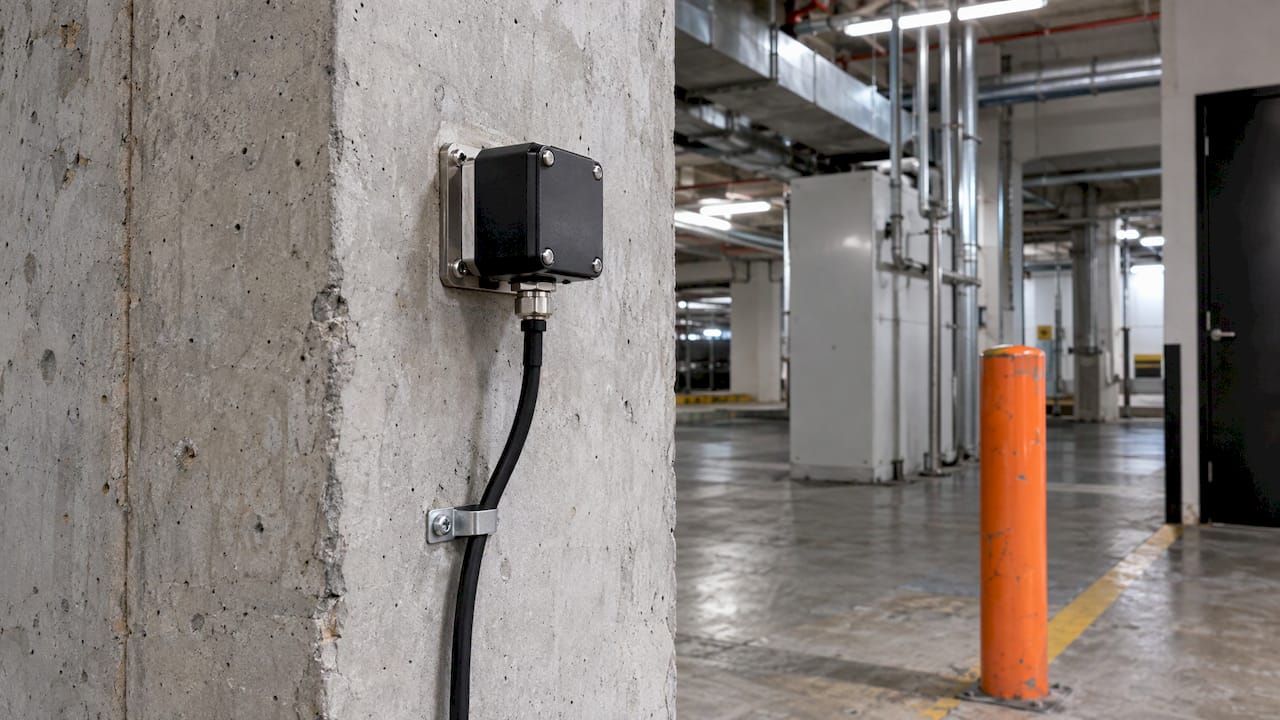
Structural health monitoring (SHM) is the repeated measurement of how a structure behaves over time, so that changes pointing to damage or deterioration are detected early and maintenance or repair decisions rest on data. In Singapore it is most often required where construction next to an existing building could cause settlement or movement, and it is most useful to owners as a complement to the statutory Periodic Structural Inspection. A monitoring programme delivers value only when its sensors, trigger levels and escalation actions are designed by a Professional Engineer (PE) and tied to the approvals the project needs. Aman Engineering Consultancy coordinates statutory submissions, PE endorsements and structural inspections as a single point of contact, so that monitoring data feeds directly into the submissions and inspections it supports.
TL;DR
- SHM measures displacement, strain, vibration, temperature, humidity and loading over time to detect change in a structure, and it supports inspection rather than replacing it.
- Under Singapore’s 2021 Building Assessment Framework, adjacent buildings affected by earth retaining and stabilising structure (ERSS) works and tunnelling are monitored against assessed limits for settlement, relative movement, tilt and cracks.
- In the deemed-to-satisfy approach, the alert level is set at 70% of the work-suspension level, and each level triggers a defined action.
- BCA’s Periodic Structural Inspection remains a separate obligation: every five years for non-residential buildings and every ten years for residential buildings, with listed exclusions.
- Monitoring is a design decision: define the objective, the thresholds and the response before any sensor is installed.
Table of Contents
- What structural health monitoring measures
- Why buildings move
- When monitoring applies in Singapore
- Monitoring and Periodic Structural Inspection
- Designing a monitoring programme
- New sensing approaches
- Perspective
- How Aman supports owners and project teams
- FAQ
- Sources
What structural health monitoring measures
The American Concrete Institute’s 2021 report on SHM technologies describes monitoring as collecting measurements of structural performance over time to detect changes that may indicate damage or deterioration. Depending on the asset and the purpose, the quantities recorded include displacement, strain, vibration, temperature, humidity and loading.
The same report distinguishes between monitoring periods and sensor arrangements:
- Short-term monitoring supports a specific event, such as a load test or a construction stage.
- Long-term monitoring runs for months or years to track ageing and deterioration.
- Fixed installations use embedded or surface-mounted wired or wireless sensors that remain in place.
The report also lists humidity, load-cell, pH, piezometer, temperature, weather-station and weigh-in-motion sensors among the technologies in use, together with wireless sensor networks and energy harvesting for powering remote devices.
The US Geological Survey’s National Seismic Monitoring Program describes SHM as measuring structural response, often in near real time, to assess condition after severe loading and to track progressive deterioration. Its analysis methods include inter-story drift ratios, modal parameters, shear-wave travel times and the base-shear capacity-demand ratio. These are the indicators from which an engineer judges whether a measured change is significant.
Structural health monitoring and building movement monitoring
The two terms overlap but are not identical. Building movement monitoring concentrates on geometry: settlement, tilt, relative movement between parts of a building, and the width and growth of cracks. SHM is the wider discipline and also covers dynamic behavior (vibration, modal properties), strain in members and environmental conditions. In practice a Singapore project often begins with movement monitoring because that is what the regulatory framework asks for, and extends to broader SHM where the owner wants a continuing record of condition.

Why buildings move
Not all movement signals a defect. The Institution of Structural Engineers explains that buildings move because of thermal effects, moisture changes, founding-soil influences and environmental forces. The purpose of monitoring is to determine whether the movement is cyclic and benign, or progressive and risky.
This distinction governs how a programme is planned:
- Baseline first. Readings taken before disturbance establish what normal seasonal and daily variation looks like for that building.
- Separate cause from effect. Temperature and rainfall records recorded alongside displacement allow cyclic movement to be separated from a trend.
- Judge the trend, not the single value. A progressive drift in one direction over weeks carries more weight than an isolated spike, which is frequently a sensor or access disturbance.
Singapore’s tropical climate and dense urban construction influence all three steps, because heat, heavy rainfall and nearby works all act on the same structure at once. The practical consequence is that the baseline period, sensor protection and the record of nearby site activity should be specified at the design stage, and a PE should interpret the results against that context.
When monitoring applies in Singapore
Construction next to existing buildings
The strongest regulatory driver is adjacent construction. The 2021 Singapore Building Assessment Framework, issued for the industry, calls for close monitoring of affected adjacent buildings and structures during ERSS and tunnelling works, to verify that construction impacts stay within assessed limits and that the structures remain safe. ERSS refers to the temporary retaining systems, such as diaphragm walls and soldier piles, that hold back soil around a deep excavation.

The framework also records that Regulation 33 requires an impact assessment of adjacent buildings, so that settlement or other movement does not impair stability or cause damage. It covers settlement, relative movement, tilt and cracks, with monitoring levels and escalation actions attached.
Monitoring levels and escalation
The framework describes a deemed-to-satisfy approach for all projects and an alternative rigorous approach that applies only to Geotechnical Building Works (GBW) projects. The qualified person states the selected approach at plan submission. Under the deemed-to-satisfy approach, the alert level is set at 70% of the work-suspension level, and the work-suspension level is the lesser of the design value that satisfies the impact assessment and the rigorous allowable building settlement.
The framework links trigger levels to impact-assessment criteria and staged escalation rather than treating each reading as an isolated alarm. The structure can be summarized as follows:
| Element | Function in the programme |
|---|---|
| Impact assessment | Establishes what movement the adjacent structure can tolerate |
| Work-suspension level | The limit at which work stops; the lesser of the design value and the rigorous allowable settlement |
| Alert level | Set at 70% of the work-suspension level under deemed-to-satisfy; prompts a defined response before the limit is reached |
| Escalation actions | Staged responses assigned in advance to named parties |
An owner of an adjacent building, and a developer excavating beside one, should therefore expect thresholds and actions to be agreed before work begins, not improvised when a reading rises.
Records the regulations require
The Building Control Regulations 2003 require the supervising qualified person to keep instrumentation and monitoring reports and records of the actions taken when earth-retaining wall deflection or adjacent-ground settlement exceeds allowable limits, or when neighboring properties are damaged. The Regulations are amended periodically; Singapore Statutes Online’s timeline of the Building Control Regulations lists amendments dated 30 December 2024, 1 April 2025, 1 October 2025 and 31 March 2026. Project teams should work from the current version.
BCA permits and forms
BCA’s permit for structural works page states that a permit is required before approved structural works start, and that material changes requiring redesign of key structural elements need BCA approval before they are carried out. The same page carries the forms for pile-load and piling supervision and building-settlement monitoring, and for tunnelling inspection and ground-movement records, as well as the ERSS design-considerations template. Form versions are updated from time to time, so the BCA page is the reference for the current set at the time of submission.
Monitoring and Periodic Structural Inspection
Monitoring and inspection answer different questions. The ACI report states that SHM can augment routine inspections and nondestructive evaluation, or help owners decide when a specific on-demand method should be used. It is decision support for owners and asset managers, and it complements inspection rather than automatically replacing it.
For most owners in Singapore the statutory baseline is the Periodic Structural Inspection. BCA’s PSI regime requires an inspection once every five years for non-residential buildings and once every ten years for residential buildings. It excludes specified detached, semi-detached, terraced and linked houses used exclusively for residence, and temporary buildings.
The relationship works in both directions:
- From inspection to monitoring. A PSI that finds a crack of uncertain cause, a suspected foundation movement or a member under distress may justify instrumenting that location, so that the trend is established before a repair decision is made.
- From monitoring to inspection. Records of movement, strain and environmental conditions give the inspecting PE a documented history, which supports a better-informed assessment at the next PSI.
Owners who want the inspection requirements set out in full can read our guides to Periodic Structural Inspection in Singapore and to what commercial landlords must know about PSI. Our article on structural health monitoring and retrofitting of existing steel structures addresses the case of older steel buildings.
Designing a monitoring programme
The following sequence applies to both construction-stage movement monitoring and long-term SHM of an existing building.
- Define the objective. State the question the data must answer: whether adjacent settlement stays within the assessed limit, whether a known crack is active, or how a structure’s response changes as it ages.
- Select the parameters. Choose the quantities that bear on the objective, for example settlement points and tilt sensors for excavation, or crack gauges and strain sensors for a distressed member. More channels do not improve a programme if no one has defined what each will be used to decide.
- Set the trigger levels. Derive alert and work-suspension levels from the impact assessment, and record the actions linked to each level, the persons responsible and the time allowed for response.
- Establish a baseline. Collect readings before the disturbance begins, covering enough of the daily and seasonal cycle for normal variation to be understood.
- Specify the reporting chain. Decide who reviews the data, how often, and who is notified when a level is crossed. Under the Building Control Regulations the supervising qualified person keeps the reports and the records of action.
- Interpret with an engineer. A reading acquires meaning only against the structure’s design, condition and the activities around it. A PE reviews the trend and recommends action.
- Close out. Where monitoring or inspection identifies defects, track each rectification item to completion. A structured construction punch list process is a common way of recording and closing such items.
Where programmes go wrong
- Sensors are installed before thresholds are defined, so there is data but no basis for a decision.
- No baseline exists, so normal cyclic movement is mistaken for a defect, or a real trend is mistaken for normal variation.
- Alert levels are set without a named response, so a crossing prompts discussion instead of action.
- Records are scattered between contractor, consultant and owner, which complicates later demonstration of what was measured and done.
New sensing approaches
Permanent sensors are not the only option. In April 2025 the Singapore-ETH Centre and ETH Zurich reported that a partnership including NUS, NTU and LTA had tested mobile sensing using robots, trains, bicycles and cars to collect infrastructure data for roads, bridges and railways. The project combines real-time sensing with AI analysis, aims at scalable inspections and more efficient maintenance, and was field tested in Singapore and Switzerland.
For building and infrastructure owners the implication is a wider range of data sources feeding the same decision: fixed sensors for continuous records at critical points, and mobile or visual survey methods for coverage across the whole asset. Our article on inspection technology for Singapore’s buildings describes how such methods fit into inspection practice.
Perspective
Monitoring data has value when it is attached to a decision. In our work on statutory submissions and inspections, the recurring weakness is not the lack of measurements but the lack of an agreed link between a measurement, a limit and an action.
We therefore treat monitoring as part of the compliance chain: the impact assessment sets the limits, the sensors report against them, and the PE endorses the response. Our single-point statutory coordination and multidisciplinary PE team are designed to keep that chain in one place, so that the structural engineer, the authority submission and the inspection record are consistent with one another.
For existing buildings, we regard monitoring and the Periodic Structural Inspection as complementary. The inspection gives the statutory view of condition at a point in time, and monitoring gives the history between inspections. Our integrated drone inspection capability supports the visual side of that record, particularly on facades and elevated structures.
Aman
How Aman supports owners and project teams
Owners and developers who need structural movement or condition assessed can engage our Real Estate Inspection service, and those with statutory obligations can review our Periodic Structural Inspection, Periodic Façade Inspection and Fire Safety Certificate services. Our authority-approval work covers submissions to agencies including BCA, URA, JTC, HDB, SCDF, PUB and LTA, and we state a 99% authority clearance rate for that work.

Where a monitoring requirement arises inside a wider project, our PE endorsement and PE inspection service and our Authority Approvals team handle the endorsement and submissions together, which keeps the monitoring records consistent with the plans the authority has approved. To discuss a specific building or site, contact us through the main site.
FAQ
Is structural health monitoring mandatory for Singapore buildings?
There is no general requirement to instrument every building. Monitoring is expected where construction affects adjacent structures, notably ERSS and tunnelling works under the 2021 Building Assessment Framework, and the Building Control Regulations require monitoring records to be kept in those cases. Existing buildings remain subject to Periodic Structural Inspection on the BCA cycle.
Does monitoring replace the Periodic Structural Inspection?
No. Monitoring complements inspection by supplying a continuous record, whereas the PSI is the statutory assessment of condition carried out every five years for non-residential buildings and every ten years for residential buildings, subject to the listed exclusions. A PE can use monitoring data to inform the inspection findings.
What does building movement monitoring detect?
It records settlement, relative movement between parts of a building, tilt and crack growth. These are the quantities the Singapore framework uses for adjacent buildings, each with monitoring levels and escalation actions. Wider SHM adds strain, vibration and environmental readings such as temperature and humidity.
What is an alert level?
It is a pre-set reading at which a defined response starts before the limit is reached. Under the deemed-to-satisfy approach in the 2021 framework it equals 70% of the work-suspension level, the point at which work must stop. The responses attached to each level are agreed before works begin.
Sources
- ACI 444.2-21: Structural Health Monitoring Technologies for Concrete Structures
- USGS National Seismic Monitoring Program: Structural Health Monitoring FAQ
- Institution of Structural Engineers: Conservation compendium, Part 16, movement monitoring
- Building Assessment Framework circular, 2021
- Building Control Regulations 2003, Singapore Statutes Online
- Building Control Regulations 2003, amendment timeline
- BCA: Permit for structural works
- BCA: Periodic Structural Inspection
- Singapore-ETH Centre and ETH Zurich: Dynamic mobile sensing for resilient transport infrastructure
- Construction punch list process