
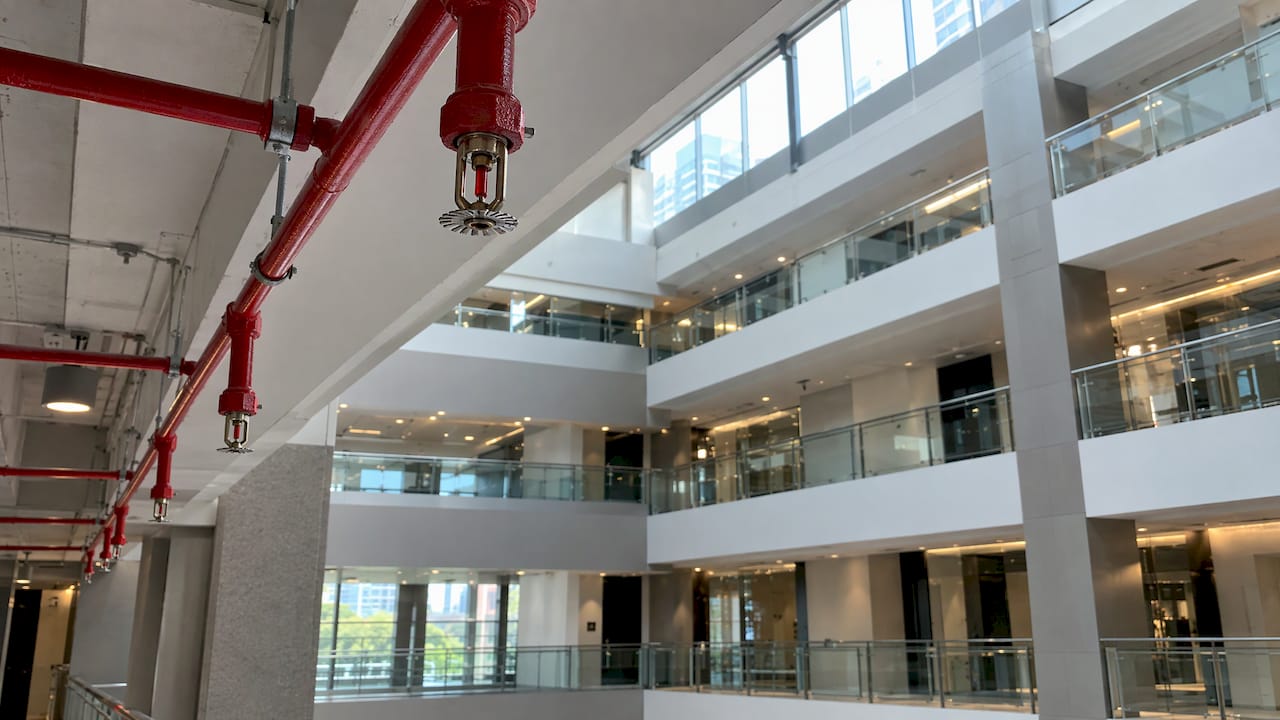
Automatic sprinkler systems are required in Singapore when the Fire Code triggers them by purpose group, habitable height, compartmentation or use. The governing provision is Clause 6.4 of the Fire Code 2023, which sets when sprinklers are mandatory and refers design, water supply, controls and testing to SS CP 52. This guide sets out the triggers, the differences between residential, commercial, industrial and storage buildings, the technical standard, the submission route to SCDF and the maintenance obligations that follow.
TL;DR
- Sprinklers are required when compartmentation under Chapter 3 cannot be met, throughout buildings above 24 m habitable height (other than Purpose Group I and II), and in specified basement, factory, warehouse, high-bay storage and smoke-control situations.
- Ordinary Purpose Group II apartments are not sprinklered solely because they are residential, but towers, mixed occupancies and non-compliant basement car parks are caught.
- Design, installation, water supply and testing follow SS CP 52, and the system must be monitored through an approved alarm-monitoring company.
- A Qualified Person submits the plans and hydraulic calculations to SCDF before work starts.
- The 4th batch of Fire Code 2023 amendments, generally effective from 1 March 2026, revised the atrium sprinkler provisions.
Table of Contents
- Legal basis: Fire Code 2023 and SS CP 52
- When automatic sprinklers are required
- Requirements by building type
- Warehouses and high-rack storage
- Design, water supply and monitoring
- Submission to SCDF
- Recent amendments: atria
- Maintenance and the Fire Certificate
- Our perspective
- How Aman Engineering Consultancy supports sprinkler-related projects
- Frequently asked questions
- Sources
Legal basis: Fire Code 2023 and SS CP 52
The baseline for fire precautions in Singapore buildings is SCDF’s Code of Practice for Fire Precautions in Buildings 2023. It sets minimum fire-safety requirements, requires the latest referenced codes and standards to be used, and provides that the Fire Code prevails where a referenced standard conflicts with it.
The two documents divide the work as follows:
| Document | Question it answers |
|---|---|
| Fire Code 2023, Clause 6.4 | Is a sprinkler system required in this building or part of it? |
| SS CP 52 | How must the system be designed, installed, supplied with water, controlled and tested? |
| Fire Code 2023, Table 1.2A | Which code or standard governs maintenance of each installed system? |
SS CP 52 is intended to guide design, installation, commissioning and maintenance. Its published preview states that compliance requires the installation to be designed and supervised by professional engineers recognised by the relevant authority for this class of work. Project teams should always confirm the edition of the standard currently referenced by the Fire Code before finalising a design basis.
For a wider view of how the Fire Code is organised, see our guide to navigating the SCDF Fire Code.
When automatic sprinklers are required
Clause 6.4 does not impose sprinklers on every building. It names specific conditions. The principal triggers are:
- Compartmentation cannot be met. Sprinklers are required whenever the compartmentation requirements of Chapter 3, Table 3.2A cannot be satisfied. Sprinklers then serve as the compensating measure.
- Height. Sprinklers are required throughout every storey of buildings exceeding 24 m habitable height, other than Purpose Group I and II buildings.
- Specified Purpose Group II situations. These include certain mixed-occupancy conditions and compartmentation failures.
- Basements. Basement areas, including car parks that do not comply with the prescribed provisions, are covered.
- Factories and warehouses. Protection is triggered through compartmentation, smoke-control or high-bay-storage conditions.
- Other Fire Code applications. Atria are one example.
The exact trigger depends on purpose group, height, compartmentation and use, as stated in Clause 6.4. In practice, compartmentation is the most frequent route by which a design acquires a sprinkler requirement. A layout that exceeds the permitted compartment size, or that cannot provide the required fire-resisting separation, is generally resolved either by redesign or by sprinkler protection. Our analysis of fire compartmentation and SCDF inspection failures explains where these shortfalls arise.
Requirements by building type
The same clause produces different outcomes depending on use. The summary below reflects the position stated in Clause 6.4.
| Building type | Sprinkler position under Fire Code 2023 |
|---|---|
| Ordinary PG II apartments and maisonettes | Not automatically sprinklered solely because they are residential |
| PG II with specified compartmentation failure | Protection triggered |
| Residential units within commercial towers above 24 m | Protection triggered |
| Qualifying mixed occupancies | Protection triggered |
| Non-compliant basement car parks | Protection triggered |
| Commercial buildings above 24 m habitable height | Sprinklers throughout every storey |
| Factories and warehouses | Triggered by compartmentation, smoke-control or high-bay-storage conditions |
| Atria | Governed by the atrium provisions, as amended in 2025 |
Residential buildings
A common misconception is that every condominium must be sprinklered. Under Clause 6.4, an ordinary Purpose Group II apartment block is not caught merely because it is residential. Protection follows when a specified condition arises, for example where a residential unit sits within a commercial tower exceeding 24 m, or where the development is a qualifying mixed occupancy. Buyers assessing units in tall or mixed-use developments often review the wider cost of ownership, including home insurance for condo buyers, but the fire-protection position of a particular building is determined by its approved plans and Fire Code classification, not by its marketing description.
Commercial and mixed-use buildings
Office, retail and mixed developments above 24 m habitable height require sprinklers throughout every storey. Lower commercial buildings depend on compartmentation outcomes. Shophouse conversions present particular difficulty because the existing fabric rarely accommodates modern compartment sizes; the relevant route is described in our guide to SCDF submission in shophouses.
Industrial buildings and data centres
Factories trigger protection through the same compartmentation and smoke-control conditions. Data centres add specialised considerations, which are addressed in our SCDF fire safety submission guide for data centres.
Warehouses and high-rack storage
Storage buildings carry the most specific obligations. High-bay storage warehouses require automatic sprinklers, and installation, water supply, controls and testing must comply with SS CP 52. SCDF’s fire safety requirements for general warehouses add further points:
- An automatic sprinkler system is required when the warehouse compartment exceeds the maximum allowable size in the guidance table.
- In high-rack warehouses, sprinkler coverage must extend to areas shielded by access platforms.
- Wall signage and a 50 mm red line marked “No Storage Above This Line” must be provided at intervals of no more than 30 m, with lettering at least 100 mm high.
- Plans must show storage-height limits, and the Qualified Person must inform the owner and operator of the applicable clearance limits under CP 52.
The warehouse document is published under the 2013 Fire Code. Owners should therefore read it alongside the current Fire Code 2023 provisions and confirm with the Qualified Person which version governs the project. The clearance between storage and sprinkler deflectors is an operational discipline as much as a design figure: a layout that complies at handover can cease to comply once racking is raised or reconfigured. Any change in storage height or arrangement should be reviewed by the Qualified Person before it is implemented.
Design, water supply and monitoring
Clause 6.4 and SS CP 52 together impose the following on a required system:
- Design and installation to SS CP 52, including spacing and location of sprinklers, piping, valves and controls.
- Water supply suitable for the hazard class, as specified in SS CP 52.
- Electrical monitoring through an approved alarm-monitoring company.
- Pump rooms that are fire-compartmented in accordance with the Fire Code, where pumps are installed.
- Testing and commissioning before the system is accepted.
Hydraulic calculations are a central design deliverable. They demonstrate that the water supply delivers the density required across the design area for the assigned hazard class. SCDF expects them within the fire-protection plan submission where applicable. Coordination with the mechanical and electrical design is essential, since pumps, tanks, power supply and alarm links are interdependent. Our mechanical engineering consultancy addresses this coordination for building projects.
Submission to SCDF
The process follows SCDF’s plan approval procedure:
- The owner or occupier engages a Qualified Person (QP), defined as a registered architect or professional engineer acting for them.
- The QP prepares and submits the fire-safety plans, including sprinkler hydraulic calculations where applicable, before work starts.
- SCDF reviews the submission and issues its approval or comments.
- Where the design departs from the prescriptive Fire Code, an alternative solution is proposed. This requires a fire safety engineer and a separate peer reviewer.
- Exemptions and minor-alteration lodgement apply only where the stated routes permit them.
Submission accuracy affects the schedule more than any other factor in this process. Frequent causes of rejection include unreconciled compartment sizes, missing storage-height information on warehouse plans and inconsistencies between architectural and fire-protection drawings. Access for fire appliances is reviewed in the same submission; our note on fire engine accessway requirements lists the audit failures a QP should check before submitting.
Recent amendments: atria
SCDF issued its 4th batch of Fire Code 2023 amendments on 1 September 2025. They generally took effect on 1 March 2026, subject to transition rules, and they revised the atrium sprinkler provisions. Sprinklers are required for atrium space up to 18 m, and extended-throw sprinklers are required for the portion exceeding 18 m.

Projects whose plans were submitted before the effective date should confirm with their QP how the transition rules apply. Projects submitted afterwards should assume the amended provisions.
Maintenance and the Fire Certificate
A sprinkler system remains a regulated asset after handover. Fire Code 2023 requires all installed fire-protection systems to be maintained according to the applicable codes or standards in Table 1.2A. The QP documents maintenance details in the Fire Safety Instruction Manual and hands it to the building owner at project completion.
For larger buildings, the Fire Certificate scheme applies. It covers:
- Industrial buildings and foreign dormitories with an occupant load of at least 1,000, a floor or site area of at least 5,000 m², or a habitable height above 24 m.
- Residential buildings above 24 m, or those installed with an automatic fire alarm, sprinkler or wet riser system, unless used as an HDB flat.
- Specified public buildings and hospitals.
For Fire Certificates with validity starting on or after 1 April 2026, SCDF states that validity is 36 months unless otherwise stated, with revised application fees payable once every three years when requirements are met. Owners should consult the SCDF page for the current fee schedule. Our guides to Fire Certificate compliance and the Fire Safety Certificate application describe the preparation involved.
Our perspective
Sprinkler compliance fails most often at the interface between disciplines rather than within any single one. A compartmentation shortfall identified late converts into a sprinkler requirement, which in turn alters pump room size, water storage, power supply and ceiling coordination.
We therefore treat the statutory submission as a single coordinated exercise. Our multidisciplinary PE team works across structural, facade, mechanical, electrical and fire-safety scopes, and we act as a single point of statutory coordination with SCDF and the other authorities. Our stated authority clearance rate is 99%, which we attribute to transparent requirements set out at the outset and thorough review before lodgement.
For owners and developers, our recommendation is to establish the sprinkler position at feasibility stage, when layout can still be adjusted, and to retain one team through submission, inspection and certification. Integrated 3D BIM coordination further reduces clashes between sprinkler pipework and other services before construction begins.
Aman
How Aman Engineering Consultancy supports sprinkler-related projects
We provide authority approvals, Fire Safety Certificate support, mechanical and electrical engineering, PE endorsements, feasibility studies and 3D BIM for building projects in Singapore. Developers, construction firms and building owners engage us to establish the fire-protection position early and to carry it through to certification. Our authority approvals and Fire Safety Certificate services describe the scope in detail.

To discuss a specific project, contact the team through the Aman Engineering Consultancy website. Where the sprinkler requirement affects project viability, our feasibility studies assess it before design is fixed.
Frequently asked questions
Does every building in Singapore need a sprinkler system?
No. Clause 6.4 of the Fire Code 2023 names specific triggers, including failure to meet Chapter 3 compartmentation, habitable height above 24 m for most purpose groups, and specified basement, factory, warehouse and high-bay storage situations. Ordinary Purpose Group II apartments are not sprinklered solely because they are residential. The QP determines the position for each project.
Which standard governs sprinkler design in Singapore?
SS CP 52, the code of practice for automatic fire sprinkler systems, governs installation, associated water supply, controls and testing. The Fire Code 2023 decides whether a system is required and prevails where a referenced standard conflicts with it. The Fire Code also requires the latest referenced codes and standards to be used.
Who submits sprinkler plans to SCDF?
A Qualified Person, being a registered architect or professional engineer acting for the owner or occupier, prepares and submits the plans. Sprinkler hydraulic calculations are included where applicable. Submission is made before work starts.
What changed for atria in the latest amendments?
The 4th batch of Fire Code 2023 amendments, generally effective from 1 March 2026, requires sprinklers for atrium space up to 18 m and extended-throw sprinklers for the portion exceeding 18 m. Transition rules apply to earlier submissions.
Do sprinkler systems require ongoing maintenance?
Yes. Fire Code 2023 requires installed fire-protection systems to be maintained according to the applicable code or standard in Table 1.2A. The QP records maintenance details in the Fire Safety Instruction Manual, which is handed to the owner at completion.
Sources
- Clause 6.4 Fire Sprinkler Installation, Fire Code 2023
- Code of Practice for Fire Precautions in Buildings 2023
- SS CP 52 Code of practice for automatic fire sprinkler system (preview)
- Fire Safety Requirements for General Warehouses
- SCDF Plan Approval
- Circular: Amendments to Fire Code 2023, 4th batch
- SCDF Fire Certificate