
Introduction
The BCA Periodic Structural Inspection (PSI) is a mandatory structural health check that every condominium in Singapore must undergo at prescribed intervals under the Building Control Act. If your building is managed by a Management Corporation Strata Title (MCST), the legal duty to ensure this inspection happens falls squarely on the MCST as the building owner. Understanding these obligations is not optional – it is a core governance responsibility that protects residents, preserves property value, and keeps your condominium on the right side of Singapore’s building control regulations.
This article focuses specifically on residential condominiums governed by MCSTs, covering the full scope of PSI compliance under the Building and Construction Authority’s periodic inspection regime. Whether you sit on the MCST council, serve as a managing agent, or are a subsidiary proprietor wanting to understand your collective obligations, this guide addresses your situation. The stakes are real: non-compliance can lead to fines of up to SGD 20,000, enforcement actions from BCA, insurance complications, and – most critically – structural failures that endanger residents; it can also affect the MCST’s credibility, insurer relationships, and day-to-day management standing.
In direct answer to the core query: the PSI occurs every 10 years under Building Control Act regulations for residential buildings used solely for residential purposes, with the first inspection due 10 years after the Temporary Occupation Permit (TOP) or Certificate of Statutory Completion. The MCST must appoint a BCA-registered Professional Engineer (Structural) to carry out the inspection, act on findings, and submit the report to BCA within prescribed deadlines, with any overdue fines or penalties paid before related compliance matters are treated as fully regularised.
By reading this guide, you will:
-
Understand what triggers a PSI and how inspection cycles work for condominiums
-
Know the MCST’s specific legal duties and the penalties for non-compliance
-
Follow the step-by-step PSI process from BCA notice to final submission
-
Learn what documentation and financial records the MCST must prepare
-
Discover how to manage common PSI challenges and align inspections with long-term asset management
Understanding BCA Periodic Structural Inspection (PSI)
Periodic Structural Inspection is a legislated regime administered by the Building and Construction Authority (BCA) – Singapore’s construction authority – requiring existing buildings to undergo regular structural assessments to verify their ongoing safety. Before examining MCST-specific duties or procedures, it helps to understand the fundamentals of what PSI requires and who it applies to.
What Is PSI Under Singapore’s Building Control Regulations?
PSI is a formal structural health check carried out by a BCA-registered Professional Engineer (Structural) at prescribed intervals for existing buildings across Singapore. The Building and Construction Authority mandates Periodic Structural Inspections for buildings 13 years or older, though the statutory framework under Section 28 of the Building Control Act and the Building Control (Periodic Inspection of Buildings and Building Façades) Regulations 2021 sets the formal cycle at 10 years from first occupation for purely residential buildings.
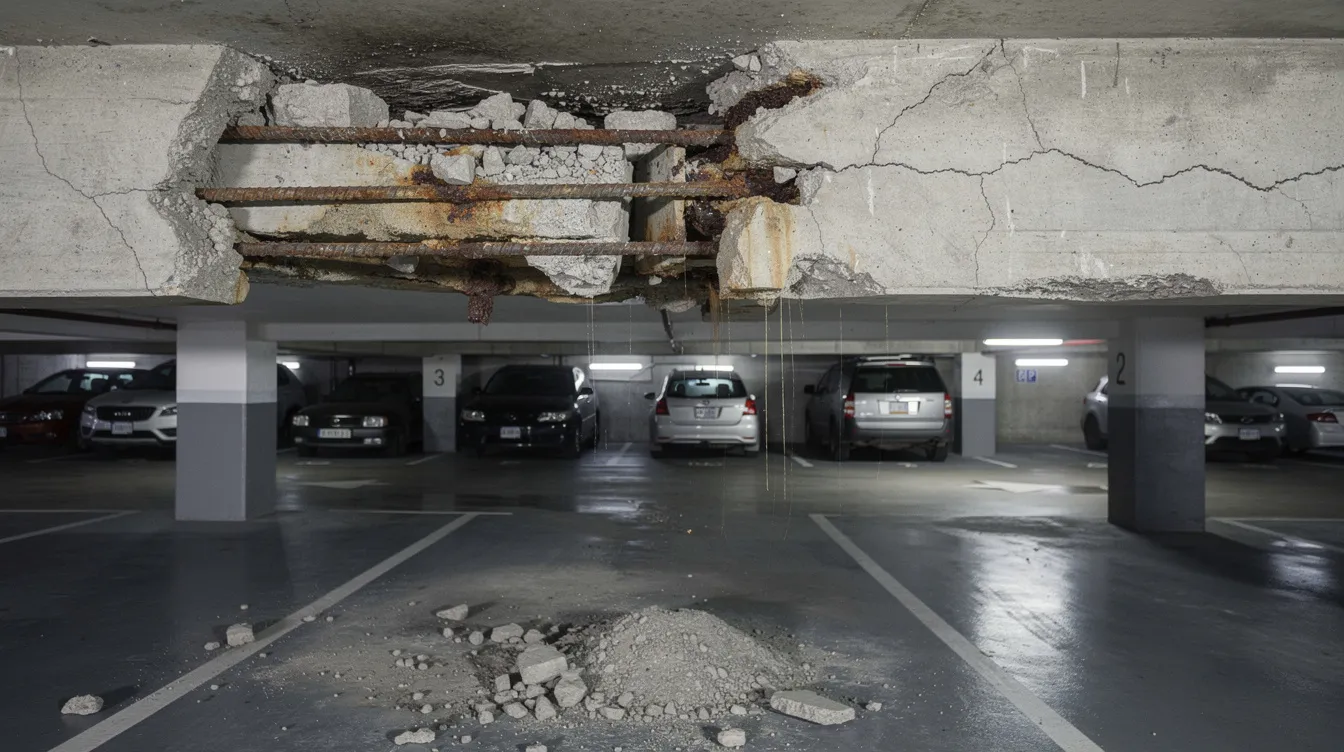
Structural inspections are required under BCA regulations to cover the building’s structural framing – columns, beams, slabs, load-bearing walls – as well as foundations (where accessible), roof structures, stair and lift cores, and critical common property elements such as podium carparks, link bridges, canopies, and basements. The appointed engineer conducts a visual inspection looking for cracks, deflection, corrosion, spalling concrete, signs of deformation, and evidence of unauthorized structural works. If serious defects are suspected, a full structural investigation is triggered.
PSI is distinct from façade inspection (PFI), which focuses on building facades, external tiles, and cladding. However, PSI and PFI are types of structural inspections that often run in parallel for older condominiums. Facade inspections are part of structural inspection services that a competent person or engineering consultancy can coordinate alongside PSI to reduce disruption and costs.
Which Condominium Buildings Must Undergo PSI?
The applicability of PSI depends on several factors:
Building use. Residential strata developments managed under the Building Maintenance and Strata Management Act (BMSMA) by an MCST fall under the PSI regime. For buildings used solely for residential purposes, the inspection frequency differs: the cycle is every 10 years from first occupation. Non-residential or mixed-use buildings must undergo inspection every 5 years. If your condominium includes a commercial podium with shops, F&B outlets, or offices, the entire structural system may fall under the shorter 5-year cycle depending on BCA’s classification.
Age thresholds. A building becomes due for its first PSI after the Temporary Occupation Permit or Certificate of Statutory Completion is issued, with the clock starting at 10 years for purely residential developments. BCA may issue a notice earlier if there are structural concerns, a change of use, or if the building presents particular risk factors.
Building owner definition. The “building owner” in BCA’s eyes for common property is the MCST – not individual unit owners. This means the MCST council bears direct legal responsibility for compliance, including appointing the engineer, funding the inspection, and acting on findings.
Mixed-use condominium developments require careful classification. Where residential blocks share a structural system with commercial components, MCSTs should verify their usage classification with BCA to confirm whether the 5-year or 10-year cycle applies. A recent pilot between BCA and URA for shophouse buildings now requires structural engineers conducting PSI to include usage declaration observations, which may signal future expansion of such requirements to other building types.
Key Stakeholders, Including Private Limited Companies, in a PSI for Condominiums
Several parties play essential roles in a condominium PSI:
-
MCST / council members represent the collective owners and hold ultimate legal responsibility as the building owner. They approve budgets, appoint the engineer, and ensure follow-through on recommendations.
-
Managing agent (MA) handles day-to-day coordination, maintains financial records and building documents, tracks deadlines, and facilitates access during inspections.
-
BCA-registered Professional Engineer (Structural) serves as the competent person who plans and conducts the inspection, prepares the report, and submits findings to BCA. The appointed engineer must be independent and qualified without stake in the original design.
-
Contractors and maintenance vendors support access requirements, provide equipment such as scaffolding or mobile elevated work platforms, and carry out any testing or remedial building works identified.
While responsibilities are shared across these parties, the legal duty ultimately rests with the MCST. Understanding exactly what the MCST must do in practice is the next critical step.
How PSI Applies to Condominium MCSTs
The general PSI framework translates into specific, concrete obligations for residential condominiums. This section focuses on what MCSTs must practically do – from their legal duties to the structural elements covered, and how PSI fits alongside other mandatory inspections.
MCST’s Legal Duties as “Building Owner”
Under the Building Control Act and the complementary BMSMA, the MCST is treated as the building owner for all common property, and as the legal entity or company responsible for common-property compliance. BCA provides guidelines for the PSI process and responsibilities of MCST and owners, and the legal duties are non-negotiable:
-
Appoint a structural PE within 2 months of receiving BCA’s PSI notice. MCST must appoint a registered Professional Engineer to conduct the PSI. Failure to appoint within the prescribed timeframe is a criminal offence carrying fines of up to SGD 20,000, and an MCST that misses required statutory steps may face penalties under the Building Control Act.
-
Notify BCA of the appointment using prescribed Form D2 within 7 days after the appointment deadline. Late filing of this notification can attract fines of up to SGD 10,000.
-
Provide access, drawings, and historical records. The MCST must facilitate inspections by providing access to common property, supply as-built structural drawings, previous PSI reports, maintenance and repair histories, and records of alterations and additions. The MCST must ensure documentation and historical records are available for inspections.
-
Act on PE recommendations. If defects or deterioration are detected, repair works identified during the PSI must be executed promptly by MCST. If immediate risk exists, interim measures such as load restrictions or closures may be required.
-
Submit the inspection report to BCA by the deadline. MCST is responsible for timely submission of the inspection report to BCA using prescribed forms and report templates via the CORENET-X portal.
-
Budget adequately. MCST must maintain sufficient sinking funds under BMSMA to cover both the inspection expenses and any recommended rectification works.
Failure to ensure PSI compliance can lead to fines and insurance complications. It can also weaken the MCST’s legal standing and strain working relationships with managing agents, insurers, or service providers. In severe cases, council members and directors may face personal exposure. The High Court decision in Smart Property Management v MCST Plan No 4375 [2022] SGHC 219 confirmed that managing agents have obligations to advise MCSTs on statutory inspections – failure to remind or ensure PSI compliance was actionable in that case.
Cooperation from individual owners is essential for effective inspections and compliance. Individual owners provide access for inspections and share costs based on unit value, with inspection fees and repairs funded through MCST’s sinking fund. Individual owners are collectively responsible for funding inspection fees and repairs. Property owners must avoid actions compromising building’s structural integrity, including unauthorized structural alterations by owners which can compromise building safety.
What PSI and Façade Inspection Cover in a Typical Condominium
A periodic structural inspection for a condominium covers the full range of structural elements that form common property:
-
Residential blocks: columns, beams, slabs, shear walls, staircases, and lift cores across all storeys
-
Common facilities: swimming pool shells and supporting slabs, clubhouse structures, gymnasiums, and function rooms
-
Podium and basement structures: carpark decks, basement retaining walls, entrance canopies, and link bridges connecting blocks
-
Ancillary structures: guardhouses, boundary walls, retaining walls, covered walkways, and sheltered areas
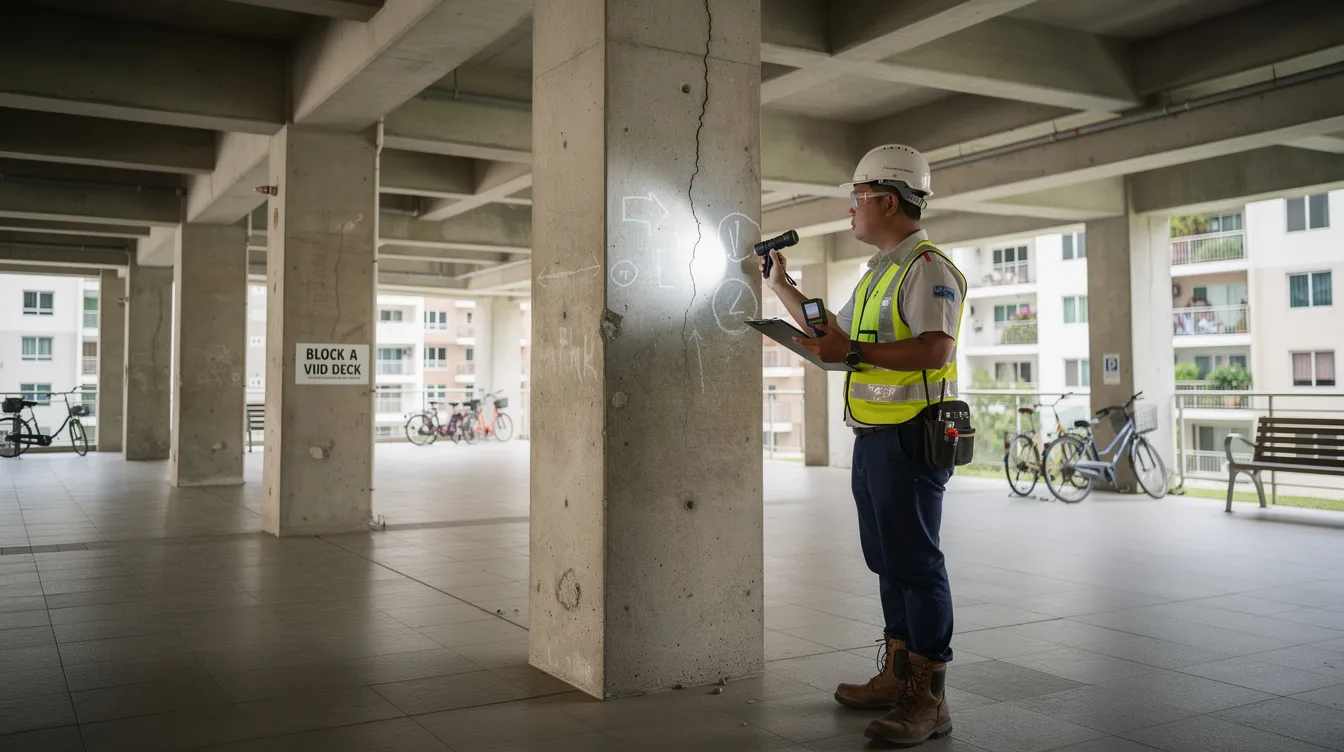
The interface between waterproofing systems and structural integrity is particularly important. Water ingress through failed waterproofing membranes on podium decks or balconies often leads to hidden corrosion of reinforcement, concrete spalling, and progressive structural damage that only becomes visible once deterioration is advanced. Older residential buildings built before 1989 with slender columns in void decks using lower-grade concrete (Grade 20) present special risk concerns that BCA has flagged in past advisories.
PSI vs Other Mandatory Inspections (PFI, Lifts, Fire Safety)
MCSTs must comply with multiple inspection regimes, and understanding the differences helps with planning and efficiency:
-
PSI – focuses on the structural integrity of the building framework (columns, beams, slabs, foundations) under BCA building control regulations.
-
PFI – Periodic Façade Inspection covers external walls, tiles, cladding, and fixed installations on building facades, typically required for buildings over 20 years old.
-
Lift and escalator inspections – governed under the Lift Maintenance & Safety Act with their own inspection cycles and competent person requirements.
-
Fire safety certifications – administered by SCDF, covering fire protection systems, escape routes, and fire safety compliance issues.
-
Electrical inspections – periodic checks of electrical systems under relevant regulations.
MCSTs should integrate PSI with these other compliance cycles using a statutory compliance calendar. Coordinating inspections can reduce disruption to residents and control costs – for example, shared scaffolding between PSI and PFI activities, or scheduling inspections during the same period to minimise access restrictions.
With the fundamentals and regulatory context established, the next section walks through exactly how the PSI process unfolds for a condominium MCST.
The PSI Process for Condominium MCSTs
This section provides a practical walkthrough of how a typical PSI unfolds – from the moment BCA issues a notice through to final submission. Understanding these steps and their timelines allows MCST councils and managing agents to plan effectively and avoid compliance risks.
Step-by-Step PSI Workflow for a Condo
-
Check BCA notification and building age. The MCST must monitor deadlines and ensure compliance with PSI notices. Confirm the date of your building’s TOP/CSC and determine when the next PSI is due. BCA will serve a formal PSI notice, but proactive MCSTs track this independently.
-
Shortlist and appoint a BCA-registered Structural PE. Engage a qualified structural engineering consultancy – such as AMAN Engineering Consultancy – through council approval. Obtain at least two to three quotations for comparison. Allow 4–8 weeks for budget approval through AGM or council resolution.
-
Collate existing documents. Gather as-built structural drawings, previous PSI or structural reports, major repair records, alteration and addition (A&A) approvals, and defect logs. Good document preparation significantly reduces the PE’s uncertainty and can control both cost and inspection duration.
-
Conduct initial site walk-through. The PE and managing agent review the site together to scope inspection areas, identify access requirements, and plan for any areas where false ceilings or cladding may need temporary removal to expose hidden structural elements.
-
Execute detailed inspection. The PE personally carries out the visual inspection – this is a regulatory requirement. The survey covers all structural elements, looking for cracks, spalling, corrosion staining, deflection, settlement, and evidence of unauthorized structural works. Selective non-destructive testing (NDT) such as cover meter surveys, rebound hammer tests, or concrete core sampling may be conducted where the PE deems necessary.
-
Full investigation if required. If the visual inspection reveals defects of structural significance, the PE triggers a full structural investigation with BCA’s prior approval. This may include material testing, load testing, reconstruction of design calculations, and detailed analysis of deterioration mechanisms.
-
Receive and review PSI report. The PE prepares a comprehensive report summarising findings, defect severity classifications, risk levels, and recommended rectification works with priorities and timeframes. Photographic evidence and defect mapping on plan layouts are included per BCA’s updated September 2024 Guidelines for Structural Engineers.
-
Implement recommended measures. The MCST acts on the PE’s recommendations, prioritising immediate safety items. This may involve engaging contractors for remedial structural works, imposing load restrictions, or implementing monitoring regimes.
-
Submit final PSI certification to BCA. The PE submits the completed report and prescribed forms (D2, D3–D7 as applicable) via BCA’s CORENET-X portal. The MCST must ensure this happens within the deadlines specified in the PSI notice.
Documentation, Annual Return, and Technical Information Required
The quality and completeness of documentation directly affects the efficiency and cost of PSI. MCSTs should prepare:
-
Structural and architectural as-built drawings – especially for all blocks, podium structures, basements, and ancillary buildings
-
Past A&A records – any alterations affecting structure, such as new roofs, extended canopies, mezzanine floors, or loft constructions
-
Maintenance and repair records – previous spalling concrete repairs, strengthening works, waterproofing upgrades, and any related expenses
-
Incident records – documented complaints of water ponding, settlement, cracks reported by residents, and any past BCA advisories
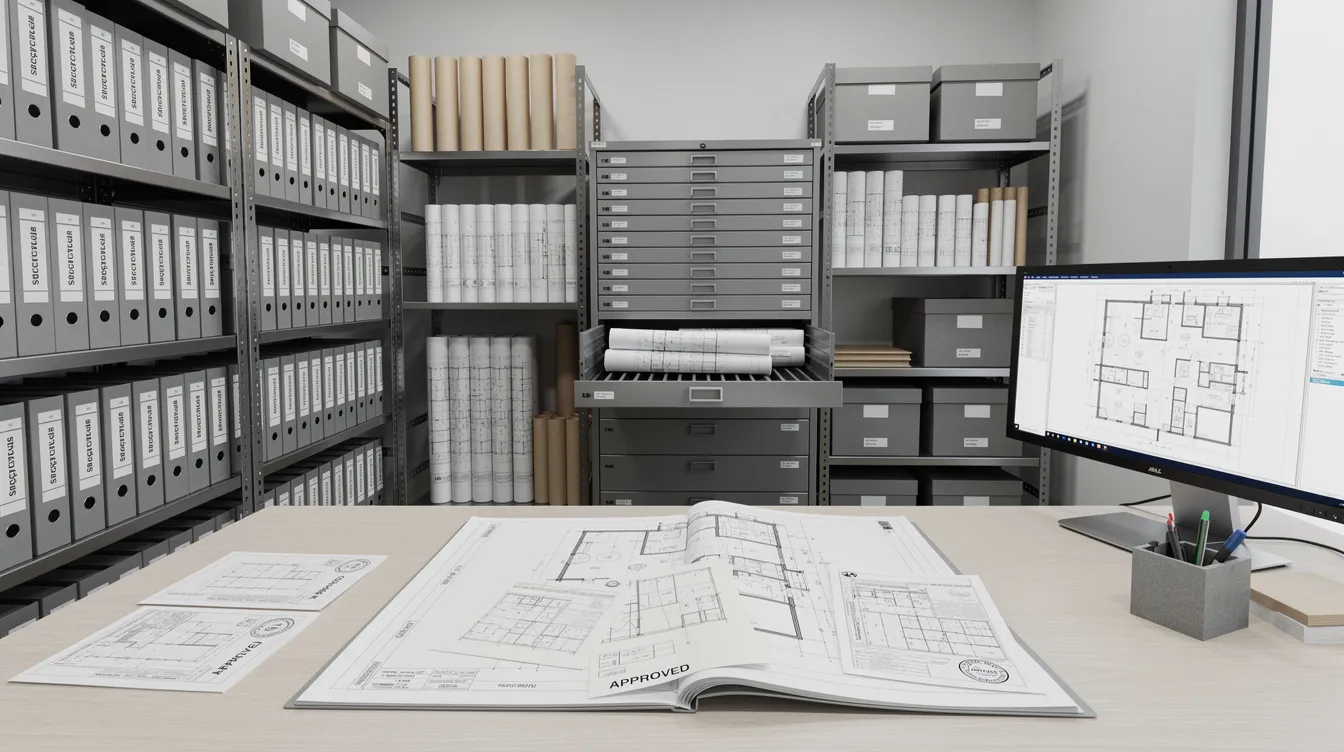
When these financial records and technical documents are well-organised, the PE can focus testing on areas of genuine concern rather than making conservative assumptions across the entire building. Missing documentation increases cost because the engineer may need investigative surveys to reconstruct structural assumptions. A centralised digital archive – ideally maintained by the managing agent – is a best practice that every MCST should implement, especially when the managing agent is a company coordinating records across multiple developments or business functions.
Timeframes, Cost Drivers, and Planning Considerations
Typical duration from PE appointment through to BCA submission is 4–10 weeks for most condominiums during Stage 1 (visual inspection and reporting). Complex developments with multiple blocks, access challenges, or Stage 2 investigations can take significantly longer.
Key cost drivers include:
|
Factor |
Impact on Cost |
|---|---|
|
Size and number of blocks |
More blocks and storeys increase inspection area and time |
|
Basements and ancillary structures |
Podium carparks, retaining walls, and link bridges add scope |
|
Access equipment needs |
MEWPs, scaffolding for high or hard-to-reach areas increase costs |
|
Extent of NDT or laboratory tests |
Material sampling, cover meter surveys, and load testing add expenses |
|
Completeness of existing drawings |
Missing records require investigative surveys and reconstruction |
Indicative Stage 1 PSI fees for condominiums:
-
Small condos (50–100 units, ≤10 storeys): SGD 3,500–5,500
-
Medium condos (100–300 units, 10–20 storeys): SGD 5,500–9,000
-
Large condos (300–600 units, 20–30 storeys): SGD 9,000–15,000
-
Mega developments (600+ units, 30+ storeys): SGD 15,000–25,000+
Stage 2 investigation costs are quoted separately and depend on the scope of testing required. MCSTs should include PSI costs and anticipated follow-up rectification works in their sinking fund planning and annual budget cycles. Budget approval from MCSTs can take 4–8 weeks in practice, so early planning is essential to meet BCA deadlines.
Practical Implementation, Risk Management, and Optimisation
Once MCSTs understand the PSI process, the next consideration is how to manage it efficiently – minimising disruption to residents, interpreting findings correctly, and extracting long-term value from the inspection results.
Coordinating PSI with Residents and Operations
Effective communication between the MCST, managing agent, and residents is critical during PSI activities:
-
Issue advance notices for any noisy works, NDT activities, or temporary closures of common corridors, carparks, or facilities. Use digital channels – resident apps, email, and physical notice boards – to keep schedules updated.
-
Establish clear safety cordoning and signage around active inspection zones, particularly in carparks and void decks where residents and vehicles regularly pass.
-
Stagger inspection schedules across blocks and facilities to avoid simultaneous disruption to all residents. Coordinate with the PE to plan efficient access routes that minimise the need for repeated mobilisation of equipment.
-
Maintain access to essential services – fire escape routes, drop-off points, emergency vehicle lanes – throughout the inspection period.
Regular maintenance is required between PSI inspections to ensure safety. BCA has emphasised that buildings aged 30 years or more should undergo more frequent self-inspections beyond statutory PSI and PFI cycles, especially for exposed surfaces, weather-worn elements, and suspended installations.
Interpreting PSI Findings and Prioritising Repairs
The PE’s report typically classifies findings into categories that guide the MCST’s response:
-
Immediate safety concerns – defects requiring urgent action such as temporary propping, load restrictions, or area closures. These cannot be deferred regardless of budget constraints.
-
Medium-term defects – corrosion, spalling concrete, water ingress damage, or cracking that requires planned rectification within a defined timeframe, typically months rather than days.
-
Minor defects and monitoring items – cosmetic or early-stage issues that should be tracked and reassessed during the next inspection cycle or through periodic self-inspections.
A risk-based approach – weighing probability of failure against consequence – helps MCSTs prioritise works and allocate money from the sinking fund effectively. Transparent communication of findings and cost estimates to subsidiary proprietors builds confidence for necessary levy adjustments and supports AGM budget approvals.
Aligning PSI With Long-Term Asset Management
PSI results should not be treated as a one-off compliance checkbox. They create valuable data that feeds into broader asset management:
-
Capital replacement planning – PSI findings inform 10–15 year forecasts for structural component renewal, helping MCSTs plan sinking fund contributions realistically under BMSMA requirements.
-
Sinking fund forecasts – accurate knowledge of structural condition allows the MCST to set adequate levies rather than facing sudden large assessments when problems become urgent.
-
Value engineering opportunities – where structural capacity allows, PSI data can support decisions about integrating new uses such as solar panel installations on roofs or heavier equipment loads in common areas.
-
Technology integration – BIM and 3D structural models can track defect locations across inspection cycles, improve accuracy of future assessments, and support digital submissions to BCA.
Treating PSI as part of a long-term risk mitigation strategy rather than a reactive compliance exercise ultimately saves money, reduces disruption, and preserves property values for all owners.
Common PSI Challenges for MCSTs and How to Solve Them
Many condominium councils face recurring pain points when meeting PSI obligations – particularly older estates with volunteer-run councils, limited budgets, or fragmented record-keeping. Here are the most common mistakes and practical solutions.
Problem 1: Missing Drawings and Historical Records
The challenge: Original structural drawings or past inspection reports cannot be located after changes in managing agents or council turnover. This is especially common in condominiums that have passed through multiple management transitions over decades of operations.
Solutions:
-
Request copies from BCA, the original architect, structural engineer of record, or developer where possible
-
Allow the PE to adopt investigative surveys and limited testing to reconstruct structural assumptions – though this increases costs and may lead to more conservative recommendations
-
Implement a centralised digital archive going forward, ensuring all as-built drawings, A&A records, PSI reports, and repair documentation are maintained electronically by the managing agent with handover protocols during any management transition
Problem 2: Budget Constraints and Sinking Fund Limitations
The challenge: Older estates may be underfunded for both the PSI itself and recommended remedial works. Individual owners may resist levy increases, and AGM resolutions for significant expenses can be contentious.
Solutions:
-
Phase rectification works by priority based on the PE’s risk classification – address immediate safety items first, then schedule medium-term works across financial year cycles
-
Integrate PSI costs into upcoming budgets and AGM approvals early, well before BCA notices arrive
-
Use PSI findings to justify necessary levies or adjustments transparently to owners – factual, well-documented presentations to subsidiary proprietors build support and reduce objections
-
Note that delaying works due to budget unwillingness does not exempt the MCST from legal liability if safety is compromised
Problem 3: Access and Operational Disruption
The challenge: Limited working hours, tight carpark layouts, or residents objecting to temporary facility closures can slow or obstruct the inspection process.
Solutions:
-
Plan access routes and equipment needs with the PE and contractor well before the inspection commences
-
Use a staggered inspection schedule across blocks and facilities to spread disruption
-
Deploy less intrusive technologies where practical – for example, selective NDT methods instead of extensive hacking, or drone inspections for preliminary assessments of hard-to-reach areas
-
Coordinate PSI access with other scheduled maintenance or inspection activities (PFI, lift inspections) to consolidate disruption periods
Problem 4: Council Turnover and Loss of PSI Follow-Through
The challenge: A new MCST council inherits unresolved PSI recommendations from a previous term. Outstanding remedial works, monitoring schedules, or BCA submissions may be forgotten or deprioritised, creating serious compliance risks and potential legal exposure.
Solutions:
-
Maintain a standing Compliance Register that documents all statutory inspection deadlines, outstanding actions, and responsible parties – this register should survive council transitions
-
Ensure the managing agent has explicit standard operating procedures to track statutory inspections including PSI, PFI, fire safety, and lift certifications
-
Request the PE or engineering consultant to brief incoming councils after AGMs, providing a clear review of the building’s structural status and any pending obligations
-
Consider engaging an accredited managing agent with demonstrated competency in statutory compliance management
With proactive planning and systematic record-keeping, PSI compliance becomes a manageable, routine part of condominium governance rather than a crisis-driven scramble.
Conclusion and Next Steps for MCSTs
PSI is a mandatory BCA requirement that directly protects resident safety and preserves the structural integrity – and financial value – of condominium property. The MCST, as building owner under Singapore law, bears full legal responsibility for timely, competent inspections and follow-through on findings. There is no waiver available for this obligation, and the penalties for non-compliance extend beyond fines to potential court summons, insurance voidance, and personal liability for council members.
Every MCST should take these immediate actions:
-
Confirm when your condominium’s next PSI is due based on building age, TOP date, and previous inspection records
-
Review whether structural drawings and past reports are properly archived – if not, begin reconstruction and digitisation now
-
Identify budget provisions for the upcoming PSI and likely rectification works within your sinking fund plan
-
Engage a qualified structural PE or consultancy early to scope works and establish realistic timelines – allow at least 2–3 months before BCA deadlines
-
Establish an internal compliance calendar to track PSI, PFI, fire safety, and other statutory inspection cycles systematically
MCST owners must file Annual Returns to ACRA as part of their corporate obligations, with late Annual Return filings incurring penalties of up to $600. All companies in Singapore must maintain accurate financial records and financial statements. While these accounting and corporate compliance duties are separate from PSI, they form part of the broader governance landscape that MCST councils – particularly those structured as private limited companies or managing dormant companies – must navigate alongside building safety obligations. Staying current on tax assessments, annual return filings, and building inspection compliance together prevents cumulative compliance issues.
Related topics MCSTs may want to explore include Periodic Façade Inspection (PFI) requirements, SCDF fire safety certifications, BIM-based asset records for structural documentation, and integrated maintenance planning for ageing estates.
AMAN Engineering Consultancy supports MCSTs across Singapore with PSI, PFI, structural assessments, BIM documentation, and authority submissions – providing the technical confidence and implementation support that condominium councils need for efficient, fully compliant building safety management.
Additional Resources for Condominium PSI Compliance
This section provides supplementary references and tools for MCSTs seeking deeper detail beyond the core process explained above.
Key regulatory references:
-
BCA’s Periodic Structural Inspection guidelines and circulars – the primary published resource for building owners and structural engineers
-
Building Control (Periodic Inspection of Buildings and Building Façades) Regulations 2021 – the full legal text including amendments through S 594/2025
-
BCA FAQ for Building Owners (September 2024) – practical answers to common MCST questions
Practical planning tools:
-
A PSI document checklist: as-built drawings, previous PSI reports, A&A records, maintenance logs, incident reports, BCA correspondence, sinking fund budget allocations
-
A sample high-level PSI timeline spanning 3–4 months: BCA notice receipt → council approval and PE appointment (weeks 1–4) → document collation and site scoping (weeks 3–6) → visual inspection and testing (weeks 5–10) → report preparation (weeks 8–12) → MCST review and BCA submission (weeks 10–14)
Digital tools and future-proofing: BIM and 3D structural models help MCSTs track defects over successive inspection cycles, visualise structural conditions for subsidiary proprietors during AGM presentations, and create efficient digital archives that benefit future PSIs. These technology solutions reduce cost and improve accuracy with each successive inspection cycle.
Requirements evolve – BCA published updated Guidelines for Structural Engineers in September 2024, and regulatory amendments continue. MCSTs should always consult the most current BCA publications and engage qualified professionals to confirm current obligations before acting.