
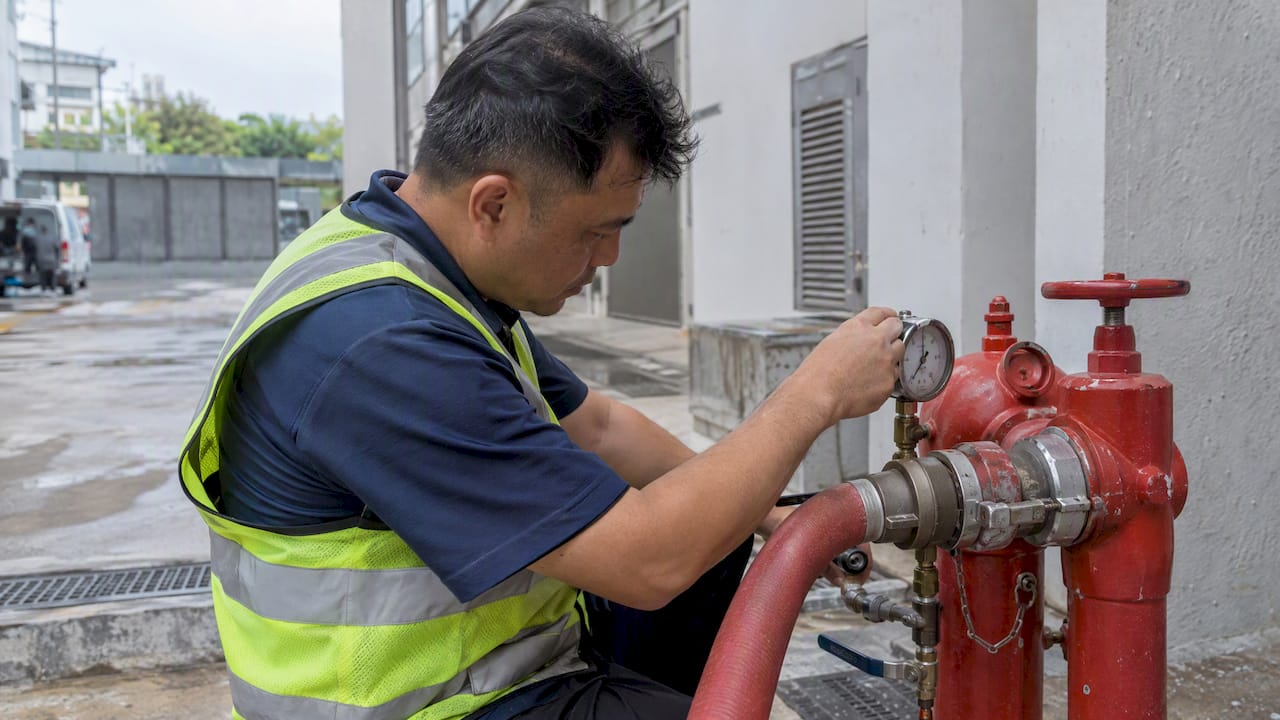
A hydrant flow test measures the static pressure, running pressure, and flow rate at a private fire hydrant to confirm it can deliver water at the volume firefighters need. For compliance in Singapore, the two checks that matter most are whether the running pressure meets or exceeds 0.9 times the nearest public hydrant’s reading and whether the running pressure stays above 2 bars. A Professional Engineer and a licensed contractor must witness and certify the results. If either threshold fails, we recommend halting the test and arranging rectification before resubmission.
TL;DR:
- Tests are annual, with a licensed Professional Engineer signing off and a certified fire protection contractor performing them; schedule six to eight weeks before certificate expiry.
- Test the hydraulically most unfavorable hydrant, account for meter pressure loss, and sustain at least 2 bars of running pressure for the full 45 minutes.
- A failed reading should trigger a root cause check, especially for meter pressure loss, restricted valves, sediment buildup, or pump faults, before remedial work.
Table of Contents
- What SCDF requires: Clause 4.4 and Table 4.4.2 summarized
- Who must do the test and how often (PE, contractor, and FC timing)
- Step-by-step hydrant flow test procedure (equipment, measurements, sequence)
- Interpreting results and common failure causes
- Records, forms and how tests feed the Fire Certificate
- Practical planning and compliance tips from Aman Engineering Consultancy
- Aman’s short perspective: treat flow tests as continuous maintenance
- How Aman Engineering Consultancy can help with testing coordination and FC readiness
- FAQ
- Sources
What SCDF requires: Clause 4.4 and Table 4.4.2 summarized
Singapore’s fire hydrant obligations sit under Clause 4.4 of the SCDF Code of Practice, which sets the pass or fail criteria every private hydrant must meet before a Fire Certificate can be issued. The clause measures performance relative to the nearest public hydrant rather than against a fixed universal figure, which means the benchmark shifts depending on where a building sits in the water network.
The core requirements are:
- Running pressure at the hydraulically most unfavourable hydrant must reach at least 0.9 times the nearest public hydrant’s reading, after accounting for meter pressure drop.
- Flow rate must reach at least 0.9 times the nearest public hydrant’s flow, or meet the total demand set out in Table 4.4.2, whichever applies.
- Minimum running pressure is 2 bars, sustained for a minimum duration of 45 minutes.
- Flow rate tiers scale with Accessible Floor Area and are specified in official guidelines in litres per second for different size categories of buildings.
Where mains pressure cannot reliably deliver these figures, storage tanks and pumps become mandatory, and hydrants serving levels above RL125m carry additional pumping provisions given the elevation loss involved. Table 4.4.2 is the reference point for every flow calculation that follows, so we treat it as the starting document for any test plan.
Who must do the test and how often (PE, contractor, and FC timing)
Fire hydrant flow tests in Singapore run on an annual cycle tied to the Fire Certificate scheme, which requires fire protection systems to be inspected and tested each year before renewal. Missing this window risks a lapsed certificate, which exposes the building owner to enforcement action.
Three points govern who can perform the work and when:
- A licensed Professional Engineer must verify the test methodology and sign off on the readings submitted to SCDF.
- A certified fire protection contractor carries out the physical test, operates the equipment, and records the data on the prescribed forms.
- Owners should schedule testing at least six to eight weeks ahead of the FC expiry date, leaving room for a rectification cycle and a re-test if the first attempt fails.
Booking early matters more than it sounds. A failed first test with no buffer time left before expiry often forces an emergency rectification scramble, and that pressure tends to produce rushed repairs rather than durable fixes.
Step-by-step hydrant flow test procedure (equipment, measurements, sequence)
A compliant test follows a fixed sequence, and skipping a step is the fastest way to generate a result SCDF will reject on review.
- Identify the hydraulically most unfavourable hydrant, typically the one farthest from the water main connection or at the highest elevation on site, since this is the hydrant most likely to fail if the system is marginal.
- Exercise and partially open isolation valves before the formal test begins. A valve that has not been cycled recently can artificially suppress running pressure readings and trigger a false failure.
- Record static pressure with the hydrant closed, using a calibrated pressure gauge connected to the outlet.
- Open the hydrant and record running pressure once flow stabilizes, typically after 30 to 60 seconds.
- Measure flow rate using a pitot gauge or flow meter fitted to the outlet, converting the pitot reading to liters per second using the standard orifice coefficient for the nozzle size in use.
- Sustain the flow for the full 45-minute duration, noting any pressure drift, and engage pump sets where the system includes fire pumps to confirm they start and hold pressure correctly.
Equipment typically includes a calibrated pressure gauge, a pitot tube or inline flow meter, and a pillar hydrant adapter sized to the local SCDF-standard outlet. Calibration certificates for each gauge should be current and photographed alongside the readings.
Key documentation to capture during the test:
- Photographs of the gauge face at static pressure, running pressure, and peak flow.
- Serial numbers and calibration dates for every instrument used.
- Time stamps for the start and end of the 45-minute run.
- Any valve, pump, or meter anomalies observed mid-test.
Pro Tip: Flush the hydrant briefly before connecting gauges; trapped sediment in a rarely used hydrant can skew the first pressure reading and cause an unnecessary retest.
Isolate the test zone from active firefighting systems during the run and post a site notice, since sudden pressure drops elsewhere in the building’s water supply can alarm occupants or trip unrelated alarms.
Interpreting results and common failure causes
Compare every reading against Table 4.4.2 and the 0.9 times rule rather than against a flat number, since the pass threshold depends on the nearest public hydrant’s own performance on test day. A running pressure below 2 bars is an automatic fail regardless of flow rate, because duration and pressure both have to hold for the full 45 minutes.
Common causes of failure include:
- Partially closed or seized isolation valves restricting flow before it reaches the hydrant.
- Water meter pressure drop that was not accounted for in the original design calculation.
- Scale or sediment buildup inside aging pipework reducing effective bore diameter.
- Fire pump faults, including delayed start or inability to sustain discharge pressure.
Pro Tip: When a reading fails by a narrow margin, check the meter pressure drop first. It is the most frequently overlooked variable and the cheapest to correct.
Document the failure mode immediately, since SCDF and the engaging Professional Engineer will want a clear root cause before approving remedial works, not just a note that the hydrant failed.
Records, forms and how tests feed the Fire Certificate
Every reading has a designated field on SCDF’s prescribed forms, and leaving one blank is a common reason submissions get returned. The Fire Certificate application form and its Annex A-1 attachment require static pressure, running pressure, and actual flow rate for each private hydrant tested, along with separate fields for hydrostatic pump readings where a fire pump is installed.
Supporting attachments owners should prepare alongside the form:
- Photographs of gauge readings at each measurement stage.
- A signed endorsement from both the Professional Engineer and the testing contractor.
- Current calibration certificates for every gauge and meter used.
We recommend retaining test logs, photographs, and calibration records for at least the full FC cycle, since SCDF can request supporting documentation during a compliance review even after the certificate has been issued. Treating this as a standing file rather than a one-time submission saves significant time at the next renewal.
Practical planning and compliance tips from Aman Engineering Consultancy
We advise booking the PE and testing contractor at least six to eight weeks before FC expiry, which leaves enough buffer for rectification and a re-test without risking a lapsed certificate. Always test the hydraulically most unfavourable hydrant rather than the easiest to access, and validate the meter pressure drop separately, since it is the detail most often missed in a first attempt.
Pro Tip: Keep one consolidated log per hydrant covering photographs, equipment serial numbers, calibration dates, and the PE’s sign-off, so renewal season becomes a review rather than a scramble.

Where mains pressure cannot sustain Table 4.4.2 flows, storage tanks and pump sets, guided by PUB’s water supply handbook, are the accepted design remedy rather than a workaround.
Aman’s short perspective: treat flow tests as continuous maintenance
Most owners treat the hydrant flow test as a once-a-year event, scrambling in the weeks before FC expiry. We think that approach creates avoidable risk. A monthly quick check, exercising isolation valves and confirming gauge access, catches the kind of valve seizure or sediment buildup that otherwise surfaces for the first time during the formal test, when there is far less room to fix it.
— Aman
How Aman Engineering Consultancy can help with testing coordination and FC readiness
We coordinate the hydrant compliance process for property owners and facility managers, from scheduling the PE and contractor through to Fire Certificate submission.

Our relevant services include:
- Authority Approvals covering Fire Safety Certificate applications and statutory submissions to SCDF.
- Real Estate Inspection support for pre-test condition checks and documentation.
- PE Endorsements for test readings and Annex A-1 sign-off.
- Fire Safety Certificate coordination from test scheduling through to submission.
Reach out with your FC expiry date and site details, and we will scope the testing schedule, flag any rectification risk early, and manage the paperwork through to approval. For budgeting the maintenance cycle around testing and rectification costs, the condo maintenance checklist from Haio is a useful planning reference. Start with our authority approvals page to see how the engagement works.
FAQ
What are the requirements for SCDF hydrant testing in Singapore?
Private hydrants must deliver a running pressure at least 0.9 times the nearest public hydrant’s reading, with a minimum running pressure of 2 bars sustained for 45 minutes. A Professional Engineer and certified contractor must perform and certify the test on SCDF’s prescribed forms.
How are hydrants flow tested?
A contractor records static pressure with the hydrant closed, then opens it and measures running pressure and flow rate using a pitot gauge or flow meter once the flow stabilizes. The test runs for a minimum duration of 45 minutes, with readings photographed and logged throughout.
What are the requirements for hydrant flow testing?
Flow rate must meet the tier set by Accessible Floor Area under Table 4.4.2: 38 liters per second for buildings up to 1000 m², 57 liters per second for buildings over 1000 to 5000 m², and 76 liters per second for buildings above 5000 m². Running pressure must stay at or above 2 bars for the full test duration.
How often should hydrants be flow tested?
Private fire hydrants in Singapore are tested annually as part of the Fire Certificate renewal cycle. We recommend scheduling the test six to eight weeks before expiry to leave room for rectification if the first attempt fails.
Sources
- Clause 4.4 Fire hydrant – Singapore Civil Defence Force
- Handbook on application for water supply – PUB