
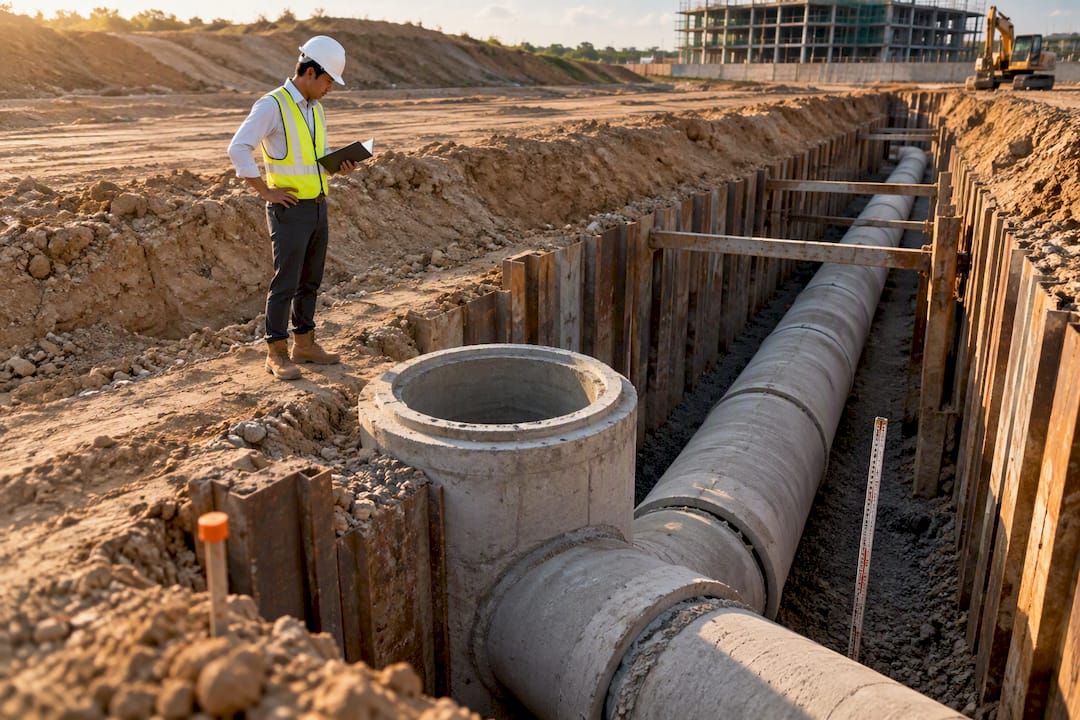
Singapore does not issue a standalone sewer diversion permit. Diversions of existing public sewers are governed under the Sewerage and Drainage Act and PUB’s Code of Practice on Sewerage and Sanitary Works, and they are handled through coordinated PUB submissions rather than a single license. The immediate next step for any project team is to obtain a Sewerage Interpretation Plan and engage a Qualified Person before excavation begins, since unauthorized works risk fines and stop-work orders.
TL;DR:
- Singapore requires property owners and developers to follow a layered approval process, involving a Sewerage Interpretation Plan and multiple PUB submissions before excavation near sewers.
- Deviations from technical COPSSW standards, such as setbacks or pipe materials, incur fees and lengthen approval timelines, especially if resubmissions are needed.
- The sequence of SIP verification, DC, DP, and POWS applications must be strictly followed; skipping steps can cause rejection, delays, or legal penalties.
- PUB reviews focus on specific technical details like manhole materials, hydraulic data, and monitoring requirements, with most rejections caused by preventable documentation gaps.
- A coordinated project approach through expert consultancy reduces resubmission cycles, prevents costly errors, and ensures compliance with Singapore’s sewer diversion regulations.
Table of Contents
- How Singapore Regulates Sewer Diversions
- Who Must Apply and What the Law Requires
- The Submission Sequence: SIP, DC, DP, and PUB Clearance
- Technical Standards COPSSW Expects in Every Submission
- Deviation Fees and Realistic Approval Timelines
- Practical Steps for the QP and the Contractor on Site
- Common Pitfalls That Delay Approval
- How Aman Engineering Consultancy Supports PUB Submissions
- Why the Checklist Matters More Than the Paperwork
- Get Submission Support Before You Break Ground
- Sources
- FAQ
How Singapore Regulates Sewer Diversions
Property developers, contractors, and building owners often search for a “sewer diversion permit” expecting a discrete license number. What they actually encounter is a layered regulatory system built around two documents: the Sewerage and Drainage Act, which establishes the legal authority PUB holds over public sewers, and the Code of Practice on Sewerage and Sanitary Works (COPSSW), now in its 3rd Edition dated March 2025, which sets the technical rules for how sewers must be designed, protected, or moved.
The Act makes it an offense to carry out works affecting a public sewer without the required clearance or approval, and it gives PUB the power to direct how such works are executed. COPSSW then translates that authority into engineering detail: pipe materials, manhole spacing, gradients, and the circumstances under which PUB will even consider a diversion, always at the developer’s cost.
A handful of terms recur throughout every submission and are worth fixing early:
- Sewerage Interpretation Plan (SIP): a PUB-issued reference showing indicative sewer alignments and depths near a site.
- Public sewer corridor: the protected strip of land above and around a public sewer where specified activities trigger separate approval.
- POWS/WRN: the Permit to Carry Out Works system and its associated Work-within-Reserve Notification advisory notes covering activities in that corridor.
- DC and DP: Development Control and Detailed Plan submissions, the two sequential clearances a Qualified Person lodges with PUB.
- TOP/CSC: the Temporary Occupation Permit and Certificate of Statutory Completion stages where PUB issues final sewerage clearance.
Large sewers and corridors within the Deep Tunnel Sewerage System, or DTSS, receive additional scrutiny because any disruption there affects citywide wastewater conveyance rather than a single catchment. Projects near DTSS infrastructure should expect instrumentation and monitoring requirements layered on top of the standard submission sequence.
Who Must Apply and What the Law Requires
Responsibility for sewer diversion compliance splits across three parties, and confusion about who owns which task is a common source of delay. The property owner or developer commissions the project and bears ultimate liability for unauthorized works. The Qualified Person, typically a professional engineer, prepares and endorses the DC and DP submissions. The contractor executes site works and carries the day-to-day duty to enquire with PUB before any excavation near a known or suspected sewer line.
That duty to enquire is not optional. Before breaking ground, the contractor must obtain current PUB service plans and confirm whether the works fall within a public sewer corridor. Skipping this step is one of the most frequently cited causes of accidental sewer strikes on Singapore construction sites.
- Owner/developer: holds overall statutory responsibility and financial exposure for the project.
- Qualified Person: signs and submits DC and DP documents, endorsing technical compliance with COPSSW.
- Contractor: submits POWS applications for specified activities and implements protective measures during construction.
Under the Sewerage and Drainage Act, carrying out works affecting a public sewer without prior clearance is an offense carrying fines and, for continuing breaches, daily penalties on top of the original sum. Severe or repeated violations can escalate further under the Act’s enforcement provisions, and PUB retains the authority to order works stopped or reinstated at the offending party’s cost. For any project team weighing whether a submission is worth the paperwork, that enforcement backdrop answers the question decisively.
The Submission Sequence: SIP, DC, DP, and PUB Clearance
PUB’s building plan submission process follows a fixed order, and skipping ahead in that order is a reliable way to trigger a rejection. The sequence applies whether the project needs a full diversion, a protection scheme, or an additional sewer alongside the existing one.
- Request the Sewerage Interpretation Plan. The SIP shows PUB’s indicative record of sewer alignment, depth, and diameter near the site, and it is the baseline every later submission references.
- Verify SIP data against site conditions. A trial trench or CCTV survey confirms actual invert levels and pipe positions, since PUB’s service plans are a planning tool and often lack detail on existing lateral connections.
- Lodge the DC submission. Straightforward projects that meet eligibility criteria may use a Simplified Submission, acknowledged quickly by PUB’s system, while projects outside that scope require a full DC submission with the SIP attached.
- Lodge the DP submission. This stage requires endorsed layout plans, longitudinal sections, manhole schedules, and the PUB-DPCLR.XFD clearance form completed by the Qualified Person.
- Submit POWS/WRN applications where triggered. Any specified activity within the public sewer corridor, including piling, excavation, or heavy loading near a sewer, needs its own approval through the POWS system, separate from DC/DP.
- Carry out works under approved protective measures. For large sewers or DTSS-adjacent works, this includes the Construction Impact Assessment Report and any instrumentation PUB specifies.
- Submit as-built drawings and CCTV records. Once works are complete, PUB reviews the finished condition before granting clearance.
- Obtain PUB clearance for TOP or CSC. This final sign-off confirms the sewerage works meet approved plans and clears the way for occupation or completion certification.
A few distinctions matter within that sequence. Simplified Submissions save time but shift the burden onto the Qualified Person to confirm eligibility and retain documentation for audit, since PUB can request supporting records after acknowledgment. POWS and WRN approvals run on their own track and timeline, independent of DC/DP, which means a project can clear building plan approval and still be waiting on a POWS decision before it can break ground near the sewer corridor. Our POWS PUB submission service exists precisely because that parallel track catches project teams off guard when schedules are built around DC/DP alone. For a broader walkthrough of what each drainage deliverable contains, see our guide to PUB drainage submission.
Technical Standards COPSSW Expects in Every Submission
PUB reviewers check submissions against specific COPSSW design rules, and most rejections trace back to a handful of recurring gaps rather than exotic technical failures.
- Manhole connections require the specified materials. COPSSW does not permit uPVC pipe for manhole connections, a detail that trips up designers used to standard drainage practice.
- Diversions require minimum setback distances. Where a diversion is not feasible, PUB may instead require protection measures or an additional sewer positioned at least 5-meter horizontally from the affected sewer’s outer edge, unless PUB accepts a shorter distance on technical grounds.
- Longitudinal plans must show full hydraulic detail. Pipe diameter, gradient, bedding type, invert levels, top-of-pipe levels, and design velocity all need to appear on the submitted drawing, not just the plan view.
- DTSS-adjacent works carry monitoring obligations. Where the site sits close to DTSS infrastructure, PUB commonly requires a Construction Impact Assessment Report, ground or structural instrumentation, and in some cases web-based camera surveillance for the duration of works.
The Quick Guide to Detailed Plan submissions lists these drawing requirements in full, and treating that checklist as a pre-submission audit rather than a reference document catches most errors before PUB does.
Pro Tip: Draft the longitudinal plan and manhole schedule before finalizing the architectural layout, since sewer invert constraints often force adjustments to basement or foundation levels that are far cheaper to absorb early.
Deviation Fees and Realistic Approval Timelines
When a design cannot fully meet a COPSSW clause, such as the 5 meter setback rule, the Qualified Person applies for a deviation rather than redesigning around an impractical constraint. PUB reviews each deviation on its technical merits, and the application needs a clear justification supported by calculations, site constraints, or comparable precedent.
- Each deviation item is charged individually. Requesting deviations from several unrelated clauses in one submission means paying the fee for each item separately.
- Grouping related sub-clauses can reduce total fees. Where multiple deviation points share a single technical justification, a consolidated cover letter presenting them as one item is often accepted, cutting the number of chargeable items.
- Resubmissions are the most common timeline risk. Incomplete longitudinal data or unaddressed setback issues are the usual reasons a DP submission bounces back for correction.
- Build review time into the master schedule, not around it. Treating PUB clearance as a fixed-duration milestone rather than a variable one is where many project timelines go wrong.
As of April 2025, PUB charges a standardized processing fee of $950 per deviation item, which makes the grouping strategy above a genuine cost lever rather than a technicality. A project with four related deviation points can see meaningful savings if they are consolidated into a single, well-argued submission instead of filed as four separate items.
Practical Steps for the QP and the Contractor on Site
Turning the regulatory sequence into a workable site process comes down to a short list of disciplined checks, most of which cost little but prevent expensive rework later.
- Confirm SIP accuracy with a trial trench or CCTV survey before the design is locked, since indicative plans routinely miss lateral connections and true invert depths.
- Secure all required endorsements early. DP submissions need a professional engineer’s endorsement, plumbing works may need a licensed plumber’s sign-off, and boundary-sensitive plans need a registered surveyor’s confirmation.
- File POWS applications for every specified activity, including piling, excavation, or surcharge loading, within the public sewer corridor before mobilizing plant on site.
- Implement the protective measures PUB approves, such as trench support, monitoring instrumentation, or working hour restrictions, and document compliance throughout construction.
- Commission as-built surveys and CCTV inspection once works are complete, since PUB will not issue final clearance without them.
- Submit the as-built package for PUB clearance ahead of the planned TOP or CSC date, allowing buffer time for review.
For projects tracking multiple approval streams at once, our overview of updated PUB approval processes for Singapore builders covers how these steps interact with other statutory submissions running in parallel.
Pro Tip: Keep a single master log of SIP reference numbers, POWS approval dates, and DP endorsement versions, since PUB queries almost always ask for a specific document version rather than the latest one on file.
Common Pitfalls That Delay Approval
Most rejected submissions share a small set of root causes, and recognizing them in advance is far cheaper than discovering them after a resubmission notice.
- Trusting the SIP without site verification leads to designs based on inaccurate invert levels that fail once construction begins.
- Missing endorsements on DP drawings, particularly the professional engineer’s signature or surveyor confirmation, are an easy rejection trigger.
- Incorrect gradient or invert data on longitudinal plans forces a full technical resubmission rather than a minor correction.
- Unupgraded Y-junction connections where COPSSW requires a manhole connection instead create both a technical and legal exposure.
- Encroachments inside the sewer setback without an approved deviation are treated as noncompliant regardless of intent.
| Pre-submission check | Why it matters |
|---|---|
| SIP verified against trial trench or CCTV survey | Confirms actual pipe position and invert level before design is finalized |
| DP drawings carry all required endorsements | Missing signatures are a common cause of automatic rejection |
| Longitudinal plan shows gradient, bedding, and design velocity | These fields are checked directly against COPSSW clauses |
| POWS application filed for corridor activities | Required separately from DC/DP and often overlooked in scheduling |
| Deviation items grouped where technically justified | Reduces the number of chargeable processing fees |
Building a short internal sign-off against this list before a submission leaves the office catches the majority of issues PUB reviewers flag. Our drainage submission requirements overview expands on several of these checks for teams preparing their first PUB filing.
How Aman Engineering Consultancy Supports PUB Submissions
Aman Engineering Consultancy coordinates the statutory work sewer diversion projects require, from SIP verification and site surveys through Construction Impact Assessment Reports and instrumentation plans for DTSS-adjacent sites. Our team prepares POWS applications, secures the professional engineer endorsements DP submissions require, and manages as-built and CCTV reporting through to PUB clearance for TOP or CSC.
Project teams benefit from a coordinated approach that offers a single point of contact for the SIP, DC, DP, and POWS threads that would otherwise run through separate consultants. This single-point coordination, combined with a multidisciplinary professional engineering team, helps reduce resubmission cycles and schedule slippage that sewer corridor works near DTSS infrastructure tend to generate.
Why the Checklist Matters More Than the Paperwork
The recurring mistake in sewer diversion planning is not misunderstanding COPSSW, it is assuming the SIP is a design document rather than a starting point for verification. Teams that skip the trial trench step because the indicative plan looks precise enough are the ones filing the most resubmissions.

The COPSSW 3rd Edition update and its standardized deviation fee also change the economics of design decisions in a way many project teams have not caught up to. A setback that would have been a free design choice under looser interpretation now has a fixed cost attached, which means the grouping strategy for deviations is no longer a minor administrative tactic, it is a line item worth planning for at budget stage.
If there is one priority above the others, it is sequencing the POWS application correctly against the DC/DP timeline rather than assuming they move together. That single scheduling error, more than any technical drawing mistake, is what turns a routine diversion into a stalled project.
— Aman
Get Submission Support Before You Break Ground
Aman Engineering Consultancy prepares and coordinates the statutory submissions a sewer diversion requires, from SIP verification through POWS applications and PUB clearance.

Reach out through our Authority Approvals services to get your submission sequence reviewed before it reaches PUB’s desk.
Sources
Keep these primary documents on hand before drafting any submission, since PUB reviewers check plans directly against them.
- Code of Practice on Sewerage and Sanitary Works (3rd Edition – Mar 2025)
- Sewerage and Drainage Act – Singapore Statutes Online
FAQ
Do you need permission to connect to a public sewer?
Yes, any connection to a public sewer requires prior clearance under the Sewerage and Drainage Act, typically through the DC and DP submission process with PUB. Carrying out the connection without that clearance is an offense with attached fines.
What is a sewerage Interpretation Plan (SIP) in Singapore?
The SIP is a PUB-issued plan showing the indicative alignment, depth, and diameter of public sewers near a site, used as the starting reference for DC and DP submissions. Because it is a planning tool rather than an as-built survey, project teams typically verify it with a trial trench or CCTV survey before finalizing designs.
How long is DTSS?
DTSS refers to the Deep Tunnel Sewerage System, Singapore’s islandwide network of deep tunnels and centralized water reclamation plants, rather than a fixed measurement relevant to a single project. What matters for a sewer diversion submission is whether the site sits within or near a DTSS corridor, which triggers additional requirements such as a Construction Impact Assessment Report and instrumentation under the WRN advisory notes.
What is DC and DP submission?
DC, or Development Control, and DP, or Detailed Plan, are the two sequential clearances a Qualified Person lodges with PUB for sewerage works, following the SIP stage. The DP submission requires endorsed layout and longitudinal plans, manhole details, and the PUB-DPCLR.XFD form, as outlined in PUB’s building plan submission process.