
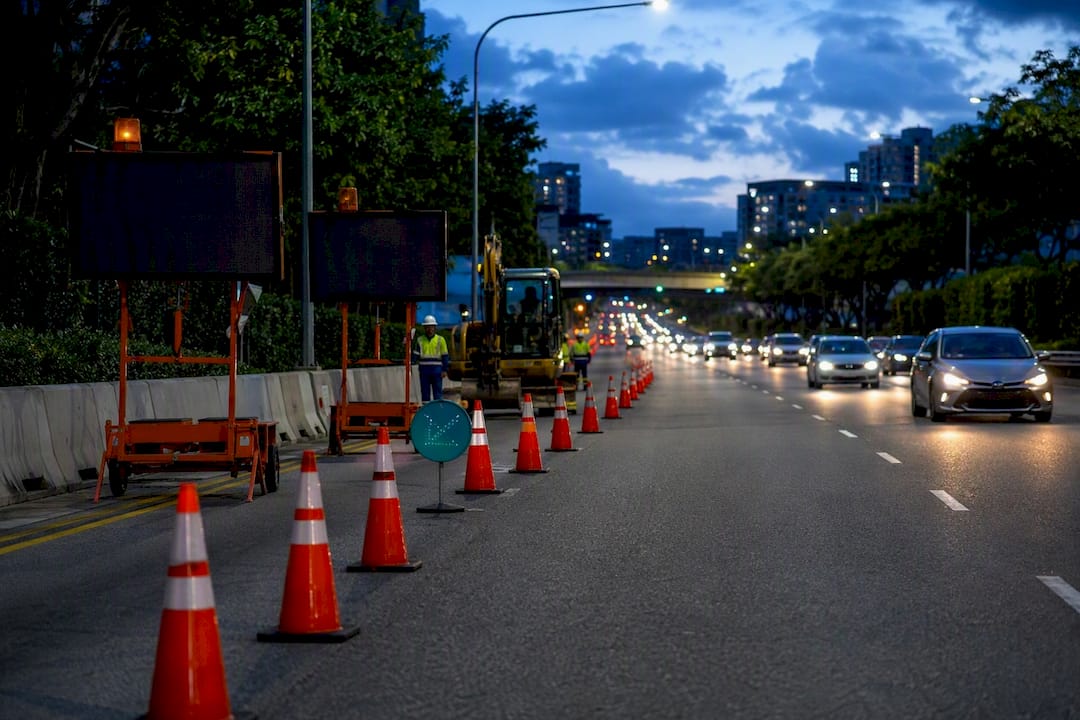
A compliant Traffic Control Plan for works on public streets in Singapore must follow the Land Transport Authority’s Code of Practice for Traffic Control at Work Zone, carry a Qualified Person’s endorsement, and reach LTA with the Diversion Checklist and supporting studies at least 45 working days before implementation. Approval is mandatory whenever works touch lane counts, junction movements, or diversions on a public street. Start the traffic study early, lock in your QP, and build your submission timeline backward from your intended start date.
TL;DR:
- Traffic control plans must be endorsed by a Qualified Person and submitted at least 45 working days before works begin, especially if works affect lane counts, junctions, or diversions.
- The plan must include four work-zone subzones—advance warning, transition, activity, and termination—with precise signage placement, device specifications, and detailed drawings like phasing and cross-sections.
- Taper lengths and buffer distances should scale with posted speeds, requiring careful calculation to prevent inspection failures, especially on faster roads.
- A traffic study is mandatory if works restrict junction movements, eliminate turning options, impact bus routes, or occur during peaks; the study must demonstrate actual impact and mitigation strategies.
- Ongoing site supervision, daily inspection logs, and timely post-implementation close-out within 10 working days are critical to maintaining compliance during work zone operations.
Table of Contents
- What Rules Govern a Traffic Control Plan in Singapore?
- What Must Be Inside a Compliant Traffic Control Plan?
- How Do You Calculate Safety Buffers and Taper Lengths?
- When Do You Need a Traffic Study for Your TCP?
- What Is the LTA and Traffic Police Approval Process?
- How Do You Manage a Work Zone During Implementation?
- Who Is Responsible for Endorsing and Executing the TCP?
- Practitioner Checklist: Avoiding Approval Delays and Rectification Notices
- Aman’s View: Why a TCP Is Never Really Finished
- How Aman Engineering Consultancy Supports Your Traffic Control Plan
- Official Documents Worth Bookmarking
- Sources
- FAQ
What Rules Govern a Traffic Control Plan in Singapore?
Four documents form the regulatory backbone of every traffic control plan Singapore contractors submit, and skipping any one of them is the fastest route to a rejected application.
The Code of Practice for Traffic Control at Work Zone (LTA, April 2026 edition) is the technical standard. It sets out how a work zone must be structured, prescribes device types and sign dimensions, and walks through the planning, design, and implementation phases a TCP has to follow. If your drawings don’t reflect this document’s zone structure and device schedule, LTA will send them back.
Running alongside it is the Code of Practice for Works on Public Streets (LTA, June 2025 edition), which governs the broader permit process for any works affecting a public street. Section 5 of this COP explicitly lists the Traffic Control Plan as a required submission item, and Section 4.4.8 requires contractors to post information signs informing road users at least one week before works commence. That advance notice requirement is easy to overlook and even easier to get flagged for during a spot check.
Then there’s the paperwork that trips up otherwise sound submissions:
- Diversion Checklist (LTA, August 2024): the form that accompanies every diversion or lane-closure submission, confirming you’ve addressed each COP requirement before LTA reviews your drawings.
- Post-Implementation Checklist: due within 10 working days of putting the scheme into effect, confirming the site matches what was approved.
- Traffic Police Code of Practice for Road Closures: governs event-style closures and full road shutdowns, with its own taper distance tables, night lighting rules, and lifting procedures.
Whether you need Traffic Police involvement at all depends on the nature of the works. Lane narrowing, shoulder closures, and most diversions for road works, utility works, or building construction fall under LTA’s jurisdiction alone. Full road closures, parades, marathons, and other event-driven closures require a separate Traffic Police clearance, and that permit runs on its own timeline, distinct from LTA’s process. Contractors managing a road closure permit application often find the two approval streams collide on a calendar if they aren’t planned together from the outset.
Copies of every LTA form referenced above sit on LTA’s Street Work Proposals portal, and the SCAL guide referenced later in this article is worth downloading for its plain-language summary of the same obligations from a contractor’s vantage point.
What Must Be Inside a Compliant Traffic Control Plan?
Every TCP the LTA Code of Practice recognizes as compliant is built around four distinct work-zone subzones, and each one has to appear on your drawings whether the job is a two-day utility trench or a six-month road widening.
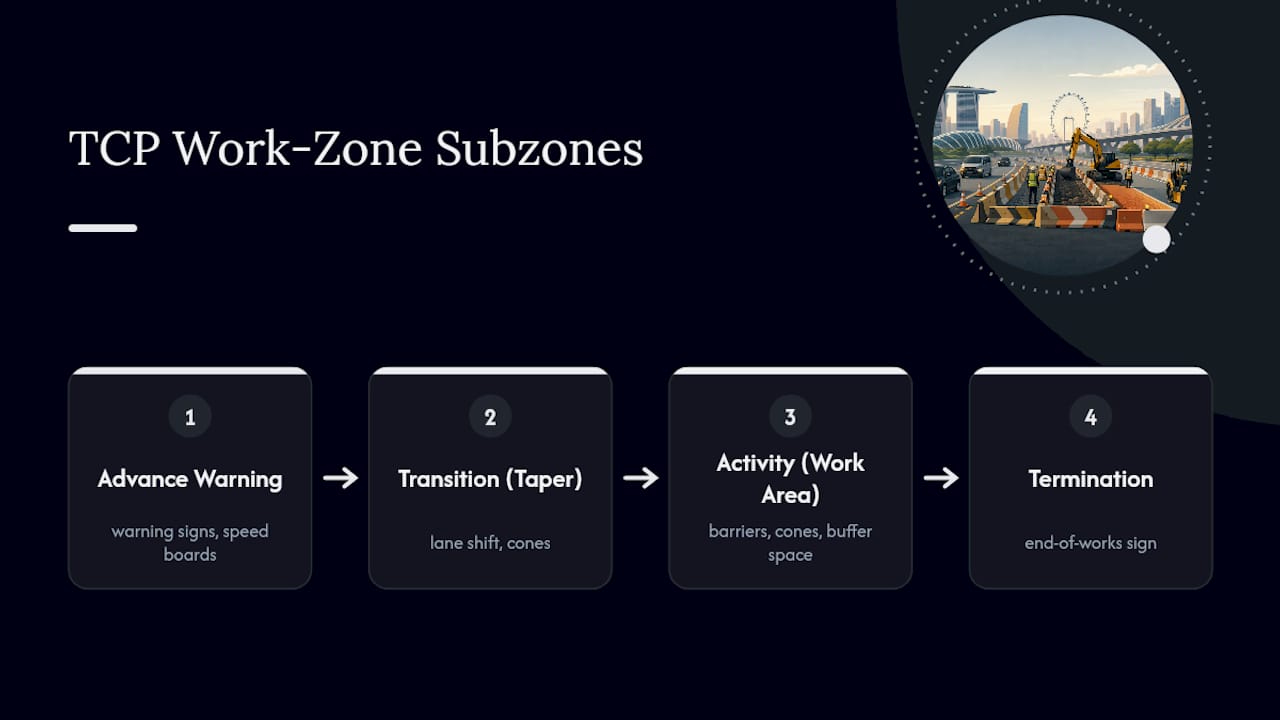
The advance warning zone is where drivers first learn something has changed ahead. It carries the earliest warning signs, speed advisory boards, and, on higher-speed roads, flashing arrow boards well before the physical taper begins. Get the placement wrong here and drivers arrive at your taper with no time to react.
The transition zone is the taper itself, where traffic actually merges or shifts lanes. This is the zone most inspectors scrutinize first, because a taper that’s too short or a cone spacing that’s too wide is where rear-end collisions happen.
The activity zone is the working area, protected by barriers, cones, or water-filled barricades depending on the exposure and duration of the works. This is also where your buffer space sits, the gap between moving traffic and your crew.
The termination zone guides traffic back to normal lane configuration and typically needs less signage than the advance warning zone, but it still requires a clear “end of works” indication so drivers don’t stay cautious longer than necessary and create secondary bottlenecks.
Drawings LTA expects in the submission package
A complete drawing set generally includes:
- A key plan showing the work zone’s location relative to surrounding roads and landmarks.
- Plan and elevation drawings detailing device placement, dimensions, and lane configuration.
- Cross-sections confirming lane widths, buffer distances, and clearances are maintained.
- Phasing diagrams if the works run in stages, each phase drawn separately.
- Signal phase diagrams where traffic signal timing changes because of the works.
Missing even one of these, particularly the phasing diagrams for a multi-stage job, is one of the more common reasons a submission comes back with a request for more information rather than an approval.
Devices and signage your drawings need to specify
Reviewers check your device schedule against what’s actually described in the LTA Standards and Specifications for traffic management markings, which cover everything from pedestrian crossing treatments to bus-friendly humps and marker spacing. A typical device inventory includes:
- Warning signs and speed limit signs sized to the approach speed
- Traffic cones, delineators, or water-filled barriers depending on exposure
- Barricades with reflective sheeting and, for night works, amber blinkers
- Temporary pavement markings where lane lines shift
- Flagmen or traffic controllers at points where manual direction is needed
- Lighting for night operations, sized to maintain visibility at the posted speed
Pro Tip: Give every device a unique ID on your drawing and cross-reference that same ID in a device schedule table. Reviewers move faster through submissions where they can match a symbol on the plan to a spec sheet without hunting for it.
The COP frames the TCP as something you revisit at the start of every major phase, not a document you file once and forget. A scheme that worked for excavation may be entirely wrong once you’re backfilling and reinstating the surface, and the plan needs to reflect that.
How Do You Calculate Safety Buffers and Taper Lengths?
Taper length and buffer distance scale directly with posted speed, and getting this wrong is the single most common reason a technically “complete” TCP fails a site inspection after approval.
The governing principle across both the LTA work zone COP and the Traffic Police road closure COP is that faster roads need longer warning distances and wider physical separation between moving traffic and the activity zone. On an expressway or arterial road running at 70 to 80 km/h, the advance warning sign has to sit far enough back that a driver has adequate reaction and braking distance before reaching the taper. On a slower estate road at 40 to 50 km/h, that same distance shrinks considerably, but the temptation to under-space signage on “quieter” roads is exactly where many contractors get caught out, since local road speeds can spike outside peak hours.
By the Numbers: The Traffic Police Code of Practice for Road Closures sets taper distances that scale with posted speed and mandates blinker spacing along barricades for night works, reflecting the core principle that higher speeds demand proportionally longer warning and transition distances.
Buffer space works on a similar sliding scale. The longitudinal buffer, the gap between the end of your taper and the start of the actual work activity, absorbs a vehicle that fails to merge in time. The lateral buffer, the sideways gap between the traffic lane and your barriers, protects workers from vehicles that drift. Both need to widen as speed increases, and both need to be shown as dimensioned distances on your cross-section drawings rather than described in words alone.
A few design checks that reviewers look for beyond the taper and buffer numbers:
- Swept path analysis for any turning movement that changes, confirming the largest vehicle expected (often a bus or a concrete truck) can complete the turn without encroaching on the opposing lane or mounting a kerb.
- Minimum lane widths maintained through the work zone, since narrowing a lane below the standard width forces drivers to slow unpredictably or drift toward adjacent lanes.
- Sight distance at any junction or bend near the work zone, confirming that a driver approaching the taper can actually see the advance warning signage in time, not just that the sign exists on paper.
- Expressway and ERP-specific handling, where lane closures often require overnight or off-peak windows, additional signage lead time, and coordination with LTA’s ITS Operations team because of the higher speeds and traffic volumes involved.
Enforcement context matters here too. The Singapore Police Force’s most recent road traffic data notes an expansion of speed enforcement infrastructure, including the operationalization of new Traffic Violation Enforcement Cameras from March 2026. A work zone sitting near an enforcement camera or a red light camera junction needs its taper and signage coordinated so drivers aren’t forced into last-second braking that trips an offense they wouldn’t have committed under normal conditions.
When Do You Need a Traffic Study for Your TCP?
A traffic study becomes mandatory the moment your scheme removes a turning movement, reduces a junction’s lane count, or touches a bus route, cycling path, or pedestrian crossing that the public relies on daily. Cosmetic lane shifts on a quiet stretch of road rarely need one. A diversion that eliminates a right-turn pocket at a signalized junction almost always does.
The trigger list reviewers watch for includes:
- Removal or restriction of a turning movement at a signalized or priority junction
- Lane reductions at or approaching a junction, where queuing spillback risk is highest
- Diversions affecting a bus route, bus stop, or bus lane
- Changes affecting a cycling path or a pedestrian crossing, including temporary crossing relocations
- Any scheme expected to run during peak periods for more than a few days
Once a study is triggered, LTA expects it to actually demonstrate the impact, not just assert that “minimal disruption is expected.” A defensible study package typically includes:
- Traffic volume counts for the affected approaches, ideally covering both AM and PM peaks
- A capacity analysis showing how the junction or road segment performs under the proposed scheme
- Queuing and delay estimates, particularly where a turning movement is removed
- Swept path checks for the vehicle types using the affected route
- A mitigation and staging strategy, showing how impacts are reduced or spread over time
If the numbers come back unfavorable, the strongest submissions present a staged alternative rather than asking LTA to accept the disruption outright. Breaking works into phases that each affect fewer movements, or shifting the heaviest-impact activity to overnight or weekend windows, often turns a borderline traffic study into an approvable one. A traffic impact assessment prepared early, before drawings are finalized, gives you room to redesign the scheme around the study’s findings instead of scrambling to patch a rejected submission later.
What Is the LTA and Traffic Police Approval Process?
Submission timing is where most schedule slippage actually happens, and it’s almost always because the contractor treated the 45-working-day guidance as a target rather than a floor.
-
Confirm scope and speed context first. Before drawings even start, establish the posted speed, the road classification, and whether the works touch a junction, bus route, or ERP gantry. This determines whether a traffic study is required and which authority’s COP governs the closure type.
-
Prepare the drawing set and device schedule. Build the key plan, plan and elevation drawings, cross-sections, and phasing diagrams per the LTA work zone COP, with every device numbered and cross-referenced to a schedule table.
-
Secure QP or Traffic Consultant endorsement. No submission proceeds without a Qualified Person’s signature confirming the scheme meets the COP’s design standards. This endorsement carries real weight, since the QP is professionally accountable for the scheme’s adequacy.
-
Complete the Diversion Checklist. This form confirms every COP requirement has been addressed and needs to accompany the drawing package, not follow it days later.
-
Submit through LTA’s channels at least 45 working days ahead, though the Diversion Checklist guidance itself recommends allowing 18 weeks where the works are complex or touch multiple junctions. Include the traffic study, if one was triggered, the public notice text you intend to post, and site contact numbers.
-
Route event-style road closures through Traffic Police separately. LTA handles road-related works and diversions; Traffic Police handles full closures, parades, and event traffic management, each on its own submission track and its own clearance.
-
Loop in ITS Operations early for arterial or expressway works. Where a scheme touches a major arterial or an expressway, ITS Operations review can act as a separate gating item that runs in parallel with, not after, the main LTA review.
-
Maintain daily reporting once works begin. LTA and, where applicable, Traffic Police expect ongoing confirmation that the scheme on site matches what was approved, particularly after any weather delay, equipment breakdown, or phase change.
Contractors chasing a road works permit on a compressed program often try to compress this timeline instead. It rarely works, because the traffic study, if triggered, alone can take several weeks to compile properly.
How Do You Manage a Work Zone During Implementation?
Approval is the easier half of the job. Keeping the scheme compliant once traffic is actually moving through it is where day-to-day discipline matters most.
Barricades and cones need regular inspection, not a one-time setup check. Wind, passing heavy vehicles, and general wear shift devices out of position within hours, and a taper that’s drifted even a meter can undermine the sight distance calculations baked into your design. Night works carry an added obligation: barricades along the taper need reflective sheeting and, per the Traffic Police road closure COP, blinkers spaced along the barrier line so drivers can read the taper’s shape in the dark, not just spot isolated points of light.
A few operational habits separate sites that run clean from sites that generate complaints:
- Assign a site supervisor who checks device position and condition at shift start, not just at setup.
- Keep traffic controllers and banksmen in high-visibility PPE and confirm they understand hand signal protocol before the first shift, not on day one of live traffic.
- Log every inspection, every device adjustment, and every incident, since these records are what you’ll draw on if a complaint or an accident triggers a review.
- Watch for full-time supervision requirements on higher-risk schemes, particularly expressway lane closures, where LTA or the QP may require continuous presence rather than periodic checks.
- Reassess the scheme at the start of every new phase rather than assuming the original design still fits.
Pro Tip: Set a numeric trigger for reverting to a backup plan before works start, for example, “if queue length exceeds a defined threshold for two consecutive peak periods, switch to staged plan B and notify LTA within a set number of hours.” Deciding this threshold under pressure, mid-shift, almost always produces a worse call than deciding it on paper beforehand.
Digital site tracking tools, such as the real-time monitoring platforms used across the construction site tracking space, can help supervisors log inspection timestamps and device conditions without relying on paper logs that get lost or filled in retroactively.
Close-out is a formal step, not an afterthought. Once the works finish and the road reverts to normal, LTA expects the Post-Implementation Checklist submitted within 10 working days, confirming devices were removed, markings reinstated, and the road handed back in the condition specified. Skipping or delaying this checklist is one of the more common reasons a contractor ends up with a rectification notice on a job that was otherwise executed well.
Who Is Responsible for Endorsing and Executing the TCP?
A TCP’s Qualified Person or Traffic Consultant endorsement isn’t a formality. Signing it means certifying that the scheme’s taper lengths, buffer distances, sight lines, and device selection meet the LTA Code of Practice’s standards, and that certification carries professional accountability if the scheme fails in the field. QP supervision also typically extends beyond the drawing stage into periodic site checks confirming the built scheme still matches what was endorsed on paper.
Contractors carry their own distinct set of obligations under the Works on Public Streets COP, separate from the QP’s design certification:
- Post information signs at least one week ahead of works, per Section 4.4.8 of the COP
- Maintain the scheme exactly as approved, escalating to the QP or LTA if site conditions demand a change
- Meet Workplace Safety and Health Act obligations for anyone working within the activity zone, including PPE and risk assessments specific to working near live traffic
- Keep contact numbers current on public notices, since an unanswered complaint line tends to escalate faster than a staffed one
Traffic controllers and banksmen working the site need practical competence in flagging procedures, hand signals, and positioning, typically gained through a recognized Basic Traffic Controller course. Course providers and training centers list current fees and schedules directly, and enrollment usually involves a short classroom session plus a practical assessment before certification is issued. Treat this training as a prerequisite for site deployment, not something crews pick up on the job.
Practitioner Checklist: Avoiding Approval Delays and Rectification Notices
The gap between a TCP that sails through review and one that bounces back twice usually comes down to a handful of details that have nothing to do with the underlying engineering.
Drawings that answer a reviewer’s questions before they’re asked move faster. Add a clear north arrow and an enlarged key plan showing adjacent intersections, not just the immediate work zone. Include a device schedule table with IDs that match your plan callouts exactly, and index your phasing diagrams so a reviewer can tell at a glance which phase they’re looking at. Public notice text should state the works, the dates, and a live contact number, since a vague notice invites more public enquiries, and more enquiries tend to invite more scrutiny.
Cross-agency coordination is the other recurring failure point. A scheme that looks complete from LTA’s perspective can still stall if PUB has an unrelated main replacement scheduled on the same stretch, or if a bus operator’s route change wasn’t flagged early enough to adjust stop locations.
- Confirm ITS Operations involvement early for any arterial or expressway-adjacent works.
- Check for concurrent utility or PUB works on the same road before finalizing your phasing.
- Notify affected bus operators directly if your diversion touches a route or stop, rather than assuming LTA will relay it.
- Build a toolbox talk into every shift start, covering device condition, weather forecast, and any phase change since the last shift.
- Keep a simple night-check log for barricade lighting and blinker function, since a burned-out blinker at 2 a.m. is exactly the kind of gap an incident report will highlight.
Pro Tip: Field experience consistently shows the same two failure points: treating an approved TCP as fixed once the works begin, and forgetting the Post-Implementation Checklist entirely. Building a calendar reminder for the 10-working-day deadline the moment works start costs nothing and prevents most rectification notices.
Aman’s View: Why a TCP Is Never Really Finished
Most contractors treat the approved drawing set as the finish line. It’s closer to the starting point. Engineering judgment on a live work zone means watching how traffic actually behaves against how you predicted it would, and adjusting before a near-miss forces the adjustment for you.
The COP’s own framing supports this: it expects the scheme to be reassessed at the start of every major phase, not treated as a fixed artifact from approval to close-out. In practice, that means the strongest TCPs are the ones with pre-decided thresholds for change, not the ones improvised on site when a queue starts backing up.
Our experience across statutory submissions and site inspections tells us the schemes that avoid rectification notices are the ones where the QP stayed engaged past the endorsement signature, and where the contractor’s site team understood why each buffer distance and taper length existed rather than just following a drawing. If you’re preparing a submission and want a second set of eyes on the design before it reaches LTA, that kind of review is worth arranging early.
— Aman
How Aman Engineering Consultancy Supports Your Traffic Control Plan
Getting a Traffic Control Plan through LTA on the first pass takes more than a correct taper table. It takes someone who has coordinated the QP endorsement, the ITS Operations review, and the Traffic Police clearance on the same project timeline before, and knows where each one typically stalls. Some engineering consultancies offer coordination services to help submissions pass smoothly without delays between agencies.

Our team provides Authority Approvals and PE endorsements for TCP drawings, manages the full LTA submission package including the Diversion Checklist and supporting traffic studies, and produces the phasing and device-schedule drawings reviewers expect through our 3D BIM service. On site, we support inspections and the Post-Implementation Checklist handover so the close-out doesn’t fall through the cracks. If your project also needs sequencing support around the works, our project management team can align the TCP timeline with the rest of your construction schedule.
Before reaching out, have your scoped works, intended start and end dates, and a rough key plan ready. That’s enough for us to scope the submission and flag any traffic study risk before drawings even begin. Visit Aman Engineering Consultancy to start the conversation on your project.
Official Documents Worth Bookmarking
Keep these on hand before you start designing or submitting anything, since each one is referenced repeatedly during LTA review:
- Code of Practice for Traffic Control at Work Zone (LTA, April 2026 edition), the primary design standard.
- Code of Practice for Works on Public Streets (LTA, June 2025 edition) and the Diversion Checklist (August 2024).
- Construction Site Traffic Management Guide (SCAL) for a contractor-facing summary of workplace duties.
- Traffic Police Code of Practice for Road Closures, required for event and full-closure schemes.
Sources
- Code of Practice for – Traffic Control at Work Zone (LTA, Apr 2026)
- Code of Practice for Works on Public Streets (LTA, Jun 2025)
- Diversion Checklist (LTA, Aug 2024)
- Traffic Police Code of Practice for Road Closures (Traffic Police)
- Construction Site Traffic Management Guide (SCAL)
FAQ
What Should Be Included in a Traffic Control Plan?
A compliant TCP needs the four work-zone subzones (advance warning, transition, activity, termination), a full drawing set covering key plan, cross-sections, and phasing diagrams, a device schedule matching the plan callouts, and QP endorsement confirming the design meets the LTA Code of Practice.
How Much Does the Basic Traffic Controller Course Cost in Singapore?
Course fees vary by training provider and are updated periodically, so check current pricing directly with an accredited training center rather than relying on a fixed figure. Confirm the course leads to recognized certification before enrolling crew members.
Is It Allowed to Stop at a Double Yellow Line in Singapore?
Double yellow lines mark a no-stopping zone at all times, and this applies inside and around active work zones just as it does elsewhere on the road network. A TCP’s activity and buffer zones should be positioned so temporary works don’t force vehicles to stop on a stretch marked with double yellow lines.
Which Projects Need an Approved Traffic Control Plan?
Any project affecting lane configuration, junction turning movements, or diversions on a public street needs an approved TCP, whether the works are road construction, utility installation, building construction fronting a public road, or an event-driven closure. Works confined entirely within a private site boundary with no impact on the public road network generally fall outside this requirement.
How Far in Advance Must a TCP Be Submitted to LTA?
LTA’s Diversion Checklist guidance sets a minimum of 45 working days, with 18 weeks recommended for complex schemes involving multiple junctions or a triggered traffic study.