
Introduction
Slab stabilization and polyurethane foam injection for sunken concrete is now the preferred engineering-led repair strategy for warehouse floors, carpark decks, loading yards, and podium slabs across Singapore and the wider ASEAN region. Where traditional concrete repair methods once demanded weeks of demolition, re-casting, and curing, modern polyurethane injection delivers equivalent or superior structural support beneath the slab with a fraction of the downtime, demolition waste, and operational disruption.
This article explains how polyurethane foam injection works as a mudjacking alternative, details the soil stabilization and void filling science behind it, and walks through the practical workflow for implementing concrete leveling on a live industrial or commercial facility. The scope is deliberately focused on slab-on-grade floors – logistics warehouses, open hardstands, ground-level carparks, and podium slabs over basement structures – rather than deep foundation piling or high-rise superstructure design. Target readers include facility managers, property developers, consulting engineers, and contractors responsible for maintaining large-format concrete slabs and hardstand areas in Singapore’s demanding climate.
In short: polyurethane foam injection lifts sunken concrete slabs by expanding closed-cell foam into voids and compromised soil beneath the slab, restoring load bearing capacity and designed grades with minimal disruption – often in just a few hours rather than days or weeks. Polyurethane foam injection is a trenchless method used to stabilize sunken concrete slabs, and polyurethane foam can support loads up to 14,000 pounds per square foot when properly specified.
Key takeaways you will gain from this article:
-
How polyurethane foam injection works at a technical level, including chemistry, foam expansion, and curing behaviour
-
Why concrete slabs sink in Singapore’s soil conditions and how to recognise early warning signs
-
A direct comparison of mudjacking vs polyurethane foam injection vs full slab replacement
-
The step-by-step project workflow for foam jacking on a live facility, including engineering checks and authority interfaces
-
How AMAN Engineering Consultancy supports design verification, BIM integration, and regulatory coordination for slab stabilization projects
Understanding Slab-On-Grade Settlement and Stabilization
Slab-on-grade construction places a concrete slab directly on prepared subgrade or compacted fill, relying entirely on the underlying soil for support. When that support degrades – through consolidation, washout, or poor initial compaction – the slab settles unevenly, creating the sunken slabs, rocking panels, and joint damage that plague industrial and commercial facilities throughout Singapore. Long-term slab performance depends not only on the concrete itself but on three interdependent factors: soil behaviour beneath the slab, effective sub-slab drainage, and reliable load transfer across slab joints.
Understanding why settlement happens and what “stabilization” actually involves is essential before selecting a repair process. The sections below break down the causes, symptoms, and engineering definitions that inform every successful concrete repair project.
Why Concrete Slabs Sink and Rock
Sunken concrete slabs rarely result from a single cause. Several mechanisms typically act together, often over years, before visible distress appears.
Consolidation settlement is the dominant long-term driver in Singapore, where much of the developed land sits on the Kallang Formation – marine clay with water contents between 60–95% and low undrained shear strengths. Under sustained load, this clay compresses slowly, sometimes over decades, before reaching residual settlement levels. Reclaimed land compounds the problem: hydraulically placed sand fills are initially loose, while dredged clay fills contain voids between clay lumps that consolidate unevenly over extended periods.
Loss of fines and sub-base erosion occur when rainwater “pumps” through slab joints under dynamic wheel loads, gradually washing out fine particles from the fill layer. Singapore’s high annual rainfall intensifies this soil erosion mechanism, especially in open carparks and container yards without sealed joints.
Poor initial fill compaction – particularly around utility trenches, drains, and service corridors – leaves zones of unstable soil that settle differentially once operational loads are applied. Nearby excavation or tunnelling activity can also disturb support beneath adjacent slabs.
Facility managers and engineers should watch for these observable field signs:
-
Level differences of 10–30 mm at warehouse rack base plates or along forklift aisles
-
Ponding water in open carparks after heavy rain, indicating loss of designed drainage gradients
-
Impact damage and spalling along construction joint arrises
-
Rocking or “see-saw” movement of adjacent slab panels under foot and vehicle traffic
-
Vibration complaints from forklift operators traversing uneven surfaces
These symptoms signal that the soil underneath has lost its capacity to uniformly support the existing slab – the point at which slab stabilization becomes necessary.
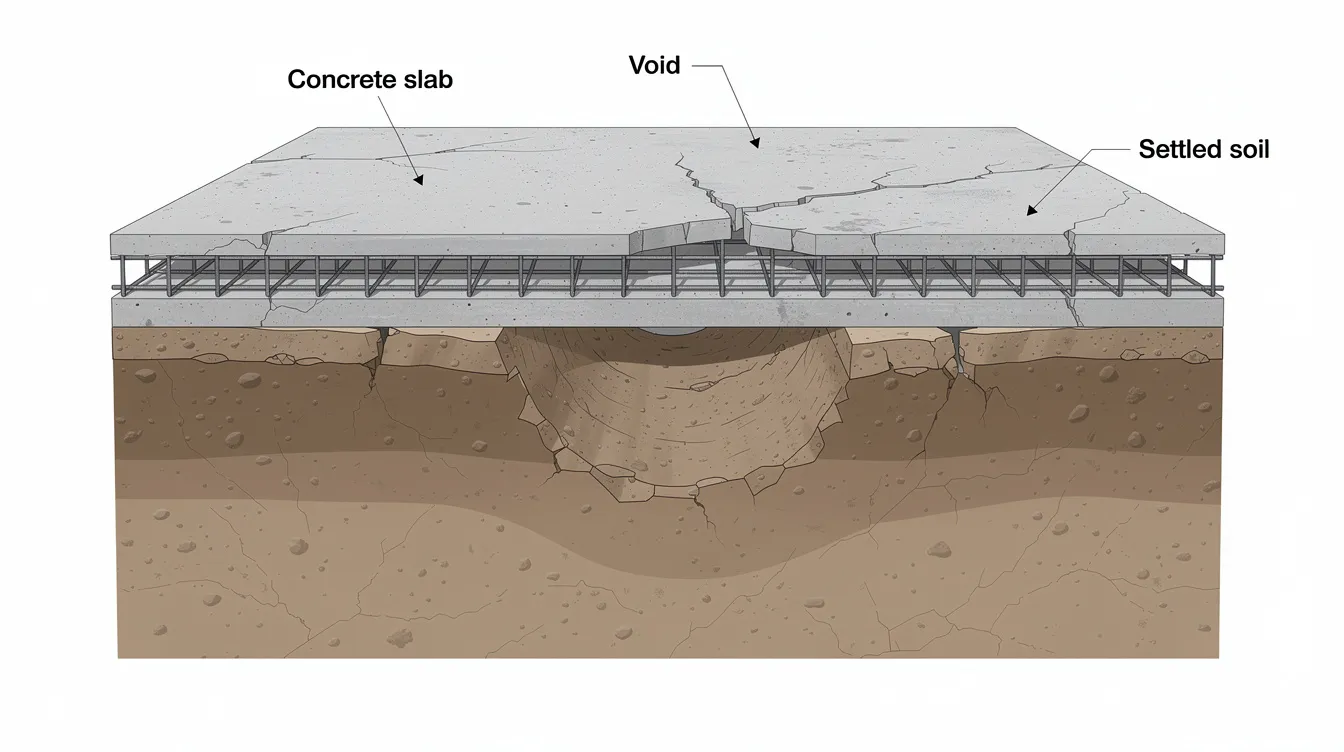
What “Slab Stabilization” Really Means
Slab stabilization means restoring uniform, reliable structural support to a concrete slab by treating the underlying soil and filling voids – not simply patching cracks or applying a self-levelling screed over the concrete surface. It addresses the root cause of settlement rather than masking the symptoms.
In practice, three distinct but related interventions fall under the stabilization umbrella:
-
Pure stabilization (void filling and soil improvement with minimal lift): The primary goal is to eliminate voids and improve subgrade stiffness so the slab no longer deflects under load. Slab elevation may change only marginally. This suits situations where the slab is still close to its design level but support is compromised.
-
Slab re-levelling (controlled upward movement): Here, the concrete lifting objective is explicit – the slab is raised by a targeted amount to restore design grades, re-establish drainage falls, or realign rack uprights. Polyurethane foam provides precision leveling within 1/8 inch, making controlled re-levelling feasible even in sensitive areas.
-
Load-transfer restoration at dowelled joints: Settlement often causes adjacent panels to sit at different levels, breaking the load-transfer mechanism across joints. Stabilization can restore contact between panels and dowels, reducing the rocking that accelerates joint damage under heavy equipment.
Addressing the cause – the compromised soil and voids beneath the slab – is essential for long-term serviceability. Cosmetic repairs alone will fail within months under racking loads, truck docks, and MHE corridors where warehouse loading requirements impose sustained and repeated stress on every square metre of floor. These mechanisms of settlement and support loss are precisely what polyurethane foam injection is designed to control.
Polyurethane Foam Injection as a Modern Stabilization Method
The settlement problems described above – voids, weak subgrade, and differential movement – are exactly the conditions that polyurethane foam injection was developed to address. Originating as an engineered, non-invasive foundation repair technique in the 1990s, the method has since been adopted worldwide for concrete leveling, slab lifting, and soil stabilization beneath industrial and commercial floors. Polyurethane foam injection is also known as polyjacking or foam lifting, and in various markets you may hear it called foam jacking, polyurethane resin injection, or simply poly-jacking.
How Polyurethane Foam Injection Works
Polyurethane foam injection uses a two-part chemical reaction to create rigid, closed-cell foam directly beneath a settled concrete slab. Technicians drill small access holes through the concrete slab – injection holes are typically 5/8 inch in diameter – at predetermined injection points across the affected area. Through these small injection holes, an injection gun delivers two liquid components (an isocyanate and a polyol resin) that mix at the point of delivery.
Within seconds, the combined liquid begins to react exothermically. The foam expands to fill voids and lift concrete slabs, growing to approximately 15–25 times its original liquid volume as it develops a dense, closed-cell structure. As the foam flows outward from each port, it performs three functions simultaneously: it compacts loose surrounding soil and weak sub-base material, fills irregular gaps and honeycombed zones beneath the slab, and applies controlled uplift pressure to re-level the concrete surface.
Curing time for polyurethane foam is about 15 minutes. More precisely, polyurethane foam cures to 95% strength in 15 to 20 minutes, with full structural properties developing within 30 minutes. This rapid cure means that treated zones can be reopened to foot and vehicle traffic the same day – often within just a few hours of injection. The cured material is a rigid, closed-cell solid with high moisture resistance.
Polyurethane foam weighs only 2 to 4 pounds per cubic foot, which is a critical advantage over cementitious grout methods: the minimal material weight avoids adding significant dead load to already weak soils.
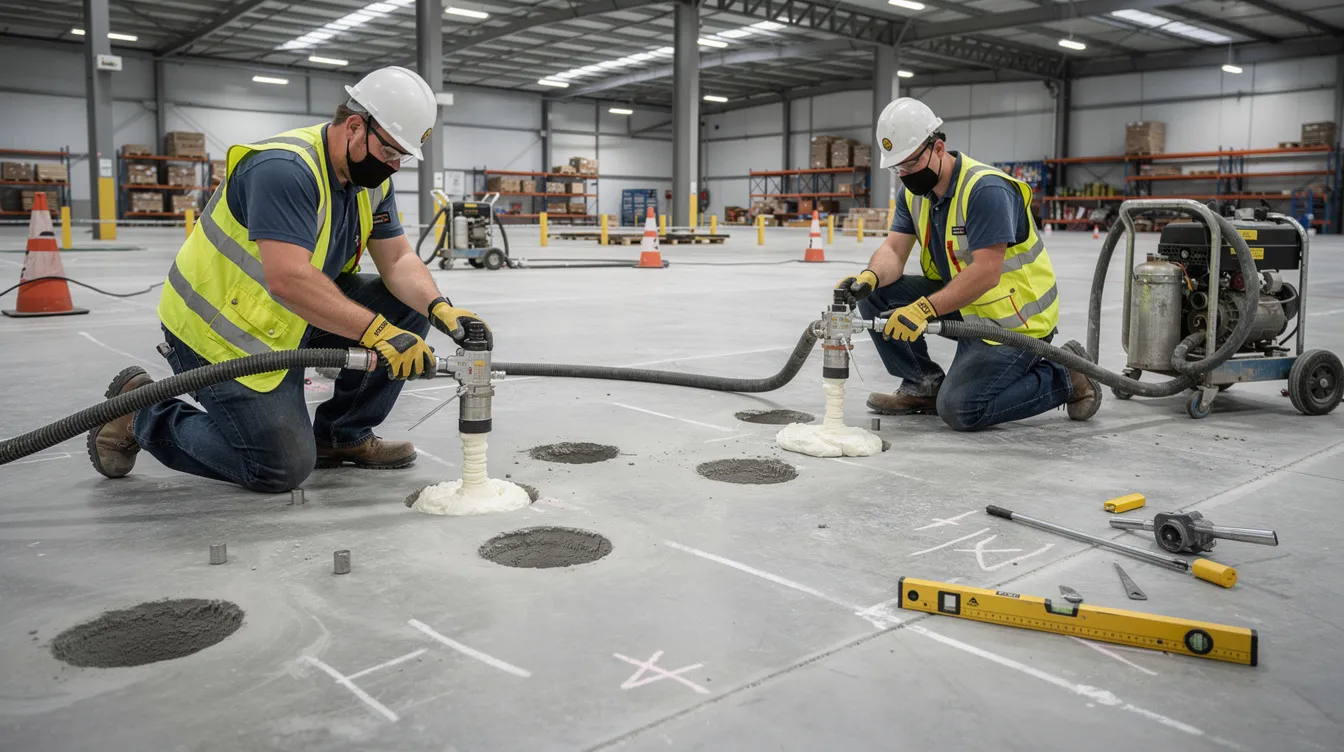
Soil Stabilization and Void Filling Capabilities
Polyurethane foam injection is an effective solution for addressing soil erosion and voids beneath slabs – but its benefits extend beyond simply lifting concrete. The foam expansion process actively densifies loose granular fill in the surrounding soil, improving subgrade stiffness and soil compaction in the immediate injection zone. Because cured polyurethane foam is hydrophobic and does not wash out or erode over time, it also cuts off water migration paths that cause ongoing sub-base erosion. The foam resists water infiltration, effectively sealing the treated zone against the washout cycles that created the voids in the first place.
Typical injection depths range from 200–400 mm below the slab soffit for standard warehouse floors, addressing the most common void zone between the slab and the compacted sub-base. For heavily compromised ground – particularly on reclaimed land or around backfilled service corridors – deeper staged injections of up to 2–3 m can be executed to treat multiple weak layers. Polyurethane foam injection is effective for sealing foundation cracks and bridging small cavities left by previous utility installations.
This combination of void filling, soil densification, and moisture sealing is what makes polyurethane foam attractive as a mudjacking alternative for slab-on-grade floors that must remain largely in place. Unlike traditional methods that simply fill space with heavy grout, the foam actively improves the load bearing capacity of the soil beneath while adding negligible weight.
Where Polyurethane Foam Injection Is Typically Used
In Singapore and the broader ASEAN region, polyurethane foam concrete lifting addresses a wide range of settled concrete problems. Common applications include:
-
Logistics warehouses in Jurong and Tuas industrial estates where racking aisles have differentially settled, causing rack upright misalignment and forklift vibration
-
Open-air loading bays and container yards with sub-base pumping, joint breakdown, and progressive soil erosion under heavy equipment traffic
-
Ground-level carparks in commercial buildings with chronic ponding after tropical storms – a direct result of lost drainage gradients from settlement
-
Podium slabs over basement carparks where fill settlement has created local depressions, affecting waterproofing membranes and surface finishes
-
It is commonly used for driveways, sidewalks, and pool decks in residential contexts, though industrial applications dominate in Singapore
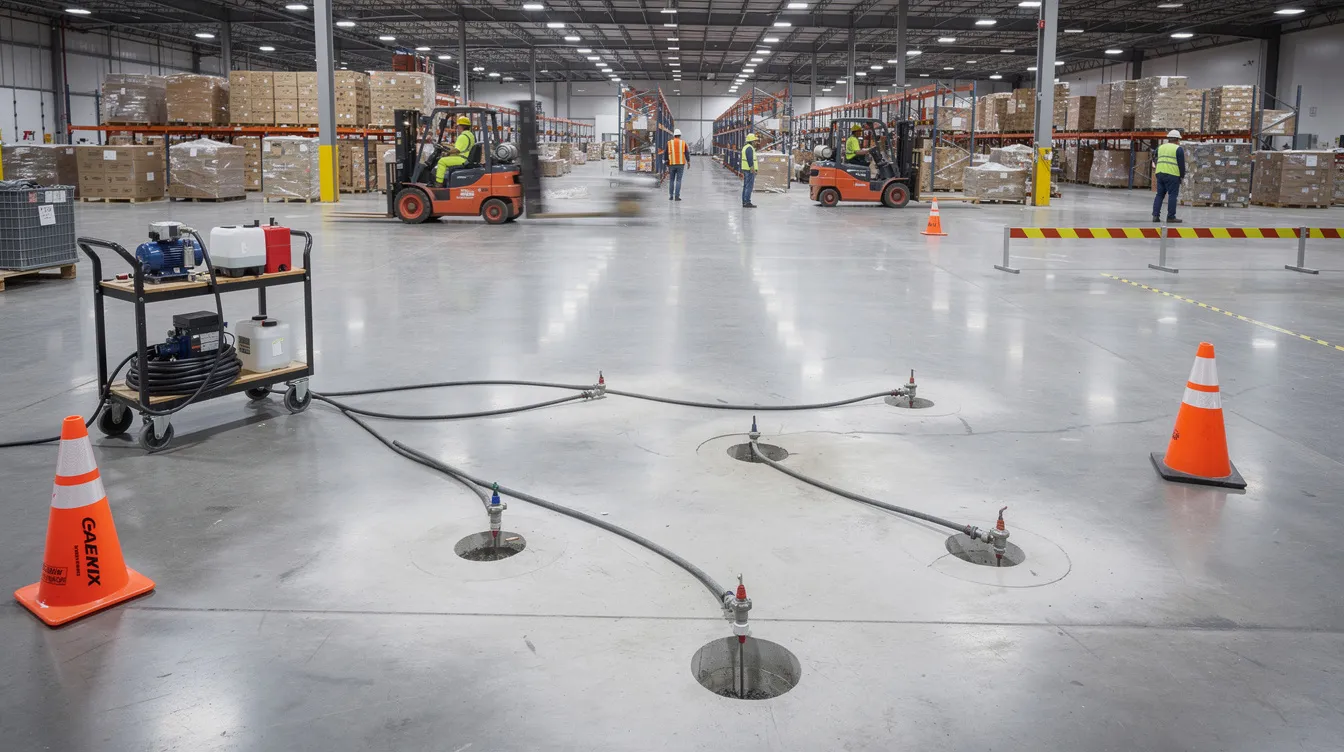
Because the injection process creates small drill holes that are less disruptive than traditional methods, foam injection can be planned during off-peak hours or night shifts to maintain facility operations. Polyurethane foam reduces operational downtime for commercial facilities significantly compared with full replacement, which is why the method has gained rapid traction among facility managers managing high-utilisation assets.
The following section details the step-by-step implementation process and decision-making framework for choosing between stabilization methods.
Implementing Slab Stabilization with Polyurethane Foam
While polyurethane foam injection may appear straightforward in demonstration videos, successful implementation on a live facility follows a structured engineering process. AMAN Engineering Consultancy can help design, supervise, or review each phase – from initial structural inspection through to handover documentation. This section provides a clear numbered workflow and a comparison table to support decision-making for owners evaluating their options.
Typical Project Workflow on an Operating Facility
The following procedure applies to a typical 3,000–5,000 m² warehouse floor or external hardstand and can be scaled up or down to suit the project. Each step ensures that the repair process is controlled, documented, and aligned with engineering and regulatory requirements.
-
Preliminary condition survey: Carry out a slab level survey using laser or digital levelling instruments, map all visible cracking, assess joint conditions, and compile a photographic record. AMAN can perform periodic structural inspections (PSI) or targeted structural assessments at this stage to establish baseline conditions and identify any major structural failure risks.
-
Subsurface investigation: Review as-built drawings and geotechnical records. Where information is incomplete, deploy ground-penetrating radar (GPR), excavate test pits, or conduct dynamic cone penetrometer (DCP) tests to map voids, assess soil layers, and understand permeability and bearing conditions in the soil beneath the slab.
-
Stabilization design: Based on survey and investigation data, select the appropriate foam density, define the injection grid layout, set target lift values for each zone, and prepare a phasing plan. This design should be prepared or checked by a Professional Engineer (PE) registered in Singapore to ensure it accounts for existing slab reinforcement, load paths, and connected structural elements.
-
Site preparation: Mark injection points on the concrete surface, install protection around racking, services, and fire safety systems, and coordinate with SCDF and building management if fire access routes or emergency exits are affected. Segregate work zones clearly so that forklifts and personnel can continue operating safely in unaffected areas.
-
Drilling of injection ports: Drill ports at the designed grid spacing – typically 1.0–1.5 m centres – through the existing concrete. Injection holes for polyurethane foam are about 5/8 inch in diameter, small enough to minimise visible scarring on the finished floor.
-
Foam injection and real-time monitoring: Inject the two-part polyurethane resin through each port using calibrated equipment. Use laser levels or digital instruments to track slab elevation changes in real time. In sensitive areas – dock leveller pockets, rail tracks, embedded anchor plates – lift in staged increments of 1–3 mm per pass to avoid inducing stress on connected elements. The foam expands to fill voids and lift concrete slabs in a controlled, progressive manner.
-
Finishing and quality assurance: Patch injection holes with fast-setting cementitious filler. Reseal joints and expansion/control joints if they have opened during the lifting process. Conduct a post-works level survey to document achieved slab elevation improvements and verify that target tolerances have been met.
-
Handover documentation: Prepare an as-built injection layout showing all port locations and volumes injected, compile material certifications and technical data sheets, and provide maintenance recommendations for the owner/operator. This documentation supports future structural inspections and asset management records.
Throughout the process, safety and operational continuity must be planned explicitly – including segregated work zones, traffic management for forklifts, and clear communication with tenants about noise, odour, and access restrictions.
Mudjacking vs Polyurethane Foam Injection vs Full Slab Replacement
Owners frequently ask whether to mudjack, foam-inject, or fully replace sunken slabs. The right choice depends on slab condition, soil characteristics, operational constraints, and budget. The table below compares the three traditional repair methods across criteria most relevant to Singapore and ASEAN projects.
|
Criterion |
Traditional Mudjacking (Cementitious Grout) |
Polyurethane Foam Injection |
Full Slab Demolition & Recasting |
|---|---|---|---|
|
Typical downtime |
Several hours to a full day per zone; grout requires 24+ hours to cure |
Most zones back in service within just a few hours; polyurethane foam cures to usable strength in 15 to 30 minutes |
Days to weeks depending on slab area; includes demolition, formwork, pouring, and curing of new concrete |
|
Operational disruption |
Moderate: slurry, water, dust; larger access closures needed |
Low: small holes (5/8 inch), minimal equipment, less mess; works can be phased by aisle or bay |
High: complete removal of existing slab, heavy machinery, extended traffic blockage; significant demolition waste |
|
Weight added to weak soils |
High: cementitious grout is heavy (~2,000+ kg/m³), potentially contributing to further settlement on unstable soil |
Very low: polyurethane foam weighs only 2 to 4 pounds per cubic foot (~32–64 kg/m³); negligible additional load on compromised ground |
Variable: new concrete adds full slab weight, though subgrade can be re-compacted |
|
Load bearing capacity |
Variable: grout strength depends on mix quality and curing; lower early strength |
High: polyurethane foam can support loads up to 14,000 pounds per square foot; high density polyurethane foam products reach compressive strength of 400–700 kPa |
Highest: new reinforced slab provides full design-life structural capacity |
|
Suitability for heavy forklift / reach-stacker traffic |
Limited: grout can crack and settle again under repeated dynamic loads |
Strong: advanced materials designed for industrial loads; supports repeating loads from 3–6-tonne forklifts when correctly specified |
Best for severely damaged slabs: new concrete and reinforcement ensure full structural continuity |
|
Relative cost |
Low material cost, moderate labour |
Medium: polyurethane foam injection typically costs 30–50% more than mudjacking, but polyurethane foam injection can save up to 70% compared to replacement when downtime savings are included |
Highest: demolition, new reinforcement, concrete, finishing, plus cost of lost operations |
|
Expected service life |
5–10 years; risk of re-settlement on weak soils |
Repairs using polyurethane foam last 10 to 20 years or longer, provided drainage issues are addressed |
20–30+ years for new slab with proper subgrade preparation |
Synthesis: For slabs where the existing concrete is structurally sound but the soil beneath has failed – voids, settlement, or weak bearing – polyurethane foam injection offers the best trade-off of strength, speed, and cost. Mudjacking may suit smaller, lightly loaded surfaces where budget is the primary constraint, but its heavy material weight makes it poorly suited for Singapore’s soft marine clay subgrades. Full slab replacement remains the correct path when slabs are severely cracked, under-reinforced, or affected by chemical attack – essentially, when there is major structural failure of the concrete itself rather than minor structural movements from subgrade issues.
Engineering Checks, BIM Integration, and Authority Interfaces
For larger industrial or commercial projects, foam injection and slab stabilization should be integrated into broader asset management and compliance workflows. This is especially true in Singapore, where authority interfaces touch multiple agencies.
AMAN Engineering Consultancy can support this integration in several ways:
-
BIM modelling and coordination: Model affected slabs in BIM/Tekla to understand load paths, identify clashes with embedded services, and coordinate injection works with other trades (M&E, waterproofing, flooring finishes). Integrating slab condition data into a digital model provides a permanent record for future civil and structural design decisions.
-
Professional Engineer endorsements: Provide PE sign-off for structural safety declarations where required – particularly when injection works affect load-bearing elements or alter slab behaviour. This is essential for BCA submissions related to alterations to existing structures.
-
Authority submissions and coordination: Support submissions or clarifications to agencies including BCA (structural safety), JTC (industrial estate compliance), LTA (if works affect road or transport infrastructure), SCDF (fire access and egress), and PUB (if drainage gradients or stormwater management are altered). Modern polyurethane formulations contain 39 to 49% renewable materials, which may be relevant for sustainability reporting requirements.
Poor planning or execution can negate the benefits of foam injection entirely. The next section addresses the most common challenges and how to prevent them.
Common Challenges and How to Address Them
Many slab stabilization projects fail not because of the materials but due to incomplete diagnosis, rushed design, or poor coordination with ongoing facility operations. The challenges below are drawn from real project experience and each includes practical, action-oriented guidance. An early engineering assessment significantly reduces the likelihood of encountering these issues.
Over-Lifting or Inducing New Cracks
Lifting too quickly or too far is the most common cause of new damage during polyurethane foam injection works. Excessive foam expansion in a single pass can crack the existing slab, misalign anchor bolts, or shift dock levellers and roller shutter tracks out of tolerance. Because polyurethane foam provides precision leveling within 1/8 inch, the capability for fine control exists – but only if the operator uses it.
Controls: Implement millimetre-based laser monitoring at every lift zone. Set a maximum lift per pass (typically 1–3 mm in sensitive areas). Before starting, inspect all connected elements – ramps, rail tracks, embedded plates, and door frames – and define acceptable movement limits in writing.
Injecting into the Wrong Layer or Losing Foam into Soft Soil
Without proper subsurface investigation, foam can migrate into unintended voids or very soft underlying soil layers rather than building pressure directly beneath the slab. The foam flows along paths of least resistance, and in areas with deep marine clay pockets or abandoned utility ducts, significant volumes can be lost without achieving the desired stabilization effect.
Solutions: Conduct staged trial injections in representative zones before committing to full-scale works. Use packers and pressure control to contain foam within the target zone. Base the injection design on soil test data, GPR results, or existing geotechnical reports – not assumptions. Where foundation subsidence is suspected to extend below the fill layer, deeper investigation may be needed before foam injection proceeds.
Working Around Services, Drains, and Fire Safety Systems
Industrial and commercial slabs frequently contain embedded utilities – fire mains, electrical conduits, floor drains, and communication ducts. Injecting foam near these services without accurate mapping risks blocking drains, damaging conduits, or displacing critical infrastructure. Additionally, injection works may temporarily affect fire egress routes, requiring SCDF coordination.
Best practices:
-
Commission upfront services mapping using GPR and as-built records, coordinating with M&E consultants
-
Temporarily re-route pedestrian paths and install clear signage to maintain SCDF-compliant escape routes throughout the works
-
After injection, conduct leak testing on critical drainage lines and verify that no services have been compromised
Managing Expectations on Level Tolerances
In retrofit projects on settled concrete, the goal is typically “functionally acceptable” flatness rather than as-new tolerance. Very old or heavily warped slabs may not achieve perfect flatness across their entire area, and attempting to do so risks inducing new stresses.
Recommendation: Agree on target tolerances in writing before works commence – for example, a maximum 5 mm step across joints in forklift aisles, aligned with relevant warehouse floor flatness standards. Polyurethane foam injection is a concrete repair solution, not a rebuilding exercise; setting realistic expectations avoids disputes and ensures all parties measure success against the same criteria. For assets approaching end-of-life, a value engineering study may help determine whether stabilization or replacement delivers better long-term value.
Conclusion and Practical Next Steps
Slab stabilization and polyurethane foam injection for sunken concrete addresses the root causes of slab settlement – voids, weak subgrade, and loss of soil support – with minimal disruption to high-utilisation industrial and commercial assets. The method delivers immediate load bearing capacity, generates virtually zero demolition waste, and allows treated zones to return to service in just a few hours. For Singapore’s challenging soil conditions – marine clay, reclaimed land, and high rainfall – the lightweight, hydrophobic, and high-strength characteristics of polyurethane foam lifting make it a superior grouting alternative to traditional mudjacking in most scenarios.
However, successful outcomes depend on proper diagnosis, engineering-led design, and careful execution. The technology is only as effective as the investigation and planning behind it.
Immediate steps for owners and facility managers:
-
Conduct a simple in-house checklist: Walk the facility and identify locations with ponding, rocking slabs, cracked joints, or repeated patch repairs – these are signs of active settlement
-
Gather existing documentation: Collect as-built drawings, past repair records, soil investigation reports, and any floor survey data for the affected areas
-
Engage an engineering consultant: Contact AMAN Engineering Consultancy to perform a structured floor and subgrade assessment, determine whether foam injection, mudjacking, or replacement is appropriate, and develop a stabilization strategy tailored to your site
-
Plan works around operational windows: Schedule polyurethane injection during night shifts, weekend shutdowns, or planned maintenance windows to minimise impact on tenants and logistics operations
Related topics worth exploring include structural inspections for ageing buildings, concrete spalling assessment that may accompany slab settlement, and broader value engineering studies for industrial estates approaching their next lease cycle.
Additional Resources and Visual Aids
This section provides concise technical references and suggested visuals to supplement the main text.
Suggested figures and photographs:
-
Before/after images of a sunken warehouse aisle re-levelled by polyurethane injection, with level survey overlays showing achieved improvements (e.g., 2023 Jurong logistics facility)
-
Annotated cross-section showing the existing slab, polyurethane foam bulbs injected beneath, compacted fill zone, and underlying marine clay layers – illustrating how foam fills voids while densifying surrounding soil
-
Photo of an injection rig with 5/8-inch port drilling on a live site, highlighting the non invasive nature and minimal equipment footprint compared with demolition works
-
Comparative photo pair showing mudjacking slurry equipment versus polyurethane foam injection setup, emphasising the difference in site impact
Reference standards and guidance:
-
BCA guidelines on alterations to existing structures (structural safety declarations)
-
ASTM D1621 – Standard test method for compressive properties of rigid cellular plastics (used to verify foam compressive strength)
-
ACI 117 / TR 34 – Industrial floor flatness and levelness tolerances, commonly referenced for warehouse slab assessments
-
Product technical data sheets for structural polyurethane foams (e.g., Insulthane Lift, AP Lift 475, PURL-SJ80)
Frequently Asked Questions on Slab Stabilization and Foam Injection
This section answers common questions from Singapore and ASEAN property owners, focusing on practicality, safety, and compliance.
Is polyurethane foam injection suitable for heavy forklift and racking loads?
Yes. High density polyurethane foam used for industrial slab lifting achieves compressive strength values ranging from 280 kPa to over 700 kPa depending on foam density and formulation. Polyurethane foam can support loads up to 14,000 pounds per square foot, which comfortably exceeds the bearing pressures generated by 3–6-tonne forklifts and high-bay racking systems. However, foam type and density must be matched to the specific load case – this requires engineering verification by a qualified professional to ensure that the selected product provides adequate immediate load bearing capacity with an appropriate safety factor.
How long will stabilized and lifted slabs typically last?
Repairs using polyurethane foam last 10 to 20 years or longer, depending on drainage conditions, soil behaviour, and the loads applied. The cured polyurethane foam is hydrophobic and does not wash out or erode over time, so the material itself is inherently durable. Longevity is most often limited by ongoing water ingress – if the source of sub-slab water infiltration is not addressed (e.g., leaking drains, failed waterproofing, or unsealed joints), new voids can form adjacent to the treated zone. Addressing drainage concurrently with foam injection is critical to maximising service life.
Will there be disruption to tenants or operations during injection works?
Minimal disruption is one of the method’s primary advantages. Polyurethane foam cures in 15 to 30 minutes, meaning most treated zones can be reopened to foot and vehicle traffic the same day. Noise levels are far lower than jackhammering for full replacement, dust is negligible since only small holes are drilled, and polyurethane foam injection generates virtually zero demolition waste. Work can be phased by aisle, bay, or zone so that parts of the facility remain fully operational throughout. Night-shift scheduling is common for 24/7 logistics operations.
Are there environmental or health concerns with polyurethane foam under slabs?
Polyurethane foam is chemically inert and does not leach harmful substances once cured. In fact, polyurethane foam is certified for direct contact with drinking water in many formulations. During installation, the liquid components can produce temporary isocyanate odours that require standard ventilation and PPE protocols – these dissipate quickly once the polyurethane foam cures to its final closed-cell solid state. One consideration: polyurethane foam is not biodegradable and contributes to landfill waste if removed during future demolition, though this is offset by the fact that injection avoids the large volumes of demolition waste generated by full slab replacement.
When should we choose full slab replacement instead of foam injection?
Full replacement is the appropriate path when slabs are severely cracked through their full depth, when reinforcement is corroded or structurally compromised, or when the concrete has suffered chemical attack that has degraded its integrity. In these cases, polyurethane foam injection cannot restore what the concrete itself has lost – the problem is major structural failure of the slab, not just the soil beneath it. Foam injection is most effective when the existing concrete is mostly intact but the support from surrounding soil is inadequate. We encourage owners to seek an engineering assessment from AMAN to determine the most appropriate option on a case-by-case basis, as the boundary between repairable and replacement-grade damage requires professional judgement.