
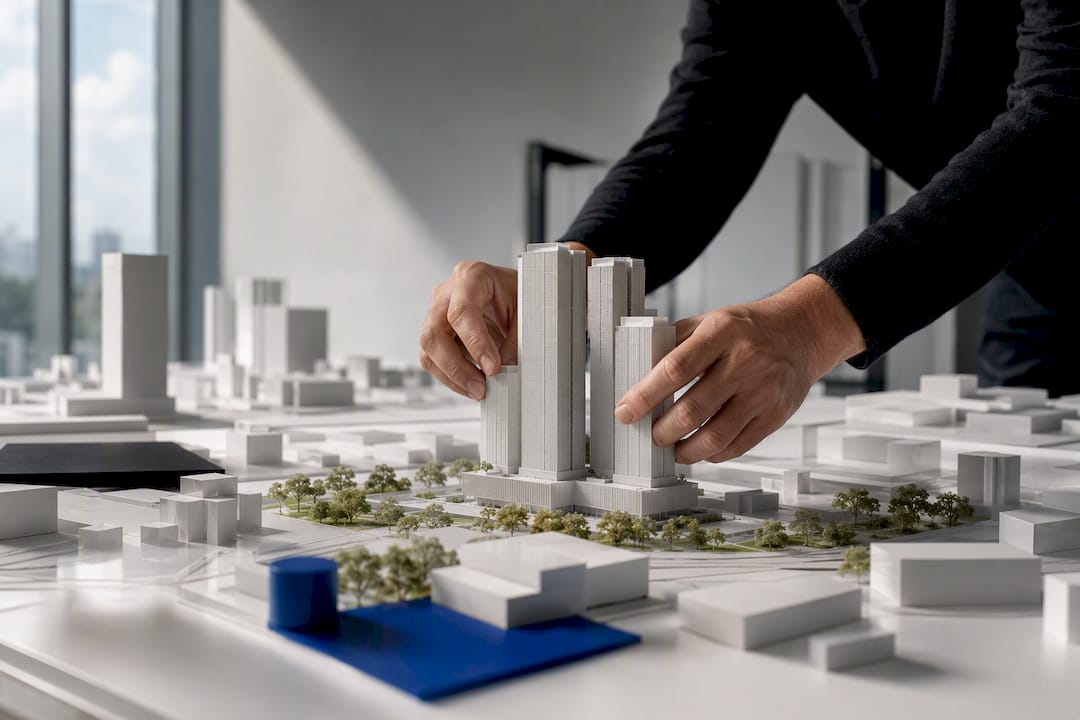
Bonus GFA concessions in Singapore let developers build beyond the Master Plan Gross Plot Ratio, but only up to a hard ceiling of 10% additional floor area. Within that cap, developers can draw on several distinct schemes, including the Built Environment Transformation GFA Incentive Scheme, District/Centralised Cooling System (DCS/CCS) utility allowances, the Balcony Incentive, the Conserved Bungalows Scheme, Indoor Recreation Spaces, Community & Sports Facilities, and Rooftop Outdoor Refreshment Areas. BE Transformation carries a fixed application window and its own percentage limits for private and government land sale (GLS) sites. None of these bonuses carry forward once a site is redeveloped.
TL;DR:
- The total bonus GFA from all incentive schemes cannot exceed 10% of the site’s Master Plan GPR, regardless of how many schemes are stacked.
- The Built Environment Transformation scheme offers up to 3% bonus GFA for private sites and 2% for GLS sites, with applications due by November 23, 2026; results depend on meeting digital and productivity targets.
- Utility GFA concessions for district or centralised cooling systems allow developers to reclaim floor area used for mechanical equipment, but may trigger additional land or property charges.
- Residential schemes such as balcony incentives, conserved bungalows, and indoor recreation spaces compete for the same 10% cap, requiring early sequencing during design planning.
- Early cross-disciplinary coordination and thorough documentation are crucial to maximize bonus GFA benefits and avoid missing opportunities due to last-minute decision-making or design conflicts.
Table of Contents
- What Are Bonus GFA Concessions Under URA Rules?
- Built Environment Transformation: Eligibility, Quantum, and Timeline
- District Cooling and Centralised Cooling System Concessions
- Residential Schemes: Balconies, Conserved Bungalows, and Indoor Recreation
- Commercial Schemes: Sports Facilities, Rooftop Dining, and CBD Incentives
- How Does the 10% Cap and GFA Computation Actually Work?
- Application Process: Forms, Timelines, and Documentation
- Practical Planning and Risk-Mitigation Advice
- Where Developers Find the Most Value in Bonus GFA Strategy
- How Aman Engineering Consultancy Supports Your Bonus GFA Strategy
- Sources
- FAQ
What Are Bonus GFA Concessions Under URA Rules?
Bonus gross floor area is additional built area the Urban Redevelopment Authority (URA) permits above what the Master Plan Gross Plot Ratio (GPR) otherwise allows for a site. Developers earn it, not by right, but by meeting specific design, sustainability, or public-benefit conditions attached to named incentive schemes. The umbrella term covers a family of concessions administered jointly by URA and the Building and Construction Authority (BCA), each with its own eligibility rules, quantum limits, and application procedure.
The governing constraint sits above all of them: total bonus GFA from every scheme combined cannot exceed 10% of the site’s MP GPR. That means a developer stacking the Balcony Incentive with BE Transformation and a DCS/CCS utility allowance still answers to one shared ceiling, not three separate ones. Understanding which schemes apply to a given asset class, and in what order to pursue them, is what separates a project that captures meaningful extra yield from one that leaves it on the table through expert construction marketing strategies.
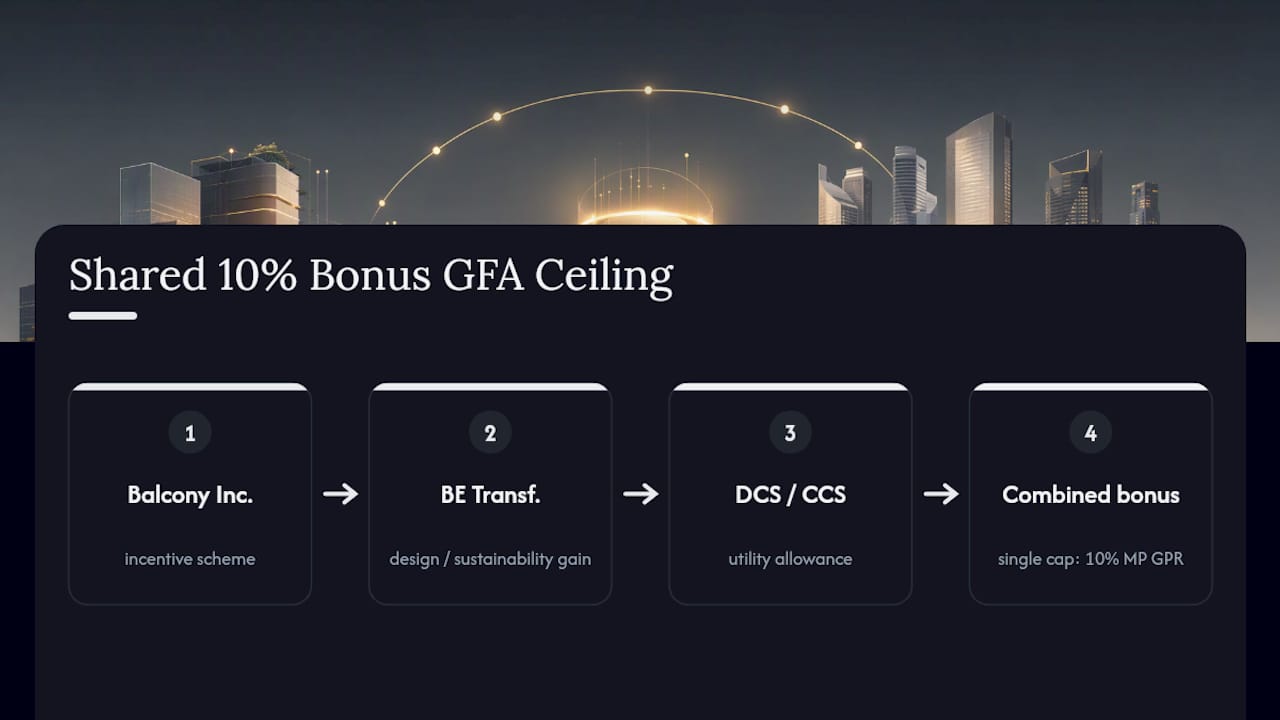
Active bonus GFA incentive schemes at a glance
Residential schemes (flats and condominiums):
- Balcony Incentive Scheme: rewards private enclosed spaces (balconies, roof terraces) designed to specific dimension and ventilation rules, common in condominium layouts.
- Conserved Bungalows Scheme: applies to conserved or voluntarily conserved bungalows, granting additional GFA tied to conservation commitments.
- Indoor Recreation Spaces Scheme: covers shared facilities such as function rooms and gyms within residential developments.
- BE Transformation: available to qualifying residential sites that meet the minimum GFA threshold.
Non-residential and mixed-use schemes:
- Community & Sports Facilities Scheme: applies to commercial and mixed-use sites providing public sports or community amenities.
- Rooftop Outdoor Refreshment Areas (ORA): applies to landscaped rooftop dining or leisure spaces on commercial buildings.
- DCS/CCS Utility GFA: applies wherever a development hosts or receives district or centralised cooling infrastructure, residential or commercial.
- BE Transformation: available across private and GLS sites of sufficient scale, residential or non-residential.
BE Transformation and DCS/CCS are the two schemes most likely to interact with others on the same site, since both deal with mechanical and sustainability infrastructure that touches multiple use zones. A mixed-use tower, for instance, might combine a Community & Sports allocation on lower floors with a BE Transformation bonus tied to building-wide energy performance.
Built Environment Transformation: Eligibility, Quantum, and Timeline
The BE Transformation GFA Incentive Scheme is the most consequential concession introduced in recent years, and it rewards outcomes rather than fixed design features. Instead of granting bonus GFA for including a specific amenity, BCA and URA grant it for hitting measurable performance targets tied to Singapore’s Integrated Digital Delivery and productivity goals under the Building and Construction Authority’s Built Environment Transformation agenda.
Eligibility and quantum:
- Sites must meet a minimum size threshold to qualify.
- Private sites can receive up to 3% bonus GFA.
- GLS sites are capped lower, at up to 2% bonus GFA.
- The scheme applies to new proposals submitted until November 23, 2026, after which its future is subject to review.
Quick Reference: A private site with 5,000 sqm minimum GFA can unlock up to 3% bonus floor area under BE Transformation; a comparable GLS site tops out at 2%, a gap developers should factor into land bids on government tenders.
The scheme rewards outcomes verified against an Integrated Transformation Masterplan (ITM) framework, which typically means demonstrating gains in areas like design for manufacturing and assembly, digital delivery adoption, or productivity metrics agreed with BCA in advance. This outcome-based structure is a deliberate policy shift: BCA wants proof, not intent, which pushes the evidence-gathering work earlier into the design process than developers may be used to.
Securing the bonus follows a defined sequence. The applicant first obtains a BCA Letter of Acceptance confirming the project meets ITM outcome criteria, then submits the corresponding planning application to URA, using the BE Transformation GFA computation form to demonstrate the quantum claimed. Approved projects may need to raise a security deposit calculated from Equivalent Market Value (EMV), and the bonus GFA itself can trigger Development Charge or Differential Premium assessments depending on the site’s existing land use approval. Teams should factor these cash flow timing effects into feasibility models well before submission, not after.
District Cooling and Centralised Cooling System Concessions
DCS and CCS concessions treat the mechanical and electrical space needed to support district or centralized cooling as bonus Utility GFA, sitting outside the normal GPR calculation. This matters because M&E plant rooms otherwise eat directly into a building’s usable floor area. Converting that space into a recognized utility bonus effectively lets a developer reclaim floor area that would otherwise be a pure cost center.
The mechanics differ depending on whether a building hosts cooling infrastructure for a district network or simply receives chilled water from one:
- Host buildings that accommodate the central plant serving multiple developments can apply for bonus Utility GFA proportional to the equipment footprint required.
- Receiving developments that tap into an existing district or centralized system may also qualify, though the eligibility criteria are narrower and depend on whether the building already sits on an established network.
- Existing buildings already connected to a DCS/CCS generally cannot claim a fresh bonus for infrastructure already accounted for under prior approvals.
- GLS sites with mandatory CCS conditions attached at tender stage follow a distinct compliance path, since the cooling tie-in is a condition of sale rather than a discretionary bonus application.
Bonus Utility GFA is not free of downstream cost. Additional Utility GFA can attract a Land Betterment Charge, and owners converting existing plant space to claim the bonus sometimes need to address In-Building Common Property (IBCP) conversion questions, particularly where the space transitions from a strata-shared function to a bonus-eligible utility use. Decanting occupants during a conversion is often cheaper than demolition and rebuild, but only where the base structure can accommodate the new plant layout without triggering separate structural approvals.
Pro Tip: *Before committing to a DCS/CCS tie-in, run the utility GFA numbers against your project’s internal floor efficiency targets first.
Residential Schemes: Balconies, Conserved Bungalows, and Indoor Recreation
Residential developers working on flats and condominiums have access to three schemes that show up repeatedly across new launches, each with its own qualifying logic under URA’s residential bonus GFA guidance.
- Balcony Incentive Scheme: covers balconies, private enclosed spaces, and roof terraces that meet minimum dimension and open-air ventilation requirements; most condominium developments use at least a portion of this allowance to add saleable outdoor area without consuming core GPR.
- Conserved Bungalows Scheme: applies where a bungalow is conserved under statutory heritage controls or voluntarily submitted for conservation status, with the resulting bonus computed as additional GFA layered onto the conserved footprint.
- Indoor Recreation Spaces Scheme: covers shared facilities such as function rooms, gyms, and communal lounges, a common feature in mid-to-large condominium projects seeking to differentiate their amenity offering.
- DCS/CCS where applicable: residential developments tied into a district cooling network follow the same host or receiving building logic described above, though uptake is less common than in commercial districts.
Every one of these schemes draws from the same 10% aggregate pool. A condominium project that maximizes its Balcony Incentive allocation has that much less headroom left for Indoor Recreation Spaces or a BE Transformation claim, which is why sequencing decisions need to happen at the concept design stage rather than being retrofitted once units are already laid out. Developers who treat each scheme as independent, rather than as competing claims on one shared cap, routinely discover late in the process that their most valuable amenity idea no longer fits.
Commercial Schemes: Sports Facilities, Rooftop Dining, and CBD Incentives
Commercial and mixed-use developments draw on a different set of concessions, generally tied to public amenity provision or urban design outcomes rather than private unit features.
- Community & Sports Facilities Scheme: rewards developments that incorporate public sports or community amenities, typically capped at 10% of GFA or 2,000 sqm, whichever applies under the specific site conditions, with allocations commonly going toward gyms, courts, or multi-purpose community halls.
- Rooftop Outdoor Refreshment Areas: available for landscaped rooftop dining or leisure spaces, a scheme that has shaped the rooftop bar and restaurant trend across the Central Business District, subject to landscaping and safety design conditions.
- CBD-specific incentives: cover elements like architectural lighting and public art integration, and these are periodically revised through URA’s circular package on bonus GFA incentives, so developers active in the CBD should check for updates before finalizing a design brief.
- BE Transformation on commercial sites: follows the same 5,000 sqm threshold and percentage caps described earlier, applicable to office, hotel, and retail developments as much as residential ones.
Mixed-use sites complicate the math further, because the allowable BE Transformation bonus allocation often needs to be split proportionally across residential and commercial GFA components. A developer combining a hotel podium with residential towers above it cannot simply apply the full site-wide percentage to whichever use case is more convenient. Confirming the use-quantum split early, ideally as part of the same feasibility exercise that shapes the GFA calculation for the whole scheme, avoids a costly redesign of the bonus allocation later.
How Does the 10% Cap and GFA Computation Actually Work?
The starting point is the Master Plan Gross Plot Ratio, the baseline density URA assigns to a site under the current Master Plan. Bonus GFA sits on top of that baseline, but the 10% cap applies to the aggregate of every scheme claimed, not to each scheme individually. A developer cannot claim 3% under BE Transformation, 5% under a residential scheme, and 4% under DCS/CCS and expect to stack them to 12%; the total simply caps out at 10%, whichever combination of schemes gets there.
Key Figure: Total bonus GFA across all combined incentive schemes cannot exceed 10% of a site’s Master Plan GPR, regardless of how many individual schemes a developer applies for.
Equally important: bonus GFA granted under any of these schemes does not become part of the site’s baseline development potential going forward. If the building is redeveloped decades later, the next scheme runs its own calculation from the Master Plan GPR in effect at that time, not from the enhanced GFA the prior building enjoyed. Developers modeling long-term land value should never treat a bonus GFA grant as a permanent uplift to the site’s inherent development rights.
A practical computation sequence looks like this:
- Confirm the site’s MP GPR and calculate the resulting base GFA in square meters.
- Calculate 10% of that base GFA to establish the maximum bonus GFA ceiling available.
- Estimate the quantum available under each scheme the project is pursuing (for example, 3% under BE Transformation, plus a residential Balcony allocation).
- Sum the estimated quanta and check the total against the 10% ceiling, trimming the lowest-value scheme first if the total exceeds the cap.
- Model the associated Development Charge, Differential Premium, or Land Betterment Charge implications, since these payments are typically assessed at the point the bonus GFA is formally granted, not at project completion.
Running this sequence during feasibility, rather than after schematic design is locked, is the difference between a bonus GFA strategy that survives value engineering and one that gets quietly abandoned when the numbers stop working. A plot ratio checklist at this stage helps confirm the baseline figures before layering incentive assumptions on top.
Application Process: Forms, Timelines, and Documentation
The administrative path for bonus GFA concessions follows a fairly consistent sequence, though BE Transformation adds an extra step compared to the older, simpler schemes.
- Step one: For BE Transformation, secure a BCA Letter of Acceptance confirming the project’s ITM outcome commitments meet scheme criteria.
- Step two: Submit the corresponding planning application to URA, generally within six months of receiving the BCA Letter of Acceptance, using the required computation form for the scheme claimed.
- Step three: Raise a security deposit, where required, calculated against Equivalent Market Value, before the bonus GFA is formally reflected in the approved plans.
- Common supporting documents: sustainability statements, IBCP conversion details for DCS/CCS-related claims, and the BE Transformation computation form itself.
- Post-approval obligations: monitoring and reporting requirements to confirm the ITM outcomes claimed at application stage are actually delivered once the building is operational.
Most queries URA and BCA raise during review trace back to incomplete quantum computations or mismatched figures between the planning submission and the BCA Letter of Acceptance. Reviewing the construction compliance checklist before submission, and confirming every figure in the planning application matches the source computation form exactly, tends to cut review rounds significantly. Teams working through a broader URA planning permission application at the same time should sequence the bonus GFA submission to align with, rather than trail behind, the main planning approval.
Practical Planning and Risk-Mitigation Advice
Prioritization matters more than most teams expect. BE Transformation, by contrast, rewards measurable outcomes, which makes it a stronger fit for projects that can commit to digital delivery or productivity targets early enough to document them properly for BCA’s review.
Practical priorities for project teams:
- Run volumetric scenarios against the 10% cap before finalizing schematic design, not after.
- Compare utility-based bonuses against amenity-based ones on a net usable area basis, not headline percentage alone.
- Build documentation discipline early: ITM outcome evidence, computation forms, and sustainability statements all need a paper trail from the start of design, not the end.
- Budget for security deposits and Development Charge exposure in the project’s cash flow model, not as a late surprise.
Pro Tip: Treat the bonus GFA strategy as a governance item with a named owner on the project team, not a design afterthought. Projects that assign accountability for tracking scheme eligibility, deposit obligations, and ITM evidence from kickoff consistently avoid the late-stage scramble that erodes the value of the bonus in the first place.
Coordinating architectural, M&E, and planning input at the feasibility stage, rather than in silos, is what makes this kind of early modeling possible in practice.
Where Developers Find the Most Value in Bonus GFA Strategy
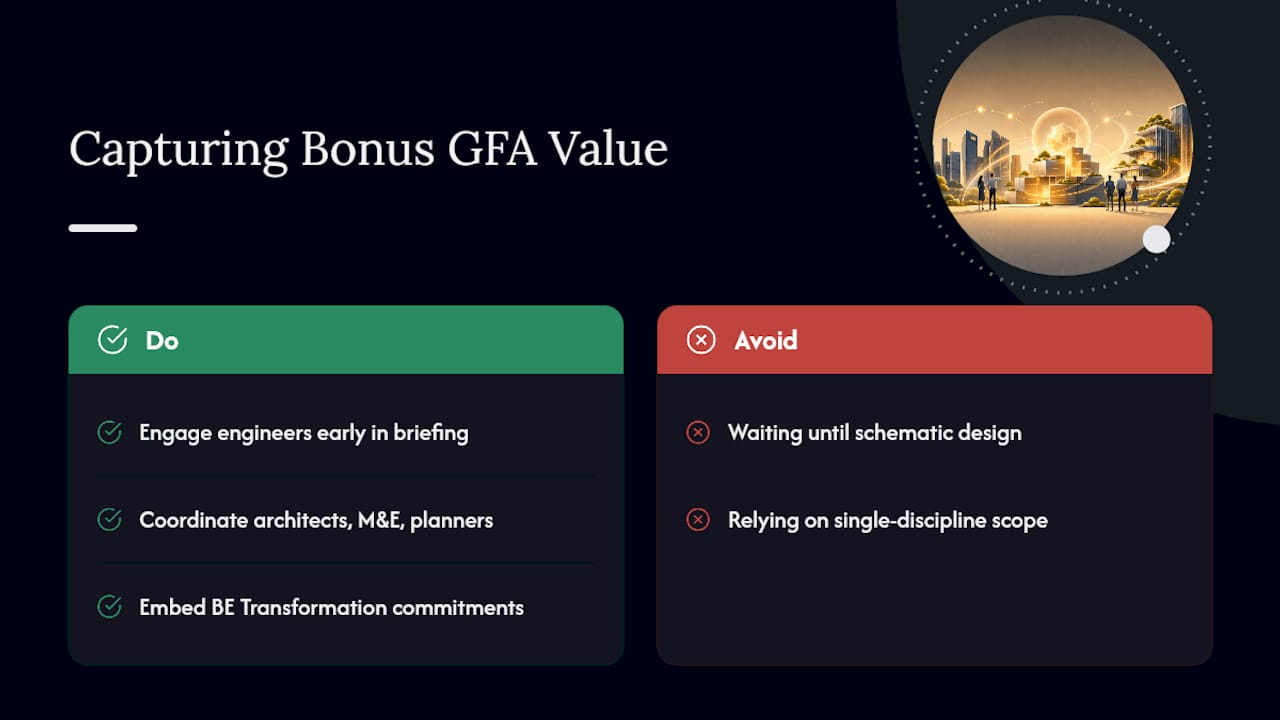
In practice, the developers who get the most out of bonus GFA concessions are the ones who bring their engineering and planning consultants in before the design brief is finalized, not after. Waiting until schematic design is locked to ask which schemes apply almost always means leaving value on the table, because the highest-quantum options, particularly BE Transformation, require outcome commitments baked into the building’s systems from the start.
Cross-disciplinary coordination between architects, M&E engineers, and planning consultants is where the real gains show up, since the schemes worth the most rarely live in a single discipline’s scope.
How Aman Engineering Consultancy Supports Your Bonus GFA Strategy
Working out which bonus GFA schemes actually fit your site, and in what order to pursue them, is a feasibility exercise before it is ever a submission exercise.
Engaging the firm typically starts with a feasibility review of your site’s MP GPR and the scheme combinations realistically available, followed by a defined submission plan covering BCA Letter of Acceptance timelines, URA planning application requirements, and the supporting computation forms each scheme demands. From there, the team tracks post-approval monitoring obligations so the bonus GFA granted stays compliant through construction and beyond. For projects still at the numbers stage, the feasibility studies service is the natural starting point, and for teams already deep in statutory coordination, the project compliance workflow service outlines what a structured submission process looks like end to end. Reach out through the Aman Engineering Consultancy site to scope a feasibility review for your next project.
Sources
Verify every figure in this guide against the primary source before finalizing a submission, since URA and BCA periodically revise scheme parameters.
FAQ
What Is Not Included in GFA in Singapore?
Certain spaces are excluded from GFA computation under URA’s handbook, including specific mechanical, void, and utility areas that meet defined exemption criteria, though bonus Utility GFA from DCS/CCS schemes is treated separately from these standard exclusions.
What Is the Balcony Incentive Scheme in Singapore?
It grants bonus GFA for private balconies, enclosed spaces, and roof terraces in residential developments that meet URA’s minimum dimension and ventilation requirements, letting developers add saleable outdoor area without drawing on core Master Plan GPR.
Does Bonus GFA Carry Over If a Building Is Redeveloped?
No. Bonus GFA granted under any scheme applies only to that specific approved development and does not form part of the site’s baseline development potential in a future redevelopment.