

A Registered Inspector (RI) is the professional the Fire Safety Act recognizes as qualified to inspect and certify fire safety works, and no Temporary Fire Permit (TFP) or Fire Safety Certificate (FSC) will be issued without an RI’s inspection certificate. Regulations split the role into two categories, RI (A) for architectural fire provisions and RI (M&E) for fire protection and mechanical ventilation systems, and most projects need both before occupation is approved.
TL;DR:
- Most projects require both RI (A) and RI (M&E) certificates to cover building fabric and active fire protection systems before occupation approval.
- Certification typically results in a Form 1 for full compliance or a Form 2 for minor deviations, with quick rectification required for the latter to avoid delays.
- Early appointment, comprehensive documentation, and full commissioning before inspection significantly reduce the risk of Form 2 outcomes or certification delays.
- RI registration must be current, FSE-qualified for alternative solutions, and their independence is enforced through strict notification and reporting rules.
- Coordinating testing, documentation, and inspections early with qualified consultants enhances the chances of securing a TFP or FSC smoothly.
Table of Contents
- Statutory Basis: Fire Safety Act and the Registered Inspectors Regulations
- RI Categories and Scope: RI (A) vs RI (M&E)
- How to Qualify and Register as a Registered Inspector
- Inspection Certificates: Form 1 vs Form 2 Explained
- Statutory Duties, Impartiality, and Notification Rules
- Practical Pre-Inspection Checklist to Avoid Delays
- When You Must Use an FSE-Qualified Registered Inspector
- How Aman Engineering Consultancy Supports RI Coordination
- Renewal, Suspension, and Revocation of RI Registration
- How RIs Work With SCDF and Qualified Persons
- Common Challenges During RI Inspections
- Three Priorities to Avoid Inspection Delays
- Aman Engineering Consultancy: Getting to TFP and FSC Faster
- Primary Legislation and SCDF Guidance to Bookmark
- Sources
- FAQ
Statutory Basis: Fire Safety Act and the Registered Inspectors Regulations
The Registered Inspector role exists because of a specific piece of subsidiary legislation and not general industry practice. The Fire Safety (Registered Inspectors) Regulations set out who may be appointed, what they must inspect, and how they must report their findings. Every fire safety work on a project, from sprinkler risers to smoke barriers, must be checked against the approved plans, the relevant codes of practice, and the Act itself.
The RI’s core obligation is procedural as much as technical. Once an inspection confirms compliance (or identifies a shortfall), the RI must prepare and submit an inspection certificate without delay to the Commissioner of Civil Defence. Delay isn’t a minor administrative lapse here. It stalls the TFP or FSC application behind it, and on a live construction schedule, that translates directly into holding costs.
SCDF backs this framework with active oversight rather than a one-time credential check. The regulations enable:
- Random checks on inspection certificates already submitted
- Verification that inspections matched the approved plans and codes cited
- Disciplinary action against RIs whose certificates don’t hold up to scrutiny
Pro Tip: Keep a chronological log of every inspection date, deviation noted, and remediation closed out. If SCDF flags a certificate for review, a clean paper trail resolves the query in days instead of weeks.
The consequence for owners and developers is straightforward: an RI who cuts corners doesn’t just create risk for the building, they create risk for the paperwork that unlocks your occupation permit.
RI Categories and Scope: RI (A) vs RI (M&E)
Fire safety works fall into two statutory categories, and each requires a different RI to sign off. RI (Architectural), or RI (A), covers the building fabric: compartmentation walls, fire doors, means of escape, and structural fire resistance. RI (M&E) covers the mechanical and electrical systems that detect and fight fire, including sprinklers, fire alarms, wet and dry risers, and mechanical smoke ventilation.
This split traces back to the First Schedule of the regulations, which divides inspection duties into two parts:
- Part I items generally align with RI (A) scope: fire compartmentation, escape routes, protected staircases, and passive fire protection measures built into the architecture.
- Part II items generally align with RI (M&E) scope: active systems such as sprinklers, fire alarm networks, smoke control fans, and fire pumps.
A mid-rise commercial redevelopment, for example, typically needs an RI (A) to certify the compartmentation and escape stair upgrades, and a separate RI (M&E) to certify the new sprinkler network and smoke exhaust system installed alongside it. Skipping either one leaves a gap in the certificate package that SCDF will not accept for TFP or FSC purposes.
Most mixed-use and larger developments need both categories engaged simultaneously, ideally from the design stage rather than bolted on near completion. Waiting until the final weeks to appoint an M&E inspector, while an architectural inspector has already been reviewing drawings for months, creates a scheduling mismatch that shows up as delay at the worst possible time.
How to Qualify and Register as a Registered Inspector
Becoming an RI isn’t a short course you complete on a weekend. It’s a professional credential layered on top of an existing one, and understanding the bar helps project teams vet who they’re hiring. The eligibility path runs through several fixed requirements:
- Hold an existing professional credential. Applicants must already be a registered architect under the Architects Act or a professional engineer under the Professional Engineers Act.
- Show 10 years of relevant practical experience. The regulations require at least a decade of hands-on work in the design or inspection of fire safety works, or fire protection and mechanical ventilation systems, immediately before applying.
- Submit documentary evidence. This means testimonials, project certificates, and proof of the specific fire safety work experience claimed, not a general résumé.
- Pass a selection panel interview. Shortlisted applicants meet a panel that assesses technical judgment, not just paper qualifications.
- Complete the mandatory SCDF short course. Selected candidates attend SCDF’s training program before formal registration is confirmed.
Pro Tip: If you’re a developer vetting an RI candidate for a large project, ask to see their registration confirmation directly rather than relying on a CV line. SCDF periodically requires re-training or refresher attendance, and a lapsed or suspended registration won’t surface on a resume.
Fees and specific forms are administered through SCDF’s own channels, and requirements are occasionally updated, so applicants should confirm the current process directly with SCDF rather than relying on secondhand summaries.
Inspection Certificates: Form 1 vs Form 2 Explained
The certificate an RI submits comes in one of two forms, and which one you get determines what happens next on your application.
- Form 1 signals full compliance. The RI has found the fire safety works match the approved plans, codes of practice, and regulatory requirements with no outstanding deviations. An FSC application backed by Form 1 certificates typically proceeds without further conditions attached.
- Form 2 signals compliance with minor deviations noted. SCDF may still consider a TFP for a limited period, giving the owner a window to rectify the flagged items before a full FSC is issued.
Owners applying for a Fire Safety Certificate must submit these RI certificates as part of the application package, since an inspection certificate is a prerequisite SCDF will not waive.
A Form 2 outcome isn’t a failure, but it does demand a rectification plan with a realistic timeline. Building owners who treat a Form 2 as the finish line, rather than a conditional pass, often find themselves scrambling when the TFP window closes before repairs are complete. Building the rectification schedule the moment Form 2 is issued, rather than after the first reminder from SCDF, keeps the project on track toward full FSC status.
Statutory Duties, Impartiality, and Notification Rules
An RI’s independence is written into the regulations, not left to professional courtesy. The role only works as an accountability check if the inspector answers to the Commissioner, not to the project team paying the invoice.
The clearest expression of this is the notification rule: an RI must notify the Commissioner within 14 days of being engaged on a project, and again within 14 days if that engagement ends. This creates a traceable record of exactly who was responsible for inspecting a building’s fire safety works at any given point.
Beyond notification, RIs carry several standing obligations:
- Submit inspection certificates without delay once an inspection concludes
- Maintain accurate records of every inspection performed
- Report contraventions to the Commissioner if an owner fails to rectify a flagged non-compliance
Owners and QPs have matching obligations on their side of the relationship. They must supply approved plans, commissioning test reports, and give the RI reasonable access to inspect works in progress. An RI who is denied documentation or site access can’t certify what they haven’t verified, and stonewalling an inspector rarely speeds up an application. It just pushes the eventual certificate further out.
Practical Pre-Inspection Checklist to Avoid Delays
Most Form 2 outcomes trace back to the same root cause: incomplete paperwork or unfinished commissioning at the moment the RI shows up. A structured approach fixes that.
- Assemble the document package first. Approved plans, system test reports, commissioning certificates, equipment cut sheets, and QA records should be in one file before you schedule anything.
- Complete witness testing before booking the inspection. Sprinkler flow tests, alarm functionality checks, and pressure tests on wet and dry risers need to be signed off, not scheduled “around” the RI’s visit.
- Walk the site against the First Schedule checklist. Confirm compartmentation seals, sprinkler head coverage, alarm audibility, exit signage, and clear means of escape before the RI arrives.
- Appoint the RI early, ideally during design development. Early engagement lets an inspector flag design-stage issues before they’re built and become expensive to fix.
Pro Tip: Schedule the final inspection only after commissioning certificates for sprinkler and alarm systems are signed. Booking the RI before testing is complete is one of the most common, and most avoidable, causes of a Form 2 result.
Industry experience consistently points to the same lesson: teams that bring an RI in early catch non-compliance while it’s still cheap to correct, rather than discovering it during a final walkthrough with occupation deadlines already looming. A detailed final-site inspection guide can help project teams map this sequence against their own schedule.
When You Must Use an FSE-Qualified Registered Inspector
Not every fire safety design follows the prescriptive codes line by line. Some projects use Alternative Solutions, a performance-based design approach where an engineer demonstrates that a non-standard method, such as a computational smoke control model for an atrium, achieves an equivalent or better safety outcome than the prescriptive code requires.
Alternative Solutions carry a strict inspection rule: they must be inspected by an RI who is also a registered Fire Safety Engineer (FSE). A general RI (A) or RI (M&E) credential alone doesn’t qualify someone to certify these works, regardless of how experienced they are with conventional systems.
This matters most at the procurement stage. Before commissioning any Alternative Solutions component, confirm the assigned RI’s FSE registration directly rather than assuming standard RI credentials cover it. Listing every Alternative Solution clearly in the submission package, and pairing it with a confirmed FSE-registered RI, avoids acceptance problems at SCDF that can otherwise surface late in the approval process.
How Aman Engineering Consultancy Supports RI Coordination
Getting a project to a clean Form 1 outcome takes more than hiring a qualified RI. It takes sequencing the document package, witness testing, and on-site checks so the inspector isn’t reviewing incomplete work.
Coordination of statutory submissions, M&E testing schedules, and BIM clash detection ahead of RI inspections aligns paperwork with on-site conditions. That kind of upfront coordination is what turns a scheduled inspection into a formality rather than a discovery process. Aman’s own RI process guide walks through the sequence in more depth for teams preparing their first final-site inspection.
Renewal, Suspension, and Revocation of RI Registration
RI registration isn’t a permanent credential earned once and held indefinitely. It operates on a cycle that requires ongoing engagement with SCDF, and lapses carry real consequences for anyone relying on that RI’s certification.
Renewal typically requires the RI to demonstrate continued active practice in fire safety inspection work, and SCDF may require attendance at refresher training if an RI’s registration has lapsed or if standards have been updated since their last course. An RI who hasn’t kept up with renewal requirements risks a gap in registration status precisely when a project needs their certificate submitted.
Suspension and revocation function as the enforcement side of SCDF’s oversight. Because the regulations already empower SCDF to run random checks on submitted certificates, an RI found to have certified work that doesn’t match the approved plans, or who submitted certificates without an adequate inspection, faces disciplinary consequences. Depending on severity, that can mean a formal warning, a suspension of registration for a defined period, or outright revocation for serious or repeated breaches.
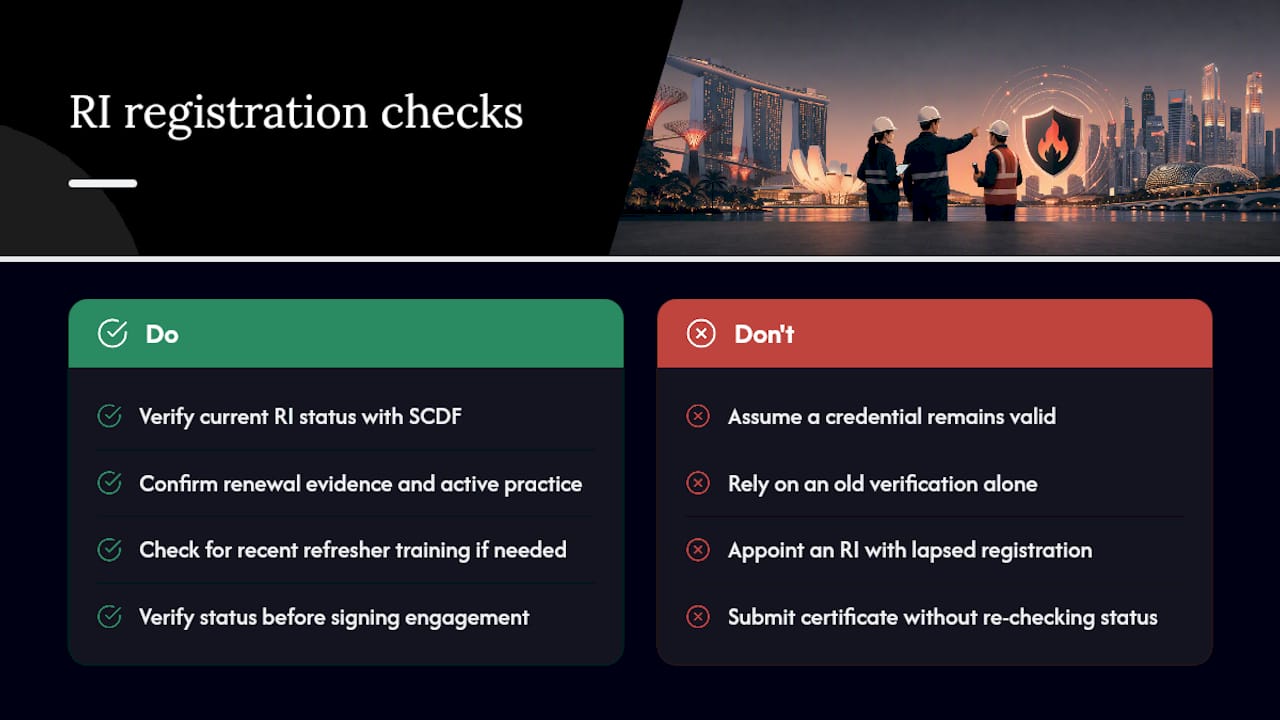
For building owners and developers, the practical takeaway is to verify an RI’s current registration status before appointment, not just at the start of a working relationship years ago. A credential that was valid when a consultant was first engaged isn’t guaranteed to still be active. Confirming current standing directly with SCDF before signing an engagement letter costs a phone call. Discovering a lapsed registration after a certificate submission costs weeks.
How RIs Work With SCDF and Qualified Persons
An RI doesn’t operate in isolation. The role sits between the project’s Qualified Person (QP), who designs and submits the fire safety plans, and SCDF, which ultimately approves TFP and FSC applications. Understanding that triangle clarifies who does what.
The QP, typically the architect or engineer of record, prepares and submits the fire safety design for SCDF’s plan approval. Once construction reaches the point where fire safety works are complete, the RI is the independent party who verifies that what got built actually matches what the QP designed and SCDF approved. That independence is deliberate. An RI functions as a check on the QP’s own work, not an extension of it, which is part of why the notification and impartiality rules exist in the first place.
SCDF sits above both roles as the regulator that receives the RI’s certificate and decides whether it satisfies TFP or FSC requirements. SCDF doesn’t typically re-inspect every item an RI has already certified. It relies on the certificate as the evidentiary basis for approval, which is exactly why the random-check enforcement mechanism matters. It’s the backstop that keeps the whole certification system trustworthy.
For owners and contractors, this means the RI relationship deserves the same attention as the relationship with your QP. A well-coordinated project has the QP and RI communicating early about design intent, not meeting for the first time at final inspection.
Common Challenges During RI Inspections
The same handful of problems account for most delays at RI inspection stage, and nearly all of them are preventable with earlier planning rather than better luck.
Incomplete documentation tops the list. Test reports that haven’t been compiled, commissioning certificates still pending signature, or as-built drawings that don’t reflect last-minute site changes all stall an inspection before it starts. An RI can’t certify against a document package that doesn’t exist yet.
Sequencing mismatches come next. Booking a final inspection before mechanical commissioning wraps up, or before architectural fire-rated works are fully closed up, forces the RI to either delay the visit or issue a Form 2 flagging items that simply weren’t ready. Neither outcome helps the project timeline.
Coordination gaps between RI (A) and RI (M&E) create a third recurring issue on mixed-scope projects. When the two inspectors work from different revisions of the drawings, or aren’t aware of changes the other has flagged, contradictory findings can surface late.
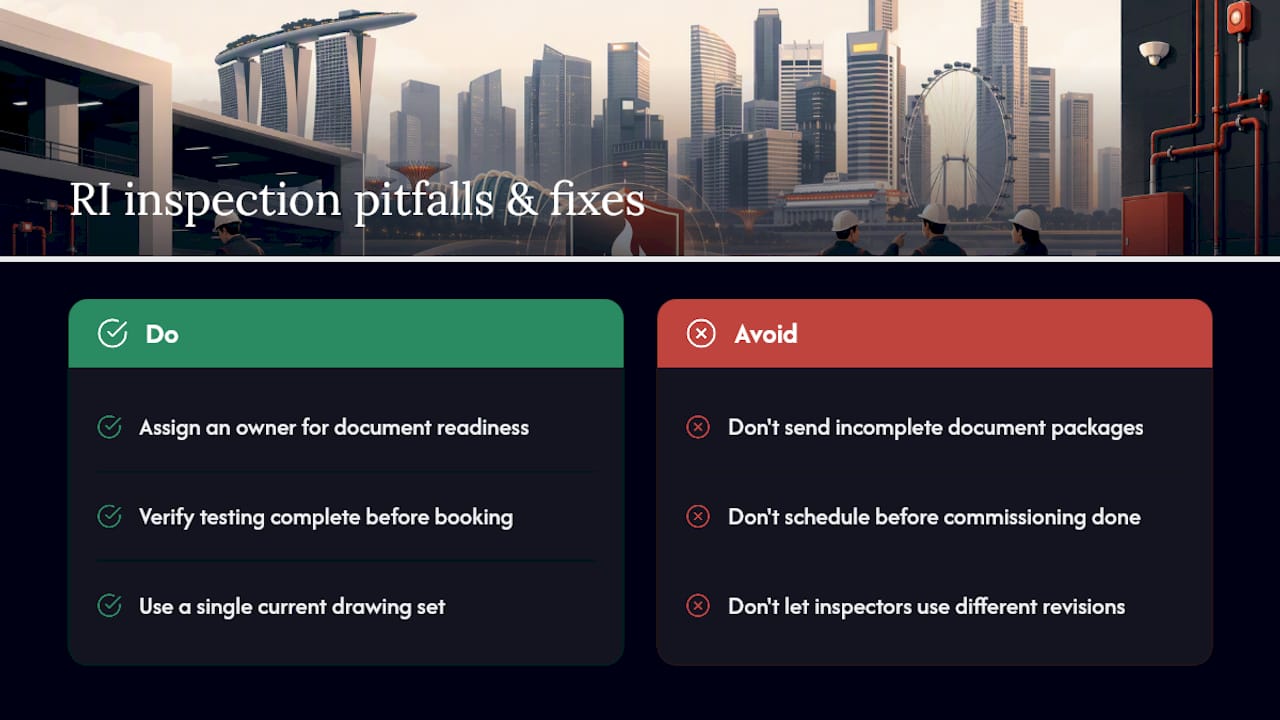
The best practice across all three is the same: treat RI engagement as a project workstream with its own timeline, not a final checkbox. Assign someone on the project team to own document readiness, confirm testing completion before scheduling, and keep both RI categories working from a single, current set of drawings. Reviewing common compartmentation-related inspection failures before your own inspection is a useful way to catch the same mistakes other projects have already made.
Three Priorities to Avoid Inspection Delays
If a project team takes away only three things from all of this, they should be these. Appoint your RI early, during design development rather than after construction is underway. Verify FSE registration before commissioning any Alternative Solutions work, since a standard RI credential won’t cover it. And build the full document package, including signed commissioning certificates, before you book the final inspection, not after.
Aman sequences these steps deliberately: coordinating testing schedules and document readiness ahead of the RI’s visit so the inspection confirms compliance rather than uncovering gaps. Projects that plan this way tend to move from inspection to Form 1 with far less back-and-forth. If your project is approaching final inspection and you want a second set of eyes on readiness, a compliance review before the RI walks the site is worth the conversation.
— Aman
Aman Engineering Consultancy: Getting to TFP and FSC Faster
Some consultancies specialize in coordinating RI certification to minimize avoidable delays. Managing statutory submissions, M&E testing coordination, and BIM clash checks as one coordinated sequence can help achieve a clean RI inspection outcome.
That coordination is the concrete difference for a Singapore project team facing a TFP or FSC deadline. Instead of discovering a documentation gap or an unfinished commissioning report during the RI’s site visit, Aman’s process surfaces those issues weeks earlier, when they’re still cheap to fix. Engineers working directly with QPs and RIs to align approved plans, test reports, and on-site conditions before an inspection can improve the likelihood of a Form 1 outcome rather than a Form 2 rectification cycle.
For construction teams managing document control across multiple contractors, pairing this with disciplined document control workflows can further cut the back-and-forth that slows RFI turnaround on active sites.
If your project is heading toward TFP or FSC submission, visit Aman Engineering Consultancy to start a compliance readiness conversation, or review how to engage engineering consultants effectively before your next inspection milestone.
Primary Legislation and SCDF Guidance to Bookmark
Every claim in this guide traces back to two sources worth bookmarking directly:
- SCDF’s Registered Inspector guidance page, covering the certificate requirement and application process
- The Fire Safety (Registered Inspectors) Regulations, covering RI duties, the First Schedule, and notification rules
Download the First Schedule and Form 1/Form 2 templates directly from these sources, and check periodically for amendments, since subsidiary legislation is updated more often than the parent Act.
Sources
- Fire Safety (Registered Inspectors) Regulations – Singapore Statutes Online
- Registered Inspector – Singapore – SCDF
FAQ
What Regulations Govern Registered Inspectors in Singapore?
The Fire Safety (Registered Inspectors) Regulations set the qualification criteria, inspection duties, notification requirements, and certificate formats RIs must follow under the Fire Safety Act.
How Much Does a Fire Safety Certificate Cost in Singapore?
SCDF administers FSC application fees directly and updates them periodically, so applicants should confirm the current fee schedule on the SCDF Registered Inspector page rather than relying on a fixed figure.
How Does an RI Conduct a Fire Safety Inspection?
An RI reviews the fire safety works against the approved plans, applicable codes of practice, and the Act, checking both architectural fire provisions and, where relevant, mechanical and electrical fire protection systems before issuing Form 1 or Form 2.
How Do I Apply for a Fire Safety Certificate in Singapore?
Owners submit the FSC application to SCDF along with the RI’s inspection certificate, since SCDF requires that certificate as a prerequisite before an FSC or TFP can be granted.
What Is the Difference Between RI (A) and RI (M&E)?
RI (A) certifies architectural fire safety provisions like compartmentation and escape routes, while RI (M&E) certifies active systems such as sprinklers, alarms, and mechanical smoke ventilation, and larger projects typically need both.