
Most changes to how you use a commercial unit in Singapore require URA approval before you sign a lease or start renovation. The two available routes are the Change of Use Lodgment scheme, which processes eligible cases instantly for a processing fee, and a full Change of Use application through GoBusiness, which costs $500 and typically takes about 10 working days. Before doing anything else, check your unit’s status on URA SPACE with proper verification, secure the owner’s written consent, and hold off on any tenancy or fit-out commitments until approval is in hand.
TL;DR:
- If your commercial unit’s intended use is on the URA checklist and within a qualifying building type, the lodgment process costs $150 and is processed instantly.
- For uses outside the approved list or buildings not covered by the scheme, planning approval typically takes about 10 working days through a full application.
- Confirm zoning, existing planning conditions, and land ownership restrictions before applying, especially on JTC, HDB, or SLA land, to avoid rejection or additional costs.
- Submitting incomplete documents or mismatched formats can delay approval, and approval from URA alone does not cover fire safety, licensing, waste, or plumbing permits.
- Engaging a professional consultancy can significantly accelerate approvals and reduce risks, especially for complex sites or when multiple agencies’ permissions are required.
Table of Contents
- Do You Need URA Approval for Your Change of Use?
- Change of Use Lodgment vs Full Change of Use Application
- How to Submit a Complete Change of Use Application
- Site Risks, Extra Costs, and the Agencies That Come After URA
- Your Timeline: What to Do Before You Sign Anything
- Where a Consultancy Like Aman Engineering Consultancy Reduces Risk
- When to File It Yourself, and When to Call a Consultant
- Get Your Change of Use Application Right the First Time
- Official Resources Worth Bookmarking
- Sources
Do You Need URA Approval for Your Change of Use?
Not every shift in business activity triggers a review. URA exempts a narrow set of conversions, mostly swaps between retail, showroom, and F&B uses within the same commercial building, but these exemptions carry conditions tied to the unit’s specific zoning and the building’s approved use mix. A shophouse converting from retail to a clinic, for instance, does not automatically qualify for the same exemption a mall unit would get.
Building type drives most of the answer. A commercial building governed by URA’s own zoning is a different case from a JTC-leased industrial unit, an HDB shop, or land under Singapore Land Authority (SLA) management, each of which layers its own consent requirements on top of URA’s.
Before assuming either way, confirm the facts:
- Search the address on URA SPACE to see the current approved use and any planning conditions attached to the unit.
- Cross-check the site against the Master Plan to confirm the zoning allows your intended activity.
- If the building sits on JTC, HDB, or SLA land, contact that landowner separately. URA’s sign-off does not override their leasehold conditions.
When URA SPACE shows ambiguity, that is your signal to file rather than guess.
Change of Use Lodgment vs Full Change of Use Application
Picking the wrong route wastes time and, in the case of a rejected lodgment, forces you to restart the process as a full application. Here is how the two compare:
- Change of Use Lodgment covers a pre-identified list of uses in selected commercial buildings and 1st storey shophouses. If your intended use is on that list and the building qualifies, URA processes it instantly for a $150 fee, with an acknowledgement slip issued the same day.
- Full Change of Use application applies to everything outside the lodgment list, or to buildings not covered by the scheme. URA assesses these against site context, meaning traffic impact, neighboring uses, and disamenity to nearby residents. The processing fee is $500, and assessment generally runs about 10 working days, longer if agencies need to weigh in or your submission is incomplete.
- If a lodgment gets rejected, the case does not disappear. It typically means your use or building falls outside the pre-approved list, and you need to refile as a full application with the added documentation that route demands.
Pro Tip: Never assume lodgment eligibility because a neighboring unit runs a similar business. Approved use status is tied to the specific unit, not the block or street.
How to Submit a Complete Change of Use Application
Applications go through GoBusiness Singapore, and who can file depends on your role: the property owner, a tenant with the owner’s consent, or a third party such as a qualified person (QP) acting under a Corppass-linked UEN. Individual applicants use Singpass; companies authorize submission through Corppass.
Have these ready before you start:
- The owner’s written consent, mandatory for every application where the applicant is not the registered owner.
- A location plan and floor plan showing the unit and proposed layout, ideally matching the sample templates GoBusiness provides.pdf).
- A written business concept statement describing the proposed activity in enough detail for URA to assess impact.
- An Assumption of Liability form, if the change could trigger Land Betterment Charge.
- Any prior clearances already obtained from agencies relevant to the proposed use.
File formats matter more than applicants expect. GoBusiness rejects malformed submissions outright, and a mismatched filename or unsupported file type is one of the most common reasons a straightforward application stalls before an officer even reviews the content. GoBusiness confirms that fees are non-refundable regardless of outcome, so an incomplete first submission costs you both money and the 10 working day clock resetting. Aman’s guide to submitting URA renovation plans walks through formatting standards in more detail.
Site Risks, Extra Costs, and the Agencies That Come After URA
URA approval is not a rubber stamp, and it is not the finish line either. On the approval side, certain site conditions push applications toward rejection regardless of how sound the business plan is: traffic congestion the new use would worsen, disamenity to nearby residential blocks, or location within an Area for Growth and Urban renewal (AGU) or other restricted zone.
On the cost side, watch for Land Betterment Charge. If your change of use raises the land’s value, SLA can issue a Liability Order requiring payment before or alongside approval. Running the SLA LBC estimator before you commit to a lease term protects you from a number that could reshape your entire deal.
URA sign-off also does not clear you with:
- SCDF for fire safety certification
- SFA for foodshop licensing
- NEA for waste and odor controls
- PUB for plumbing and drainage works
- ECDA for childcare-related uses
Pro Tip: Run your fire safety and food licensing checks in parallel with your URA submission, not after. Sequential filing is the single biggest reason commercial fit-outs open weeks later than planned. Aman’s breakdown of building compliance categories covers how these approvals interact.
Your Timeline: What to Do Before You Sign Anything
Sequence matters more than speed here. Follow this order:
- Check URA SPACE and the Master Plan for your unit’s approved use and zoning.
- Secure the owner’s written consent and, if relevant, run an early LBC estimate through SLA.
- If you qualify for lodgment, expect same-day acknowledgement and proceed once you have it in writing.
- If a full application is required, budget roughly 10 working days, plus extra time for any agency consultation.
- Only after written approval should you sign the lease, start renovation, or bring in fit-out contractors.
Committing to a tenancy before this sequence completes is the single most expensive mistake operators make.
Where a Consultancy Like Aman Engineering Consultancy Reduces Risk
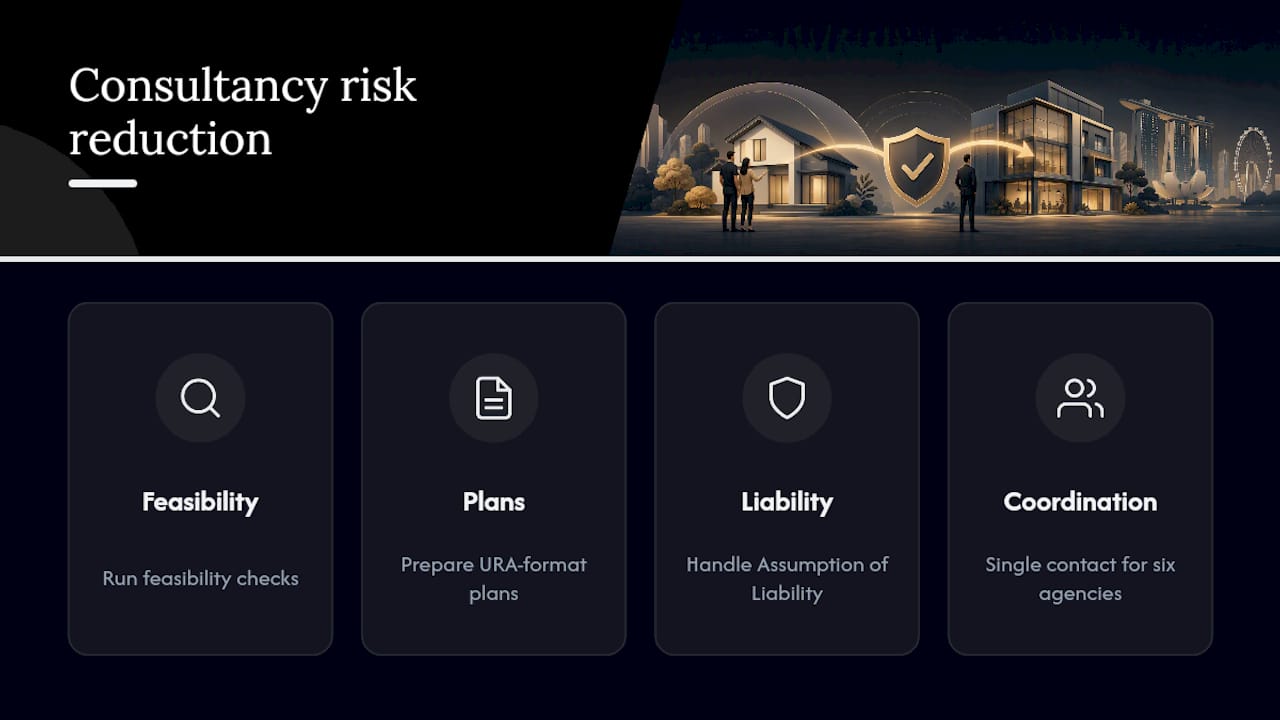
A qualified consultancy shortens this process by running feasibility checks, preparing plans to URA’s expected format, and handling the Assumption of Liability paperwork when LBC is in play. Coordinating SCDF, SFA, JTC, HDB, and SLA requirements in parallel with the URA submission, rather than sequentially, is where most delays get eliminated.
Aman Engineering Consultancy has handled statutory submissions across URA, JTC, HDB, SCDF, BCA, and PUB, giving property owners a single point of coordination instead of five separate conversations with five agencies.
When to File It Yourself, and When to Call a Consultant
Owner-operated swaps in a standard commercial building, confirmed eligible through URA SPACE, are usually simple enough to file solo. Once a site borders residential zones, sits on JTC or SLA land, or carries real LBC exposure, get a consultant involved before you sign anything. The cost of a professional review is trivial next to a rejected application or an unbudgeted Liability Order.
— Aman
Get Your Change of Use Application Right the First Time
Aman Engineering Consultancy handles the parts of this process that trip up most applicants: feasibility assessment before you commit to a site, plan preparation that meets URA’s format expectations, Assumption of Liability paperwork when LBC applies, and coordination across SCDF, SFA, HDB, JTC, and SLA so approvals move in parallel instead of one at a time.
If you are weighing a change of use for a commercial unit and want a clear read on feasibility, LBC exposure, and the agency approvals stacked behind it, reach out to Aman Engineering Consultancy for a site review before you sign a lease or book renovation works.
Official Resources Worth Bookmarking
- Change of Use Lodgment and full Change of Use guidance from URA
- GoBusiness licensing page for submission
- SLA’s Land Betterment Charge estimator
- Sample location plan template
- ScamShield to verify suspicious payment requests before transferring any fee
Sources
- Change of Use Lodgment | Urban Redevelopment Authority (URA)
- Changing the Use of Your Property | Urban Redevelopment Authority (URA)
- Change of Use Approval | Licence & Accreditation (GoBusiness)
- Singapore Land Authority (SLA) — Land betterment charge