
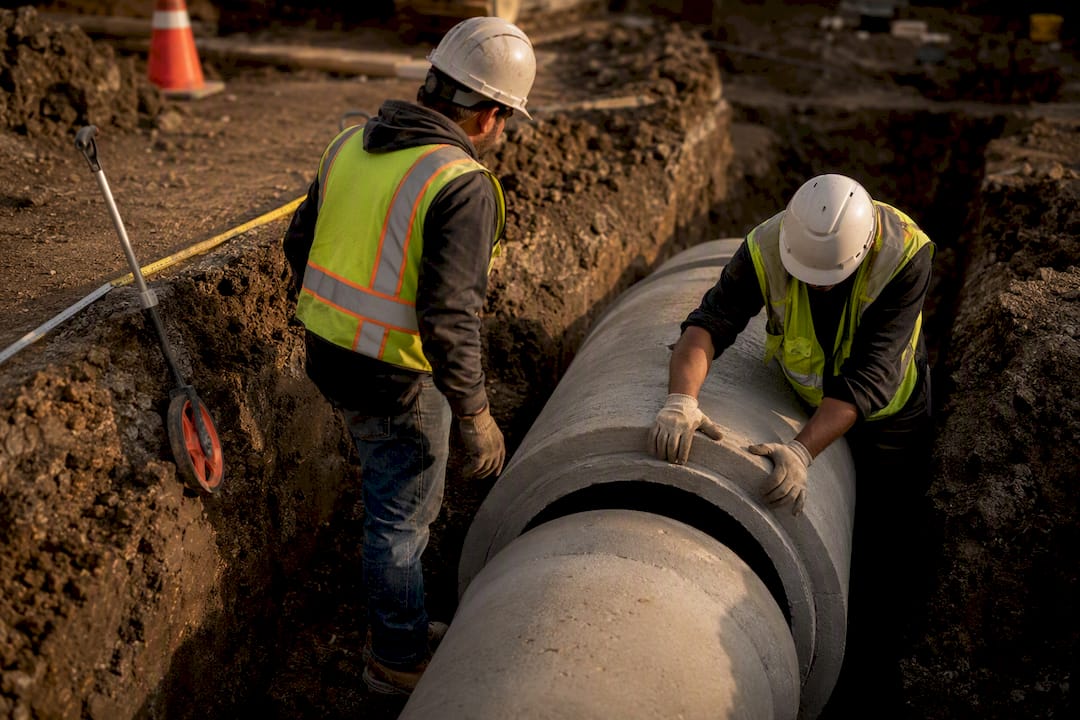
A drainage submission for a Singapore project is the PUB clearance sequence, Development Control (DC), Detailed Plan (DP), and the completion-stage TOP/CSC drainage clearance, that proves your drainage design meets the Sewerage and Drainage Act and PUB’s Code of Practice on Surface Water Drainage. The immediate action for any Qualified Person is to determine whether the project qualifies for a Simplified Submission (SS) or requires the full DC and DP route, then lodge the correct PUB e-form through CORENET.
That single decision, SS or full DC/DP, dictates the entire timeline, the documentation burden, and the audit exposure that follows. Get it wrong at the outset and you are looking at resubmission cycles that can add weeks to a project schedule.
- Confirm SS eligibility first. Additions and alterations to single landed houses and a narrow set of factory or shop works may qualify for lodgement-based Simplified Submission.
- Default to DC then DP for new erections, larger developments, and any project with pumped drainage, detention tanks, or altered site levels.
- Identify the completion forms early. PUB-DRATOP and PUB-DD-CSIDRA, plus the Certificate of Inspection for Drainage Works, govern TOP/CSC drainage clearance.
- Route everything through CORENET, PUB’s processing channel for building plan submissions, alongside BCA’s parallel structural and architectural workflows.
Key Takeaways
Drainage submission approval in Singapore hinges on correctly classifying the project as SS-eligible or full DC/DP, then matching every PUB e-form to its required technical deliverables before lodgement.
| Point | Details |
|---|---|
| Classify before lodging | Confirm SS eligibility or default to full DC/DP before selecting a CORENET form category. |
| Match forms to stage | Use PUB-DCCLR for DC, PUB-DPCLR for DP, and PUB-DRATOP/PUB-DD-CSIDRA at completion. |
| Expect a 14 working day cycle | PUB typically responds to major drainage submissions and resubmissions within about 14 working days. |
| Cloud every amendment | Highlight drawing changes and state scope in the cover letter to avoid routing delays. |
| Engage early for complex projects | Aman Engineering Consultancy manages DC/DP submissions, calculation review, and completion handover for developers and QPs. |
Table of Contents
- What Is the Difference Between DC and DP Drainage Submissions?
- When Can You Use Simplified Submission Instead of Full DC/DP?
- What Documents Does PUB Require in a Drainage Submission?
- How Do You Submit a Drainage Plan and How Long Does PUB Take to Respond?
- What Are the Most Common Mistakes That Delay Drainage Approval?
- What Happens at TOP/CSC for Drainage Clearance?
- When Should You Apply for a Deviation From PUB’s Code of Practice?
- How Do You Coordinate Drainage Submissions With Other Agencies?
- How Aman Engineering Consultancy Supports Drainage Submissions
- Where Can You Find Official PUB Drainage Submission Resources?
- What Practitioners Get Wrong About Drainage Submissions
- Managing Your Drainage Submission Without the Administrative Drag
- Frequently Asked Questions
- Sources
What Is the Difference Between DC and DP Drainage Submissions?
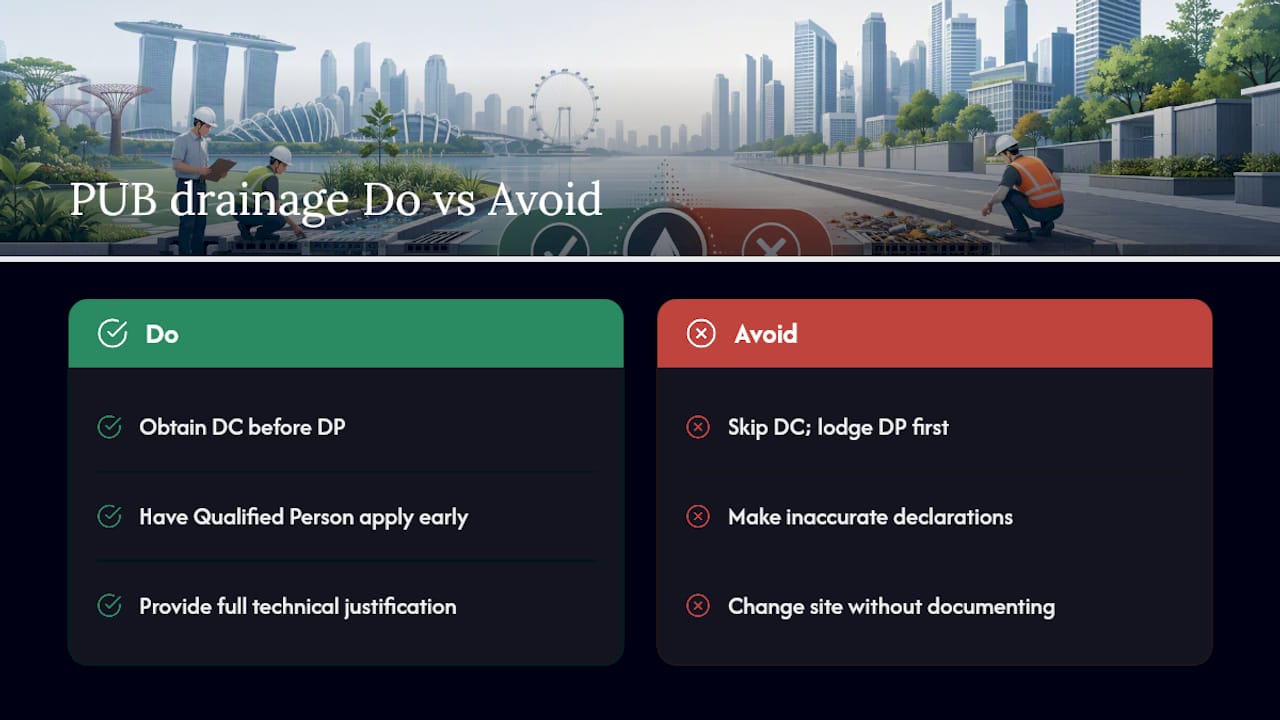
Development Control (DC) clearance and Detailed Plan (DP) clearance are two sequential stages of the same PUB drainage submission process, and confusing their scope is one of the fastest ways to trigger a rejected lodgement.
DC clearance, lodged using the PUB-DCCLR form, reviews the project at a conceptual level. PUB checks site layout, proposed outfall points, the general drainage catchment, and whether the development’s footprint respects any drainage reserve or existing public drain alignment. It is the gatekeeping stage: get DC wrong, and every drawing that follows inherits the problem.
DP clearance, lodged using PUB-DPCLR, goes into the engineering detail DC never touches. This is where PUB reviews hydraulic calculations, pump and sump schematics, detention tank sizing, and the longitudinal and cross-section drawings that show how stormwater actually moves through the site.
- Lodge DC first with site plans, proposed outfall locations, and a preliminary catchment plan showing how the development ties into the public drainage system.
- Wait for DC clearance before finalizing detailed engineering, since PUB conditions at this stage can change catchment boundaries or outfall positions.
- Lodge DP with full hydraulic calculations, pump and sump details, and construction drawings once DC conditions are settled.
- Check whether portions of the works qualify for SS instead of a full DP, particularly for minor internal alterations that don’t touch the primary drainage layout.
Under the Sewerage and Drainage Act, both clearances are mandatory before sewerage, sanitary, and drainage works proceed, and PUB typically responds to a drainage submission or resubmission within about 14 working days. A project with a straightforward internal renovation might skip DP entirely if SS criteria apply, a distinction worth confirming before your team invests hours in calculations PUB may never ask for.
When Can You Use Simplified Submission Instead of Full DC/DP?
Simplified Submission (SS) exists for a narrow category of low-risk projects, and PUB’s own guidance is precise about who qualifies. Misreading that eligibility list is the single most common reason a QP files SS when the project actually needed full DC/DP treatment.
SS applies to:
- Additions and alterations (A&A) works to single landed houses, provided the drainage layout isn’t materially altered.
- Certain limited factory or shop works where the scope doesn’t affect public drainage infrastructure.
- Projects with no change to impervious area, outfall points, or catchment characteristics.
SS explicitly excludes food establishments and any project where grease trap discharge, industrial effluent, or altered catchment area comes into play. PUB’s Simplified Submission process is lodgement-based: the system issues acknowledgement quickly, often within a working day or two, but that speed comes with a catch. PUB retains the right to audit any SS lodgement after the fact, and a poorly documented declaration can trigger a request for full plans and calculations retroactively.
Pro Tip: Keep a signed declaration file and supporting sketches for every SS lodgement, even when PUB doesn’t ask for them upfront. An audit six months later is far harder to answer from memory than from a folder you built at submission time.
Treat SS as a privilege that comes with an ongoing documentation obligation, not a shortcut that ends once the acknowledgement lands in your inbox, as explained in this drainage regulations explained for homeowners and builders guide. A related overview of when Simplified Submission applies versus full DC/DP is worth reviewing before you commit to either path.
What Documents Does PUB Require in a Drainage Submission?
PUB’s review depends entirely on the completeness of your technical package, and a drainage submission missing even one supporting drawing routinely stalls in queue rather than getting rejected outright, which wastes far more time than a clean first pass.
The core drawing set includes:
- Site plan showing catchment boundaries, existing and proposed outfall points, and drainage reserve lines.
- Longitudinal and cross-section drawings for every drain run, showing invert levels, gradients, and pipe sizes.
- Basement and first-storey layout plans identifying swan neck locations, where drainage pipes rise above flood-prone entry points.
- Pump and sump schematics for any mechanically assisted drainage, including tank dimensions and float switch levels.
The calculation package must demonstrate, not just assert, that the system works:
- Hydraulic calculations using PUB’s accepted runoff coefficients for the site’s land use category.
- Orifice sizing calculations for any detention tank discharge control.
- Pump capacity figures cross-checked against the manufacturer’s pump curve, not just a nameplate rating.
- Detention tank storage volume calculations matching the site’s peak discharge requirements under the Code of Practice on Surface Water Drainage.
At completion, PUB expects as-built records that reflect what was actually constructed, not what was designed. That means as-built drawings, site photographs of key drainage features (swan necks, outfall connections, detention tank installations), and PE endorsement confirming the constructed works match the approved DP. Every drawing in the set needs the QP’s professional endorsement stamp; a submission missing even one endorsed sheet gets bounced back before a reviewing officer looks at the content.
How Do You Submit a Drainage Plan and How Long Does PUB Take to Respond?
The submission sequence follows a fixed order, and skipping steps to save time almost always backfires into a longer overall timeline.
- Lodge DC through CORENET using PUB-DCCLR, attaching the site layout, catchment plan, and proposed outfall details.
- Receive DC clearance or conditions. PUB typically responds within about 14 working days for a straightforward submission.
- Lodge DP using PUB-DPCLR with full hydraulic calculations, drawings, and pump/sump schematics once DC conditions are incorporated.
- Address PUB’s review comments, if any, and resubmit with amendments clearly clouded on the drawings.
- Proceed to construction, then lodge completion-stage forms (PUB-DRATOP, PUB-DD-CSIDRA) as the project nears TOP/CSC.
14 working days is PUB’s typical response window for both initial submissions and resubmissions of major drainage clearances, a benchmark worth building directly into your project’s critical path schedule.
For SS lodgements, expect near-instant system acknowledgement, though that speed says nothing about audit risk down the line. The most common routing trap is selecting the wrong CORENET form category, which routes your submission to the wrong internal queue and effectively resets your position. A close second is failing to write a cover letter that flags exactly what changed since the last submission; reviewing officers who have to hunt through drawings for amendments take longer, not less time, to process your file. Cloud every amendment on the drawing itself and state the scope of the change in the cover letter, a habit that consistently shortens PUB’s review cycle.
What Are the Most Common Mistakes That Delay Drainage Approval?
Most delays trace back to a small set of recurring errors, and a five-minute pre-lodgement check catches nearly all of them.
Administrative errors dominate the list: selecting the wrong CORENET form category for the submission type, omitting a required PE endorsement on one sheet among dozens, and submitting amended drawings without clouding the changes so the reviewing officer has to compare sheet by sheet against the prior version. Industry technical sharing on common drainage mistakes consistently flags these three as the leading causes of extended review cycles.
Technical errors run deeper and take longer to fix. A mismatch between the drainage plan and the hydraulic calculations, say, a pipe size on the drawing that doesn’t match the calculation sheet, forces PUB to question every other figure in the package. Undocumented pump or sump details, where the schematic shows a tank but the calculation sheet doesn’t reference its storage volume, produce the same result.
Run this checklist before every lodgement:
- Confirm the CORENET form matches the submission type (DC, DP, SS, or completion).
- Verify every drawing sheet carries the QP’s current endorsement stamp.
- Cloud all amendments and cross-reference them in the cover letter.
- Cross-check pipe sizes, pump capacities, and tank volumes between drawings and calculations.
Pro Tip: Assign one team member to do nothing but cross-check drawing figures against calculation sheets before submission. This single step catches the mismatch errors that otherwise surface only after PUB’s review, weeks later.
If a submission does come back with rejection comments, a structured remediation approach to failed building approvals prevents the same mistake from recurring in the resubmission.
What Happens at TOP/CSC for Drainage Clearance?
Completion-stage drainage clearance is where PUB confirms the constructed works match what was approved, and it is a distinct submission from DC or DP, not a formality tacked onto the end of construction.
- Lodge PUB-DRATOP to request the drainage-related clearance needed for Temporary Occupation Permit.
- Submit the Certificate of Inspection for Drainage Works, the QP’s formal statement that constructed drainage matches approved plans and functions as designed.
- Provide as-built drawings, pump test records, and standard operating procedures for any mechanically assisted drainage system on site.
- Lodge PUB-DD-CSIDRA and the Handing Over form where drainage assets are being transferred to PUB’s ownership and maintenance.
- Complete PUB’s site inspection, since TOP/CSC drainage clearance is rarely granted on paperwork alone for projects with pumped or detention systems.
BCA’s TOP/CSC application process explicitly cross-references PUB’s completion clearances, meaning a stalled drainage handover can hold up your entire TOP application, not just the drainage-specific portion of it. The most frequent completion-stage pitfall is a pump test conducted before final commissioning adjustments, producing records that don’t match the system’s actual operating parameters at handover. Consultants managing final checks typically insist on re-testing after any late-stage adjustment, however minor, before signing the Certificate of Inspection.
When Should You Apply for a Deviation From PUB’s Code of Practice?
A deviation application is appropriate when site constraints make strict compliance with the Code of Practice on Surface Water Drainage impractical, not simply inconvenient, and PUB expects the application to carry its own technical justification rather than a request for leniency.
Common deviation scenarios include reduced pipe gradients on flat sites where achieving the standard fall would require excessive excavation, alternate detention tank configurations on constrained urban plots, and modified swan neck heights where existing site levels don’t accommodate the standard detail. Each requires:
- A written justification explaining the site constraint driving the deviation.
- Alternate hydraulic calculations demonstrating the modified design still achieves equivalent performance.
- Site photographs or survey data supporting the constraint claim.
Apply for deviations early, ideally before DP lodgement, since a deviation approved after DP submission can force a resubmission of calculations already under review. Booking a pre-submission consultation with PUB’s Building Plan Department officers to walk through the constraint before formal lodgement consistently shortens the deviation approval cycle and reduces the odds of a rejected first attempt.
How Do You Coordinate Drainage Submissions With Other Agencies?
External works rarely sit under PUB’s jurisdiction alone, and a drainage submission that ignores LTA road reserve boundaries or NParks green corridor requirements will hit a wall at the CORENET stage regardless of how solid the hydraulic calculations are.
CORENET entries for external works need to identify every agency whose jurisdiction the works cross, since PUB will often issue clearance conditional on other agencies signing off first. The most frequent inter-agency clash involves drainage reserve boundaries that overlap LTA’s road reserve, or outfall locations that require NParks endorsement because they discharge into a park connector drain.
- Map every external works boundary against LTA and NParks jurisdiction before finalizing outfall locations.
- Submit supporting correspondence or approval-in-principle letters from other agencies alongside the PUB CORENET entry.
- Sequence submissions so agency-dependent conditions are resolved before, not after, PUB’s technical review begins.
Sequencing matters more than most QPs assume: lodging PUB’s drainage submission before securing LTA’s road reserve position on an outfall often means resubmitting once LTA’s conditions come back, doubling the review cycle for no technical reason.
How Aman Engineering Consultancy Supports Drainage Submissions
Aman Engineering Consultancy handles the full drainage submission lifecycle for developers and QPs across Singapore, from initial DC lodgement through hydraulic calculation review to completion-stage handover.
- Statutory submission management for DC, DP, SS, and TOP/CSC drainage clearances.
- Independent design checks and hydraulic calculation review before lodgement.
- As-built certification and Certificate of Inspection preparation at handover.
- Coordination support for civil and structural design elements that intersect with drainage layout.
Self-managing a straightforward SS lodgement on a single landed house A&A is reasonable for an experienced QP. A multi-phase development with pumped drainage, detention tanks, and inter-agency coordination is where an experienced consultancy earns its fee back in avoided resubmission cycles.
Where Can You Find Official PUB Drainage Submission Resources?
- PUB’s quick submission guides and e-forms, including PUB-DCCLR and PUB-DPCLR.
- The Code of Practice on Surface Water Drainage and the Sewerage and Drainage Act on Singapore Statutes Online.
What Practitioners Get Wrong About Drainage Submissions
The conventional advice on drainage submissions treats PUB’s process as a paperwork exercise, fill in the right form, attach the right drawings, wait for clearance. That framing misses what actually separates a smooth approval from a stalled one: the internal consistency between your drawings, your calculations, and your cover letter narrative.

PUB’s reviewing officers aren’t grading your engineering in isolation. They’re checking whether the story your submission tells holds together across every document. A pump curve that doesn’t match your stated capacity, an outfall point on the site plan that shifted slightly from the catchment plan, these inconsistencies read as red flags even when the underlying engineering is sound.
The practitioners who get through DC and DP fastest aren’t necessarily the ones with the most sophisticated hydraulic models. They’re the ones who treat the submission package itself as a single coherent document, cross-checked line by line, rather than a folder of separately prepared files. Prioritize that internal consistency check before you prioritize calculation refinement. A technically brilliant detention tank design still stalls in queue if the cover letter contradicts the drawing revision history.
Managing Your Drainage Submission Without the Administrative Drag
Handling a drainage submission internally means absorbing every CORENET routing decision, every clouded amendment, and every PUB query into your project team’s existing workload, on top of the design work they’re already stretched across. Aman Engineering Consultancy takes that entire sequence off your plate: DC and DP lodgement, hydraulic calculation review, deviation applications, and completion-stage handover, managed by a team that lodges these submissions with PUB routinely rather than occasionally.
That routine familiarity is the practical difference. A QP juggling a drainage submission alongside structural and architectural deadlines is more likely to miss a clouding requirement or misjudge SS eligibility than a consultancy whose engineers handle PUB’s review comments as a matter of course. Aman’s statutory submission service covers the full drainage lifecycle, from the first DC lodgement to the Certificate of Inspection at TOP/CSC, with design checks built in before anything reaches CORENET.
If your project has a drainage submission approaching, whether it is a first DC lodgement or a stalled resubmission that needs rescuing, find out how to engage Aman’s engineering consultants and get the submission back on a workable timeline.
Frequently Asked Questions
What is the difference between a drainage submission and a general building plan submission?
A drainage submission specifically covers PUB’s DC, DP, and TOP/CSC clearances for stormwater and sewerage works, while a general building plan submission includes BCA structural and architectural approvals processed in parallel through CORENET.
Can a project skip DC and go straight to DP?
No. DC clearance must be obtained first, since it establishes the site layout and outfall points that DP’s detailed hydraulic calculations depend on.
How long does PUB take to review a drainage submission?
PUB typically responds to major drainage submissions and resubmissions within about 14 working days, while Simplified Submission lodgements receive near-instant system acknowledgement.
Does Simplified Submission mean PUB won’t review the project at all?
No. SS lodgements bypass the upfront full review but remain subject to PUB audit, and inaccurate declarations can trigger a retroactive request for full plans and calculations.
What triggers a PUB audit on a drainage submission?
Inconsistent or incomplete declarations, undocumented site changes, and a track record of amended works without corresponding PUB notification are the most common audit triggers.
Who can apply for a deviation from the Code of Practice on Surface Water Drainage?
The project’s Qualified Person applies, submitting technical justification, alternate calculations, and supporting site evidence, ideally before DP lodgement to avoid disrupting the review already underway.
This article is general information, not a substitute for advice from a qualified lawyer. Consult a qualified legal professional about your own circumstances before acting on anything here.
Sources
- Building Plan Submission Process Flow | PUB, Singapore’s National Water Agency
- Quick Submission Guides | PUB, Singapore’s National Water Agency
- Surface Water Drainage Regulations – Singapore Statutes Online
Recommended
- Guide to PUB Drainage Submission for Projects – Aman Engineering Consultancy
- POWS PUB Submission – Aman Engineering Consultancy
- What Are The Requirements For Building Plan Submission In Singapore – Aman Engineering Consultancy
- From Sketch to Approval: A Realistic Timeline for BCA Building Plan Clearance in 2026 – Aman Engineering Consultancy