

If your project involves construction work with a contract sum of S$10 million or more, on development falling under section 3(1) of the Planning Act, the Workplace Safety and Health (Design for Safety) Regulations 2015 apply to you. That single fact determines everything else in this article. The developer, the designer, and the contractor each carry statutory duties from the moment the project meets that threshold, and the first practical steps are not optional extras. You convene a DfS review meeting, appoint a competent design for safety professional or Risk Management Facilitator where the scope calls for one, and open a DfS Register before design work advances any further.
- Contract sum ≥ S$10 million and development under the Planning Act triggers the Regulations.
- Projects with a designer appointed before August 1, 2016 are exempt from the Regulations under the commencement exemption.
- Developer, designer, and contractor share duties to identify, eliminate, or reduce foreseeable risks across the structure’s lifecycle.
Design for Safety requirements apply the moment a project crosses that S$10 million threshold under the Workplace Safety and Health (Design for Safety) Regulations 2015, and missing that trigger point is the single most common compliance failure Aman Engineering Consultancy sees on new engagements.
Key Takeaways
Design for Safety compliance in Singapore succeeds when the DfS Register and review meetings start during feasibility, not after design is locked in.
| Point | Details |
|---|---|
| Confirm applicability first | Check the S$10 million contract sum threshold and Planning Act status before anything else. |
| Start the register early | Open the DfS Register during feasibility so design changes stay cheap to make. |
| Assign clear duties | Developer, designer, contractor, and DfS professional each carry distinct statutory responsibilities. |
| Use BIM for continuity | Capture anchors, access routes, and maintenance data in a single, version-controlled model. |
| Engage a DfS professional early | Aman Engineering Consultancy supports register setup, review facilitation, and submissions before design locks in. |
Table of Contents
- Design for Safety Requirements: A Compliance Checklist
- Statutory Duties by Stakeholder
- Managing DfS Reviews, Registers, and Handover
- Practical Design for Safety Requirements for Project Teams
- Competency and Training for DfS Professionals
- How a Singapore Consultancy Applies These Requirements
- The Overlooked Gap in Most DfS Compliance Advice
- Get Design for Safety Support From Aman Engineering Consultancy
- Where to Find the Official Design for Safety Guidance
- Frequently Asked Questions
- Sources
Design for Safety Requirements: A Compliance Checklist
Before design development proceeds past concept stage, confirm where your project stands against the following steps. Treat this as a working checklist, not a formality to file away.
- Confirm statutory applicability. Check the contract sum against S$10 million and verify the development falls under section 3(1) of the Planning Act. Confirm whether any designer was appointed before August 1, 2016, which triggers the commencement exemption.
- Open a DfS Register. Assign ownership, typically to the developer or the appointed DfS professional, and log residual risks, mitigations, and assumptions as they arise.
- Schedule review meetings early. The first review should happen well before detailed design locks in, ideally during the developer’s internal inception stage.
- Verify competency. Confirm that anyone performing DfS duties has completed recognized training and can show prior register or review experience.
- Prepare for handover. Build documentation habits now that will let you pass a complete, usable register to the building owner at completion.
Pro Tip: Don’t wait for the first external designer appointment to start the DfS Register. Opening it during internal feasibility work catches design constraints while they’re still cheap to change.
Statutory Duties by Stakeholder
The Regulations divide responsibility across four roles, and blurred accountability between them is where most compliance gaps originate.
The developer carries the broadest obligation: planning the project so DfS reviews actually happen, allocating time and budget for them, and driving the elimination or reduction of foreseeable risks at every stage. A developer who schedules a DfS review as an afterthought, squeezed between tender submission and groundbreaking, has already undermined the process.
The designer must produce design plans that remove foreseeable risks so far as reasonably practicable, and recommend modifications when a design choice creates unacceptable residual risk. This includes visualizing future maintenance, cleaning, and demolition activity at concept stage, not just construction-phase safety.

The contractor must flag residual risks the design leaves behind, follow the control measures the design specifies, and confirm that subcontractors carrying out specialized work are competent to do so safely.
The DfS professional or RMF facilitates review meetings, keeps records current, and verifies that participants hold the competency the Regulations expect.
- “Reasonably practicable” generally requires weighing the severity of a risk against the cost, time, and effort of eliminating it, not simply picking the cheapest compliant option.
- Duties extend beyond construction workers to cleaners, maintenance staff, and demolition crews affected by the finished structure.
- Where elimination isn’t practicable, collective protective measures take priority over relying on individual PPE.
Managing DfS Reviews, Registers, and Handover
Design for Safety compliance lives or dies on documentation discipline. About Design for Safety makes clear that developers, designers, and contractors must work together from the planning phase onward, and that collaboration needs a structured cadence rather than ad hoc conversations.
- Inception-stage review. Held before or shortly after concept design, this identifies major site hazards and structural risk categories.
- Scheme design review. Covers access routes, permanent anchor points, and any residual risks emerging as the design firms up.
- Pre-construction review. Confirms the register is complete and residual risks are communicated to the contractor before work starts on site.
The DfS Register itself needs specific content, not a general safety statement:
| Register field | What it should capture |
|---|---|
| Residual risk description | The hazard remaining after design mitigation, stated in plain terms |
| Mitigation measure | The control adopted, whether design change, PPE, or procedure |
| Affected parties | Workers, maintenance staff, cleaners, or demolition crews at risk |
| Access and maintenance notes | How future workers reach the hazard safely |
| Ownership and date | Who logged the entry and when it was last reviewed |
At handover, the register moves to the building owner, and incomplete or unavailable registers are a recurring reason projects fail audits. Version control matters here as much as content. A register split across email threads and superseded PDF drafts is functionally useless five years after occupation.
Practical Design for Safety Requirements for Project Teams
Translating statutory duty into a working project process is where most teams either get compliance right or quietly let it slip. The fix is to embed DfS tasks into the project programme itself, with sign-off gates that block progression until reviews are documented.
Start with early hazard identification tied to a specific milestone, not a vague “ongoing” commitment. Require a completed design-risk assessment before the scheme design gate closes, and a signed review meeting minute before tender documents go out.
BIM adds real operational value here. BIM models can capture permanent anchors, access routes, and maintenance interfaces directly in the federated model, which keeps that information attached to the asset rather than buried in a stand-alone document nobody opens after handover.
Prepare these templates before design work begins:
- A design-risk assessment template with fields matching your DfS Register columns.
- A review meeting minutes template that captures attendees, hazards raised, and decisions made.
- A residual-risk sign-off sheet the contractor countersigns before construction start.
Design moves worth prioritizing include permanent safe access to roof plant rather than temporary ladders, prefabrication of high-risk elements off site, and segregating services runs from high-traffic maintenance zones, as outlined in Crane Island | Amelia Island Luxury Intracoastal Homes.
Pro Tip: Keep a single source of truth for the DfS Register, ideally inside your BIM environment. Parallel spreadsheet copies drift out of sync within weeks, and that drift is exactly what auditors flag first.
Competency and Training for DfS Professionals
Anyone performing DfS duties needs demonstrable competency, not just job title. Perform Design for Safety Regulation courses and related WSQ modules are the standard training route in Singapore for professionals taking on DfS professional or RMF roles.
- Check certificates against the specific DFSR or WSQ module completed, not a general safety course.
- Look for prior evidence of register ownership or review facilitation on past projects, not just classroom credentials.
- Projects above the S$10 million threshold typically warrant a dedicated DfS professional or RMF appointment rather than folding the duty into an existing project role.
- Refresher training keeps pace with revised guidelines, including updates like the 2022 WSH Guidelines on Design for Safety.
How a Singapore Consultancy Applies These Requirements
Meeting DfS duties on a live project usually means bringing in a consultancy that has run the process before. Aman Engineering Consultancy typically supports developers and design teams through DfS review facilitation and RMF appointment, register setup and ongoing maintenance, BIM coordination for capturing access and anchor data, and the statutory submissions that accompany DfS compliance.
Resolving design risks during the scheme design stage, rather than after tender, is generally cheaper than redesigning around a hazard discovered on site. That is the practical case for engaging a DfS professional on projects above S$10 million early rather than treating the appointment as a late-stage formality.
A DfS Register that only gets built after design is locked in isn’t a compliance tool anymore. It’s a paperwork exercise that arrives too late to change anything.
- Services typically span DfS review facilitation, register setup, BIM coordination, and statutory submission support.
- Engagement usually starts once the S$10 million threshold is confirmed and the project is heading into scheme design.
- Clients should come prepared with existing design drawings, site survey data, and a project programme showing key design milestones.
The Overlooked Gap in Most DfS Compliance Advice
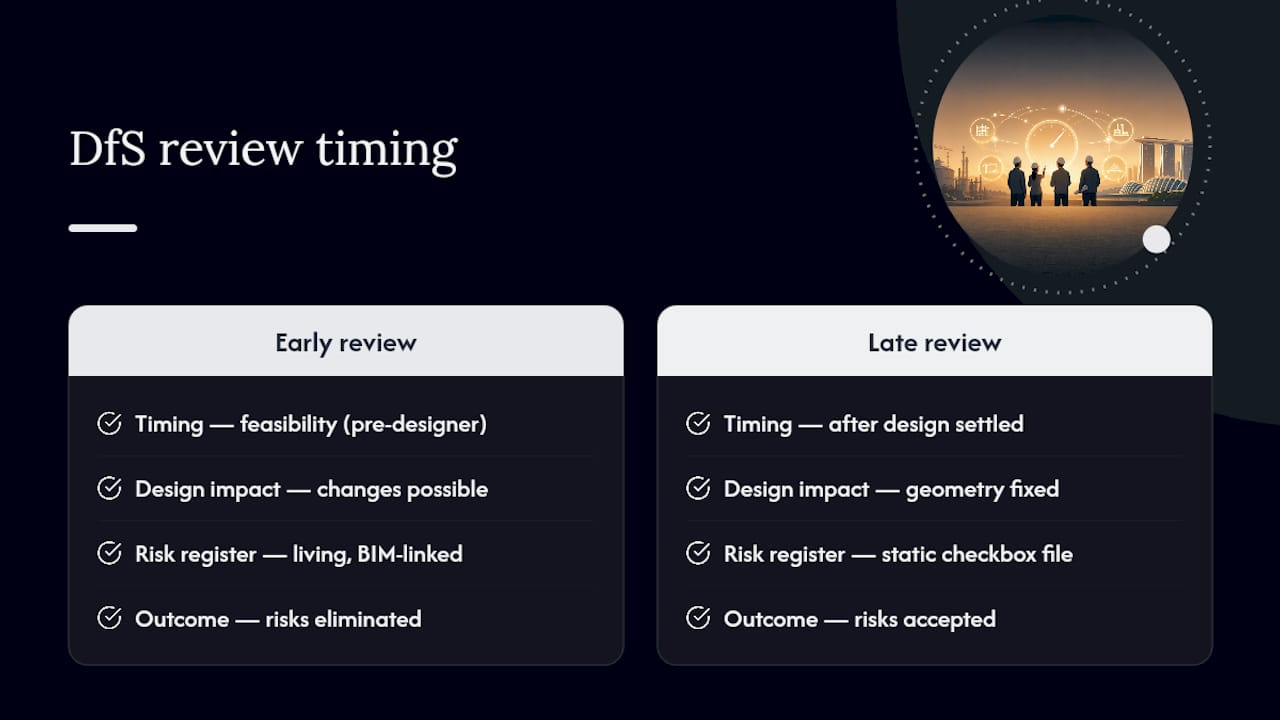
Most guidance on this topic treats Design for Safety as a paperwork exercise that gets appended to a project once the design is largely settled. That reading gets the sequence backward. The Regulations work only when the review happens early enough to actually change a design decision, not late enough to just document a risk nobody can now remove.
The conventional advice tells teams to “hold a DfS review meeting.” It rarely tells them the first one should happen during internal feasibility work, before an external designer is even appointed. By the time most teams convene their first meeting, the geometry is fixed and the register becomes a list of risks accepted rather than risks eliminated.
Prioritize the register as a living document tied to your BIM model, not a static file. Teams that treat it that way pass handover audits cleanly. Teams that treat it as a compliance checkbox tend to discover, years later, that the building owner never received a usable copy at all.
Get Design for Safety Support From Aman Engineering Consultancy
Aman Engineering Consultancy is the practical route to Design for Safety compliance for developers and design teams in Singapore who want the statutory process handled by people who run DfS reviews and registers for a living, rather than assembled in house from scratch under deadline pressure.
Where many teams lose time reconstructing a compliant register after design is already locked in, Aman’s DfS Risk Management Facilitator service starts the register during feasibility, when design changes still cost little to make. That approach fits developers managing a project above the S$10 million threshold who need statutory submissions, review facilitation, and a register that survives handover to the building owner intact. If your project is heading into scheme design and you haven’t yet confirmed applicability or appointed a DfS professional, get in touch with Aman Engineering Consultancy to scope the engagement before your next design milestone.
Where to Find the Official Design for Safety Guidance
- Workplace Safety and Health (Design for Safety) Regulations 2015
- About Design for Safety, WSH Council
- Legislation for workplace safety and health, MOM
- WSH Guidelines on Design for Safety (Revised, 2022)
Frequently Asked Questions
Does every construction project in Singapore need to follow Design for Safety requirements?
No. The Regulations apply only when the contract sum reaches S$10 million or more and the development falls under section 3(1) of the Planning Act. Smaller projects fall outside statutory DfS duties, though the underlying safety principles still apply as good practice.
What happens if a designer was appointed before the Regulations commenced?
Projects with a designer appointed before August 1, 2016 are exempt from the Regulations under the commencement rule stated in the legislation.
Who is responsible for maintaining the DfS Register after construction finishes?
The register typically passes to the building owner at handover, who becomes responsible for keeping it accessible to future contractors and maintenance staff carrying out work on the completed structure.
When should the first DfS review meeting take place?
As early as possible, ideally during the developer’s internal inception or feasibility stage, before external designers are formally appointed and before the design geometry is locked in.
What training do DfS professionals need in Singapore?
Recognized routes include Perform Design for Safety Regulation courses and related WSQ modules, paired with demonstrated experience running reviews or owning a DfS Register on prior projects.
This article is general information, not a substitute for advice from a qualified lawyer. Consult a qualified legal professional about your own circumstances before acting on anything here.
Sources
- Workplace Safety and Health (Design for Safety) Regulations 2015
- Legislation for workplace safety and health – Singapore
- Workplace Safety and Health Guidelines on Design for Safety (Revised, 2022)