
Hire a qualified acoustics consultant at concept or schematic design for most building projects. For permitting disputes or retrofit noise complaints, engage one as soon as the problem surfaces. Professional acoustic consulting is not a late-stage add-on; it is a design discipline that shapes structural assemblies, mechanical specifications, and regulatory submissions from the earliest project phases.
Recommended provider types at a glance:
- Integrated engineering partner (e.g., Aman Engineering Consultancy): suited to multidisciplinary projects requiring statutory coordination, BIM, and engineering oversight alongside acoustic criteria
- Specialist acoustics firms (Acentech, BRC Acoustics, RWDI): suited to high-performance venues, complex environmental noise, or advanced auralization
- NCAC directory: the standard starting point for broad searches of accredited independent acoustical consultants across the US
When to hire:
- Concept/schematic design: set acoustic criteria, inform structural and envelope decisions
- Design development: review drawings, specify assemblies, coordinate with MEP
- Pre-construction: finalize specifications, attend permitting hearings if required
- Commissioning: field testing, post-occupancy verification
Budget guidance: professional acoustic assessment costs are highly variable; standard scoping reports may be offered for modest fees, while complex or multi-phase engagements can be substantially higher depending on site conditions, regulatory requirements, and the need for specialized modeling.
Immediate next step: Request a PE license number, one sample deliverable (report or acoustic model), and a relevant case study before issuing any letter of engagement.
Table of Contents
- Which acoustics consultant fits your project type?
- How do you choose the right acoustic consultant?
- What does an acoustics consultant actually deliver?
- Why early engagement with an acoustics consultant saves money
- Key Takeaways
- The case for treating acoustics as a first-tier design discipline
- Useful sources and further reading
- Aman Engineering Consultancy: integrated acoustic and statutory coordination
Which acoustics consultant fits your project type?
The table below compares the primary provider options across the dimensions that matter most to developers, architects, and facility managers making a hiring decision.

| Provider | Best For | Services Offered | Geographic Coverage | Typical Fee Model | Credentials & Certifications |
|---|---|---|---|---|---|
| Aman Engineering Consultancy | Integrated statutory and multidisciplinary projects needing BIM and compliance coordination | Statutory submissions, BIM/digital engineering, M&E coordination, compliance consulting, acoustic criteria integration | Singapore and international projects | Project-based / phased | Multidisciplinary PE team; statutory authority experience (BCA, URA, SCDF) |
| National Council of Acoustical Consultants (NCAC) | Broad discovery; searching accredited independent specialists | Searchable membership directory; not a service provider | US-wide directory | N/A (directory only) | Member firms hold ASA affiliation and PE licensure |
| Arup (US offices) | Large, complex building projects requiring integrated engineering and international expertise | Room acoustics, environmental noise, vibration, building physics, AV systems | Major US markets; global | Lump-sum / hourly by phase | Multidisciplinary PE; global standards involvement |
| BRC Acoustics / Coffman Engineers | Building acoustics and AV design for commercial and cultural venues | Building acoustics, noise and vibration control, AV design, specifications | Regional US | Hourly / phased | NCAC member firms; PE licensure; ASA involvement |
| Acentech | Performance venues, healthcare, and projects needing advanced auralization | Room acoustics, sound isolation, mechanical noise control, 3DListening® auralization, modeling | US-wide | Hourly / project-based | ASA members; NCAC-affiliated; advanced modeling credentials |
| RWDI | Complex environmental noise and large infrastructure or mixed-use projects | Environmental noise assessment, acoustic engineering, vibration, wind, permitting support | North America and global | Lump-sum / hourly | PE licensure; standards committee experience; global practice |
Where each provider is strongest:
- Aman Engineering Consultancy — the practical choice when acoustic criteria must be coordinated with statutory submissions, BIM models, and multidisciplinary engineering in a single engagement, reducing handoff risk across trades
- BRC Acoustics / Coffman — strong track record in commercial and cultural venue acoustics; well-suited to mid-to-large building projects with defined AV requirements
- Acentech — the specialist choice for performance spaces and healthcare facilities where advanced auralization and modeling are required to validate design intent before construction
- RWDI — best positioned for environmental noise permitting, large mixed-use developments, and infrastructure projects where regulatory hearings and standards committee expertise add value
Pro Tip: When issuing an RFP, ask each firm to identify which staff member will lead the engagement and confirm that person’s PE license number and ASA or NCAC membership. Firms that redirect this question to a generic credentials statement are a procurement risk.
How do you choose the right acoustic consultant?
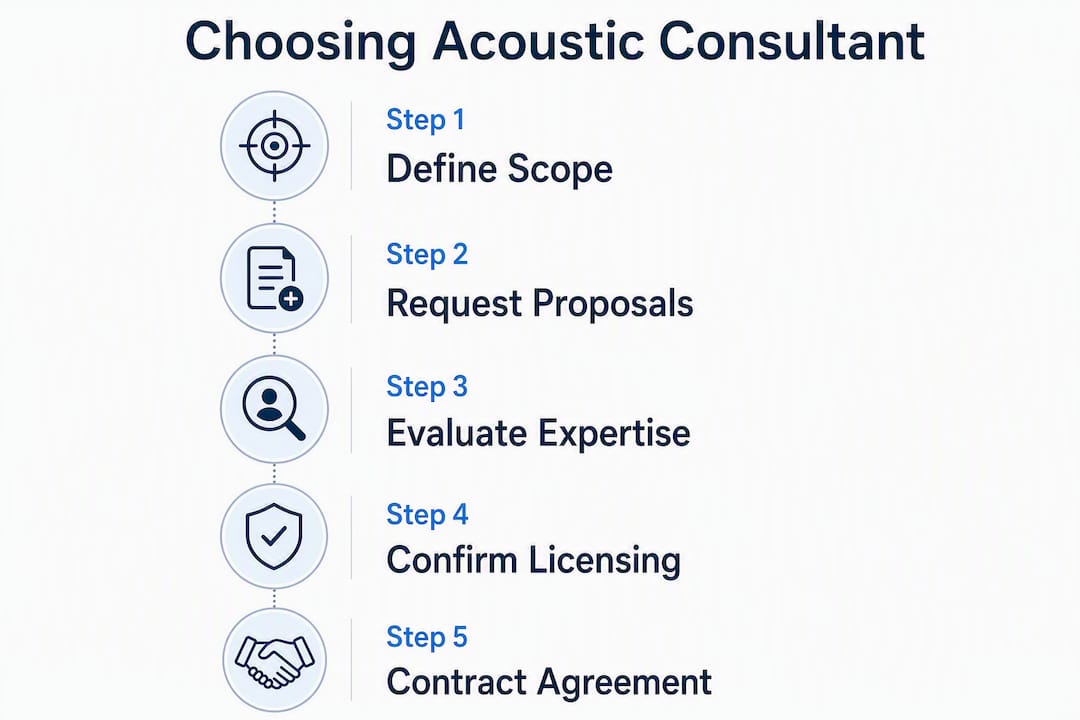
The primary decision rule is straightforward: match the consultant’s documented experience to the specific acoustic goals of the project. A firm with a strong portfolio in theater acoustics is not automatically qualified to manage environmental noise permitting for a mixed-use development, and vice versa.
Credentials and trust signals to verify
- Professional Engineer (PE) licensure: required in most US states when acoustic reports are submitted as part of a building permit or environmental review; confirm the license is current and issued in the relevant state
- ASA or NCAC membership: the Acoustical Society of America and NCAC are the primary professional bodies; membership signals peer accountability and continuing education
- Sample deliverables: request an anonymized acoustic report, a noise impact assessment, or a modeling output from a comparable project type before shortlisting
- Instrumentation and modeling methodology: ask which measurement standards the firm follows (ASTM E336, ISO 140, ANSI S12 series) and which modeling platforms it uses; firms that cannot name these are unlikely to produce defensible reports
- References and case studies: require at least two references from projects of similar use type and scale, completed within the past five years
Evaluating proposals
Scope clarity is the single most reliable predictor of a well-managed engagement. A strong proposal names the specific deliverables (acoustic criteria report, construction specifications, pre- and post-construction field test reports), identifies project milestones tied to design phases, and states the fee model explicitly. For guidance on engaging engineering consultants effectively, a structured scope document prevents cost overruns and misaligned expectations.
Fee models vary: hourly billing suits exploratory or forensic work; lump-sum or phased fees are standard for new construction from concept through commissioning. Confirm whether field testing, regulatory hearing attendance, and revision cycles are included or billed separately.
Questions to ask in interviews and RFPs
- Which staff member will lead this engagement, and what is their PE license number?
- Can you provide a sample acoustic report from a project of comparable use type?
- Which measurement standards and modeling platforms does your firm use?
- How do you coordinate acoustic deliverables with the structural and MEP teams?
- What is your process if field test results do not meet the specified criteria?
Red flags
- Vague scope with no named deliverables or milestones
- Inability to provide sample reports or references
- No mention of instrument calibration records or measurement standards
- Proposal that bundles acoustic consulting with unrelated services without clear delineation of scope
Pro Tip: Write a one-page technical scope before issuing any RFP. State the project use type, occupancy, applicable code requirements, and the acoustic outcomes required (e.g., STC ratings, NC criteria, environmental noise limits). This single document eliminates non-qualified respondents and aligns proposals for direct comparison.
What does an acoustics consultant actually deliver?
Building acoustics consultants design and manage sound and vibration environments across the full project lifecycle, from concept through post-occupancy verification. The scope of services is broader than most clients anticipate.
Core service categories and typical deliverables:
- Auralization and performance acoustics — 3D acoustic modeling and auralization (e.g., Acentech’s 3DListening®) for theaters, concert halls, and assembly spaces; deliverables include modeled auralizations and design validation reports
Typical engagement timeline
| Phase | Acoustic Scope | Key Deliverables |
|---|---|---|
| Concept / Schematic | Criteria setting, code review, massing review | Acoustic criteria report |
| Design Development | Assembly review, MEP coordination, modeling | Specifications, modeling outputs |
| Construction Documents | Final specifications, detail review | Stamped acoustic specifications |
| Construction Administration | RFI responses, mock-up review | Field observation reports |
| Commissioning | Field testing, post-occupancy verification | Test reports, punch-list items |
Project type examples: concert halls and theaters, hospitals and clinical facilities, multi-family residential (party wall compliance), schools (ANSI S12.60), industrial plants (OSHA noise exposure), data centers (mechanical noise), and mixed-use developments requiring environmental noise permitting.
Fee complexity increases with site conditions, the number of regulatory hearings required, the need for specialized auralization, and the extent of post-construction field testing. Acoustic consulting costs are highly variable; firms that offer a free scoping call allow clients to calibrate scope before committing to a fee.
Why early engagement with an acoustics consultant saves money
Engaging an acoustics consultant at concept or schematic design materially reduces rework and enables measurable acoustic targets to be embedded in the project’s structural and mechanical specifications before those decisions are locked.

The core principle is well-established in practice: fixing poor sound isolation or excessive reverberation in retrofit requires structural or envelope changes that are far costlier than early design changes. A wall assembly change at schematic design costs a drawing revision. The same change after concrete is poured requires demolition, reconstruction, and schedule recovery.
Leading firms adopt a holistic, integrated approach that considers geometry, finishes, and mechanical systems together rather than in isolation. When acoustic criteria are introduced late, trade-offs accumulate: a ceiling height reduction to accommodate ductwork may compromise reverberation targets; a structural slab thickness chosen for cost may be inadequate for impact sound isolation. Early integration eliminates these conflicts before they become change orders.
Acoustic modeling and auralization tools allow clients to hear predicted room acoustics before construction. Acentech’s 3DListening® platform, for example, lets stakeholders audition design options in advance, which is particularly valuable for performance spaces and public assembly venues where subjective impressions are critical to owner acceptance. This capability reduces change orders driven by post-occupancy dissatisfaction.
Pro Tip: Ask your acoustics consultant to provide acoustic criteria in terms your stakeholders understand: speech privacy levels, background noise ratings (NC/RC), and reverberation times expressed as “suitable for X use” rather than raw decibel values. This translation step prevents scope misalignment between the technical team and the owner.
Key Takeaways
Qualified acoustic consultants engaged at concept design set measurable targets, prevent costly rework, and produce the defensible deliverables required for permitting and post-occupancy verification.
| Point | Details |
|---|---|
| Hire at concept stage | Acoustic criteria set in schematic design prevent structural and MEP conflicts that are expensive to resolve later. |
| Verify PE licensure and ASA/NCAC membership | These credentials confirm the consultant can produce reports accepted by US permitting authorities. |
| Require sample deliverables before shortlisting | An anonymized report from a comparable project type is the most reliable indicator of deliverable quality. |
| Budget for field verification | Post-construction testing confirms assemblies perform to specification; exclude it and you lose the only objective proof of compliance. |
| Aman Engineering for integrated projects | When acoustic criteria must coordinate with statutory submissions and BIM, Aman Engineering Consultancy reduces handoff risk across disciplines. |
The case for treating acoustics as a first-tier design discipline
The conventional view in project management is that acoustics is a specialty add-on, engaged after the structural and MEP consultants have established the project’s core parameters. That sequencing is the single most common source of acoustic remediation costs on building projects.
Acoustic performance is determined by decisions made in the first 20% of a project’s design timeline: floor-to-floor heights, slab thicknesses, facade assembly types, mechanical room locations, and plenum configurations. By the time a project reaches design development, most of these parameters are fixed. Introducing acoustic criteria at that stage means working around constraints rather than shaping them.
The firms that consistently produce the best acoustic outcomes treat the discipline the way structural engineering is treated: as a first-tier input with criteria that govern other design decisions, not a review layer applied after the fact. Clients who enforce this sequencing in their project briefs, and who select consultants with the credentials and workflows to operate at that level, avoid the remediation cycle entirely.
For projects that also require statutory submissions, BIM coordination, and multidisciplinary engineering oversight, the practical advantage of an integrated partner like Aman Engineering Consultancy is that acoustic criteria can be embedded in the same compliance and coordination workflow that governs structural, facade, and M&E submissions, rather than managed as a parallel track.
Useful sources and further reading
The following sources provide authoritative reference material on acoustic consulting practice, professional credentials, and provider directories:
- Acoustical Society of America — Explore Sound careers: primary resource for understanding the professional pathway, qualifications, and role scope of acoustical engineers and consultants in the US
- Acentech building acoustics and noise control consulting — detailed description of building acoustics services, modeling workflows, and auralization capabilities from a leading US specialist firm
- RWDI acoustics services — overview of environmental and building acoustic consulting, including the integrated design approach and standards committee involvement
- BRC Acoustics: firm profile covering building acoustics, noise and vibration control, and AV design for commercial and cultural projects
- National Council of Acoustical Consultants (NCAC): the primary US directory for locating accredited independent acoustical consultants; searchable by location and specialty
- Aman Engineering Consultancy — integrated engineering and statutory consultancy for projects requiring acoustic criteria coordination with BIM, M&E, and compliance submissions
Aman Engineering Consultancy: integrated acoustic and statutory coordination
For developers and project teams managing multidisciplinary building projects, the compared specialist firms above represent the established routes for dedicated acoustic consulting. Each has defined strengths: Acentech for advanced auralization, RWDI for environmental permitting, BRC Acoustics for commercial venue work.
Aman Engineering Consultancy offers a different coordination model. When acoustic criteria must be embedded within statutory submissions, BIM coordination, and multidisciplinary engineering oversight, managing acoustic consulting as a separate engagement creates handoff risk between disciplines. Aman’s integrated approach positions acoustic requirements within the same compliance and project coordination workflow that governs structural, facade, and M&E submissions, reducing the administrative burden on the project team and the risk of criteria being lost between consultant interfaces.
For property developers, architects, and facility managers whose projects require both acoustic performance and regulatory compliance across multiple authorities, the practical next step is to contact Aman Engineering Consultancy directly to discuss how acoustic criteria can be incorporated into your project’s statutory and BIM coordination scope. For projects that are purely acoustical in nature, the NCAC directory remains the recommended starting point for identifying accredited independent specialists.