

For a U.S. building project, “LTA compliance” translates directly into a package of roadway, traffic, electric vehicle supply equipment (EVSE), and active-mobility regulatory obligations administered by the Federal Highway Administration (FHWA), state Departments of Transportation (state DOTs), Metropolitan Planning Organizations (MPOs), and local Authorities Having Jurisdiction (AHJs). This lta compliance requirements guide gives developers and construction professionals the mapped agency equivalents, permit checklists, a step-by-step workflow, and the inspection and recordkeeping obligations required to keep a U.S. project on schedule. Three immediate actions apply to every project: identify the applicable AHJs and MPO and schedule a pre-submission scoping meeting; confirm whether a Traffic Impact Study (TIA) or active-mobility plan is required under the MPO’s scoping thresholds; and verify that any EVSE equipment carries a current Nationally Recognized Testing Laboratory (NRTL) listing under NEC/NFPA 70 Article 625 and meets ADA Standards for accessible charging access.
Singapore’s Land Transport Authority (LTA) enforces a structured approval regime covering roadway design, transport impact assessments, and EV charger type approval and certification by Licensed Electrical Workers. U.S. practice distributes those same functions across multiple federal, state, and local bodies, with technical standards set by AASHTO, MUTCD, NEC, UL, and EPA rather than a single authority.
Table of Contents
- What are the U.S. equivalents of LTA’s regulatory functions?
- Which permits, studies, and certifications does U.S. compliance require?
- How does the compliance workflow run from design to operation?
- What inspection and recordkeeping obligations apply after construction?
- What are the most common compliance pitfalls for U.S. developers?
- When and how should you engage an engineering compliance consultant?
- Key Takeaways
- Why proactive regulatory planning protects your budget and schedule
- How Com supports your U.S. transport and roadway compliance program
- Authoritative sources and further reading
What are the U.S. equivalents of LTA’s regulatory functions?
LTA’s responsibilities fall into three functional clusters: roadway and access control, transport impact assessment, and equipment type-approval. Each maps to a distinct set of U.S. bodies and standards.
Roadway and access control
- FHWA / USDOT: Sets national roadway policy, funding conditions, and design standards that flow down to state DOTs.
- State DOTs: Primary permitting authority for driveway access, right-of-way (ROW) work, and roadway design on state-classified roads; enforce AASHTO geometric standards and state-adopted MUTCD for signage and traffic control.
- MPOs: Lead agency for regional travel demand modeling, TIA scoping on regionally significant projects, and multimodal access planning.
- Local AHJs: Issue ROW permits, traffic control and lane closure permits, building permits, and Certificates of Occupancy; enforce local amendments to the NEC and ADA Standards.
Transport impact assessment
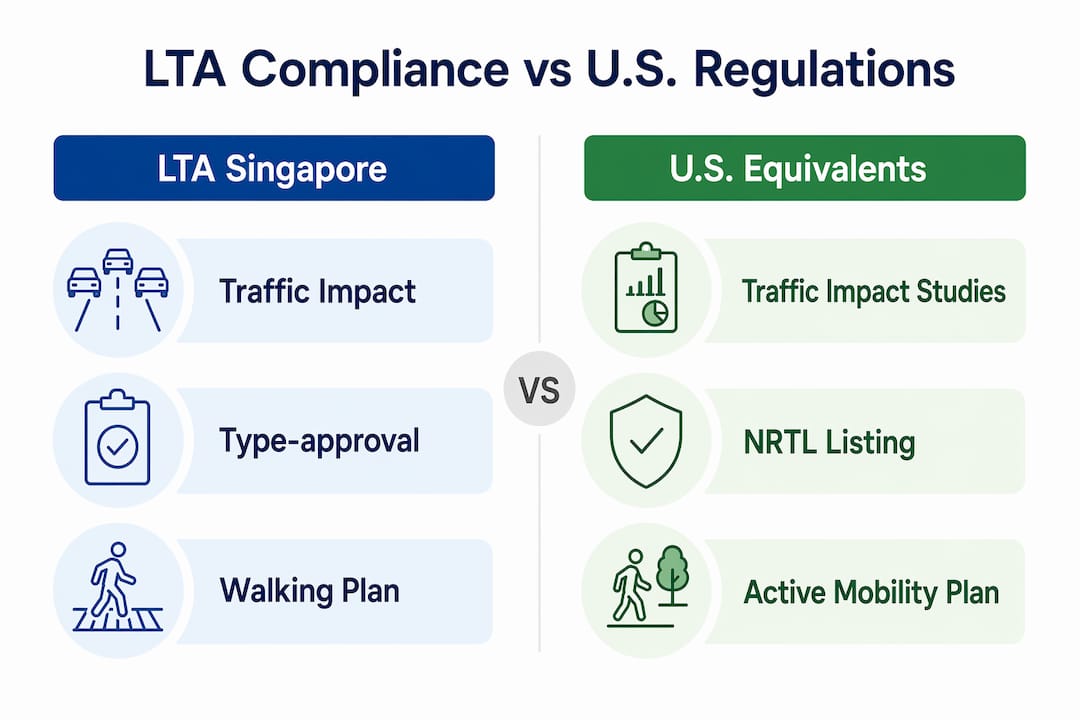
LTA’s TIA and Walking and Cycling Plan requirements map to U.S. Traffic Impact Studies (TIS/TIA) scoped by the MPO or state DOT, plus pedestrian and cyclist access plans required under local zoning or TOD ordinances. Pre-scoping meetings with the MPO and AHJ define the study area, trip-generation methodology, and required mitigation measures.

Equipment type-approval and certification
LTA’s TR25-based type-approval and on-site LEW certification model maps to two distinct U.S. requirements: NRTL listing (UL, ETL, or another OSHA-recognized lab) for EVSE hardware, and on-site inspection and sign-off by a licensed electrical inspector under NEC Article 625. Utility interconnection agreements are a third, separate obligation that has no direct LTA parallel but is mandatory for grid-connected chargers.
Which permits, studies, and certifications does U.S. compliance require?
The table below consolidates the compliance areas developers must budget and plan for on a typical U.S. project with road-facing works and EVSE.
| Compliance Area | Instrument | Primary Authority |
|---|---|---|
| Site access / driveway | ROW / driveway permit | State DOT or local AHJ |
| Traffic management | Traffic control / lane closure permit | Local AHJ |
| Transport impact | Traffic Impact Study (TIS/TIA) | MPO / state DOT |
| Active mobility | Pedestrian/cyclist access plan | Local AHJ / MPO |
| Building and electrical | Building permit + electrical permit | Local AHJ |
| EVSE installation | NEC Article 625 inspection | Licensed electrical inspector |
| EVSE equipment | NRTL listing (UL/ETL) | OSHA-recognized lab |
| Grid connection | Utility interconnection agreement | Utility / state PUC |
| Stormwater | NPDES permit / state erosion control | EPA / state agency |
| Accessibility | ADA Standards compliance | Local AHJ / DOJ |
LTA’s active mobility requirements mandate a checklist and, for larger projects, a Walking and Cycling Plan submitted independently of the main development control application. The U.S. equivalent is a standalone pedestrian/cyclist access plan submitted to the MPO or local AHJ before the building permit is issued, not bundled with unrelated submissions.
Pro Tip: Request NRTL listing documentation and the manufacturer’s model-specific test reports at procurement, then physically verify the listing label on each device upon delivery. Certification status can change between production batches, so a published approval list alone is insufficient evidence.
How does the compliance workflow run from design to operation?
The sequence below reflects standard U.S. practice for a development project with ROW works and EVSE. Timeline ranges reflect typical agency review cycles and should be confirmed with the specific AHJ and MPO.
- Agency scoping and pre-application (2–6 weeks). Meet with the MPO, state DOT, and local AHJ to define TIA scope, ROW permit requirements, and EVSE inspection expectations. Confirm whether an active-mobility plan is required.
- Discipline design (concurrent with scoping). Traffic/civil engineer prepares ROW and site-access design to AASHTO and MUTCD standards; electrical engineer designs EVSE installation per NEC Article 625; civil engineer prepares stormwater NPDES plan.
- TIA and active-mobility plan submission (6–12 weeks for preparation; agency review 4–12+ weeks). Submit TIA to MPO or state DOT for review. Submit pedestrian/cyclist access plan to local AHJ independently.
- Permit applications (4–20 weeks, jurisdiction-dependent). File ROW/driveway permit, traffic control permit, building permit, electrical permit, and NPDES permit concurrently where allowed. Initiate utility interconnection application early; utility lead times frequently exceed 12 weeks.
- Construction with approved traffic control (per project schedule). Implement approved traffic control plan; conduct stormwater BMP inspections per NPDES schedule.
- Inspections and commissioning. Licensed electrical inspector signs off on EVSE installation per NEC Article 625. Utility engineer confirms point-of-connection and metering. AHJ conducts final building inspection.
- Final sign-off and record retention. AHJ issues Certificate of Occupancy or Final Acceptance. Retain all permit close-out letters, inspection reports, as-built drawings, and O&M manuals.
Roles and sign-off matrix
| Deliverable | Responsible Party | Sign-off Authority |
|---|---|---|
| TIA / TIS | Licensed PE (traffic/civil) | MPO or state DOT |
| ROW / driveway permit drawings | Licensed PE (civil) | State DOT or local AHJ |
| EVSE installation | Licensed electrical contractor | Licensed electrical inspector / AHJ |
| Utility interconnection | Utility engineer | Utility / state PUC |
| Stormwater NPDES plan | Licensed PE (civil/environmental) | EPA / state agency |
| Certificate of Occupancy | AHJ building official | Local AHJ |
What inspection and recordkeeping obligations apply after construction?
Ongoing obligations begin at commissioning and continue for the operational life of the asset. For electrical systems and EVSE, NEC and local AHJ schedules govern periodic inspection frequency; some jurisdictions require annual inspections for public-access chargers. Stormwater BMPs require inspections per the NPDES permit schedule, typically quarterly and after significant storm events. Roadway restoration and traffic-control device condition must be confirmed at project close-out and documented in the permit file.
Certificates and documentation to retain
| Document | Retention Minimum | Held By |
|---|---|---|
| Certificate of Occupancy / Final Acceptance | Life of asset | Developer / owner |
| Electrical inspection report (EVSE) | 2–5 years (per jurisdiction) | Developer / owner |
| NRTL listing label and test report | Life of equipment | Developer / owner |
| As-built drawings | Life of asset | Developer / owner |
| O&M manuals | Life of asset | Facility manager |
| Utility interconnection agreement | Life of connection | Developer / owner |
| NPDES permit and BMP inspection logs | Minimum 3 years (federal) | Developer / owner |
LTA’s inspection regime requires certificates of continued fitness to be retained for at least two years and produced on request. U.S. practice is broadly comparable: AHJs and EPA regional offices can request permit close-out documentation during audits, and missing records are treated as non-compliance.
Pro Tip: Maintain a field-verifiable checklist that ties each inspection certificate to the serial number and NRTL label on the physical device. Certificate-to-device mismatches are among the most common causes of audit failures and re-inspection costs.
What are the most common compliance pitfalls for U.S. developers?
- Relying on manufacturer statements instead of NRTL-labeled evidence. A manufacturer’s declaration of conformity is not a substitute for an NRTL listing. Agencies and electrical inspectors require the physical label on the device and traceable test reports.
- Bundling the TIA or active-mobility plan with unrelated submissions. Submitting a TIA as part of a broader building permit package without prior MPO or AHJ scoping is a frequent cause of rejection. These studies must be scoped and cleared independently.
- Late utility coordination. Utility service upgrades for EVSE installations routinely require 12–20+ weeks. Starting the interconnection application after permits are issued adds months to the schedule.
- Missing MUTCD or AASHTO variances for non-standard signage or temporary traffic management. Temporary traffic control plans that deviate from the MUTCD require advance AHJ approval; submitting them at construction start causes lane-closure permit delays.
- Conflating product-level NRTL listing with on-site inspection sign-off. These are two separate requirements. NRTL listing covers the equipment; the licensed electrical inspector’s sign-off covers the installation. Missing either one prevents final AHJ approval.
Red flags in contractor proposals include omission of a named licensed PE for traffic or civil design, no line item for utility interconnection coordination, and EVSE procurement specifications that reference only manufacturer certifications rather than NRTL listings.
When and how should you engage an engineering compliance consultant?
The optimal engagement points are pre-feasibility (for scoping and budget estimates), before the TIA scoping meeting with the MPO or AHJ, before EVSE procurement to verify NRTL documentation, and at permit application to coordinate agency submittals. Engaging a consultant after permits are filed typically doubles the cost of corrections.
A well-scoped engagement should deliver: an agency scoping and pre-submission package; a prepared or peer-reviewed TIA; permit drawings for ROW, electrical, and stormwater; witnessed EVSE testing and commissioning; utility interconnection coordination; and a complete permit close-out file. For transport impact assessment work specifically, confirm the consultant has documented experience with the relevant MPO’s scoping checklist and trip-generation methodology.
Selection criteria: request proof of prior AHJ approvals on comparable projects, a sample sign-off matrix and timeline, named licensed PEs and electrical inspectors on the team, and references for EVSE commissioning work. Ask specifically whether the firm has managed utility interconnection timelines and whether it carries errors-and-omissions insurance.
Pro Tip: Contract a time-and-materials pre-scope phase covering agency scoping and pre-application meetings. This allows the consultant to price the full engagement with accurate scope data, which reduces change orders on the main contract.
Key Takeaways
U.S. “LTA compliance” requires coordinating FHWA, state DOT, MPO, and local AHJ obligations across permits, TIA studies, EVSE certification, and stormwater controls before construction begins.
| Point | Details |
|---|---|
| Identify AHJs and MPO first | Schedule a pre-submission scoping meeting before any permit application or TIA preparation. |
| Verify NRTL listing at procurement | Require model-specific test reports and physically check the NRTL label on each EVSE unit delivered. |
| Start utility coordination early | Interconnection applications for EVSE service upgrades can take 12–20+ weeks; late starts extend the schedule. |
| Keep records for the asset’s life | Retain inspection certificates, as-built drawings, O&M manuals, and permit close-out letters for the operational life of the asset. |
| Engage Com for compliance consulting | Com provides agency scoping, TIA preparation, EVSE procurement verification, and permit-ready submissions for building projects. |
Why proactive regulatory planning protects your budget and schedule
The most expensive compliance failures on U.S. development projects are not caused by complex regulations. They are caused by sequencing errors: a TIA submitted without MPO scoping, EVSE equipment ordered before NRTL verification, or a utility interconnection application filed six months too late. Each of these is entirely preventable with early agency engagement and a clear sign-off matrix established at pre-feasibility. Projects that invest in a pre-scope phase with a qualified regulatory engineering consultant consistently avoid the re-submission cycles and unplanned utility charges that erode contingency budgets. The regulatory framework itself is manageable; the schedule risk comes from treating compliance as a back-end task rather than a front-end discipline.
How Com supports your U.S. transport and roadway compliance program
Com delivers the full scope of regulatory engineering services that U.S. developers need to navigate transport-adjacent compliance: agency scoping and pre-submission packages, Traffic Impact Study preparation and peer review, EVSE procurement verification against NRTL and NEC Article 625 requirements, utility interconnection coordination, and permit-ready submission assembly. Every engagement includes named licensed PEs, documented sign-off matrices, and fixed-price deliverables where the scope permits.

Developers who engage Com at pre-feasibility gain accurate budget estimates for permits, studies, and utility upgrades before design costs are committed. To request a pre-scope estimate or a scoping call, contact Com through the engineering consultancy services page or review the consultant engagement guide to understand what to include in your proposal request.
Authoritative sources and further reading
- FHWA / USDOT: Federal Highway Administration — roadway design policy, ROW guidance, and TIA reference materials.
- NEC / NFPA 70 Article 625: NFPA 70 free access — governing standard for EVSE installation requirements.
- UL / ETL / NRTL listings: OSHA NRTL program — directory of recognized testing laboratories for equipment listing verification.
- ADA Standards: ADA.gov Standards for Accessible Design — pedestrian access and accessible charging requirements.
- EPA NPDES: EPA Construction General Permit — stormwater and erosion control permit requirements for construction sites.
- LTA EV charger guidelines (Singapore reference): LTA EV charger safety regulation — useful for understanding the type-approval and on-site certification model that U.S. NRTL/NEC practice parallels.
- LTA TIA and WCP guidelines (Singapore reference): TIA Guidelines and WCP — scoping best practices applicable to U.S. MPO pre-application meetings.
- AASHTO: American Association of State Highway and Transportation Officials — geometric design standards referenced by state DOTs for driveway and ROW design.
- MUTCD: Manual on Uniform Traffic Control Devices — federal standard for signage, markings, and temporary traffic control.
This article provides general regulatory guidance for informational purposes. Developers should confirm current permit requirements, fee schedules, and agency thresholds with the applicable AHJ, MPO, state DOT, and a licensed professional engineer for their specific project and jurisdiction.