

The SCDF Fire Certificate (FC) is a periodic operational certificate issued by Singapore’s Civil Defence Force that verifies a building’s fire protection systems are maintained and in working condition. Under Section 35 of the Fire Safety Act 1993, owners or occupiers of qualifying public, industrial, and private residential buildings in Singapore must hold a valid FC throughout the building’s operational life. For U.S.-based property developers managing Singapore projects, this certificate is not optional and not a one-time milestone. Two distinct certificates govern Singapore fire compliance: the Fire Safety Certificate (FSC), issued once after construction is complete, and the Fire Certificate (FC), which recurs periodically during building operation. Both carry separate obligations, and conflating them is one of the most common and costly compliance errors on cross-border projects.
Table of Contents
- What is the SCDF Fire Certificate and what law requires it?
- FSC versus FC: the differences every developer must understand
- Who is responsible, how often must the FC be renewed, and what happens if you don’t comply?
- How U.S. fire safety requirements compare to Singapore’s FC framework
- Practical checklist for U.S. developers managing SCDF FC requirements
- How a specialist fire safety consultancy reduces risk on cross-border projects
- Key Takeaways
- Why early engagement is the only defensible strategy
- Aman Engineering Consultancy: on-the-ground SCDF compliance support
- Useful sources and further reading
What is the SCDF Fire Certificate and what law requires it?
The FC exists specifically to confirm that fire safety systems remain functional after a building opens. Construction approval is not sufficient. Singapore law requires ongoing, documented verification that sprinklers, fire alarm systems, suppression equipment, and related infrastructure continue to operate to code.
“The FC Scheme ensures the proper maintenance and good working condition of fire safety systems. These systems should be tested in accordance with the relevant codes of practice.” — Singapore Civil Defence Force, GoBusiness Licensing Portal
The statutory authority is Section 35 of the Fire Safety Act 1993, which places the obligation squarely on the owner or occupier, not the contractor or developer who built the structure. Applications are submitted through the GoBusiness portal, which replaced earlier paper-based processes and now handles both first applications and renewals.
| Building Category | FC Required? | Responsible Party |
|---|---|---|
| Offices, hospitals, shopping complexes | Yes | Owner or occupier |
| Industrial buildings | Yes | Owner or occupier |
| Qualifying private residential buildings | Yes | Owner or occupier |
| Standard private residential (non-qualifying) | No | N/A |
Fees are set by floor use: SGD $11 per storey for residential use and SGD $33 per storey for non-residential use. These are Singapore-dollar figures as published by SCDF on the GoBusiness portal.
FSC versus FC: the differences every developer must understand
These two certificates address different phases of a building’s life and carry entirely separate legal obligations.

The Fire Safety Certificate (FSC) is issued once, after fire safety works are fully completed during construction or major addition and alteration works. There are no fees for FSC applications, and submissions are processed via CORENET, with SCDF targeting a response within 3 working days. It is a completion document, not an operational one.
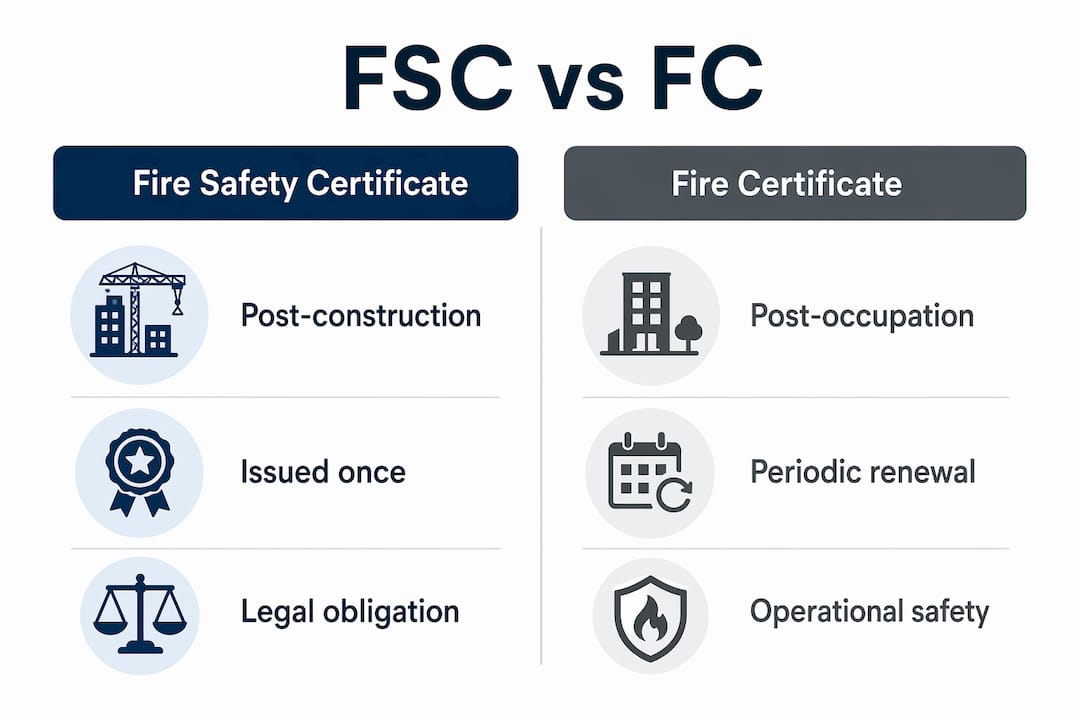
The Fire Certificate (FC) comes after occupation and recurs throughout the building’s life. It verifies that systems installed at completion are still working. The FC is the certificate that building owners and occupiers must actively manage year after year.
| Feature | Fire Safety Certificate (FSC) | Fire Certificate (FC) |
|---|---|---|
| Timing | After fire safety works are complete | During ongoing building operation |
| Frequency | One-time (per project or major works) | Periodic (36 months validity from April 1, 2026) |
| Fees | None | SGD $11–$33 per storey depending on use |
| Portal | CORENET | GoBusiness |
| Purpose | Confirms works meet approved plans | Confirms systems remain maintained and operational |
A Temporary Fire Permit (TFP) bridges the gap when a building is substantially complete but minor outstanding items remain. The TFP allows occupation before the FSC is issued, provided fire safety works are satisfactorily completed with only minor issues outstanding. Closing out those items to SCDF’s satisfaction is required before the FSC is granted, and the timeline varies by project complexity.
Pro Tip: Do not treat the TFP as a long-term solution. Developers who allow TFP status to persist without actively closing out punch-list items risk delays in the FSC and complications when applying for the first FC. Build a hard deadline into the project schedule for TFP-to-FSC conversion.
Who is responsible, how often must the FC be renewed, and what happens if you don’t comply?
The owner or occupier bears full legal responsibility for maintaining the FC. In practice, this means engaging a Professional Engineer (PE) and licensed contractors to test fire safety systems, securing endorsements from the owner, PE, and Fire Safety Manager (FSM) where applicable, and submitting documentation through GoBusiness.
From April 1, 2026, FC validity periods extend to 36 months for certificates with start dates from that date onward, reducing the frequency of renewal submissions. This change lowers compliance costs over time but requires more disciplined advance planning, since a missed renewal window now carries a longer gap before the next opportunity to correct it.
Renewal applications must be submitted at least two months before the FC expires. Late filings risk operational downtime because processing can take approximately 21 business days in practice, and SCDF conducts selective audits that can surface non-compliant systems before a certificate is issued.
Non-compliance carries serious consequences. SCDF may require full rectification of deficient systems before issuing or renewing the FC. Persistent non-compliance can result in fines, legal action, and in severe cases, closure of the premises. For U.S. developers, the risk extends further: an expired or lapsed FC can void property insurance, trigger director liability under Singapore law, and cause business interruption that affects tenants and revenue streams. Treating fire safety compliance as a continuous operational obligation, not a project milestone, is the only approach that protects against these outcomes.
How U.S. fire safety requirements compare to Singapore’s FC framework
U.S. developers familiar with domestic compliance workflows will find the SCDF FC framework conceptually similar but structurally different in several important ways.
In the United States, the functional equivalent of the FC is a combination of the certificate of occupancy (issued by local building departments after construction) and ongoing fire safety inspections conducted by the local fire marshal or Authority Having Jurisdiction (AHJ). The AHJ enforces model codes adopted at the state or local level, primarily the International Fire Code (IFC) and NFPA standards including NFPA 25 (inspection of water-based suppression systems), NFPA 72 (fire alarm systems), and NFPA 13 (sprinkler systems).
The critical operational difference is enforcement structure. Singapore’s SCDF is a centralized national authority with a single portal, standardized fees, and defined renewal windows. U.S. enforcement is decentralized: requirements vary by state, county, and municipality, and the AHJ has significant discretion in how and when inspections occur. A developer managing projects in both markets must maintain two separate compliance workflows with different documentation standards, submission portals, and inspection cadences.
For cross-border project teams, the practical recommendation is to map SCDF FC checkpoints directly to AHJ inspection milestones in the U.S. schedule. Documentation formats differ, but the underlying obligation, periodic verification that fire systems work, is the same. Aligning these workflows prevents duplicative effort and keeps both compliance tracks on schedule.
Practical checklist for U.S. developers managing SCDF FC requirements
- Engage a Singapore-qualified Professional Engineer or Qualified Person (QP) early. The PE or QP must endorse all fire safety system test results before submission. Identify and contract this resource during the design or pre-construction phase, not after occupation.
- Compile complete inspection and maintenance records. SCDF requires documented evidence that systems have been tested to the relevant codes of practice. Gaps in records are a primary cause of audit findings.
- Schedule system tests well before the FC application window. Allow time for remediation if tests reveal deficiencies. Testing immediately before submission leaves no buffer for rectification.
- Submit the first FC application via GoBusiness after obtaining the FSC, CSC, TFP, or TOP. The portal requires one of these documents as supporting evidence of building completion status.
- Set a renewal trigger at least two months before FC expiry. Given the approximately 21-business-day processing window, a two-month lead time is the minimum. Build this into project management software as a hard deadline, not a reminder.
- Use the TFP strategically for phased occupation. If construction is substantially complete, a TFP allows revenue-generating occupation to begin. Assign a dedicated team member to track outstanding items and close them before the TFP period creates downstream FC complications.
- Assign clear ownership for each compliance task to a named local contractor or consultant. Remote U.S. project teams cannot manage SCDF submissions directly. Contractual responsibility for statutory compliance must sit with a Singapore-based party who has GoBusiness access and SCDF familiarity.
How a specialist fire safety consultancy reduces risk on cross-border projects
A qualified fire safety consultancy handles the full compliance workflow: statutory submissions via GoBusiness and CORENET, coordination of PE endorsements, scheduling and witnessing of system tests, pre-audit inspections to identify deficiencies before SCDF reviews them, and remedial guidance when systems fall short of code requirements. The outcome is a shorter feedback loop between submission and certificate issuance, fewer audit findings, and documentation that satisfies both SCDF and insurance underwriters.
The right time to engage a fire safety submission consultant is at the early design stage, not at pre-TOP or just before renewal. Early engagement allows the consultant to review fire system specifications against SCDF codes before installation, which eliminates the most expensive category of rectification work: systems that must be partially replaced because they were installed to the wrong standard.
Pro Tip: When briefing a Singapore fire safety consultant, provide the building’s GFA breakdown by use type, the current fire system schedule from the M&E drawings, and the target TOP or CSC date. These three inputs allow the consultant to map the full FC timeline immediately and identify any gaps in the existing documentation.
For SCDF inspection readiness, consultants also conduct pre-audit walkthroughs that replicate SCDF’s selective audit criteria, giving owners a clear picture of deficiencies before they become formal findings.
Key Takeaways
The SCDF Fire Certificate is a periodic, maintenance-based operational requirement under Singapore law, not a one-time construction sign-off, and U.S. developers managing Singapore assets must treat it as a standing compliance obligation.
| Point | Details |
|---|---|
| FC is periodic, not one-time | The FC must be renewed throughout the building’s operational life, with validity of 36 months for certificates issued from April 1, 2026. |
| Renewal timing is critical | Submit renewal applications at least two months before expiry; processing typically requires several weeks… |
| Owner/occupier bears full liability | The legal obligation rests with the owner or occupier, not the original developer or contractor. |
| FSC and FC are distinct instruments | FSC is issued once after construction; FC governs ongoing operational compliance and carries separate fees and submission requirements. |
| Com provides end-to-end FC support | Aman Engineering Consultancy manages statutory submissions, PE coordination, system testing, and SCDF interfacing for Singapore projects. |
Why early engagement is the only defensible strategy
The most consistent mistake U.S. developers make on Singapore projects is treating the FC as a back-end administrative task. By the time a building is occupied and generating revenue, the compliance clock is already running. A lapsed FC does not just create a regulatory problem; it creates an insurance problem, a tenant relations problem, and in Singapore, a potential criminal liability problem for the responsible party.
The three-year validity period introduced from April 1, 2026 reduces renewal frequency, but it also means that a missed window carries a longer period of non-compliance before it can be corrected. The operational logic is straightforward: maintain systems continuously, document every test, and submit renewals with enough lead time to absorb processing delays. Consultants who specialize in SCDF interfacing reduce the probability of failed inspections by identifying deficiencies before they reach the audit stage, which is where rectification costs and downtime accumulate.
Aman Engineering Consultancy: on-the-ground SCDF compliance support
For U.S. developers with Singapore assets or active projects, the gap between knowing what the FC requires and executing it correctly is where compliance risk lives. Aman Engineering Consultancy provides statutory submissions, SCDF interfacing, PE coordination, and pre-audit inspection services that close that gap before it becomes a liability.
Com’s team handles the full FC lifecycle: from first application through renewal, including system test scheduling, documentation management, and remedial guidance when inspections surface deficiencies. For developers managing projects remotely from the United States, this means a single accountable point of contact in Singapore who owns every submission and every SCDF interaction. To request a pre-assessment or scope an engagement, visit Aman Engineering Consultancy and submit your project details directly.
Useful sources and further reading
- Fire Certificate — SCDF via GoBusiness/Fire-Certificate): The primary licensing page for FC applications and renewals, including fee schedules and applicant eligibility criteria.
- Fire Safety Certificate and Temporary Fire Permit — SCDF: Authoritative guidance on FSC and TFP processes, submission via CORENET, and processing timelines.
- SCDF FC Renewal Form: The official renewal form with procedural notes on submission timing and reference number validation.
- FC Compliance — Aman Engineering Consultancy: Detailed guidance on FC compliance obligations, checklists, and how Com manages the process for building owners.
- FSC and Fire Insurance Requirements — Aman Engineering Consultancy: Explains how FSC documentation intersects with fire insurance requirements for Singapore developments.
- SCDF Inspection Explained — Aman Engineering Consultancy: Practical walkthrough of SCDF inspection processes, common failure modes, and audit-readiness preparation.