

BCA guidelines are the legally binding standards that govern all aspects of building design, submission, construction, and maintenance in Singapore. The Building Control Act 1989 and the Building Control Regulations 2003 form the comprehensive legal framework that every developer, contractor, and building professional must follow. Understanding BCA guidelines is not optional. Non-compliance carries consequences ranging from stop-work orders to licence revocation. These standards cover plan submission, the duties of Qualified Persons (QPs), technical design requirements, accessibility mandates, and enforcement procedures. Com works with clients across all these compliance areas, providing statutory submissions, inspections, and regulatory approvals for projects governed by BCA, URA, JTC, HDB, SCDF, PUB, and LTA.
What are the main components of BCA guidelines?
The Building and Construction Authority Act 1999 establishes the BCA’s authority to license, regulate, and enforce building standards across Singapore. This Act works alongside the Building Control Act 1989 and the Building Control Regulations 2003 to create a three-tier legal structure. Together, these statutes cover every stage of a building project, from initial plan submission through construction to occupation and ongoing maintenance.
The BCA regulatory framework rests on several core requirements:
- Plan submission and approval. All building works above prescribed thresholds require approved plans before construction begins. The deemed approval concept under the Building Control Regulations 2003 means that if the BCA does not respond within prescribed timelines, certain plan submissions are treated as approved by default. This carries significant compliance implications because the developer still bears full responsibility for technical accuracy.
- Qualified Persons (QPs). Every regulated building project must appoint a QP, typically a registered architect or professional engineer, to supervise submissions, certify designs, and report on construction progress. QPs carry defined legal duties at every project stage.
- Technical design and construction standards. The regulations prescribe acceptable solutions for structural design, materials testing, fire safety, and facade systems. Deviating from these standards requires documented justification and formal approval.
- Enforcement powers. The BCAA Act enforcement provisions include licence revocation, permit cancellation, forfeiture, and an appeals process to the Minister. Enforcement is graduated, meaning the BCA typically escalates from warnings to administrative action before judicial proceedings.
Pro Tip: Review the full BCA submission requirements for building plans, structural plans, and electrical approvals before engaging your QP. Knowing the submission sequence prevents costly resubmissions.
A common misunderstanding is that BCA guidelines are separate advisory documents rather than legally enforceable standards. Practitioners must recognize that BCA’s regulatory mandate includes both legal and technical compliance. Treating the guidelines as optional guidance rather than statutory obligations is the fastest route to project delays.
How do BCA guidelines integrate with URA requirements?
URA guidelines complement BCA codes by regulating land use, building height, setbacks, and facade aesthetics. BCA governs technical safety and construction standards. URA governs planning and design parameters. Both sets of requirements apply simultaneously to most building projects in Singapore.

The practical consequence is that a design can satisfy BCA’s structural and fire safety standards while still failing URA’s height or setback rules. Projects must harmonize URA zoning and planning requirements with BCA’s technical safety standards to avoid rejections. Treating these as two separate compliance tracks handled by different consultants at different times is the most common cause of late-stage redesigns.
The following steps describe how professionals can integrate BCA and URA compliance from the outset:
- Conduct a joint pre-application review. Before finalizing the design brief, architects, structural engineers, and planners should review both the URA Master Plan parameters and the relevant BCA codes together. This identifies conflicts before they are embedded in the design.
- Align facade design with both authorities. URA regulates facade aesthetics and building envelopes. BCA regulates facade safety and exterior feature installation. A facade that satisfies URA’s visual requirements must also meet BCA’s structural certification requirements for exterior features.
- Coordinate submission timelines. URA planning approval typically precedes BCA building plan approval. Submitting to BCA before URA approval is finalized can result in wasted fees and rework if planning conditions change the design.
- Document all authority correspondence in one register. Keeping URA and BCA correspondence in a single project compliance register prevents teams from acting on outdated instructions from either authority.
Pro Tip: Read the BCA submission vs. URA approval breakdown to understand exactly where each authority’s jurisdiction begins and ends. This prevents teams from submitting to the wrong authority at the wrong stage.
Early collaboration between architects, engineers, and planners is the single most effective way to harmonize BCA and URA requirements. Projects that integrate these disciplines from the design brief stage consistently achieve smoother approvals than those that treat planning and technical compliance as sequential tasks.
What are the accessibility and specialized compliance requirements?
The BCA Code on Accessibility mandates barrier-free design features in new and altered buildings, covering persons with disabilities, elderly residents, nursing mothers, and families with young children. The Code is updated periodically and provides technical standards for ramps, lifts, accessible toilets, tactile guidance systems, and parking provisions. Compliance with the Code is a condition of building plan approval, not an optional enhancement.
| Accessibility Feature | BCA Code Requirement | Applies To |
|---|---|---|
| Ramps and level access | Gradient and width specifications | All public buildings |
| Accessible toilets | Dimensions, grab bars, turning radius | Commercial and institutional buildings |
| Tactile guidance systems | Floor surface indicators at hazard points | Public transport nodes, malls |
| Accessible parking | Designated bays with minimum dimensions | Buildings with car parks |
| Lift provisions | Minimum cab dimensions and controls | Multi-story buildings above prescribed height |
Beyond accessibility, BCA regulatory oversight extends to several specialized compliance areas:
- Geotechnical building works. Excavation, piling, and ground stabilization works require a QP with geotechnical certification. Failure to appoint a certified QP for these works can trigger a stop-work order.
- Exterior feature installations. Canopies, sun shading devices, signage structures, and other exterior features require separate BCA certification. The QP must certify that these features are structurally safe and properly anchored.
- Demolition works. Demolition requires a separate set of approvals and a QP who certifies the demolition method and sequence. Unauthorized demolition is a criminal offense under the Building Control Act.
Each of these specialized areas carries its own submission requirements, inspection protocols, and certification duties. Developers who treat them as minor administrative steps rather than substantive compliance obligations frequently encounter stop-work orders that halt entire projects.
What are common challenges and best practices for BCA compliance?
Structural plan submissions are the most frequent point of rejection in the BCA approval process. The most common causes include incomplete geotechnical data, inconsistencies between architectural and structural drawings, and failure to specify materials that meet BCA’s acceptable solutions. Each rejection resets the review timeline and delays the construction start date.
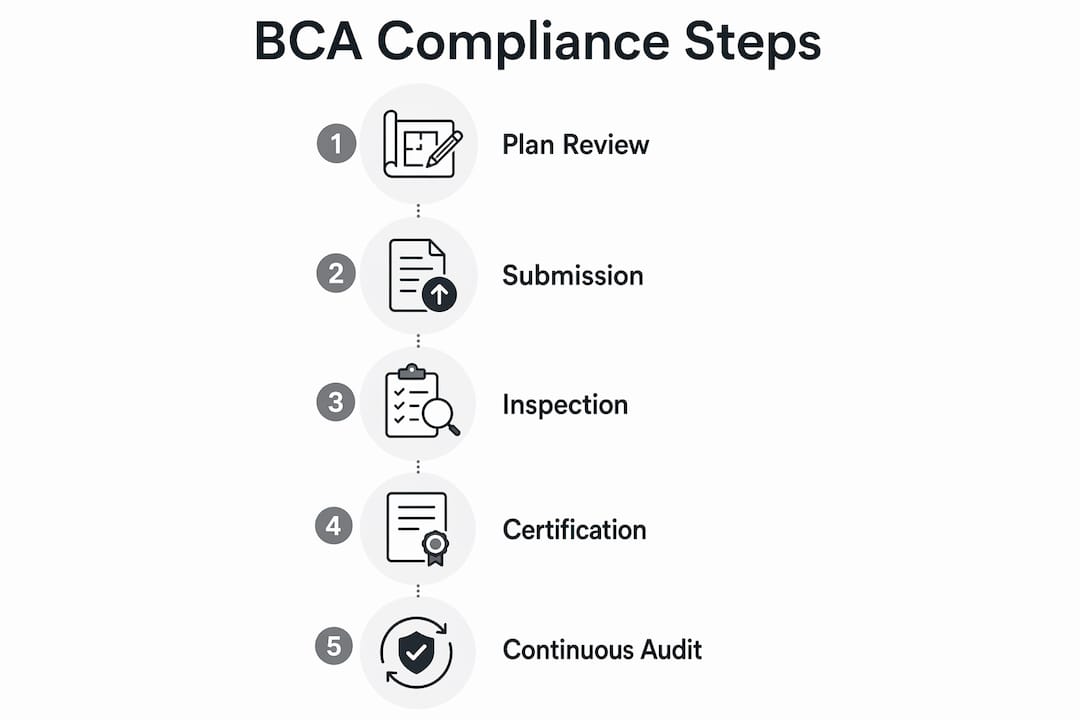
Deviations from approved plans represent a separate and serious compliance risk. Sections 18 and 18A of the Building Control Regulations set strict requirements for how deviations must be approved and reported. An unauthorized deviation does not simply require a correction. It can invalidate the original approval and expose the developer and QP to enforcement action.
Best practices for managing BCA compliance effectively include:
- Appoint QPs before design is finalized. Engaging Qualified Persons early and maintaining clear reporting and site oversight are critical for successful compliance. QPs who join a project after the design is locked in spend most of their time correcting problems rather than preventing them.
- Maintain a live deviation register. Any change to approved drawings, specifications, or materials must be logged immediately and assessed against the deviation approval requirements under the Building Control Regulations.
- Schedule regular site supervision reports. QPs are legally required to submit supervision reports at defined construction milestones. Missing a reporting deadline is an enforcement trigger, even if the construction itself is compliant.
- Understand the appeals process before you need it. Enforcement under the BCAA Act is administrative and graduated, with an appeals process to the Minister. Knowing this process in advance allows developers to respond to enforcement notices within the required timeframes rather than missing appeal windows.
- Use BIM for coordination. Building Information Modeling allows structural, architectural, and M&E teams to detect clashes before submission, reducing the likelihood of inconsistencies that cause rejection. Com’s digital engineering BIM services are specifically structured to support BCA submission accuracy.
Pro Tip: Cross-reference your structural drawings against the BCA Approved Document before every submission. This single step catches the majority of technical inconsistencies that cause first-round rejections.
The construction software glossary from DesignFlow Build provides useful definitions for compliance workflow terms, including those relevant to BCA submission management systems. Understanding these terms helps project teams communicate more precisely with QPs and submission consultants.
Key Takeaways
BCA compliance requires integrating the Building Control Act 1989, the Building Control Regulations 2003, and the BCAA Act 1999 into every stage of project planning, design, and construction.
| Point | Details |
|---|---|
| Legal framework | The Building Control Act 1989 and Building Control Regulations 2003 govern all regulated building works in Singapore. |
| QP appointment | Qualified Persons must be engaged before design is finalized to prevent costly late-stage corrections. |
| BCA and URA integration | Both authorities’ requirements must be reviewed jointly from the design brief stage to avoid rejections. |
| Accessibility compliance | The BCA Code on Accessibility is a mandatory approval condition, not an optional design feature. |
| Deviation management | Unauthorized deviations from approved plans can invalidate project approval and trigger enforcement action. |
Navigating BCA regulations in 2026: what I’ve learned
The most persistent mistake I see developers and contractors make is treating BCA compliance as a submission exercise rather than a project management discipline. They appoint a QP, hand over the drawings, and wait for approval. When the rejection comes, they are surprised. The reality is that BCA compliance begins at the design brief stage and runs continuously through occupation.
The 2026 regulatory environment has added complexity in two specific areas. First, BCA’s expectations around geotechnical documentation have become more detailed, particularly for projects near MRT tunnels and existing infrastructure. Second, the accessibility code updates have tightened specifications for tactile guidance systems and accessible parking in mixed-use developments. Projects that were designed to the 2023 code version and have not been reviewed against current standards are carrying compliance risk they may not have identified.
My strongest advice is to treat the QP as a project team member, not a submission agent. The QP’s legal duties under the Building Control Regulations extend far beyond signing drawings. They include site supervision, deviation reporting, and milestone certifications. A QP who is not integrated into the project’s construction program cannot fulfill those duties effectively. When that happens, the developer bears the consequences.
The firms that consistently achieve smooth BCA approvals share one characteristic. They invest in compliance infrastructure early, including proper documentation systems, regular QP coordination meetings, and a clear deviation management process. That investment costs far less than a single stop-work order.
— Aman
How Com supports your BCA compliance
Regulatory compliance across BCA, URA, and related authorities requires technical depth and procedural precision at every project stage. Com provides engineering consultancy services covering statutory submissions, structural and facade inspections, geotechnical certifications, and BIM-supported plan coordination for developers and contractors in Singapore.
Com’s team manages the full compliance workflow, from pre-application coordination with BCA and URA through to occupation permit applications. For developers who need structured support on regulatory requirements in construction, Com provides qualified professional engineers and registered architects with direct experience in Singapore’s statutory approval processes. Contact Com to discuss your project’s compliance requirements before your next submission.
FAQ
What does the Building Control Act 1989 govern?
The Building Control Act 1989 governs all regulated building works in Singapore, covering plan submission, construction standards, the duties of Qualified Persons, and enforcement powers including stop-work orders and licence revocation.
What is deemed approval under the Building Control Regulations?
Deemed approval means that if BCA does not respond to a plan submission within the prescribed timeline, the submission is treated as approved by default. The developer still bears full responsibility for technical accuracy under this provision.
Why must BCA and URA requirements be addressed together?
BCA governs technical safety and construction standards while URA governs land use, building height, and facade aesthetics. A design that satisfies one authority’s requirements can still fail the other’s, making joint review from the design stage necessary.
Who qualifies as a Qualified Person under BCA regulations?
A Qualified Person is a registered architect or professional engineer appointed to supervise submissions, certify designs, and report on construction progress. QPs carry defined legal duties at every stage of a regulated building project.
What happens if construction deviates from approved BCA plans?
Unauthorized deviations from approved plans can invalidate the original project approval and expose both the developer and the QP to enforcement action under Sections 18 and 18A of the Building Control Regulations 2003.