

Infrastructure valuation is defined as the structured process of determining the economic worth of infrastructure assets by integrating cost-based, income-based, and market-based methodologies to produce a transparent and defensible estimate. Real estate investors, property managers, and developers rely on this process to make sound acquisition, financing, and development decisions. The recognized industry term is “infrastructure asset valuation,” and it draws on frameworks such as the International Valuation Standards (IVS) and financial modeling techniques including Discounted Cash Flow (DCF) analysis. A credible valuation does not rest on a single method. Leading standards recommend combining multiple approaches to produce a well-supported result that withstands lender and regulatory scrutiny.
What are the main methodologies used in infrastructure valuation?
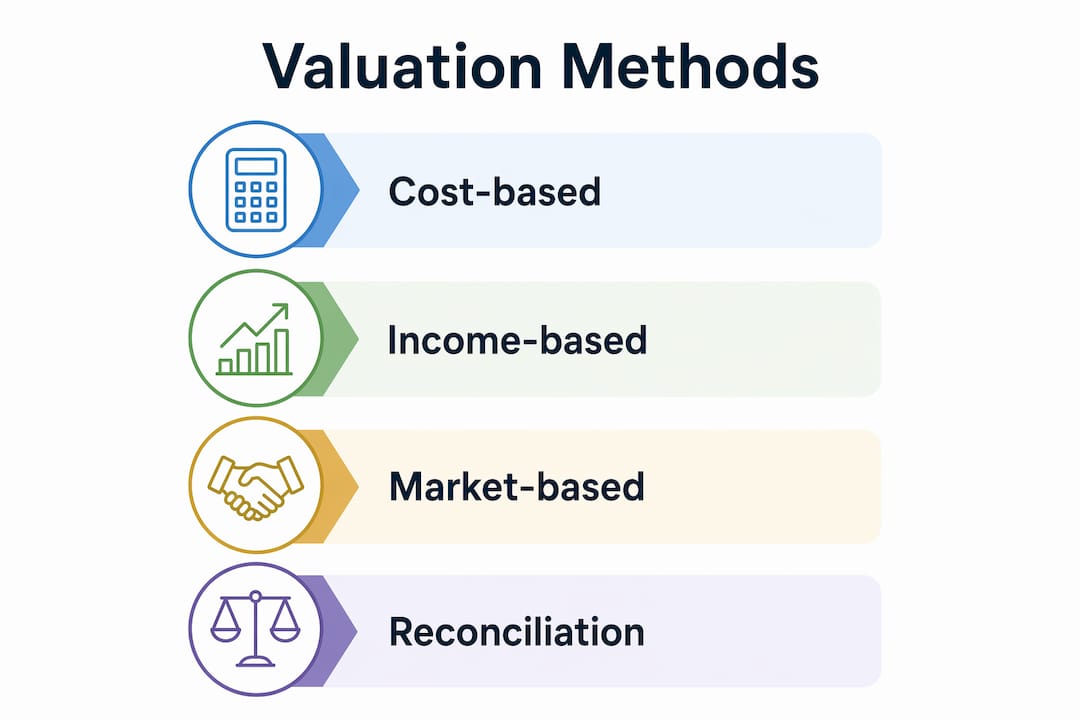
Infrastructure asset valuation relies on three primary methodologies. Each serves a distinct purpose, and the choice of method depends on the asset type, available data, and the purpose of the assessment.
Cost-based approach
The cost-based approach estimates value by calculating what it would cost to replace or reproduce the asset at current prices, then adjusting for depreciation and obsolescence. This method suits unique assets with few comparable market transactions, such as water treatment plants, tunnels, or transmission lines. The limitation is that replacement cost does not always reflect economic value, particularly when an asset generates regulated or contracted revenues.

Income-based approach
The income-based approach, centered on DCF modeling, projects future cash flows and discounts them to present value using an appropriate rate. Analysts choose between Free Cash Flow to Equity (FCFE) and Free Cash Flow to Firm (FCFF) depending on whether the valuation is from an equity or enterprise perspective. This method is the most widely applied for regulated utilities, toll roads, and Public-Private Partnership (PPP) projects because it captures the long-term, contracted nature of infrastructure revenues.
Market-based approach
The market-based approach uses comparable transactions and valuation multiples, such as EV/EBITDA or price-to-regulated asset base, drawn from recent deals in the same asset class. This method provides a useful cross-check but is limited by the availability of truly comparable transactions, particularly for specialized or regulated assets.
International Valuation Standards advocate weighted reconciliation across all three approaches rather than simplistic averaging. This hybrid approach avoids blind reliance on any single method and produces a more defensible conclusion.
| Methodology | Best suited for | Key limitation |
|---|---|---|
| Cost-based | Unique assets, limited market data | Ignores economic earning potential |
| Income-based (DCF) | Regulated utilities, PPP, toll roads | Sensitive to discount rate and cash flow assumptions |
| Market-based | Assets with active transaction markets | Requires truly comparable deals |
Pro Tip: When preparing a valuation for lender review, always present all three methodologies and explain the weighting applied to each. A single-method valuation raises immediate credibility questions.
How do financial modeling techniques inform infrastructure valuation?
DCF modeling is the primary analytical framework for how to value infrastructure, and its accuracy depends entirely on the quality of the inputs. Four technical areas require particular discipline.
-
Cash flow metric selection. Analysts must choose FCFE or FCFF before building the model, then apply the matching discount rate. Using FCFF with a cost of equity, or FCFE with a weighted average cost of capital (WACC), produces a structurally incorrect valuation. Experts caution that this mismatch is among the most common technical errors in infrastructure DCF models.
-
Inflation consistency. Infrastructure cash flows carry inflation linkage, often modeled at 2–3% annual escalation tied to regulatory tariff adjustments or contractual clauses. Failing to match inflation assumptions between cash flows and the discount rate can significantly misstate the asset’s value. Discounting nominal cash flows with a real WACC is a particularly damaging error that grossly overstates value.
-
Terminal value treatment. Long-life assets do not always warrant a perpetuity terminal value. In Build-Operate-Transfer (BOT) projects, the asset reverts to the government at concession end, typically at zero residual value. Modeling a perpetuity in this context inflates the valuation materially and misrepresents the investment’s actual return profile.
-
Regulatory asset base (RAB) integration. For regulated utilities, the RAB sets the allowed return and forms the foundation of the revenue model. Valuations that ignore the RAB or treat it as a simple book value miss the regulatory mechanism that drives cash flow predictability.
Pro Tip: Build a separate inflation assumption tab in your model. Link all cash flow escalation rates and the nominal discount rate back to this single source. Inconsistent inflation inputs are the fastest way to lose credibility with a sophisticated counterparty.
Concession agreement terms also define the modeling horizon. Projecting cash flows beyond the contract term without contractual justification introduces speculative value that lenders and equity partners will challenge. Aligning the model structure with the legal and regulatory framework is not optional. It is the foundation of a credible appraisal.
What external factors and risks affect infrastructure asset valuation?
Infrastructure appraisal techniques do not operate in isolation. Market conditions, regulatory frameworks, and macroeconomic variables all influence the final value conclusion.
-
Interest rates and cost of equity. Discount rates for listed infrastructure increased by 50–100 basis points since 2021, while equity risk premiums declined to partially offset the impact. The net effect on valuations has been moderate, but the sensitivity remains significant. A 50 basis point change in the discount rate can materially alter project value, making rate justification a central point of stakeholder scrutiny.
-
Inflation pass-through. Infrastructure assets with contractual or regulatory price escalation clauses carry a natural hedge against inflation. Assets that can pass cost increases through to end users maintain revenue stability in high-inflation environments, which supports valuation resilience.
-
Regulatory and permitting status. An asset with full regulatory approval and a signed concession agreement carries substantially less risk than one in the permitting phase. Valuations must reflect this risk differential explicitly, typically through a higher discount rate or probability-weighted cash flow scenarios for pre-approval assets.
-
Contractual risk allocation in PPPs. Concession agreements, offtake contracts, and O&M arrangements fundamentally shape predictable cash flows and risk allocation. A well-structured PPP contract that allocates demand risk to the public sector and construction risk to the contractor produces a more predictable cash flow profile, which directly supports a lower discount rate and higher valuation.
“Long-term infrastructure valuations hinge more on long-term interest rates than short-term market volatility, due to the asset life and essential services nature of the underlying investments. Revenue estimates for listed infrastructure firms have been revised upward by approximately 15% over recent years, reflecting the sector’s pricing power and policy support.”
The importance of infrastructure valuation becomes clearest when these external variables shift simultaneously. Investors who understand the mechanics can identify when market dislocations create acquisition opportunities, and when headline valuations are inflated by optimistic assumptions.
How do investors and developers practically apply infrastructure valuation?
Applying infrastructure valuation results to real investment decisions requires more than a completed model. The following practices define professional-grade application of valuation outputs.
-
Sensitivity analysis. Run the model across a range of discount rates, revenue growth assumptions, and inflation scenarios. A valuation that only holds at a single set of inputs is not a valuation. It is a point estimate with no decision-making utility. Sensitivity tables and tornado charts communicate the range of outcomes to investment committees and lenders.
-
Valuation bridges. A valuation bridge shows how value changes from one period to the next, or from one set of assumptions to another. This tool is particularly useful when comparing an acquisition price to an independently derived valuation, or when explaining value movement to fund investors.
-
Continuous market benchmarking. Transparency and rigor in financial modeling, combined with contractual awareness, are critical for valuations that withstand scrutiny. Benchmarking discount rates, EBITDA multiples, and revenue assumptions against recent comparable transactions keeps the model grounded in market reality. Unbenchmarked assumptions are the most common reason valuations fail under lender review.
-
Alignment with contractual realities. The financial model must reflect what the contract actually says, not what the developer hopes it says. Revenue assumptions, escalation mechanisms, and termination provisions all have direct valuation implications. Reviewing the concession agreement terms alongside the financial model is a non-negotiable step in any credible assessment.
-
Integration into acquisition decisions. Valuation outputs should drive bid pricing, financing structure, and equity return targets. Developers who treat the valuation as a post-decision compliance exercise rather than a pre-decision analytical tool consistently overpay or underprice assets.
For developers assessing project feasibility, understanding building valuation methods alongside infrastructure-specific techniques provides a more complete picture of total project value.
Key takeaways
Infrastructure asset valuation is a multi-method discipline where discount rate selection, inflation consistency, and contractual alignment determine whether a valuation is credible or challenged.
| Point | Details |
|---|---|
| Use all three methodologies | Combine cost-based, income-based, and market-based approaches with weighted reconciliation for a defensible result. |
| Match cash flow metrics to discount rates | FCFE pairs with cost of equity; FCFF pairs with WACC. Mismatching these inputs structurally breaks the model. |
| Align inflation assumptions | Nominal cash flows require a nominal discount rate; mixing real and nominal inputs materially misstates value. |
| Treat terminal value by contract type | BOT projects revert to government at concession end; modeling a perpetuity in this context inflates the valuation. |
| Benchmark every key assumption | Unbenchmarked discount rates and revenue growth figures are the primary reason valuations fail lender scrutiny. |
Aman’s perspective on what actually matters in infrastructure valuation
The most common mistake I see in infrastructure valuation is not a calculation error. It is an assumption error that no one questions until a lender’s technical advisor does. Sponsors spend considerable effort on model architecture and IRR presentation, then use a discount rate that has no market basis or an inflation assumption that contradicts the contract. Those are the inputs that determine whether a deal closes or collapses.
Discount rate selection deserves more rigor than it typically receives. Stakeholders rarely challenge the IRR directly. They scrutinize the risk assumptions underpinning cash flow escalation and discount rates, because those inputs drive the entire valuation. A 50 basis point error in the discount rate on a 30-year concession is not a rounding issue. It is a material misstatement.
Terminal value treatment in BOT projects is another area where I see consistent errors. Modeling a perpetuity when the asset reverts to the government at year 25 is not a conservative assumption. It is a structural mistake that overstates equity value and misleads investors about the actual return profile.
The best infrastructure valuations I have reviewed share one characteristic: the financial model and the concession agreement are read together, not separately. Every revenue assumption traces back to a contractual clause or a regulatory determination. Every risk premium has a documented basis. That level of discipline is what produces a valuation that withstands lender and regulator scrutiny from the outset.
Infrastructure assets are resilient through active management and precise valuation, not by default. Investors who treat valuation as a living analytical tool, updated as market conditions and contract milestones evolve, consistently make better capital allocation decisions than those who treat it as a one-time exercise.
— Aman
Professional infrastructure valuation support from Com
Real estate investors and developers working on infrastructure projects in Singapore and across the region require engineering and valuation expertise that goes beyond standard financial modeling.

Com, operating as Aman Engineering Consultancy, provides integrated consultancy services covering value engineering, structural assessment, regulatory compliance, and project feasibility analysis. The firm’s experience spans statutory submissions to agencies including BCA, JTC, LTA, and PUB, giving clients a direct line to the regulatory knowledge that shapes infrastructure valuations. For developers and investors seeking a consultancy that connects engineering reality with financial assessment, Aman Engineering delivers the technical depth and regulatory access that credible infrastructure appraisals demand. Contact the team to discuss your project’s valuation and compliance requirements.
FAQ
What is infrastructure valuation?
Infrastructure valuation is the process of determining the economic worth of infrastructure assets using cost-based, income-based, and market-based methodologies. The International Valuation Standards recommend combining all three approaches with weighted reconciliation for a defensible result.
What is the most common method used to value infrastructure?
The Discounted Cash Flow method is the primary framework for infrastructure asset valuation, particularly for regulated utilities, toll roads, and PPP projects. It projects future cash flows and discounts them at a rate reflecting the asset’s risk profile.
Why does the discount rate matter so much in infrastructure valuation?
Even a 50 basis point change in the discount rate can materially alter a project’s value, making it the most sensitive input in any infrastructure DCF model. Lenders and technical advisors scrutinize discount rate assumptions more than headline IRR or NPV figures.
How do concession agreements affect infrastructure valuation?
Concession agreements define the modeling horizon, revenue escalation mechanisms, and risk allocation between public and private parties. A well-structured agreement that allocates demand risk to the public sector supports a lower discount rate and a higher valuation.
How does inflation affect infrastructure asset valuation?
Infrastructure cash flows typically carry inflation linkage through regulatory tariff escalations or contractual clauses. Failing to match the inflation assumption between cash flows and the discount rate, such as discounting nominal cash flows with a real WACC, significantly misstates the asset’s value.