

Risk assessment in real estate is the structured process of identifying hazards, analyzing their likelihood and impact, and making informed decisions to protect asset value and investment returns. The role of risk assessment in real estate extends far beyond a compliance checkbox. It forms the analytical foundation that separates defensible investment decisions from intuition-driven bets. Frameworks like ISO 31000 set the standard for how professionals identify, evaluate, and treat risk across property types and market cycles. Whether you are structuring a commercial acquisition, managing a development project, or planning a portfolio exit, systematic risk evaluation determines whether your expected returns justify the exposure you accept.
What are the main categories of risk in real estate investments?
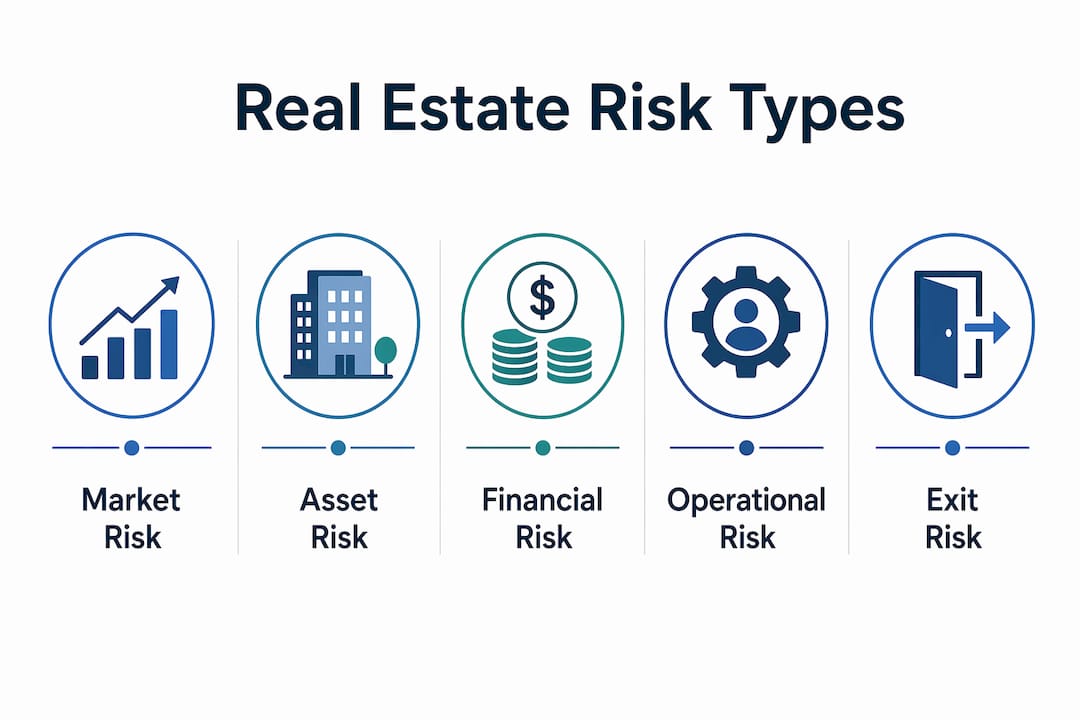
Commercial real estate risk consolidates into four primary categories: market, asset, financial, and operational risk. Each category contains distinct risk factors that require separate evaluation methods and management responses.
- Market risk covers macroeconomic trends, employment levels, demand-supply imbalances, and cap rate movements. A rising cap rate environment compresses asset values even when net operating income holds steady.
- Asset risk addresses physical condition, location quality, building obsolescence, and tenant concentration. A property with a single anchor tenant carries significantly higher asset risk than one with a diversified rent roll.
- Financial risk involves leverage ratios, debt terms, interest rate exposure, and refinancing timelines. High loan-to-value structures amplify both upside and downside, making debt structuring a core risk decision.
- Operational risk captures management quality, capital expenditure timing, lease administration, and execution intensity. Poor asset management erodes returns even in favorable market conditions.
- Exit risk evaluates market cycle timing, buyer demand depth, cap rate trends at disposition, and property condition at sale. Returns are realized at disposition, making exit risk an indispensable component of any complete risk analysis.
Consolidating these into five clearly defined buckets gives investment teams a repeatable structure for comparing risk profiles across different asset classes and geographies.
Pro Tip: Map each identified risk to one of these five categories before scoring it. This prevents double-counting and ensures your risk register covers the full exposure spectrum without gaps.

How is risk assessment conducted in real estate?
The structured process for conducting real estate risk analysis follows five sequential steps, consistent with ISO 31000 and industry norms. Each step builds on the previous one, and skipping any step degrades the quality of the final assessment.
- Identify risks. Catalog every potential threat across market, asset, financial, operational, and exit categories. Use site inspections, lease reviews, financial model audits, and regulatory checks as primary inputs.
- Analyze likelihood and impact. Score each identified risk on a probability scale and an impact scale. Quantitative scoring removes subjectivity and allows direct comparison across risk types.
- Evaluate against risk appetite. Compare each risk score against the thresholds your board or ownership group has defined. Risks above the threshold require treatment; risks below it may be accepted.
- Treat risks. Select a response: avoid, mitigate, transfer, or accept. Mitigation actions include lease restructuring, insurance procurement, capital reserves, or deal repricing.
- Monitor continuously. Risk registers are living documents that require ongoing updates when market conditions shift, controls fail, or incidents occur. Best practice calls for quarterly or event-triggered reviews, not static annual reports.
For physical property risks, the COPE methodology (Construction, Occupancy, Protection, Exposure) provides a structured framework. COPE originated in insurance underwriting but now supports rigorous investor due diligence by systematically evaluating building construction type, occupancy hazards, fire protection systems, and site-level exposure to natural or environmental hazards.
A risk register that is not actively updated and integrated with control testing and market monitoring becomes a stale report. It retains the appearance of rigor without delivering decision utility. The register must reflect current conditions, not the conditions that existed at the time of acquisition.
Pro Tip: Schedule a risk register review immediately after any significant market event, such as a central bank rate decision, a major tenant default in your submarket, or a regulatory change affecting your asset class. Do not wait for the quarterly cycle.
What are the benefits and importance of risk assessment in real estate?
Systematic risk evaluation transforms intuition-based decisions into data-driven frameworks with measurable criteria. The practical benefits extend across every phase of the investment lifecycle.
- Improved pricing accuracy. Risk-adjusted cash-on-cash return frameworks discount projected returns by identified risks, anchoring deal pricing in risk premium terms rather than optimistic projections.
- Deal-breaker identification. A structured assessment separates risks worth accepting from risks that disqualify a transaction. This distinction prevents capital deployment into fundamentally flawed assets.
- Stronger due diligence. Formal risk documentation supports insurance negotiation, lender presentations, and capital planning discussions. Lenders and insurers respond to quantified risk data, not narrative assurances.
- Reduced post-acquisition surprises. Identifying operational risks before closing allows investors to budget for capital expenditure, lease rollover costs, and management transitions with realistic figures.
- Better exit strategy alignment. Understanding exit risk at acquisition allows investors to structure hold periods, target buyer profiles, and disposition timing around market cycle projections rather than reacting to conditions at sale.
- Regulatory and compliance support. Documented risk assessments satisfy board governance requirements, regulatory expectations, and insurer mandates. This is particularly relevant for institutional investors operating under fiduciary obligations.
The importance of risk assessment also shows up in portfolio construction. Investors who score risk consistently across assets can allocate capital toward positions where expected return adequately compensates for identified exposure, and away from positions where it does not.
How do real estate professionals apply risk assessment in practice?
Risk assessment integrates into every phase of the investment cycle: acquisition, ownership, and disposition. The table below maps the primary application points.
| Phase | Application | Key Output |
|---|---|---|
| Acquisition | Underwriting and deal structuring | Risk-adjusted return model, deal-breaker list |
| Due diligence | COPE analysis, lease audit, financial stress test | Risk register, insurance brief |
| Ownership | Lease rollover monitoring, capex planning | Updated risk register, capital reserve schedule |
| Asset management | Tenant behavior tracking, regulatory compliance | Operational risk log, compliance checklist |
| Disposition | Exit timing analysis, buyer demand assessment | Exit risk score, disposition strategy memo |
During underwriting, risk scores feed directly into financial models. A property with high tenant concentration risk receives a higher discount rate, reducing the price an investor is willing to pay. This is how real estate risk analysis connects abstract risk categories to concrete deal economics.
Stress testing is a critical ownership-phase tool. Sophisticated investors model combined risk variables simultaneously, such as rising vacancy, falling rents, and increased operating expenses, rather than testing each variable in isolation. Single-variable stress tests underestimate downside potential because real market downturns involve correlated shocks, not sequential ones.
Communicating risk findings to boards, lenders, and insurers requires clear documentation. A well-maintained risk assessment register provides the audit trail that supports these conversations. For construction-phase projects, remote construction management practices add an additional layer of operational risk oversight by maintaining visibility over site conditions and contractor performance in real time.
What challenges exist in real estate risk assessment?
Real estate risk assessment carries inherent complexities that reduce its effectiveness when practitioners treat it as a mechanical exercise.
- Correlated risk factors. Market downturns rarely produce isolated shocks. Rising vacancy, falling rents, and tightening credit conditions occur simultaneously. Models that test one variable at a time miss the compounding effect of correlated risks.
- Subjective risk appetite. Without defined quantitative thresholds at the board or ownership level, risk assessments produce subjective debates rather than decisions. Risk appetite must be documented before the assessment begins, not negotiated after the results arrive.
- Optimism bias. Investors systematically favor best-case scenarios and discount low-probability, high-impact events. This bias inflates projected returns and understates tail risk, particularly in late-cycle acquisitions.
- Dynamic inputs. Market conditions, tenant behavior, and regulatory requirements change continuously. A risk assessment completed at acquisition reflects conditions that may no longer exist 18 months into the hold period.
- Operator quality variability. Asset management execution quality is difficult to quantify but materially affects risk outcomes. A capable operator reduces operational risk; a weak one amplifies it, regardless of what the underwriting model assumed.
- Exit timing uncertainty. Disposition risk is often underweighted at acquisition because investors focus on entry conditions. Exit risk evaluation requires explicit modeling of cap rate trends and buyer demand at the projected sale date, not just at the time of purchase.
Pro Tip: Assign a named owner to each risk in your register. Risks without an accountable owner are never monitored. Accountability converts a risk register from a document into a management system.
Key Takeaways
Effective real estate risk management requires structured frameworks, continuous monitoring, and clearly defined risk appetite thresholds applied consistently across every phase of the investment lifecycle.
| Point | Details |
|---|---|
| Five risk categories | Evaluate market, asset, financial, operational, and exit risk as distinct but interconnected exposures. |
| ISO 31000 process | Follow the five-step identify-analyze-evaluate-treat-monitor cycle for every asset and transaction. |
| Living risk registers | Update registers quarterly or after significant market events, not only at acquisition. |
| Multifactor stress testing | Model correlated risk variables simultaneously to capture realistic downside scenarios. |
| Defined risk appetite | Establish quantitative thresholds at the board level before conducting any assessment. |
Risk assessment is a management system, not a report
After working across engineering consultancy and property development projects in Singapore and internationally, one pattern stands out clearly. Investors who treat risk assessment as a one-time deliverable consistently underperform those who treat it as an ongoing management discipline.
The most common failure I observe is the static risk report. A team conducts a thorough assessment at acquisition, files the document, and never revisits it. Two years later, a major tenant vacates, interest rates shift, or a regulatory change affects the asset class. The risk register reflects none of these developments. The team is making decisions based on conditions that no longer exist.
The shift toward quantitative, dynamic risk modeling is accelerating in 2026. Investors increasingly rely on multi-variable stress testing and explicit exit risk modeling to navigate complex market environments. This is not a methodological preference. It is a competitive requirement. Investors who model correlated risks and maintain current registers make faster, more defensible decisions than those who rely on static snapshots.
The second failure I see regularly is undefined risk appetite. Teams spend weeks scoring risks and then cannot agree on which scores require action because no one defined the threshold in advance. Risk appetite must be set at the ownership or board level before the assessment begins. Without it, the process produces analysis, not decisions.
Real estate risk is manageable. It is not avoidable. The professionals who build durable portfolios accept this distinction and build systems around it.
— Aman
Professional risk assessment support for real estate projects
Real estate professionals who require integrated engineering and risk assessment support across development, acquisition, and compliance phases can engage Aman Engineering Consultancy for structured consultancy services covering structural, facade, M&E, fire safety, and digital engineering disciplines.

Com brings regulatory expertise across Singapore’s BCA, URA, JTC, HDB, SCDF, PUB, and LTA frameworks, ensuring that risk assessments align with statutory requirements and support project approvals. The firm’s value engineering services integrate risk evaluation directly into project planning, helping investors identify cost exposures and compliance gaps before they affect returns. For investors and developers seeking a consultancy that treats risk assessment as a technical discipline rather than a documentation exercise, Com provides the depth and regulatory knowledge that complex projects require.
FAQ
What is risk assessment in real estate?
Risk assessment in real estate is the systematic process of identifying, analyzing, and evaluating potential threats to property value and investment returns. It follows structured frameworks such as ISO 31000 to produce defensible, data-driven investment decisions.
What are the main categories of real estate investment risk?
The five primary categories are market risk, asset risk, financial risk, operational risk, and exit risk. Each category contains distinct factors that require separate evaluation and management strategies.
How often should a real estate risk register be updated?
Best practice requires quarterly updates or immediate review following significant market events, regulatory changes, or incidents affecting the asset. Static annual reports fail to provide current, actionable risk insight.
What is the COPE methodology in property risk assessment?
COPE stands for Construction, Occupancy, Protection, and Exposure. It originated in insurance underwriting and provides a structured framework for evaluating physical property risks during investor due diligence and underwriting.
Why is risk appetite important in real estate risk assessment?
Without defined quantitative thresholds established at the board or ownership level, risk assessments produce subjective debates rather than clear decisions. Risk appetite converts assessment outputs into actionable investment criteria.