

A Qualified Person (QP) in construction is a legally accountable professional, registered under Singapore’s Building Control Act, who holds personal responsibility for supervising projects, certifying plans, and ensuring compliance with building codes and safety regulations. The role of QP in construction extends beyond technical oversight. It defines the regulatory framework within which every contractor, engineer, and project manager must operate. Without a properly appointed QP, no building plan submission to the Building and Construction Authority (BCA) can proceed, and no occupation permit can be issued. For construction professionals and project managers in Singapore, understanding the QP’s authority, legal exposure, and quality planning functions is not optional. It is a prerequisite for project delivery.
What is the role of QP in construction projects?
The QP’s role in Singapore construction is defined by statute, not convention. Under the Building Control Act, a QP must be either a Registered Architect under the Architects Act or a Professional Engineer registered under the Professional Engineers Act. This statutory grounding gives the QP authority that no other project role possesses, including the exclusive right to submit building plans to BCA, certify structural works, and sign off on regulatory approvals.
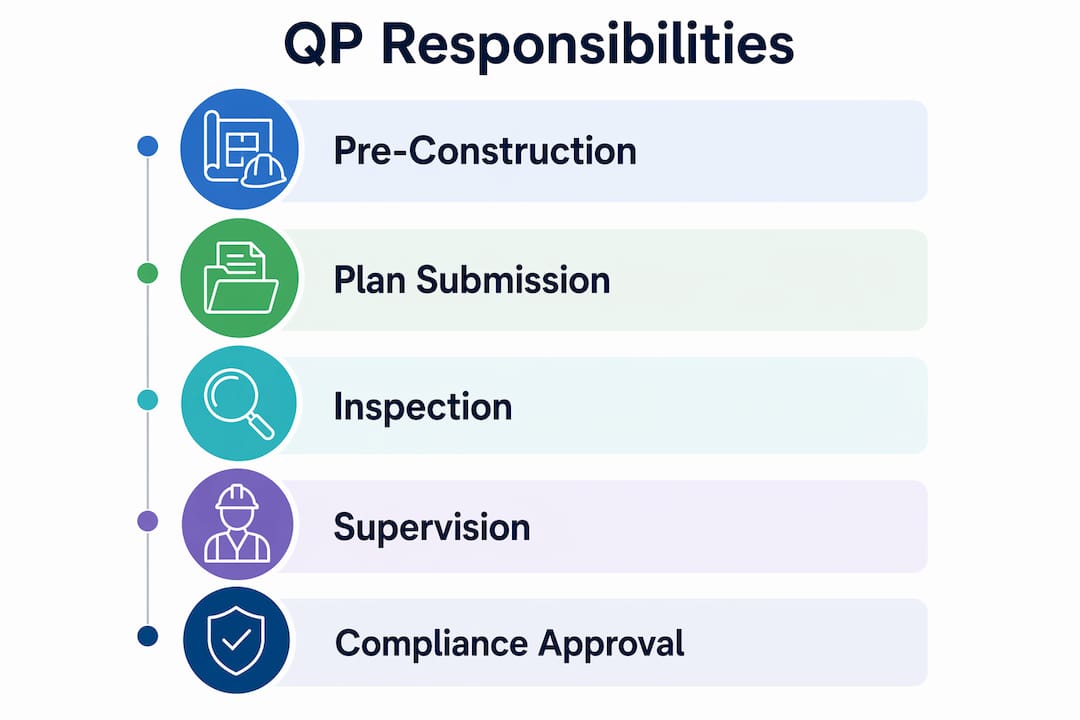
The QP’s core functions span the full project lifecycle. Before construction begins, the QP prepares and submits building plans for regulatory approval, coordinates with agencies such as URA, JTC, HDB, SCDF, PUB, and LTA, and establishes the quality and compliance framework the site team must follow. During construction, the QP conducts prescribed inspections, supervises critical works, and certifies that construction conforms to approved plans. At project completion, the QP submits the Certificate of Statutory Completion (CSC) or Temporary Occupation Permit (TOP) documentation to BCA.

The legal weight of these responsibilities is significant. QP supervision failures carry fines ranging from HK$250,000 to HK$1,000,000 and imprisonment of up to three years for safety-related non-compliance. This penalty structure reflects the degree to which regulators treat the QP as the primary safeguard against construction failures. A QP who delegates prescribed inspections without authorization, or who signs off on non-conforming works, faces personal prosecution.
The QP also holds responsibility for building plan submissions and all associated documentation. This includes coordinating with the Qualified Person for Supervision (QPS), who manages day-to-day site supervision under the QP’s overall authority. Understanding the distinction between the QP and QPS roles prevents costly gaps in site oversight.
How does quality planning integrate with the QP’s construction role?
Quality planning in construction is defined as the process of identifying standards, inspection methods, roles, and escalation paths to ensure project deliverables meet regulatory and contractual requirements. The QP is the anchor of this process. Quality planning standards require that the QP’s approved plans serve as the baseline against which all site-level quality control is measured. Without that approved plan, on-site quality control lacks the regulatory framework needed to prevent safety violations and audit failures.
The practical implication is that quality assurance and quality control are not interchangeable in the QP context. Quality assurance is the QP’s domain: establishing the standards, processes, and documentation requirements before work begins. Quality control is the site team’s domain: verifying that work conforms to those standards during execution. The QP sets the framework; the contractor and site supervisor execute within it. When this division is respected, defect rates fall and rework is minimized.
Poor quality management can increase total project costs by up to 20% due to rework, time wastage, and remediation. This figure underscores why early QP engagement in quality planning is a cost control measure, not merely a compliance exercise. Projects that involve the QP in pre-construction quality planning consistently experience fewer variation orders and lower remediation costs than those that treat QP involvement as a late-stage formality.
Pro Tip: Engage your QP during the design development stage, not after tender award. QP input at the design stage eliminates specification conflicts that generate costly variation orders during construction.
The table below summarizes the QP’s quality planning functions across project phases:
| Project phase | QP quality planning function |
|---|---|
| Pre-construction | Approve plans, define inspection hold points, establish quality standards |
| Construction | Conduct prescribed inspections, certify conformance, review test results |
| Completion | Submit CSC/TOP documentation, certify as-built compliance |
Assigning clear ownership for standards, inspections, and reviews prevents quality drift on site. The QP’s quality plan designates who is responsible for each inspection, what the acceptance criteria are, and what escalation path applies when non-conformance is identified. This structure converts quality from a vague aspiration into a documented, auditable process.
How does the QP role compare to other construction professionals?
The QP holds statutory authority that distinguishes the role from all other construction professionals. A Professional Engineer (PE) provides technical calculations and endorsements but does not hold the same submission rights or personal liability for project-wide compliance. A Registered Contractor executes works under the QP’s approved plans but cannot certify compliance or submit documentation to BCA. An Authorized Person in other jurisdictions performs a comparable function, but in Singapore, the QP role is the recognized statutory designation.
The QP works with building services engineers, architects, and contractors to ensure compliance and safety across all project disciplines. This collaboration is structured, not informal. The QP chairs coordination meetings, reviews shop drawings for compliance with approved plans, and resolves conflicts between structural, architectural, and M&E requirements before they reach the site.
The comparison below clarifies the boundaries of each role:
| Role | Statutory submission rights | Personal liability for compliance | Site supervision authority |
|---|---|---|---|
| Qualified Person (QP) | Yes, to BCA and relevant agencies | Yes, full personal liability | Yes, prescribed inspections |
| Professional Engineer (PE) | Limited to PE endorsements | Yes, for endorsed works | No, unless appointed as QPS |
| Registered Contractor | No | No, for design compliance | Yes, for workmanship execution |
| Project Manager | No | No, for regulatory compliance | No, for statutory purposes |
Key distinctions that project managers must understand:
- The QP cannot transfer personal liability for prescribed inspections to a contractor or project manager.
- The PE’s endorsement covers structural calculations; the QP’s certification covers overall project compliance.
- The QPS manages day-to-day supervision but reports to and operates under the authority of the appointed QP.
- Contractors who proceed with works without QP approval for design changes expose both themselves and the QP to regulatory action.
For a detailed comparison of submission pathways, the PE endorsement vs QP submission distinction is a frequent source of confusion that carries real regulatory consequences when misunderstood.
Practical steps for working effectively with a QP
Construction professionals who treat the QP as a compliance checkpoint rather than a project partner consistently encounter delays, variation orders, and audit failures. The following steps reflect how high-performing project teams in Singapore structure their QP engagement.
-
Verify credentials before appointment. Confirm that the QP is registered with BCA as either a Registered Architect or Professional Engineer. Check that the QP’s registration covers the specific works category for your project, whether structural, architectural, or M&E.
-
Appoint the QP at project inception. Early quality planning prevents onsite firefighting by integrating compliance requirements into the design and procurement stages. A QP appointed after tender award cannot retroactively correct specification errors embedded in the contract documents.
-
Establish a document control protocol with the QP. The QP requires timely access to shop drawings, material submittals, and test reports to conduct prescribed inspections on schedule. A shared document management system, whether Aconex, Procore, or a project-specific SharePoint site, reduces inspection delays caused by missing documentation.
-
Schedule QP inspection hold points into the construction program. Prescribed inspections are not discretionary. Build QP inspection hold points into the master program at the tender stage so that contractors price and schedule around them, rather than treating them as disruptions.
-
Brief the site team on QP authority. Site supervisors and foremen must understand that no work covered by a QP inspection hold point proceeds without QP sign-off. This briefing prevents the common scenario where works are covered up before inspection, requiring costly opening up.
Pro Tip: Request a pre-construction quality planning workshop with your QP, contractor, and site supervisor before mobilization. Aligning all parties on inspection hold points, non-conformance procedures, and documentation requirements at the outset eliminates the majority of compliance disputes that arise mid-construction.
Risk assessment in construction is another area where early QP involvement delivers measurable value. QPs who participate in pre-construction risk workshops identify compliance risks that project managers and contractors routinely miss because they lack the regulatory knowledge to recognize them.
Key takeaways
The QP is the legally accountable professional whose approved plans, prescribed inspections, and quality planning framework determine whether a Singapore construction project achieves regulatory compliance, cost control, and safe delivery.
| Point | Details |
|---|---|
| QP holds statutory authority | Only a QP can submit building plans to BCA and certify project-wide compliance in Singapore. |
| Legal liability is personal | QP supervision failures carry fines up to HK$1,000,000 and imprisonment up to three years. |
| Quality planning prevents cost overruns | Poor quality management increases total project costs by up to 20% through rework and remediation. |
| Early QP engagement is a cost control measure | Appointing the QP at project inception eliminates specification conflicts and reduces variation orders. |
| QP role is distinct from PE and contractor roles | The QP’s submission rights and personal liability for compliance are not shared by any other project role. |
Why the QP role deserves more recognition than it receives
From my experience working across construction and engineering projects in Singapore, the QP is consistently the most underutilized resource on a project when engaged late, and the most valuable when engaged early. Project managers frequently treat QP appointment as an administrative step, something to complete before the first BCA submission, rather than as a strategic decision that shapes project outcomes from design through to occupation.
The projects I have observed with the fewest regulatory delays share one characteristic: the QP was involved before the design was frozen. When the QP reviews drawings at the design development stage, compliance issues are resolved on paper, where they cost nothing. When the same issues surface during construction, they generate variation orders, program delays, and in serious cases, enforcement action from BCA or SCDF.
The integration of Building Information Modeling (BIM) into Singapore’s construction sector is shifting the QP’s working environment. BIM-coordinated models allow QPs to conduct virtual compliance reviews before construction begins, identifying clashes between structural, architectural, and M&E elements that would otherwise become site problems. This technology does not reduce the QP’s legal responsibility. It gives the QP better tools to discharge that responsibility with greater precision.
The industry needs to recognize that the QP role is not a bureaucratic formality. It is the primary mechanism through which Singapore’s built environment maintains its safety and quality standards. Construction professionals who invest in strong QP relationships and early quality planning integration will consistently outperform those who do not.
— Aman
How Aman Engineering Consultancy supports your QP requirements

Aman Engineering Consultancy provides QP supervision services across structural, facade, M&E, and fire safety disciplines, supporting construction projects from initial BCA submission through to CSC and TOP certification. The firm’s QPs work directly with project managers, contractors, and government agencies including BCA, URA, JTC, HDB, SCDF, PUB, and LTA to deliver compliant, on-schedule project approvals. Aman’s integrated approach combines QP oversight with risk assessment, statutory submissions, and digital engineering solutions including BIM coordination, giving project teams a single point of accountability for regulatory compliance. Contact Aman Engineering Consultancy to discuss QP appointment and quality planning support for your next project.
FAQ
What is a Qualified Person (QP) in Singapore construction?
A QP in Singapore is a Registered Architect or Professional Engineer appointed under the Building Control Act to submit building plans, certify compliance, and conduct prescribed inspections for construction projects. The QP holds personal legal liability for project-wide regulatory compliance.
What are the legal penalties for QP non-compliance?
QP supervision failures carry fines from HK$250,000 to HK$1,000,000 and imprisonment of up to three years for safety-related offenses. These penalties apply personally to the appointed QP, not to the contractor or project owner.
How does the QP role differ from a Professional Engineer?
The QP holds statutory submission rights to BCA and personal liability for project-wide compliance, while the PE’s authority is limited to endorsed structural calculations and specific technical works. A PE may act as QP only if registered in the appropriate category under the Professional Engineers Act.
When should a QP be appointed on a construction project?
The QP should be appointed at the project inception stage, before design is finalized, so that compliance requirements are integrated into drawings and specifications before tender. Late QP appointment forces reactive corrections that generate variation orders and program delays.
How does QP quality planning reduce construction costs?
The QP establishes inspection hold points, defines acceptance criteria, and assigns responsibility for quality checks before construction begins. This proactive structure prevents the rework and remediation that poor quality management links to cost increases of up to 20% on construction projects.