

Facade submission management is the process of organizing, tracking, and coordinating all facade design documents, test reports, and compliance records required for regulatory approval on a construction project. Property developers and construction professionals who understand how to manage facade submissions correctly avoid the costly delays that derail project programs and trigger disputes with certifiers. Digital project management platforms such as Procore and Autodesk have become standard tools in 2026 for automating submission routing and maintaining audit trails. Proactive coordination across architects, contractors, facade engineers, and suppliers is not optional. It is the single most reliable method for keeping approvals on schedule.
How to manage facade submissions: the core process
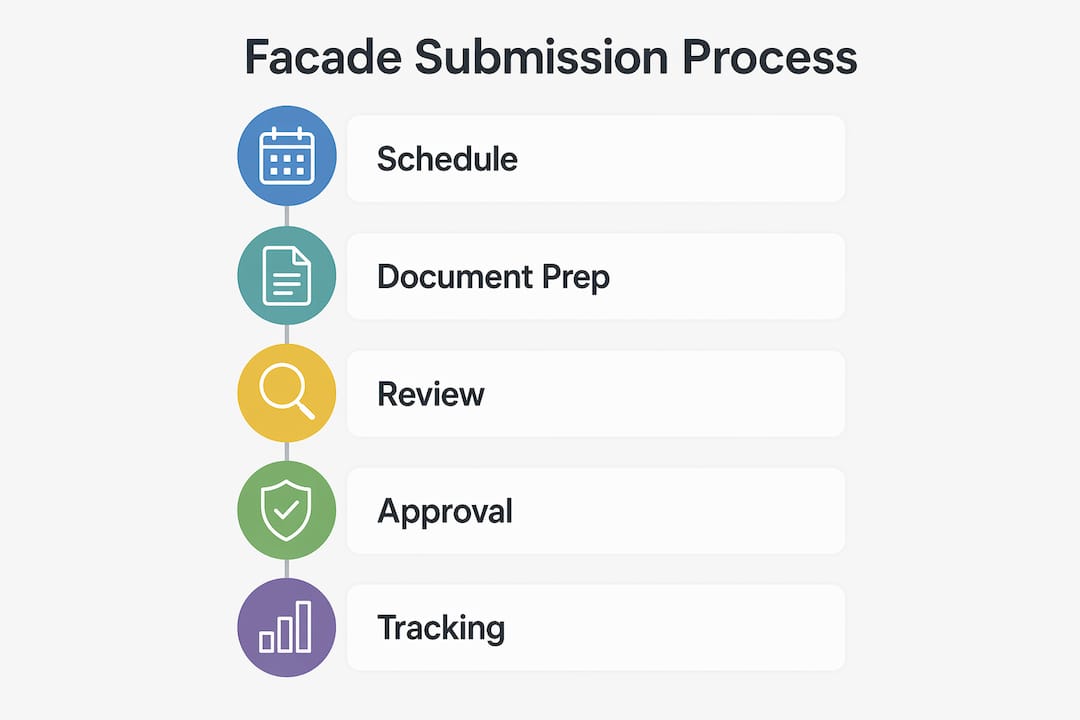
Effective facade submission management follows a defined sequence that begins at the design stage and continues through construction completion. The industry term for this process is submittal management, which encompasses the preparation, review, approval, and archiving of all facade-related compliance documents. Understanding this distinction matters because submittal management carries specific contractual obligations that differ from general document control.
The process starts with a submittal schedule agreed upon during pre-construction conferences. Submittal schedules must be defined and coordinated with the overall project program before construction begins, preventing planning gaps that cause downstream approval failures. This schedule identifies every facade component requiring a submission, assigns responsibility, and sets review deadlines aligned with procurement and installation milestones.

Facade submissions in Singapore typically require approval from the Building and Construction Authority (BCA) and, depending on the project type, from URA, JTC, or HDB. Each agency has specific documentation standards, and a submission that satisfies one authority may still require supplementary data for another. Developers who treat facade submissions as a single event rather than a staged, multi-agency process consistently encounter rejection and resubmission cycles.
What documents must be included in a facade submission?
A complete facade submission package, often called a compliance pack, contains several categories of technical documentation. Missing any one category is the most direct route to rejection and construction hold points.
Required documentation for a facade compliance pack:
- Product-specific test reports with NATA accreditation and report numbers that match exactly the references cited in compliance statements. Generic test reports or missing accreditation cause immediate submission rejection and require full resubmission.
- Compliance statements referencing specific National Construction Code (NCC) clauses applicable to the facade system, including fire performance, weatherproofing, and structural adequacy.
- Facade engineering reports confirming structural adequacy and application suitability for the specific building. Facade engineering reports are essential alongside lab test data because laboratory results alone do not confirm site-specific performance.
- Installation manuals and method statements from the facade system manufacturer, specific to the product being installed.
- Product data sheets covering material specifications, finishes, tolerances, and performance ratings.
- Maintenance schedules and warranties, which certifiers require to confirm the facade system will perform over its design life.
The most common error developers make is not listing all required documentation in the initial project specifications. Omitting test reports and maintenance schedules forces certifiers to issue mid-construction information requests, which stall work at hold points for weeks. Refer to the facade inspection rules guide for a detailed breakdown of what inspection data and maintenance documentation must accompany facade packages.
Pro Tip: Assemble the full compliance pack at the quotation stage, not after contract award. Early documentation assembly prevents weeks-long delays at construction hold points and gives suppliers time to obtain accredited test reports for non-standard products.
What are the best practices for tracking facade submittals?
Tracking facade submittals requires a structured system that operates independently of the contractor’s own records. The following steps represent current best practice for 2026 projects.
- Establish an independent tracking log. Relying solely on the contractor’s submittal log risks missing delays. Architects and developers must maintain their own log to enable proactive monitoring before project meetings surface problems.
- Implement the 10-day heads-up rule. If the contract allows 14 days for review, flag submissions at day 10 to identify any submissions approaching their deadline without a response. This prevents last-minute escalations and rushed reviews.
- Deploy a digital project management platform. Platforms like Procore and Autodesk automate routing, tracking, and auditing of submissions, reducing manual errors and unifying project data in a single environment.
- Activate real-time dashboards and automated status alerts. Dashboards that display submission status by component, reviewer, and deadline allow project managers to identify bottlenecks before they affect the construction program.
- Enforce version control. Every revised submission must carry a clear revision number and change description. Uncontrolled revisions are a leading cause of certifiers reviewing outdated documents.
The following table summarizes the key tracking tools and their primary functions:
| Tool / Method | Primary Function | Key Benefit |
|---|---|---|
| Independent tracking log | Records submission status separate from contractor records | Enables proactive issue identification |
| 10-day heads-up rule | Flags approaching review deadlines | Prevents last-minute rushed reviews |
| Procore / Autodesk | Automates routing, tracking, and auditing | Reduces manual errors and centralizes data |
| Real-time dashboards | Displays submission status by component and reviewer | Identifies bottlenecks before program impact |
| Version control protocol | Tracks document revisions with numbered changes | Prevents review of outdated documents |
Pro Tip: Digital platforms designed for architects prioritize the design team’s workflow and protect firm interests more effectively than contractor-centric tools. Evaluate platforms based on who controls the review workflow, not just who manages the upload.
How to coordinate with suppliers, contractors, and certifiers
Coordination failures between suppliers, contractors, and certifiers account for the majority of facade submission delays on mid-to-large construction projects. Structured communication protocols resolve most of these failures before they escalate.
- Specify documentation requirements in the initial project specifications. Developers who list required test reports, accreditation standards, and compliance statement formats in the tender documents eliminate ambiguity before contract award. Engaging facade suppliers during the specification stage improves their understanding of documentation needs and lead times, which directly reduces approval delays.
- Require contractors to review and stamp submittals before forwarding. The contractor’s review confirms that the submitted product matches the specified system and that installation methodology aligns with the project design. Submittals that bypass contractor review arrive at the certifier’s desk with unresolved discrepancies.
- Establish a single point of contact for facade submissions. A designated facade submission coordinator acts as the central communication point between the design team, contractor, suppliers, and certifying authority. This role prevents information from being lost across multiple email threads and ensures deadlines are enforced consistently.
- Manage post-approval amendments through a formal change process. Any product substitution or design change after approval requires a resubmission. Informal changes that bypass this process create compliance gaps that surface during inspections and can result in rectification orders.
- Coordinate submission schedules with procurement and installation programs. A submission approved two weeks after the installation window has passed provides no value. Submission deadlines must be set backward from installation dates, accounting for review periods and potential resubmission cycles.
For projects subject to BCA oversight in Singapore, the building envelope optimization guide provides additional detail on documentation preparation methods that align with local regulatory requirements.
What are the common mistakes in facade submission management?
Facade submission failures follow predictable patterns. Recognizing these patterns allows developers and project managers to intervene before they affect the construction program.
- Submitting generic test reports. A test report that does not reference the specific product, batch, or system being installed will be rejected. Certifiers require product-specific documentation with matching accreditation numbers.
- Late submissions that compress review periods. Submissions delivered at the last contractual moment leave no buffer for resubmission if the certifier raises queries. Late submissions are the primary cause of hold point delays on facade packages.
- Relying on the contractor’s log as the sole tracking record. Contractors manage their own program interests. An independent developer or architect log is the only reliable mechanism for identifying delays before they become critical.
- Failing to reject poorly prepared submittals immediately. Poorly prepared submittals from subcontractors should be rejected immediately rather than corrected by architects. Accepting and correcting substandard submittals transfers quality responsibility to the design team and increases billable hours without improving outcomes.
- Omitting the facade engineering report from the compliance pack. Developers frequently submit laboratory test data without the accompanying engineering report. Without the engineering report, the certifier cannot confirm that the tested system is appropriate for the specific building’s structural and environmental conditions.
The most preventable cause of facade submission rejection is documentation that was never specified in the first place. A compliance pack that is defined, assembled, and reviewed before construction begins eliminates the majority of mid-project information requests.
Refer to the top causes of submission rejection for a detailed analysis of how missing documentation affects project timelines and what corrective steps apply in each scenario.
Key takeaways
Effective facade submission management requires complete compliance documentation assembled before construction begins, supported by independent tracking systems and structured coordination across all project stakeholders.
| Point | Details |
|---|---|
| Assemble compliance packs early | Build the full documentation pack at the quotation stage to prevent hold point delays during construction. |
| Use independent tracking logs | Maintain a developer or architect-controlled log separate from the contractor’s records to identify delays proactively. |
| Specify documentation in tender | List required test reports, accreditation standards, and compliance formats in project specifications before contract award. |
| Apply the 10-day heads-up rule | Flag submissions approaching their review deadline at day 10 to prevent last-minute escalations. |
| Reject substandard submittals immediately | Return poorly prepared submittals to contractors without correction to preserve quality ownership and reduce rework. |
What experience with facade submissions actually teaches you
After working through facade submission processes across multiple Singapore construction projects, the lesson that stands out most clearly is this: the problems that cause the longest delays are almost never technical. They are organizational. A facade system with complex performance requirements rarely fails the approval process because the engineering is wrong. It fails because the compliance pack was assembled in the wrong sequence, by the wrong party, at the wrong stage of the project.
The concept of a dedicated facade submission coordinator is one that many project teams resist because it looks like an additional overhead cost. In practice, this role functions as the single most cost-effective investment on any project with a significant facade package. Without a coordinator, submission responsibilities fragment across the contractor, the facade subcontractor, the architect, and the developer’s project manager. Each party assumes another is tracking the critical path. The result is a submission that arrives incomplete, late, or both.
Digital tools like Procore and Autodesk have genuinely changed what is possible in submittal tracking. Real-time dashboards and automated alerts remove the dependency on manual follow-up, which was the weakest link in traditional submission workflows. However, the platform is only as effective as the submission schedule and documentation specifications loaded into it. Technology does not compensate for a compliance pack that was never properly defined.
The clearest indicator of a well-managed facade submission process is that certifiers rarely need to ask for additional information. When the compliance pack is complete, product-specific, and correctly referenced, the review cycle moves without friction. That outcome is achievable on every project. It requires discipline at the specification stage, not heroics during construction.
— Aman
How Aman Engineering Consultancy supports your facade submissions
Aman Engineering Consultancy provides integrated facade submission management support for property developers and construction professionals operating in Singapore and across the region. The firm’s technical team assists with compliance pack assembly, documentation review, and coordination with BCA, URA, JTC, and other statutory authorities to keep approval cycles on schedule. Whether you are managing a new development, a major addition and alteration project, or a facade rectification program, Aman Engineering’s regulatory compliance documentation services provide the structured support needed to avoid rejection and resubmission delays. Contact Aman Engineering Consultancy to discuss your project’s facade submission requirements and receive tailored guidance from a team with direct experience across Singapore’s regulatory framework.
FAQ
What documents are required in a facade submission?
A facade submission must include product-specific test reports with NATA accreditation, compliance statements referencing NCC clauses, a facade engineering report, installation manuals, product data sheets, maintenance schedules, and warranties. Missing any of these components results in rejection and resubmission.
Who is responsible for reviewing facade submittals before approval?
The contractor reviews and stamps submittals to confirm product and installation compliance before forwarding to the architect and certifying authority. Submittals that bypass contractor review frequently contain unresolved discrepancies that delay approval.
How early should facade compliance documentation be assembled?
Compliance documentation should be assembled at the quotation stage, before contract award. Early assembly prevents weeks-long delays at construction hold points and allows time to obtain accredited test reports for non-standard products.
What is the 10-day heads-up rule for facade submissions?
The 10-day heads-up rule requires flagging any submission that has not received a response by day 10 of a 14-day review period. This practice prevents last-minute escalations and gives reviewers adequate time to process submissions without compressing the construction program.
Why should developers maintain an independent submittal tracking log?
An independent log maintained by the developer or architect provides proactive oversight that the contractor’s log does not. Independent tracking identifies delays and incomplete submissions before they reach project meetings, allowing corrective action while there is still time to avoid program impact.
Recommended
- Building Authority Submission Services Explained – Aman Engineering Consultancy
- Guide to Facade Inspection Rules – Aman Engineering Consultancy
- Common Reasons for BCA Structural Submission Rejections (and How to Avoid Them) – Aman Engineering Consultancy
- Identifying Potential Hazards And Mitigating Risks With Periodic Façade Inspections – Aman Engineering Consultancy