

The Building and Construction Authority (BCA) is the statutory body responsible for enforcing building regulations, ensuring construction quality, and facilitating project approvals across Singapore’s construction industry. The role of BCA in construction extends well beyond issuing permits. It governs workmanship standards through frameworks like ConQUAS®, coordinates multi-agency approvals through CORENET X, and enforces compliance under the Building Control Act. For property developers, contractors, and qualified persons operating in Singapore, understanding BCA’s regulatory authority is not optional. It is the foundation of every compliant, approvable, and deliverable project.
What are the main responsibilities of the BCA in construction regulation?
The BCA’s statutory regulatory duties include issuing building consents, conducting site inspections, enforcing building regulations, and providing code compliance certificates upon project completion. These functions collectively define the regulatory lifecycle of any construction project in Singapore, from plan submission to final certification. No building work of significant scale proceeds without BCA authorization at each critical stage.
The core regulatory responsibilities of the BCA span the following areas:
- Building plan approvals: BCA reviews and approves architectural and structural plans submitted by Qualified Persons before construction commences. Plans must comply with the Building Control Act and all relevant codes.
- Site inspections and supervision: BCA officers conduct inspections at prescribed stages of construction to verify that work conforms to approved plans and applicable standards.
- Notices to fix: Where non-compliant work is identified, BCA issues formal notices requiring rectification within defined timeframes. Failure to comply can result in stop-work orders or prosecution.
- Code compliance certificates: Upon satisfactory completion of all required inspections and documentation, BCA issues compliance certificates confirming the building meets statutory requirements.
- Coordination with other agencies: BCA works alongside the Urban Redevelopment Authority (URA), the Singapore Civil Defence Force (SCDF), the Public Utilities Board (PUB), and the Land Transport Authority (LTA) to manage overlapping regulatory requirements for complex developments.
The BCA’s enforcement authority is not advisory. Developers and contractors who proceed without proper approvals or who fail inspections face financial penalties, project delays, and potential legal liability. Understanding the full scope of these responsibilities is the starting point for any professional seeking to navigate Singapore’s construction regulatory environment.
Pro Tip: Engage your Qualified Person at the pre-application stage, before any design is finalized, to identify potential non-compliance issues early. This reduces the risk of costly plan revisions after formal submission.
How does BCA’s construction quality framework support workmanship standards?
BCA’s approach to construction quality is defined by measurable, incentive-linked frameworks rather than subjective assessments. The Construction Quality Assessment System, known as ConQUAS®, was introduced in 1989 as a national standard for evaluating workmanship quality in new buildings across Singapore. ConQUAS® scores are generated through systematic on-site assessments covering structural works, architectural finishes, and mechanical and electrical installations. The system provides an objective, quantifiable measure of construction quality that both developers and contractors can reference.
The Bonus Scheme for Construction Quality (BSCQ) ties financial outcomes directly to ConQUAS® performance for public sector projects with tenders issued before October 15, 2024. Contractors who achieve high ConQUAS® scores receive financial bonuses, while those with poor workmanship face financial penalties. This mechanism shifts quality management from a compliance checkbox to a commercially significant outcome. The financial stakes make ConQUAS® scores a direct concern for project managers, site supervisors, and main contractors on public projects.
The Quality Mark scheme, launched in 2002, extends quality incentives to the private residential sector by encouraging developers to deliver homes that consistently meet or exceed homeowner expectations. Developers who achieve Quality Mark accreditation signal to the market that their projects are built to a higher standard. This distinction carries commercial value in Singapore’s competitive residential property market.
The table below summarizes the three primary quality frameworks administered by BCA and their respective scope:
| Framework | Scope | Primary Mechanism |
|---|---|---|
| ConQUAS® | All new buildings, public and private | On-site workmanship assessment scoring |
| BSCQ | Public sector projects (pre-October 2024 tenders) | Financial bonuses and penalties tied to ConQUAS® scores |
| Quality Mark | Private residential developments | Accreditation scheme signaling quality to homebuyers |
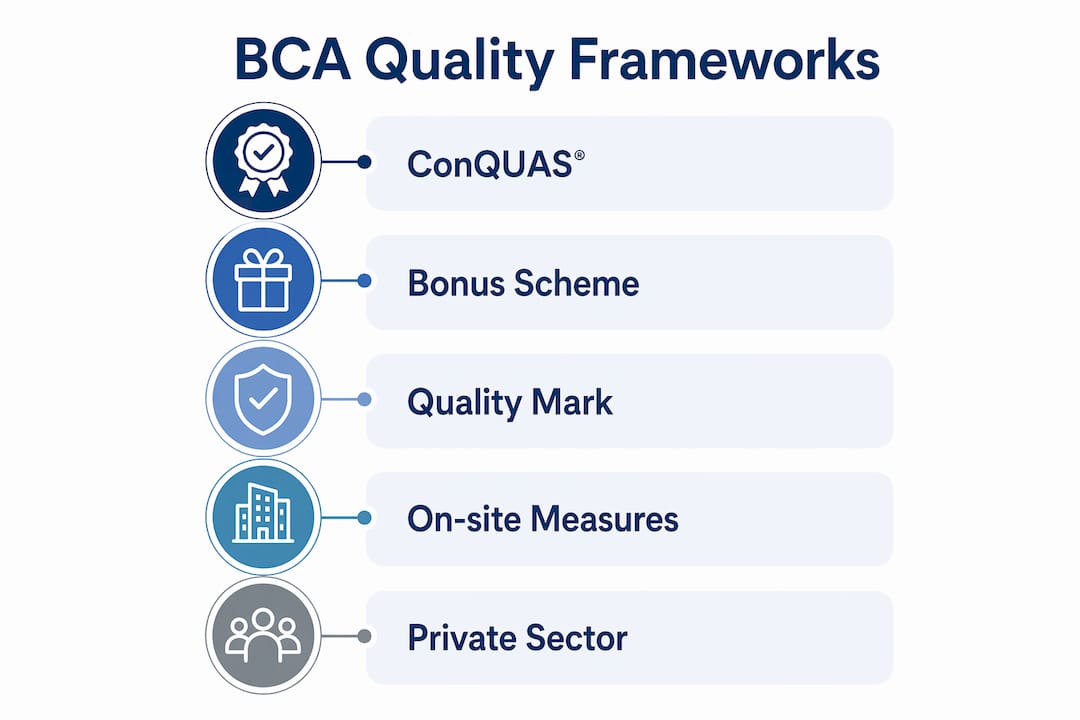
BCA’s quality assurance frameworks shift the focus from paperwork compliance to measurable workmanship outcomes on-site. This distinction matters because a project can satisfy documentation requirements while still producing substandard physical work. ConQUAS® closes that gap by assessing what is actually built, not merely what is submitted.
Pro Tip: For private residential developers, pursuing Quality Mark accreditation is not only a compliance signal. It is a marketing differentiator that directly addresses buyer concerns about defects and workmanship quality.
What role does CORENET X play in BCA’s approval processes?
CORENET X is BCA’s integrated digital submission platform, designed to consolidate building plan submissions and agency responses into a single coordinated workflow. Prior to CORENET X, developers and Qualified Persons were required to submit plans separately to multiple agencies, each operating on independent timelines and review processes. CORENET X replaces that fragmented approach with a unified system that routes submissions simultaneously to all relevant regulatory bodies.
The multi-agency coordination enabled by CORENET X includes BCA, URA, SCDF, and other statutory authorities, all reviewing submissions within the same platform. This integration reduces approval time by up to 20% compared to sequential agency submissions. For a large-scale development where approval delays translate directly into financing costs and program disruptions, a 20% reduction in approval time represents a material financial benefit.
The practical advantages of CORENET X for construction professionals include:
- Centralized submission tracking: All agency responses, queries, and approvals are visible in one location, reducing the risk of missed communications or overlooked conditions.
- Parallel agency review: Agencies review submissions concurrently rather than sequentially, compressing the overall approval timeline.
- Audit trail and transparency: Every submission, revision, and agency response is logged, providing a clear record for compliance verification and dispute resolution.
- Reduced duplication: Applicants submit project data once rather than reformatting and resubmitting to each agency separately.
Effective use of CORENET X requires clear communication and early coordination among all project stakeholders to avoid discrepancies that can stall the approval workflow. A submission that contains inconsistencies between the architectural and structural plans, for example, will generate queries from multiple agencies simultaneously, compounding delays rather than eliminating them. Preparation quality before submission determines whether CORENET X accelerates or complicates the approval process.
How can developers and professionals effectively obtain BCA approvals?
Obtaining BCA approval requires a structured approach that begins well before any formal submission is made. The process is governed by specific documentation requirements, statutory roles, and procedural timelines that professionals must understand to avoid costly delays. The BCA submissions process covers building plans, structural plans, and electrical approvals, each with distinct technical requirements and review criteria.
The following steps outline the standard pathway to obtaining BCA approval for a construction project in Singapore:
- Appoint a Qualified Person (QP). Only licensed architects and professional engineers registered under the relevant professional boards can submit building plan applications to BCA. The QP assumes statutory responsibility for the accuracy and compliance of all submitted documents.
- Prepare compliant documentation. Submissions must include architectural drawings, structural calculations, fire safety plans, and any specialist reports required by BCA or coordinating agencies. All documents must conform to the current edition of the BCA Approved Document and relevant codes.
- Submit through CORENET X. The QP submits all plans and supporting documents through the CORENET X platform, triggering simultaneous review by BCA and all relevant agencies.
- Respond to agency queries promptly. Agencies will issue technical queries or requests for additional information during the review period. Delayed responses extend the approval timeline proportionally.
- Obtain written approval before commencing work. No structural or regulated building work may commence until BCA issues written approval. Proceeding without approval constitutes a statutory offense under the Building Control Act.
Incomplete or non-compliant submissions can extend approval timelines from the typical two to four weeks to four to six weeks or longer. Beyond the time cost, non-compliant submissions increase the risk of stop-work orders and financial penalties once construction is underway. The most common causes of submission failure include incomplete structural calculations, missing fire safety coordination, and inconsistencies between architectural and engineering drawings.
Pro Tip: Conduct an internal compliance review against the Singapore construction compliance checklist before submitting to BCA. A pre-submission audit by an independent QP or consultant identifies gaps that would otherwise generate agency queries and delay approvals.
Only QPs can submit building plan applications and certify compliance for structural and MEP works. Developers who attempt to manage submissions without a properly appointed QP will find their applications rejected at the intake stage, regardless of the technical quality of the underlying design.
Key takeaways
The BCA’s regulatory authority, quality frameworks, and digital approval systems collectively define the compliance environment for every construction project in Singapore, and professionals who understand each layer operate with a measurable advantage.
| Point | Details |
|---|---|
| BCA’s statutory scope | BCA issues approvals, conducts inspections, enforces compliance, and coordinates with URA, SCDF, PUB, and LTA on all regulated projects. |
| ConQUAS® drives quality outcomes | The ConQUAS® system assesses on-site workmanship objectively, with financial bonuses and penalties tied to scores under the BSCQ scheme. |
| CORENET X reduces approval time | The integrated platform cuts approval timelines by up to 20% through parallel multi-agency review and centralized submission tracking. |
| QPs are legally required | Only licensed architects and professional engineers can submit building plan applications and certify compliance for BCA approvals. |
| Submission quality determines timelines | Non-compliant or incomplete submissions extend approval periods from two to four weeks to four to six weeks or longer, with added risk of stop-work orders. |
Why proactive compliance is the only viable strategy
From my experience working across BCA submissions, structural approvals, and multi-agency coordination in Singapore, the professionals who consistently deliver projects on time share one characteristic. They treat BCA compliance as a design constraint from day one, not as a final-stage review.
The introduction of CORENET X has changed the approval environment significantly. Parallel agency review means that a single inconsistency in your submission now generates queries from multiple agencies at the same time, rather than surfacing sequentially. Teams that used to catch errors during the back-and-forth of sequential submissions now face compressed timelines with less margin for correction. The platform rewards preparation and penalizes reactive approaches.
The ConQUAS® and BSCQ frameworks represent a shift I find genuinely significant. BCA has moved quality management from a documentation exercise to a financially consequential on-site assessment. Contractors who treat workmanship quality as a cost center rather than a performance metric will face penalties that erode project margins. Developers who understand this dynamic select contractors with demonstrated ConQUAS® track records rather than simply awarding on price.
The BCA Building Control Act updates introduced in 2025 reinforce this direction, placing greater accountability on developers and QPs for on-site compliance. My advice to any developer or construction professional in Singapore is to invest in early coordination with your QP, conduct pre-submission audits, and treat every BCA interaction as a professional obligation rather than an administrative hurdle. The projects that succeed under BCA’s regulatory framework are the ones where compliance is built into the process, not bolted on at the end.
— Aman
How Aman Engineering Consultancy supports BCA compliance
Navigating BCA’s regulatory requirements demands technical precision, statutory knowledge, and experience across multiple agency workflows. Aman Engineering Consultancy provides end-to-end support for property developers and construction professionals managing BCA submissions, structural approvals, and compliance certification in Singapore.
Aman Engineering’s team of licensed architects, professional engineers, and regulatory specialists handles building plan submissions, ConQUAS® preparation, CORENET X coordination, and multi-agency approvals across residential, commercial, and industrial projects. The firm’s engineering consultancy services cover the full project lifecycle, from pre-application feasibility through to final compliance certification. Developers seeking to reduce approval timelines and minimize compliance risk can access Aman Engineering’s structured submission process and regulatory expertise directly.
FAQ
What is BCA approval in Singapore?
BCA approval is the formal written authorization issued by the Building and Construction Authority confirming that submitted building plans comply with the Building Control Act and all applicable codes. No regulated construction work may commence without this approval.
Why is BCA approval required for construction projects?
BCA approval is required by law under the Building Control Act to verify that all proposed building works meet statutory safety, structural, and fire protection standards before construction begins. Proceeding without approval constitutes a statutory offense and can result in stop-work orders, fines, or demolition orders.
How long does it take to obtain BCA approval?
Standard BCA approval for compliant submissions typically takes two to four weeks. Incomplete or non-compliant submissions can extend this period to four to six weeks or longer, depending on the nature and volume of agency queries generated.
Who can submit building plans to BCA?
Only Qualified Persons, specifically licensed architects and registered professional engineers, are authorized to submit building plan applications to BCA and certify compliance for structural and MEP works.
What is ConQUAS® and how does it affect construction projects?
ConQUAS® is BCA’s national workmanship quality assessment system, introduced in 1989, which scores construction quality on-site. For public sector projects, ConQUAS® scores are directly linked to financial bonuses or penalties under the Bonus Scheme for Construction Quality, making workmanship performance a commercially significant metric.