
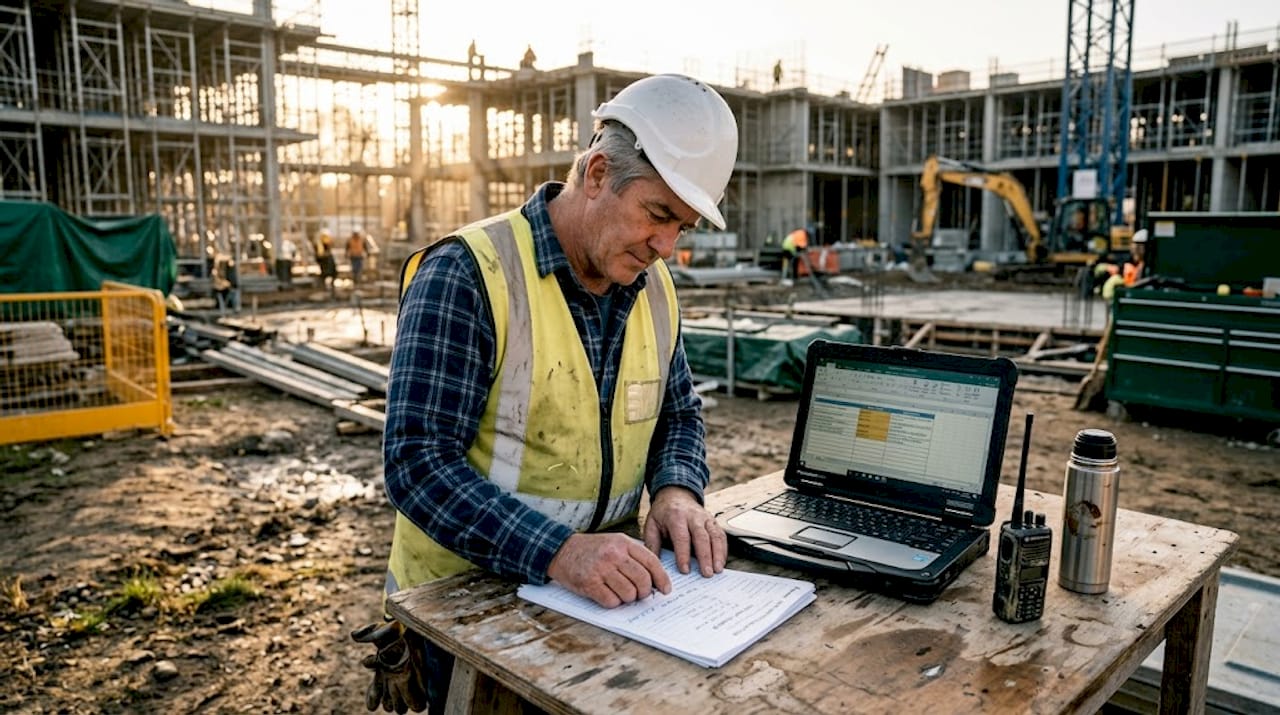
Treating a risk assessment in construction as a form to file and forget is one of the most persistent and dangerous errors in the industry. These documents are not static compliance artifacts. They are operational tools that, when maintained correctly, directly reduce fatalities, project delays, and regulatory liability. Modern risk assessment has become the spine of operational risk programs, scrutinized by boards, lenders, and ESG agencies with increasing rigor. This guide covers definitions, legal context, step-by-step processes, advanced methodologies, and the integrity standards that separate defensible assessments from checkbox exercises.
Table of Contents
- Key Takeaways
- What risk assessment in construction really means
- Step-by-step process for conducting site risk assessments
- Modern tools and methodologies for construction risk evaluation
- Top hazards to prioritize in construction risk registers
- Best practices for maintaining assessment quality and integrity
- My perspective on where construction risk practice is heading
- How Aman Engineering Consultancy supports your risk program
- FAQ
Key Takeaways
| Point | Details |
|---|---|
| Risk assessments are living documents | Review frequency must align with project complexity and be updated when site conditions change. |
| Hierarchy of controls drives effectiveness | Elimination and substitution must be attempted before relying on administrative controls or PPE. |
| Non-engineering risks carry significant weight | Inflation and statutory delays produce a higher overall risk impact than most on-site engineering hazards. |
| Critical controls require active verification | Each control barrier needs assigned ownership, regular verification, and a degraded-state response plan. |
| Integrity cannot be assumed | Commercial pressure and documentation fraud are documented threats that require independent scrutiny and digital traceability. |
What risk assessment in construction really means
Risk assessment in construction is the structured process of identifying hazards present on or around a building site, evaluating the likelihood and severity of harm those hazards could cause, and implementing controls to reduce that risk to an acceptable level. The process applies across all project phases, from demolition and excavation through to final commissioning and handover.
Construction sites carry a concentration of hazards that few other work environments match. Workers operate at height, in confined spaces, near energized equipment, and alongside heavy plant. Subcontractor interfaces introduce additional layers of exposure. Understanding what risk assessment means in this context requires clarity about both its technical definition and its legal obligation.
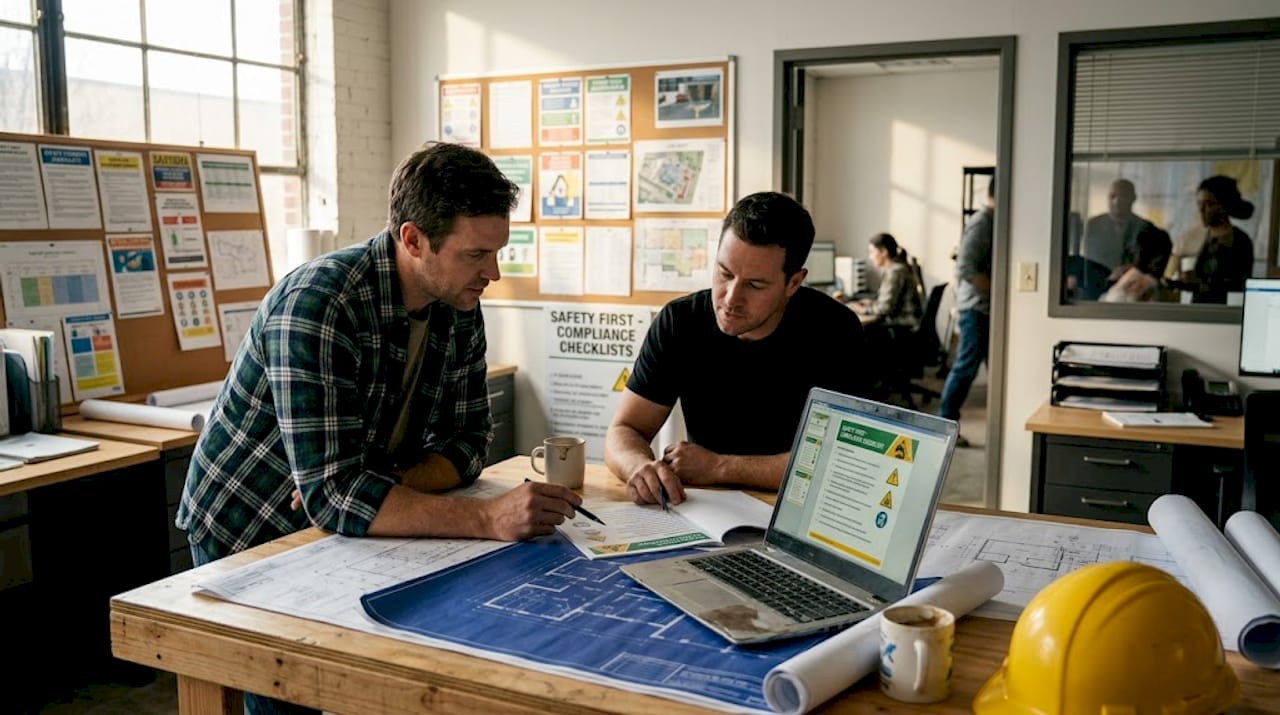
Legal frameworks governing construction risk assessments
Several regulatory frameworks define the minimum standards for risk assessment practice:
- OSHA 29 CFR 1926: The U.S. standard for construction safety, requiring written hazard assessments for personal protective equipment selection and site-specific safety plans.
- CDM Regulations 2015 (UK): Requires principal designers and principal contractors to systematically manage and coordinate health and safety risks from concept through to completion.
- ISO 45001:2018: The international occupational health and safety management standard, setting requirements for hazard identification, risk assessment, and determination of controls.
- Singapore WSH Act and Regulations: Applicable to projects managed within Singapore’s jurisdiction, requiring documented risk assessments for all construction activities.
Each framework assigns specific responsibilities to designers, contractors, project managers, and safety officers. The role of risk assessment in construction under these frameworks is not advisory. It is a legal obligation with enforceable consequences.
Step-by-step process for conducting site risk assessments
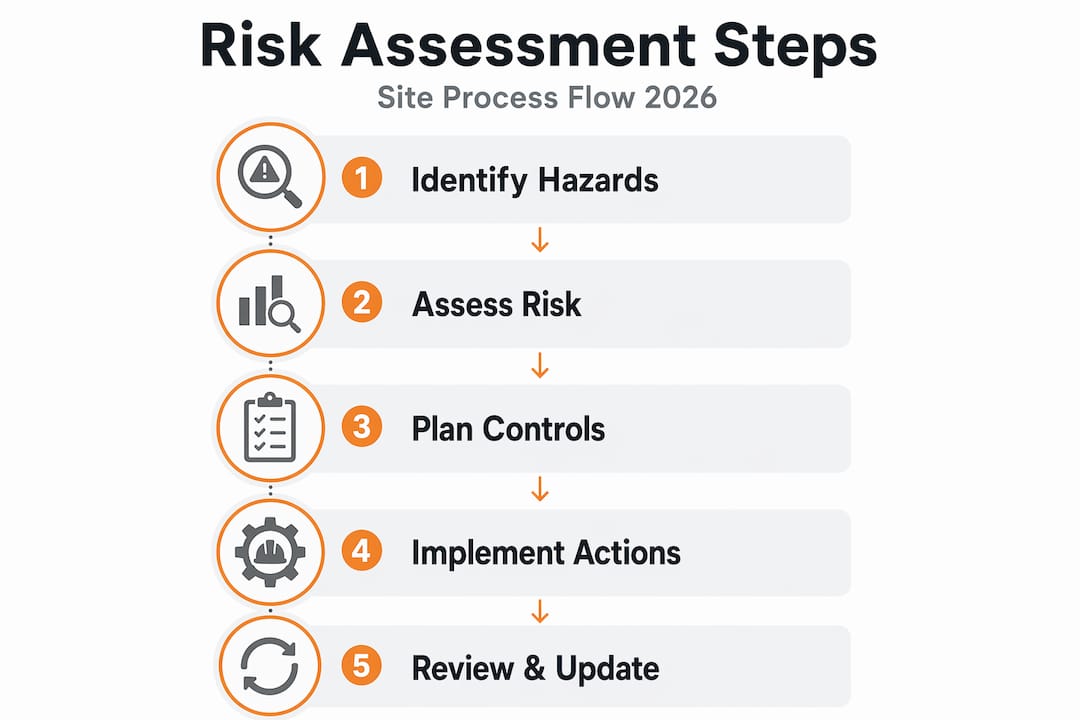
A defensible, operationally useful construction risk assessment follows a structured sequence. Deviation from this sequence typically produces assessments that are either incomplete or impossible to verify after the fact.
-
Identify hazards through systematic site review. Conduct structured walkarounds before work begins, review previous incident reports, consult with frontline workers, and examine manufacturer documentation for plant and materials. Engage workers directly since they frequently identify hazards that desk-based reviews miss entirely.
-
Determine who is at risk and how. Consider all persons on site, including subcontractors, visitors, inspectors, and adjacent members of the public. Account for varying levels of competence and familiarity with the site environment.
-
Evaluate likelihood and consequence using a risk matrix. A standard qualitative matrix plots severity against probability across a scale, typically from negligible to catastrophic, allowing practitioners to prioritize which hazards demand immediate attention and which can be monitored.
-
Apply the hierarchy of controls in sequence. The hierarchy moves from elimination (removing the hazard entirely) through substitution, engineering controls, administrative controls, and finally personal protective equipment. PPE is the last line of defense, not the primary response.
-
Document findings clearly with assigned ownership. Each identified risk must have a named responsible party, a defined control measure, and a target completion or review date. Vague entries like “take care” or “be aware” carry no operational value and no legal weight.
-
Schedule reviews based on project phase and complexity. Dynamic, risk-based review cycles that incorporate real-time data such as near-miss reports and inspection findings represent current best practice. A risk assessment completed at project inception and never revisited is a liability, not a safeguard.
Pro Tip: Link your risk assessment review schedule directly to project milestone dates. When scope, sequencing, or subcontractor interfaces change, trigger an immediate review rather than waiting for the next scheduled cycle.
Building a consistent process for risk assessment registers allows project teams to track control status, ownership, and review history in a single auditable record.
Modern tools and methodologies for construction risk evaluation
The methodologies available for building site risk analysis have evolved substantially. Practitioners who rely solely on generic checklists are working well below the standard now expected on major projects.
Qualitative and quantitative frameworks in use
- HAZID (Hazard Identification) workshops: Structured team sessions that systematically examine each project activity or system to identify credible hazard scenarios before construction begins.
- Bowtie analysis: A visual method that maps the causes and consequences of a top event, then identifies the barriers that prevent escalation on either side. The combined use of HAZID and Bowtie techniques provides a rigorous framework for focusing controls on major accident hazards.
- Job Safety Analysis (JSA): A task-level method that breaks each work activity into steps, identifies the hazard at each step, and assigns a specific control. JSA is particularly effective for non-routine and high-risk tasks.
- Layer of Protection Analysis (LOPA): A semi-quantitative method used to verify that enough independent protection layers exist to reduce a scenario to an acceptable risk level. Typically applied to high-consequence scenarios where qualitative assessment alone is insufficient.
Digital tools and real-time data integration
| Capability | Traditional approach | Modern digital approach |
|---|---|---|
| Risk register maintenance | Paper or static spreadsheet | Cloud-based, real-time dashboard with mobile access |
| Control verification | Periodic manual audits | Automated check prompts with digital sign-off trails |
| Near-miss integration | Manual incident log review | Automated flagging linked to relevant risk entries |
| ALARP demonstration | Narrative statements | Evidence-based cost-benefit analysis with audit trail |
| Review triggering | Calendar-based | Event-driven, linked to site data and incident feeds |
Static, one-time documents fail to capture evolving hazards on active construction sites. Digital tools integrated into daily pre-task talks and safety briefings correct this. Risk assessments are increasingly expected to demonstrate ALARP through evidence-based cost-benefit analysis of controls, not just narrative statements.
Major projects also incorporate financial buffers as part of risk management. Cost contingencies of up to 15% for known unknowns and management reserves reaching 40% for unknown unknowns reflect how formally project risk translates into financial planning.
Pro Tip: When selecting digital risk management software, prioritize platforms that generate tamper-evident audit logs. Secure record systems are a primary defense against the documentation fraud that is increasingly documented across the construction sector.
Top hazards to prioritize in construction risk registers
Recurring hazards dominate critical control lists across bowtie analyses and major incident investigations. Any thorough risk evaluation in construction must address these categories with specific, verifiable controls rather than generic statements.
| Hazard category | Typical consequence | Priority control measures |
|---|---|---|
| Working at height | Fatal or serious falls | Edge protection, fall arrest systems, permit-to-work |
| Falling objects | Head injury, fatality | Exclusion zones, toe boards, secured tool lanyards |
| Scaffold failure | Multiple fatalities | Independent scaffold inspections, tagged and certified systems |
| Electrocution | Cardiac arrest, fatal burns | Service detection surveys, isolation procedures, insulated tools |
| Struck by vehicle | Severe injury or death | Segregated pedestrian routes, banksman controls, speed limits |
| Confined space entry | Asphyxiation, explosion | Atmospheric testing, rescue standby, entry permits |
One factor that practitioners frequently underweight in construction risk management is the impact of non-engineering risks. Research shows that non-engineering risks, including inflation and statutory approval delays, produce an Overall Risk Index of 0.441 compared to 0.401 for engineering risks. This means that project risk registers which focus exclusively on physical site hazards are structurally incomplete.
Statutory compliance risks, such as delays from agency approvals or scope changes triggered by regulatory review, must appear in the risk register with defined mitigation strategies. Understanding how professional engineers manage compliance with regulatory requirements is directly relevant to controlling this category of risk.
Best practices for maintaining assessment quality and integrity
The quality of a construction safety assessment deteriorates rapidly without active maintenance. The following practices distinguish organizations that maintain genuinely effective risk programs from those that accumulate documentation without operational impact.
-
Make the risk register a working document, not an archive. Schedule reviews at defined project milestones and trigger unscheduled reviews whenever scope, method, or subcontractor interfaces change. Frequency should scale with project complexity.
-
Involve frontline workers in hazard identification. Involving the frontline workforce and making controls specific to actual site conditions improves both the relevance of the assessment and worker compliance with the controls identified.
-
Apply critical-control verification with defined cadence. Effective assessments verify that critical controls remain in place and functioning, and maintain plans for degraded states where a control has failed or been bypassed. Each control must have an owner.
-
Maintain independent scrutiny against commercial pressure. Erosion of assessment integrity due to commercial pressure and falsified documentation is a documented and serious risk in the construction sector. Professional curiosity and independent review are the primary defenses.
-
Use digital traceability to protect documentation integrity. Digital traceability and secure record systems are now considered critical countermeasures against the increasing normalization of fraud in construction assessment and certification.
Pro Tip: Treat any risk assessment that has not been updated since project inception with the same skepticism you would apply to an unverified structural calculation. The absence of an update record is itself a red flag worth investigating.
Tracking leading KPIs alongside the risk register strengthens the overall program. Leading indicators including TRIR, LTIFR, dropped object rates, near-miss reporting ratios, and critical control verification completion rates provide objective evidence of whether the assessment is driving actual risk reduction or simply satisfying a filing requirement.
You can review project planning guidance for 2026 for additional context on integrating risk management into construction program delivery.
My perspective on where construction risk practice is heading
I have reviewed risk assessments across a wide range of project types, from small commercial fit-outs to major infrastructure developments, and the pattern is consistent. The documents that get people hurt are not the ones with obvious errors. They are the ones that looked acceptable on paper, were filed, and were never looked at again.
The industry’s shift toward digital tools and real-time data integration is genuinely positive, but technology does not fix a culture problem. I have seen organizations implement sophisticated risk dashboards while their frontline supervisors remain unaware that a risk register exists. The tool is only as effective as the discipline behind it.
What concerns me most in 2026 is the documented normalization of fraudulent assessment practices. Professional competence cannot be assumed from certificates alone. Active oversight and a culture of genuine inquiry are necessary, and commercial timelines create systematic pressure to shortcut both. Project managers and safety officers need to treat independent scrutiny of their own assessments as a professional obligation, not an inconvenience.
The organizations producing the best outcomes are the ones that treat risk assessment as an operational discipline with real accountability. They do not wait for an incident to tell them their controls have degraded.
— Aman
How Aman Engineering Consultancy supports your risk program
For construction professionals and project managers who need rigorous, audit-ready risk management support, Aman Engineering Consultancy delivers structured consultancy across the full project lifecycle.

Aman Engineering Consultancy provides risk assessment registers, statutory compliance support, and project management services aligned with BCA, URA, SCDF, and LTA requirements in Singapore. The firm’s BIM modeling services support hazard visualization and control integration at the design stage, where intervention is most cost-effective. For projects requiring structured value optimization alongside risk management, Aman’s value engineering services provide a rigorous, documented framework. Contact Aman Engineering Consultancy to discuss how professional risk management support can be structured for your specific project requirements.
FAQ
What is risk assessment in construction?
Risk assessment in construction is the formal process of identifying site hazards, evaluating the likelihood and consequence of harm, and implementing controls to reduce risk to an acceptable level. It is legally required under frameworks including OSHA, CDM 2015, and ISO 45001.
How often should construction risk assessments be reviewed?
Reviews should align with project complexity and be triggered by scope changes, phase transitions, near-miss events, or subcontractor interface changes. Dynamic, event-driven review cycles are considered current best practice rather than fixed calendar intervals.
What are the most critical hazards in a construction risk register?
The top recurring hazards are working at height, falling objects, scaffold failure, electrocution, struck-by-vehicle incidents, and confined space entry. Each requires specific, verifiable control measures rather than generic precautionary statements.
Why do construction risk assessments lose effectiveness over time?
Static assessments that are not updated as site conditions evolve fail to reflect current hazards and controls. Integrity erosion driven by commercial pressure and, in documented cases, falsified records, are additional factors that reduce real-world effectiveness.
How do non-engineering risks affect construction project risk assessments?
Non-engineering risks such as statutory approval delays and inflation carry an Overall Risk Index of 0.441, exceeding the 0.401 recorded for engineering risks. Project risk registers must include these categories with defined mitigation strategies to present a complete risk picture.