
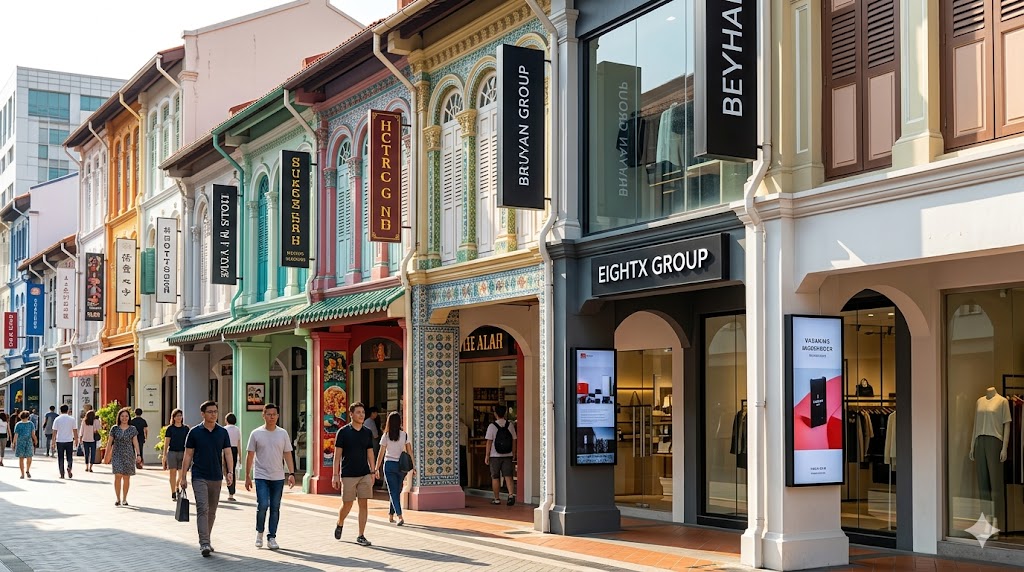
Does Your Business Signage Need BCA Approval? A guide to the Outdoor Advertising Signage license
Introduction to Singapore Business Signage Regulations
Outdoor business signage forms the visual identity of any commercial enterprise. Therefore, proper signage is critical for achieving maximum brand visibility. However, installing signage in Singapore requires strict regulatory compliance. The Building and Construction Authority enforces these rules very strictly.1 Consequently, business owners must understand the regulatory landscape thoroughly. This ensures seamless operations and avoids costly government penalties.
Does your business signage need BCA approval? The short answer is yes. Almost all outdoor signs require a formal license.2 This includes permanent signboards, temporary banners, and digital billboards.2 Furthermore, multiple government agencies govern these physical installations. The Urban Redevelopment Authority manages visual aesthetics and historical conservation.2 Meanwhile, the Singapore Civil Defence Force oversees strict fire safety.3 Additionally, the Land Transport Authority regulates street-facing promotional banners.4
This comprehensive guide details the BCA outdoor advertising signage license. It explores application processes, fee structures, and technical structural requirements. Furthermore, it examines specific zoning laws across different districts. Therefore, businesses can navigate the Advertisement Licensing System efficiently.1 Understanding these rules prevents frustrating application rejections. Moreover, it protects businesses from subsequent legal complications and fines.
Defining Outdoor Signage Under BCA Guidelines
The Building and Construction Authority defines outdoor signage precisely.5 You must apply for a license for outdoor displays.1 What exactly qualifies as an outdoor commercial space? Firstly, it includes any roofed space not fully enclosed.1 Secondly, the space must facilitate general pedestrian traffic flow.1 Alternatively, the physical space must be publicly accessible.1
Therefore, signs facing external public walkways fall under this category. The regulations distinguish between two primary commercial sign categories.5
Advertisements Versus Business Signboards
Understanding the difference between signboards and advertisements is crucial. Signboards relate directly to the physical business premises.4 They display the business name or official occupant details.4 Furthermore, they may show operating hours or provided services.4 A signboard may include identifying logos and symbols.4 It can also contain necessary written directions or legal cautions.4 However, signboards cannot promote external third-party brands.4
Conversely, advertisements promote specific external goods or commercial services.5 This includes logos and visual devices for third-party brands.5 Animated billboards displaying moving pictures fall under this category.4 Directional signs guiding vehicular traffic also require advertisement licenses.4 Both categories require the BCA outdoor advertising signage license.4
Prohibited Outdoor Signage Types
Certain signage types are strictly prohibited across Singapore. The authorities aim to prevent unsightly urban streetscapes.1 Therefore, flickering or flashing lights are largely banned.6 However, specific entertainment belts like Orchard Road are exempt.6 Bras Basah, Bugis, and Chinatown also permit animated lights.6
Furthermore, free-standing structures cannot display external brand advertisements.6 Building signs extending above roof parapets are entirely illegal.6 Additionally, signs on public infrastructure are strictly prohibited.6 This includes MRT columns and transit station entrances.6
Signs are also banned on all residential buildings.6 Mixed-use buildings cannot have signs on residential components.6 Finally, signs over expressways and traffic islands are illegal.6 Signs are banned inside water catchment areas and reserves.6 Coastlines and vacant lands also prohibit commercial advertisement displays.6
Complete Exemptions from BCA Licensing
Not every commercial sign requires a formal government license. The government provides specific exemptions for low-impact displays.6 Therefore, businesses should check these exemptions before applying online.
The Five Square Metre Rule
The most common exemption applies to small business signboards. A single signboard under five square metres requires no license.6 Alternatively, a series of related signboards can be exempt.6 However, their total aggregate area must remain under five square metres.6
Importantly, this is a one-time exemption per business premise.6 Furthermore, this exemption strictly applies to signboards only.6 It does not apply to third-party advertisement signs.6 To claim this, applicants must submit a formal declaration.5
Institutional and Public Exemptions
Various public and institutional entities enjoy total licensing exemptions. Religious bodies do not need licenses for their signboards.6 Similarly, government-aided schools operate under this exact exemption.1 Furthermore, charitable healthcare facilities are completely exempt.1 This includes hospitals, clinics, and hospices run by charities.1 Nursing and welfare homes also bypass these licensing requirements.1
Additionally, specific public locations are exempt from signage licenses. Signs displayed within hawker centres require no regulatory approval.6 Furthermore, signs in food markets are fully exempt.6 Underpasses, tunnels, and MRT stations also bypass these requirements.1 Finally, election posters follow separate parliamentary acts during campaigns.6
The Advertisement Licensing System Application Process
For signs requiring approval, the process happens entirely online. The Advertisement Licensing System manages all formal applications.1 Furthermore, this portal handles preliminary consultations and fee payments.1
Singpass Login and Account Creation
Accessing the Advertisement Licensing System requires a Singpass account.7 Individual users can log in using their personal Singpass.7 Consequently, no Corppass account is necessary for individuals.7 Conversely, business users require a UEN-registered Corppass account.7
Third-party individuals can register on behalf of a company.6 However, they must produce a formal company authorization letter.6 This authorized individual becomes the official contact person.6 The BCA will liaise exclusively with this contact person.6 Nevertheless, the approved license is issued to the final applicant.6
Consultation Versus Formal Application
The application process features two distinct assessment phases. Firstly, applicants must submit a proposal for consultation.1 The Building and Construction Authority evaluates this initial proposal.1 Evaluation typically takes seven to fourteen working days.1
If URA evaluation is required, it takes an additional two weeks.1 During consultation, authorities check compliance with urban guidelines.6 If the design complies, they grant an in-principle no objection.6 Subsequently, the applicant converts the consultation into a formal application.6
The system offers an auto-convert feature for maximum convenience.6 If selected, successful consultations automatically become formal applications.6 This eliminates manual steps and accelerates the approval timeline.6 Importantly, no design edits are permitted after formal submission.6 Editing is strictly prohibited once a consultation is submitted.6
Mandatory Submission Documents
Comprehensive documentation is vital for a successful application. Incomplete submissions lead directly to frustrating project delays.6 All files must use specific formats like PDF or JPG.1 Word documents and ZIP files are also fully acceptable.1
The required technical drawings must detail the installation perfectly.5
| Document Type | Purpose and Detail Requirements |
| Front Elevation Plan | Shows display location on the building facade with dimensions. 1 |
| Side Section View | Details fixing methods, installation materials, and structural depth. 1 |
| Site Plan | Displays sign location relative to roads and adjacent buildings. 1 |
| Superimpose Visuals | 3D mockups showing the final sign position and artwork. 1 |
| Declaration Form | Confirms eligibility for the five square metre exemption. 1 |
Furthermore, the authorities require strict endorsement protocols for drawings. The landlord and tenant must endorse all technical drawings.1 A company director must sign and stamp every single page.1 Failure to secure these signatures results in outright rejection.9
Landlord, MCST, and Town Council Approvals
Government approval is only one part of the equation. Applicants must secure private consents before submitting BCA applications.9 Missing these private approvals will stall the entire government review.9
Landlord Consent and Fit-Out Manuals
Commercial leases dictate strict rules for external property alterations.9 Therefore, landlords require written approval for any new signage.9 Landlords usually issue detailed fit-out manuals to commercial tenants.9 These manuals restrict aesthetic choices to maintain building branding.9
For example, signage must conform to the brand palette.9 Furthermore, landlords often cap the maximum overall length per bay.9 They enforce specific letter height ceilings for all tenants.9 On historic streets, landlords may demand subtle matte finishes.9
Exposed electrical cables are strictly prohibited by building management.9 Additionally, landlords demand IP-rated lighting to prevent electrical hazards.9 They also enforce dimming schedules to control nighttime glare.9 For example, signs must turn off after 22:00 hours.9 Heavy signs over 15 kilograms require engineering endorsements.9
Management Corporation Strata Title Rules
Strata-titled properties rely on the Management Corporation Strata Title.9 The MCST acts as an independent approval track.9 Their primary goal is maintaining uniform property appearance.9 Furthermore, they safeguard emergency access routes and building services.9
MCST restrictions are often tighter than national regulations. They commonly enforce maximum height limits around 600 millimetres.9 Additionally, signs cannot project more than 150 millimetres outwards.9 Lighting rules require non-flashing illumination between 3000 and 4000 Kelvin.9
Crucially, MCSTs strictly ban drilling into structural building beams.9 Installers must use pre-designated architectural anchor points.9 Substrates must be fully fire-rated and feature non-glare finishes.9 All documents must be clearly endorsed by the MCST.6
Town Council and HDB Commercial Guidelines
Signs on commercial units managed by Town Councils require consent.5 If the applicant is the owner, the Town Council must approve.5 If the applicant is a tenant, three signatures are needed.5 The Town Council, lot owner, and landlord must provide consent.5
The Housing and Development Board regulates shop renovations tightly.10 Any installation outside the shop requires prior Town Council approval.11 Retractable awnings and LPG fixtures fall under these rules.10 Furthermore, electrical loads must not exceed the approved building supply.10
The outdoor display area must match the shop’s trade.12 Goods must be kept inside after business hours end.12 Subletting the outdoor display area is strictly prohibited.12 Certain trades are entirely prohibited in HDB civil defence shelters.13 This includes second-hand goods, shoes, and clothing accessories.13 Tuition centres and video libraries are also banned there.13
The HDB Home Office scheme has specific regulatory rules.14 Home offices require specific fire safety equipment for compliance.14 You must purchase a 2kg ABC dry chemical extinguisher.14 A single-station battery-operated smoke detector is also mandatory.14
Structural Requirements and Permit To Use
Large structural signs carry inherent structural and safety risks. Consequently, the authorities impose rigorous structural engineering requirements.1 A simple BCA outdoor advertising signage license is insufficient here.1
Triggering the Permit To Use Requirement
A Permit To Use is a mandatory prerequisite for large signs.4 The final sign license cannot be granted without this permit.4 Two distinct criteria trigger this strict legal requirement.4
Firstly, it applies if the advertising signage exceeds 10 square metres.1 Secondly, it applies if the structure exceeds 10 square metres.1 Furthermore, the height of the structure is closely monitored.1 If the highest point sits 4 metres above ground, permits apply.4 This measurement includes the frame, panel, and support mechanisms.4
The CORENET Submission Process
Applying for a Permit To Use requires highly specialized expertise.4 A Professional Engineer must handle the entire permit application.4 The engineer assesses load paths, fixings, and structural integrity.9
The engineer submits the application via the CORENET e-Submission System.4 This system handles all complex building plan approvals in Singapore.4 The validity period of the permit is critically important.4 It must cover the entire duration of the sign display.4
If the permit expires before the display period ends, rejection occurs.4 Therefore, applicants must align their permit and license timelines perfectly.4
| Structure Type | Permit To Use Annual Fee |
| General Advertising Structure | $120 per structure. 6 |
| Temporary Building (Measurable Area) | $200 for every 100 square metres. 4 |
| Temporary Building (No Measurable Area) | $200 per structure. 4 |
Professional Engineer certification is also required for large banners.4 Banners exceeding 10 square metres displayed with bars need certification.4 Any banner exceeding 30 square metres requires engineering endorsement.4
Urban Redevelopment Authority Guidelines
The Urban Redevelopment Authority guides the aesthetic location of outdoor signs.15 Their guidelines prevent streets from becoming visually cluttered.15 Consequently, they divide the Central Area into distinct regulatory districts.15
Zoned Advertising Routes
Commercial advertisements are strictly channeled to high-activity corridors.15 These areas benefit from high pedestrian traffic and street vibrancy.15 Designated signage routes include Orchard Road and Chinatown.15 Furthermore, Bras Basah, Bugis, and the Singapore River are approved zones.15
Conversely, outdoor advertisements are banned outside these specific areas.15 They are not allowed in financial districts or residential zones.15 This zoning protects the unique character of civic and business districts.15
Applicants can verify their location using the interactive URA Space Map.4 This centralized portal provides access to urban design guidelines.4 Users can view detailed control plans and conservation maps.4 The portal features advanced layers, legends, and location filters.4 It also includes drawing tools to mark specific boundaries.4
Strict Conservation Area Rules
Conservation areas in Singapore face the most stringent design controls.9 Signage must respect the historical facade, scale, and traditional materials.9 Consequently, modern bright light boxes are generally not approved here.9
Original architectural features and original building dates cannot be removed.16 Traditional signs must be retained if they hold historical significance.16 Plaster relief signs on columns are considered cultural history.16
Specific guidelines apply to Little India and Jalan Besar.17 The entire building must be conserved in these historic districts.17 Tiong Bahru conservation areas share identical stringent detailed controls.17
New signs on shophouses must follow precise mounting rules.16 For residential fronts, signs mount entirely within the transom panel.16 They must not exceed the width of the entrance door.16 Signs projected from a first-storey column must sit on the left.16 Furthermore, their width cannot exceed 600 millimetres.16 They need a minimum headroom clearance of 2500 millimetres.16 Upper storey signs can project from pilasters under similar constraints.16
All conservation signage proposals go directly to the Advertisement Licensing Section.16 However, URA offers a premium service for fully compliant proposals.16 For a $40 fee, submissions are processed immediately on the spot.16
Detailed Licensing Fee Structures
Securing a BCA outdoor advertising signage license involves specific financial costs.18 The authorities calculate fees based on sign type and physical dimensions.6
Signboard License Fees
Signboards enjoy the lowest regulatory fee structures.4 The initial five square metres are often exempt for businesses.6
| Signboard Size Criteria | Annual Fee Rate |
| Up to 15 square metres | $50 flat fee per license. 6 |
| Above 15 square metres | $20 per square metre in excess of the 5sqm exemption. 6 |
Advertisement and Directional Sign Fees
Advertisements and directional signs face tiered pricing based on total area.6
| Advertisement Size Criteria | Annual Fee Rate |
| Up to 1 square metre | $20 per sign. 6 |
| Above 1 to 5 square metres | $90 per sign. 6 |
| Above 5 to 10 square metres | $140 per sign. 6 |
| Above 10 square metres | $20 per square metre or part thereof. 6 |
Specialized Display Fees
Animated billboards and balloon signs incur the highest regulatory fees.18 An animated billboard up to 10 square metres costs $225 annually.6 If it exceeds 10 square metres, the fee becomes $30 per square metre.6 Meanwhile, sky signs and balloon signs cost $40 per square metre.6
Fees are pro-rated for licenses valid for less than one year.19 However, a minimum fee of $20 always applies.19 Furthermore, any fraction of a month is rounded to a full month.6 The license expiry date defaults to the second-to-last month’s end.6
Payment Processing and License Renewals
The Building and Construction Authority mandates strict electronic payment methods.4 Cheque payments are completely phased out and no longer accepted.4 Cash payments over the counter are also strictly prohibited.6
Accepted Payment Methods
Applicants must process payments through the Advertisement Licensing System.4 The system provides quick links for instant fee settlement.4 Accepted electronic modes include eNets and major credit cards.4
Furthermore, applicants can utilize PayNow for seamless mobile transactions.4 The required PayNow proxy is T08GB0005B101 for BCA.4 Internet bank transfers directly to the BCA current account are permitted.4 Upon successful transfer, users submit a payment notification via a government link.4
Auto-Renewal and GIRO Setup
Annual auto-renewal is highly recommended for permanent business signage.4 GIRO payment setup is strictly compulsory for this auto-renewal service.4 Applicants set up this mandate via an online FormSG application.4
For participating banks, users utilize the rapid eGIRO application option.4 This digital process guarantees approval within 48 hours.4 Conversely, non-participating banks require hardcopy GIRO application forms.4 Processing physical forms can take up to two months.4 Therefore, applicants must plan their renewals well in advance.4
Importantly, auto-renewal only applies to licenses valid for a full year.6 Short-term licenses require manual renewal requests subject to commissioner approval.6 Furthermore, signage license ownership is strictly non-transferable.4 New business owners must submit completely new applications.4
License cancellation is processed easily via the ALS portal.4 Users can also retrieve past records and drawings online.4 A non-refundable search fee of $20 applies for each search.4 Retrieving a license copy costs $5, while drawings cost $25.4
Building Control Regulations for Outdoor Advertising
The Building Control Regulations dictate physical dimensions and clearance heights.4 These rules ensure signs do not endanger pedestrians or vehicular traffic.4 The Commissioner of Building Control enforces these strict parameters.4
Signs installed over public footpaths must meet specific elevation requirements.4 They must be elevated at least 2.5 metres above the footpath.4 Similarly, signs projecting over a street drain require a 2.5-metre clearance.4
Projection limits depend heavily on the sign’s vertical placement.4 If a sign is between 3.75 and 5 metres high, restrictions apply.4 It cannot project more than 60 centimetres from the building line.4 However, if the sign is 5 metres or higher, rules relax slightly.4 It may project up to 1.5 metres from the street line.4
These dimensional regulations prevent structural collisions with large utility vehicles.4 The Commissioner of Building Control holds authority to issue removal orders.4 Displaying non-compliant signs makes the exhibitor liable for immediate prosecution.4
JTC Industrial Estate Signage Guidelines
Industrial estates operated by JTC Corporation have unique signage requirements.20 JTC was established in 1968 to develop Jurong Industrial Estate.20 It now administers the bulk of Singapore’s industrial and logistics land.20 Zoning categories include Business 1, Business 2, and Business Park.20 Achieving compliance here is essential for large manufacturing facilities.21
JTC strictly prohibits the duplication of signage along the same facade.22 This prevents visual clutter in heavy industrial manufacturing zones.22 Furthermore, JTC enforces strict mathematical ratios for sign dimensions.22 The combined signage height is capped at 1:15 of the building height.22 Additionally, the combined width cannot exceed one-third of the facade length.22
Signs must be placed against a contrasting background for visibility.22 All metal struts and brackets must be completely concealed from public view.23 The National Environment Agency also monitors industrial zone pollution codes.21 Furthermore, written consent from JTC or the Singapore Land Authority is mandatory.24 Fees may apply for the granting of this official consent.24
LTA Guidelines for Public Lampposts and Banners
Displaying vertical banners on public street lampposts requires LTA approval.4 This route is highly restricted and heavily regulated.4 Banners are generally permitted only for national events or major festivals.4
Specific Application Precincts
The application routing depends entirely on the requested geographical precinct.4 For the Civic District, applications go to the National Arts Council.4 Conversely, the Orchard Precinct routes through the Singapore Tourism Board.4 All other locations require direct application to the Land Transport Authority.4
Applicants can only book spaces three months before the display date.4 The maximum permitted display duration is strictly one month.4 Furthermore, banners are completely prohibited on all expressways and flyovers.4
Design and Printing Specifications
The banner design must prioritize event information over commercial branding.4 The event name and venue must cover at least 50% of the space.4 Conversely, sponsor names and logos are strictly capped at 15%.4 The supporting government agency logo must appear at the bottom.4
Commercial call-to-action messages and ticket prices are entirely prohibited.4 Additionally, designers cannot use cursive fonts or vertical text orientations.4 Banners mimicking traffic signs or traffic lights will face immediate rejection.4 Content must conform to the Advertising Standards Authority of Singapore guidelines.4 Printing must utilize high-grade techniques to prevent outdoor fading.4
Technical Dimensions and Installation Rules
LTA mandates exact technical dimensions based on the specific lamppost type.4
| Lamppost Pole Type | Maximum Banner Dimensions |
| Galvanised Pole (Single Arm) | 2.2 metres by 0.85 metres (Single-sided) 4 |
| Galvanised Pole (Double Arm) | 0.85 metres by 0.85 metres (Single-sided) 4 |
| Civic District Poles | 3 metres by 0.75 metres (Double-sided) 4 |
| Smart Pole (Road Group A) | 3 metres by 0.6 metres (Single-sided) 4 |
Installation processes are governed by strict safety protocols.4 Workers must maintain a 2.4-metre height clearance above pedestrian walkways.4 Furthermore, banners must sit 600 millimetres away from the road kerb.4
Drilling or welding onto public posts is strictly illegal.4 Installers must use PVC-sleeved U-clamps to secure the banners.4 Installation and dismantling can only occur between midnight and 0600 hours.4 Temporary traffic warning signs must be deployed during the installation.4 Dismantling must finish within 48 hours after the display ends.4
SCDF Fire Safety Regulations for Signage
The Singapore Civil Defence Force monitors fire safety for all installations.25 Signage cannot compromise building evacuation routes or fire safety equipment.25 Compliance with the Fire Code is an absolute necessity.25
Clearances and Evacuation Routes
Temporary indoor exhibition signs face strict spatial limitations.3 SCDF mandates a minimum 1.2-metre clear passageway on all evacuation routes.3 Display structures must never reduce this critical emergency pathway.3 Furthermore, maximum indoor booth height is strictly capped at 3 metres.3 Booth blocks cannot exceed 15 metres in length.3
Signs must never obstruct fire shutter tracks or emergency corridors.3 Fire shutters must close seamlessly within a 30-second window upon activation.3 Obstructing these mechanisms triggers severe legal and financial penalties.3
Emergency Lighting and Exit Signs
Exit signage visibility is a critical focus for SCDF regulations.26 Every exit entrance must feature a clearly visible exit sign.26 Fire alarm panels and firefighting equipment must be adequately illuminated.26
All exit and emergency luminaires must comply strictly with SS 563 standards.26 Emergency lighting must activate within 15 seconds of a power failure.26 Signage within exit staircases prevents occupants from wandering into basements.26 These signs comply with SS 508 standards for directional clarity.26
SCDF Chapter 3 clauses dictate fire resistance of elements of structure.27 Signage materials must meet these strict construction material limits.27 This includes clauses restricting the spread of flame over surfaces.27 Signage must also guide firefighters entering underground transit stations.27
Common Reasons for Application Rejection
Despite clear guidelines, many BCA outdoor advertising signage license applications fail.28 Understanding common pitfalls helps applicants avoid costly project delays.9
Dimensional and Location Failures
Oversized signage is the most frequent cause for immediate rejection.9 Designs failing to adhere to specified building envelopes will not pass.9 Furthermore, signs placed in unapproved or restricted locations face instant denial.9
Obstructions pose another major regulatory hurdle for applicants.9 Signs blocking windows, service access points, or public pathways are illegal.9 The authorities will issue repair directives if structural hazards are identified.9 Excessive illumination and uncontrolled glare also trigger application rejections.9
Heritage and Endorsement Clashes
In conservation zones, aesthetic mismatches guarantee application failure.9 Using modern materials on historic facades violates preservation rules.9 For example, bright modern light boxes clash with heritage architecture.9 Furthermore, signs covering key architectural features like cornices will be rejected.9
Administrative errors frequently ruin otherwise compliant signage applications.29 Submitting applications without prior landlord or MCST approvals stalls the review.9 The government will not override private property management restrictions.9
Signatory compliance is incredibly critical in regulated works.29 If a document lacks the correct director’s signature, rejection is certain.29 Similarly, if the professional engineer’s endorsement is missing, the permit fails.29
When rejection occurs, the BCA issues a formal rejection notice.28 This document outlines the exact regulatory gaps in the submission.28 Applicants must correct these specific errors before attempting a reapplication.28 Reapplication requires checking all data to prevent repeating previous mistakes.28
Navigating the Online Consultation Tool
To prevent rejections, the BCA provides a self-help consultation tool.4 This preliminary system helps applicants check proposed signs against regulations.4 However, it does not replace the formal Advertisement Licensing System assessment.4
Users navigate this tool by inputting their specific sign parameters.4 First, they select the zoning classification, such as Central or Conservation.4 Second, they define the approved use of the development site.4 Options include commercial, industrial, residential, and civic institutions.4
Next, users indicate if the sign sits on a designated route.4 They also specify the exact physical placement of the sign.4 This could be a building wall, boundary fence, or freestanding structure.4 Finally, users input the display medium and overall physical dimensions.4
The system utilizes built-in definition aids to clarify complex terms.4 By completing a captcha security check, users view their preliminary results.4 The output highlights things to note and additional regulatory conditions.4 This rapid feedback allows businesses to adjust designs before formal submission.4
If mistakes occur, users can hit the reset function easily.4 This disables zone selections and clears the text input fields.4 It generates a new captcha image for the next attempt.4
Feedback Forms and Contact Procedures
Sometimes, applicants need to submit manual feedback or update particulars.4 The online BCA Feedback form handles these specific administrative requests.4 The government emphasizes that officials will never ask for bank details.4 They will never request this sensitive information over phone calls.4
Users can follow up on existing cases using their case number.4 For new enquiries, users must select a specific problem category.4 Categories include Advertising Sign Matters and Lift Escalator Matters.4 Users must provide their full name, company, telephone, and email.4
They select a customer category like Public or Media Company.4 The description field allows up to 4000 characters for details.4 Users must identify the incident location using the integrated map tool.4 Attachments up to 10 megabytes per file are fully supported.4
Illegal Signage and Public Enforcement
The Singapore government aggressively enforces signage regulations to maintain order.9 Displaying unlicensed signage constitutes a direct violation of building laws.9 Consequently, offenders face rapid enforcement actions from multiple agencies.9
Unlicensed signs face immediate removal by government-appointed contractors.2 The exhibitor bears the full financial cost of this forced removal.2 Furthermore, offending businesses face substantial financial fines for non-compliance.2
Affixing advertisements onto public property constitutes a public nuisance offence.30 Under the Miscellaneous Offences Act, this incurs fines up to $1,000.30 Therefore, pasting flyers around HDB common areas is legally risky.30
The BCA encourages the public to report illegal banner displays.6 An online reporting portal facilitates the tracking of these unauthorized installations.6 The public can submit locations and banner details directly to authorities.6 This crowdsourced enforcement ensures high compliance rates across the island.6
Strategic Conclusion and Final Recommendations
Securing a BCA outdoor advertising signage license requires meticulous preparation. The regulatory framework intertwines multiple agencies with specific safety mandates. Therefore, businesses must approach signage deployment as a structured compliance project.
Firstly, applicants must determine exact location constraints using the URA map. This dictates whether conservation rules or commercial route restrictions apply. Secondly, businesses must consult their landlords and MCSTs early. Securing private endorsements prevents frustrating delays during the government review phase.
Thirdly, structural safety cannot be overlooked by business owners. Engaging a Professional Engineer is mandatory for signs exceeding standard limits. The Permit To Use must be secured via CORENET before license approval. Finally, businesses must maintain diligent records of their licenses and renewals.
Transitioning to GIRO payments ensures uninterrupted compliance for permanent business installations. By adhering strictly to these guidelines, businesses can successfully deploy impactful signage. They avoid financial penalties while contributing positively to Singapore’s ordered urban landscape.
Works cited
- Guide to Applying for Advertising License Signage (BCA ALS), accessed May 27, 2026, https://bigimage.com.sg/guide-to-applying-for-advertising-license-signage-bca-als-in-2025/
- Signboard License in Singapore: What You Need Before Installing Your Shop Sign, accessed May 27, 2026, https://www.advertandsigns.com/post/signboard-license-in-singapore-what-you-need-before-installing-your-shop-sign
- SCDF Exhibition Banner Fire Safety Rules: Singapore 2026 Guide, accessed May 27, 2026, https://pullupstand.com/blogs/blog/scdf-exhibition-banner-fire-safety-rules-singapore-2026-guide
- Supporting information on new and existing licences | Building and Construction Authority, accessed May 27, 2026, https://www1.bca.gov.sg/safety-and-standards/applications-and-licenses/outdoor-advertising-sign-signboard-licence-application/supporting-information-on-new-and-existing-licences/
- Outdoor Advertising Sign / Signboard Licence Application, accessed May 27, 2026, https://www1.bca.gov.sg/safety-and-standards/applications-and-licenses/outdoor-advertising-sign-signboard-licence-application/
- BCA – Building and Construction Authority, accessed May 27, 2026, https://eservices.bca.gov.sg/advertisementlicence/LandingPageEvents/FAQs
- Advertising Sign/ Signboard Licence – GoBusiness Licensing, accessed May 27, 2026, https://licensing.gobusiness.gov.sg/licence-directory/bca/advertising-sign-signboard-licence
- BCA Signage License in Singapore | Advert&Signs – Advert & Signs, accessed May 27, 2026, https://www.advertandsigns.com/signage-license-submission-requirements
- Navigating Singapore Signage Regulations: URA, BCA & Landlord Approvals, accessed May 27, 2026, https://www.advertandsigns.com/post/navigating-singapore-signage-regulations-ura-bca-landlord-approvals
- renovation guide for shop tenant/owner – hdb, accessed May 27, 2026, https://www.hdb.gov.sg/-/media/doc/PLG/Renovation-Guide-for-shop-tenant-and-owner.ashx
- Addition & Alteration (A&A) Works – Renovation – HDB, accessed May 27, 2026, https://www.hdb.gov.sg/shops-and-offices/managing-an-hdb-shop-or-office/renovation/addition-alteration-aa-works
- APPLICATION FOR USE OF SHOP FRONT AS OUTDOOR DISPLAY AREA SECTION II – Tampines Town Council, accessed May 27, 2026, https://www.tampines.org.sg/Resources/Documents/ResidentServices/a8ac8910ee17452f976e6c7883cc6546.pdf
- Permissible Trades – Singapore – HDB, accessed May 27, 2026, https://www.hdb.gov.sg/shops-and-offices/managing-an-hdb-shop-or-office/change-of-use/permissible-trades
- Conditions of Use for Home Office Scheme – Singapore – HDB, accessed May 27, 2026, https://www.hdb.gov.sg/managing-my-home/home-ownership/home-business/home-office-scheme/conditions-of-use
- accessed May 27, 2026, https://www.orchardroad.org/wp-content/uploads/2015/09/14-07-16-URA-guidelines-PDF-of-Webpage.pdf
- Conservation Guidelines on Signage, accessed May 27, 2026, https://isomer-user-content.by.gov.sg/338/7d74509d-5eaf-4272-8f6e-f7d41d7220bc/gl_ura_conservation_guidelines.pdf
- GUIDELINES CONSERVATION – Singapore – Interior Design, accessed May 27, 2026, https://www.thehomelook.com/resources/tools/tool-ura-guidelines.pdf
- Fees and Payment | SignageMaker.Sg Singapore, accessed May 27, 2026, https://www.signagemaker.sg/faqs/signage-license/fees-and-payment/
- BCA Signage License in Singapore | Advert&Signs – Advert & Signs, accessed May 27, 2026, https://www.advertandsigns.com/signage-license-fees-and-payment
- JTC Industrial Estates: Structure, Zoning and Allocation in Singapore | GrindlefordLane, accessed May 27, 2026, https://grindlefordlane.com/articles/jtc-industrial-estates-singapore/index.php
- Achieving Compliance with JTC Regulations for Industrial and Commercial Properties, accessed May 27, 2026, https://structures.com.sg/achieving-compliance-with-jtc-regulations-for-industrial-and-commercial-properties/
- JTC Sale of Site – Industrial – Development, accessed May 27, 2026, https://www.jtc.gov.sg/-/media/project/jtc-cx/corpweb/assets/find-land/land-for-tender-and-temp-use/igls/13-gul-drive/4-technical-conditions-of-tender_gul-drive_part-1.pdf
- urban-design-guidelines.pdf – JTC, accessed May 27, 2026, https://www.jtc.gov.sg/-/media/project/jtc-cx/corpweb/assets/get-help/urban-design-guidelines.pdf
- JTC Sale of Site – Industrial – Development, accessed May 27, 2026, https://www.jtc.gov.sg/-/media/project/jtc-cx/corpweb/assets/find-land/land-for-tender-and-temp-use/igls/plot-5-jalan-papan/4-technical-conditions-of-tender_plot-5-jalan-papan_part-1_30jul24.pdf
- Choosing the Right Fire Safety Signage for Your Property – National City Corporation, accessed May 27, 2026, https://nationalcitycorporation.sg/choosing-the-right-fire-safety-signage-for-your-property/
- Clause 8.1 Exit Lighting and Exit Sign – Singapore – SCDF, accessed May 27, 2026, https://www.scdf.gov.sg/fire-safety-services-listing/fire-code-2023/table-of-content/chapter-8-emergency-lighting-voice-communication-systems/clause-8.1-exit-lighting-and-exit-sign
- Clause 8.4 Signage For Firefighters – SCDF, accessed May 27, 2026, https://www.scdf.gov.sg/fire-safety-services-listing/cpfprts-2022/table-of-content/chapter-8-emergency-lighting-voice-communication-systems/clause-8.4-signage-for-firefighters
- What You Should Do If Your BCA License Got Rejected – QES Consultancy, accessed May 27, 2026, https://qesafety.com/what-you-should-do-if-your-bca-license-got-rejected/
- Top Causes of Submission Rejection – Aman Engineering Consultancy, accessed May 27, 2026, https://www.amanengineering.com.sg/top-causes-of-submission-rejection/
Outdoor Advertising: How to Legally Display Public Ads in Singapore – SingaporeLegalAdvice.com, accessed May 27, 2026, https://singaporelegaladvice.com/law-articles/can-i-display-advertisements-at-public-places/