
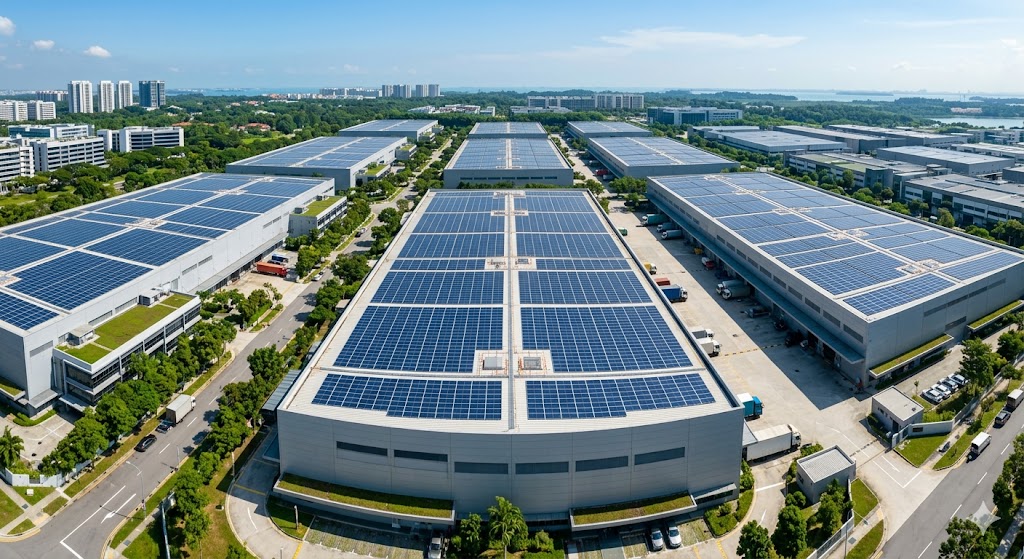
Solar Deployment on JTC Roofs: Mandatory Requirements for New Redevelopments
Introduction to Singapore Solar Energy Goals
The Singapore Green Plan 2030 sets highly ambitious national sustainability targets.1 Therefore, solar energy deployment remains central to these ecological objectives.1 The nation recently achieved 2 gigawatt-peak (GWp) of installed capacity.2 Consequently, the government confidently raised the 2030 target.2 The new national goal is 3 GWp by 2030.2
This impressive capacity can power half a million households annually.3 However, severe land scarcity restricts traditional ground-mounted solar farms.4 Therefore, rooftop installations constitute over 80 percent of total capacity.2 Commercial solar solutions are critical for national energy resilience.5 Industrialists must understand the pros and cons of solar panels.6 Ultimately, deploying the best solar panels reduces corporate carbon footprints.7
JTC and the Industrial Solar Revolution
Jurong Town Corporation (JTC) drives industrial infrastructure development locally.4 JTC manages vast tracts of industrial estates and buildings.4 Consequently, JTC holds unique influence over national solar adoption rates.4 The agency launched two major initiatives for renewable energy.4 These are the SolarLand and JTC SolarRoof programmes.4
SolarLand brings temporary solar farms to otherwise idle land.4 Conversely, SolarRoof focuses on deploying photovoltaic panels atop buildings.4 Initially, this focused strictly on JTC-owned industrial facilities.4 Later, JTC expanded the initiative to include private lessees.8 This expansion accelerates commercial solar solutions across Singapore.4 Furthermore, it helps companies manage rising commercial electricity tariffs.4
Core Thresholds for JTC Mandatory Solar Deployment
To enforce sustainability, JTC introduced mandatory solar deployment requirements.9 Industrialists undertaking new redevelopments must carefully navigate these complex regulations.9 These mandates became officially effective from 1 April 2022.9 Understanding these thresholds is vital for any property developer.8
The regulations apply primarily to new and renewed land leases.9 Furthermore, facility assignments or massive redevelopments trigger these rules.9 JTC enforces strict eligibility criteria for mandatory solar installations.9 If a site meets these conditions, solar installation becomes compulsory.8 If not, building owners can pursue voluntary solar deployment.9
The Contiguous Rooftop Area Threshold
The primary physical threshold involves available contiguous rooftop area.10 A site must possess at least 800 square metres.9 Crucially, this space must be physically suitable for solar panels.10 Calculating this 800-square-metre threshold requires meticulous spatial analysis.8 Not every square metre of a physical roof is usable.8
JTC specifically excludes areas hindered by technical or regulatory constraints.11 For instance, mechanical equipment often occupies significant roof space.8 Heating, ventilation, water tanks, and skylights fragment the surface.8 Therefore, heavily fragmented roofs might fail the contiguous area test.8 Furthermore, regulatory fire safety pathways consume substantial perimeter space.12 Consequently, the practical solar capacity frequently falls below initial expectations.8
The Remaining Lease Term Threshold
The second defining threshold involves the remaining lease term.9 The property must have 15 years or more remaining.9 This duration ensures the solar investment yields sufficient financial returns.13 Most solar panel warranties and performance guarantees span 25 years.13 Therefore, a 15-year lease provides a viable operational runway.9
Property owners must conduct thorough structural and electrical audits early.14 Engaging professional photovoltaic system design experts is highly recommended.5 These experts accurately map the legally permissible contiguous deployment zones.8 They help determine if the site legitimately meets the thresholds.8
| Assessment Factor | Mandatory Threshold | Implication for Property Developer |
| Contiguous Area | 800 square metres | Requires exact mapping of unblocked, usable roof space. |
| Remaining Lease | 15 years | Ensures long-term viability for capital expenditure recovery. |
| Excluded Zones | Fire paths, HVAC units | Reduces raw roof area to practical solar capacity. |
| Deployment Type | Mandatory if conditions met | Solar becomes a strict condition for lease approval. |
Table 1: Key thresholds for JTC mandatory solar deployment requirements.8
The JTC Lease Renewal Process
Solar deployment regulations intersect heavily with lease renewal procedures.15 JTC operates a structured process for renewing industrial land leases.16 Industrialists must submit comprehensive applications well before lease expiry.16 Historically, engagement began six years prior to lease expiration.15 Recently, JTC enhanced this to allow engagement 10 years prior.15
However, applications must be submitted at least three years beforehand.15 Lease renewal is never automatically guaranteed by the agency.16 JTC meticulously assesses the proposed business and redevelopment plans.16 They evaluate economic contributions, job creation, and land intensification.16 Consequently, mandatory solar commitments form a core evaluation metric.8
Integrating Solar into Business Plans
Property owners must integrate solar capital expenditures into investment plans.8 Applicants must provide extensive documentation through the Customer Service Portal.15 These documents prove the viability of the proposed industrial redevelopment.15 Missing solar deployment plans can severely delay the renewal process.14
Tenants must also maintain proper business operations throughout the lease.15 Paying rent on time is critical for renewal eligibility.15 Furthermore, tenants must fulfill investment commitments within stipulated timeframes.15 JTC generally grants a three-year building and investment period.15 During this period, all promised redevelopment works must conclude.17
| Required Document | Purpose in JTC Assessment |
| Audited Financial Statements | Proves the company’s financial health and investment capability. |
| Updated Company Profile | Verifies current directorships and official business standing. |
| Fixed Asset Investment Plan | Details budget for plant, machinery, and civil works. |
| Business Transformation Strategy | Outlines operational upgrades, including sustainability and solar integration. |
| Gross Plot Ratio Proposal | Demonstrates land intensification and optimised space utilisation. |
Table 2: Essential documentation for JTC lease renewal applications.15
JTC SolarRoof Deployment Models
JTC offers flexible frameworks to facilitate compliance with solar mandates.8 The JTC SolarRoof programme encompasses three distinct business deployment models.8 These models cater to varying capital capabilities and operational preferences.18 Building owners must select the model matching their financial strategy.13 The three models are Direct Ownership, Solar Leasing, and Rooftop Licensing.9
Direct Ownership (CAPEX Model)
Direct ownership requires the building owner to purchase the system.8 The owner finances the solar panels and all installation costs.9 Consequently, this model requires significant upfront capital investment.13 However, the financial returns are historically the most lucrative.13 This model provides the lowest total cost over a 25-year lifespan.13
The owner consumes the generated solar energy directly onsite.9 This drastically reduces monthly commercial electricity grid utility bills.9 Furthermore, owners can sell any excess power back.9 They export this surplus electricity directly to the national grid.9 The owner also retains all associated Renewable Energy Certificates (RECs).19 These certificates offer additional income through corporate sustainability markets.3
Owners claim full tax depreciation benefits on the solar assets.13 Direct ownership ensures complete operational control over the system.13 Nevertheless, the owner bears all ongoing maintenance and insurance responsibilities.13 Financially stable companies typically prefer this high-yield, long-term approach.13 However, it requires technical capability or ongoing maintenance service contracts.13
Solar Leasing (Power Purchase Agreement)
Solar leasing operates as an on-site Power Purchase Agreement (PPA).20 A third-party solar vendor installs the panels completely free.9 The building owner pays absolutely zero upfront capital costs.13 The vendor technically owns, maintains, and insures the physical system.13 In return, the building owner agrees to purchase the electricity.9
Crucially, this solar electricity is priced at a discounted tariff.4 It is significantly cheaper than standard SP PowerGrid rates.4 The discount rate typically ranges from 5.65% to 73%.18 Contract periods usually span between 8 and 20 years.21 This model provides immediate energy cost savings without capital risk.13
However, total long-term savings are lower than direct ownership.13 The overall cost is typically 15% to 30% higher ultimately.13 Furthermore, the building owner claims no asset ownership benefits.13 They cannot claim tax depreciation or clean energy investment credits.13 Electricity costs are locked in but escalate annually by 1-3%.13 This model suits companies seeking easier approval processes without capital.13
Rooftop Licensing
Rooftop licensing is ideal for generating passive rental income.9 The building owner essentially rents their unused roof space.8 A selected solar vendor installs the photovoltaic system entirely.9 There is zero capital cost borne by the property owner.9 The vendor exports all generated solar energy to the grid.9
The building owner does not consume this specific electricity onsite.18 Instead, the vendor pays the owner a recurring license fee.9 License fee rates fluctuate based on the Uniform Singapore Energy Price.22 Fees generally range from $0.32 to $42.86 per square metre annually.18 Contract terms similarly span between 8 and 20 years.18
This model demands the least operational involvement from the lessee.4 However, if leases end early, severe relocation penalties heavily apply.18 Removal costs can reach $334.47 per square metre depending on timing.18 Therefore, property owners must ensure their lease outlasts the contract.8
| Deployment Model | Upfront Capital Required | Maintenance Responsibility | Financial Benefit Type |
| Direct Ownership | High (Owner funded) | Property Owner | Maximum energy savings and REC revenue. |
| Solar Leasing (PPA) | Zero | Solar Vendor | Discounted solar electricity tariffs. |
| Rooftop Licensing | Zero | Solar Vendor | Passive rental income per square metre. |
Table 3: Comparison of JTC SolarRoof deployment business models.9
Solar Vendor Analysis and Licensing Rates
JTC partners with reputable solar companies to facilitate these programmes.21 Notable vendors include Sembcorp Solar, Terrenus Energy, and Engie.21 These vendors finance, design, build, and operate the PV systems.21 Analysing their specific rates helps businesses choose the best solar companies.6 Consumers heavily search for “best solar company in [City]” today.5
Sembcorp Solar offers competitive licensing fees for industrial rooftops.22 For roofs exceeding 1,000 square metres, rates are favourable.22 Sembcorp charges between $0.50 and $5.50 per square metre annually.22 If a system requires relocation, Sembcorp levies distinct penalty charges.22 These relocation costs range from $48.99 to $71.44 per square metre.22
Engie South East Asia provides alternative competitive licensing frameworks.18 Their license fee unit rates range dramatically based on constraints.18 Rates span from $0.32 up to $42.86 per square metre annually.18 Engie’s removal penalties adjust based on remaining contract years.18 Early termination removal costs vary from $75.00 to $334.47.18 Therefore, industrialists must select vendors aligned with their lease longevity.8
Solar Panel Cost and Financial Viability
Evaluating solar panel cost is imperative for the Direct Ownership model.5 Singapore solar panel cost metrics vary by total system size.23 Economies of scale heavily dictate the final pricing structures.23 Smaller residential solar installation projects face higher per-watt costs.23 Conversely, massive commercial solar solutions enjoy significant volume discounts.23 Search queries like “solar panel cost” demonstrate high buyer intent.5
A standard 10 kWp system costs approximately $15,000 to $20,000.24 This translates to roughly $1,540 per kWp of capacity.23 On a spatial basis, costs range from $300 to $400/m².25 However, a large 1,000 kWp industrial setup is much cheaper.23 Large commercial systems average roughly $940 per kWp installed.23 Furthermore, annual operations and maintenance consume about 1% of CAPEX.23
Smart maintenance using AI algorithms helps reduce these operational costs.26 AI enables early fault detection and targeted dispatch of personnel.26 Consequently, this drastically lowers the long-term manpower maintenance expenses.26 Users frequently seek out “solar panel maintenance” services online.5
Levelised Cost of Electricity (LCOE)
The Levelised Cost of Electricity (LCOE) proves solar’s economic viability.23 LCOE calculates total lifecycle costs divided by lifetime energy generation.23 Currently, the LCOE for rooftop solar is highly competitive globally.23 In Singapore, small-scale solar LCOE ranges from $0.11 to $0.15/kWh.23 Future high-efficiency photovoltaic modules will drive this cost down further.26
By comparison, commercial electricity tariffs are substantially more expensive.27 Grid electricity costs approximately $0.29 per kWh including taxes.27 Therefore, self-generated solar energy is roughly half the grid cost.23 This massive price differential ensures a rapid return on investment.23 Most commercial systems achieve full financial payback within seven years.25 Considering a 25-year lifespan, the long-term monetary gains are tremendous.23
| System Size Category | Estimated Cost (per kWp) | Estimated LCOE (per kWh) | Grid Tariff (per kWh) |
| Small Scale (10 kWp) | ~$1,540 | $0.11 – $0.15 | ~$0.29 |
| Large Scale (1000 kWp) | ~$940 | < $0.11 (estimated) | ~$0.29 |
Table 4: Comparative cost analysis of solar deployment in Singapore.23
Urban Redevelopment Authority (URA) Zoning Compliance
All industrial redevelopments must comply strictly with URA zoning regulations.28 JTC mandates adherence to these urban planning guidelines unconditionally.29 Changing the use of an industrial property requires extensive clearances.28 Applicants need clearance from the National Environment Agency (NEA).28 Furthermore, they require approvals from the Land Transport Authority (LTA).28
A central pillar of this zoning compliance is the 60:40 rule.29 This regulation prevents the misuse of subsidised industrial real estate.30 It ensures industrial land serves its primary economic purpose effectively.16 Therefore, businesses cannot convert factories into cheap commercial offices.30 Non-compliance attracts severe operational and financial penalties from authorities.30
The 60:40 Space Utilisation Rule
The 60:40 rule governs gross floor area (GFA) distribution strictly.29 At least 60% of total GFA must support core industrial activities.29 This includes heavy manufacturing, warehousing, data centres, or telecommunications infrastructure.30 Core media activities like broadcasting and audio engineering also qualify.30 Businesses may allocate 100% of space to core activities seamlessly.30 This occurs when ancillary support functions remain entirely unnecessary.30
However, the remaining 40% is strictly capped for ancillary uses.29 Ancillary spaces include administrative offices, staff canteens, and communal facilities.29 It also permits limited indoor recreational amenities for worker dormitories.31 For dormitories, recreational GFA depends on the total worker population.31 For example, dorms housing 500 workers require 100sqm of recreational space.31 Commercial amenities like minimarts are also allowed within this quantum.31
Industrial Showrooms and Retail Restrictions
Furthermore, industrial showrooms fall under this 40% ancillary allowance allowance.30 However, they cannot operate as standard retail consumer storefronts.30 URA guidelines strictly define permissible showroom display items carefully.30 Showrooms may only display bulky products requiring specialised off-site delivery.30
Acceptable examples include large furniture, heavy machinery, or motor vehicles.30 Incidental sales of smaller items remain conditionally permissible sometimes.30 However, the primary focus must continually remain on bulky items.30 Furthermore, showrooms are strictly confined to the first storey.30
Planning Permission for Solar Panels
Generally, URA does not require planning permission for solar panels.32 Building Applied Photovoltaics (BAPV) normally bypass this administrative hurdle completely.33 These panels are simply applied onto existing building roofs directly.33 Similarly, Building Integrated Photovoltaics (BIPV) face minimal urban planning restrictions.33 BIPVs are solar panels integrated directly into the building materials.33 They typically replace window glass or exterior wall cladding seamlessly.33
However, notable exceptions exist within architectural conservation areas specifically.32 Installations in these protected zones demand rigorous aesthetic urban reviews.32 Urban design guidelines aim to preserve historical architectural integrity strictly.32 Therefore, glaring modern solar panels might face rejection in these zones.32
Elevated Solar Panels and GFA Calculations
Furthermore, elevated solar panels might trigger formal planning permission requirements.32 Usually, elevated panels are assessed as an additional building storey.32 This affects the overall storey height control limits of the building.32 If the space beneath panels remains open, GFA is unaffected.32
However, enclosing the space for commercial usage triggers GFA calculations.32 For example, outdoor refreshment areas under solar canopies count towards GFA.32 Therefore, planning permission is absolutely required for such commercial instances.32 Property developers must carefully consult architects before constructing massive canopies.32
Building and Construction Authority (BCA) Guidelines
The Building and Construction Authority (BCA) governs absolute structural safety.34 Solar panels add significant dead weight to existing building roofs.12 Furthermore, they introduce complex aerodynamic wind uplift forces during storms.12 Therefore, a Qualified Person (QP) must evaluate structural integrity beforehand.12 This structural Professional Engineer validates the building’s load-bearing capacity rigorously.12
If the roof lacks capacity, structural strengthening becomes mandatory immediately.35 Strengthening works always require formal BCA structural plan approval beforehand.35 Furthermore, lightning protection is a crucial structural safety consideration locally.36 Solar PV systems are highly exposed to frequent lightning strikes.36
The 2.5m and 10sqm Structural Rules
Most standard rooftop installations bypass formal BCA plan submissions entirely.12 However, BCA enforces strict specific dimensional rules that trigger submissions.35 Firstly, any supporting plinth or platform exceeding 2.5 metres height.35 Frames raised above this threshold require detailed engineering plan reviews.35 High structures alter the building’s fundamental aerodynamic and structural profile.12
Secondly, solar panels functioning as a continuous roof shelter.35 If this shelter covers an area exceeding 10 square metres.35 For example, a large solar canopy shading a rooftop carpark.12 Such extensive structures act like massive sails, capturing immense wind forces.12 Therefore, BCA must formally verify the anchoring and structural resilience.12 Any new building works defined under the Building Control Act apply.35
| BCA Trigger Condition | Requirement | Engineering Rationale |
| Insufficient Roof Load | Structural Strengthening | Prevents catastrophic roof collapse from dead weight. |
| Plinth Height > 2.5m | BCA Plan Approval | High structures alter aerodynamic wind resistance heavily. |
| Canopy > 10 sqm | BCA Plan Approval | Large canopies capture massive storm uplift forces. |
Table 5: BCA structural submission triggers for solar installations.12
Daylight Reflectance and Solar Glare Mitigation
Solar panels naturally reflect some sunlight, potentially causing intense glare.37 In dense urban environments, this reflected glare creates severe nuisances.38 It negatively impacts the visual amenity of surrounding building occupants.39 Therefore, BCA strictly regulates the daylight reflectance of external surfaces.39 Designers must assess solar reflectance during the initial planning phase.38
Reflectance is divided into diffuse and specular reflectance categories.40 Diffuse reflection scatters light safely in multiple random directions.40 Consequently, the amount of daylight seen by an observer is small.40 Conversely, specular reflection beams light intensely in one specific direction.40 Specular reflection directly causes blinding solar glare for nearby observers.40 Therefore, BCA regulations heavily target the mitigation of specular daylight reflectance.40
Reflectance Testing and Limits
The testing of reflectance values follows strict international technical standards.39 Assessors use the ASTM E903 standard testing method for solar absorptance.39 They utilise an integrating sphere of minimum 150mm diameter.39 For roofs inclined under 20 degrees, strict regulatory limits apply.39 The maximum allowable specular reflectance is strictly 10 percent.39 There is no requirement on total diffuse daylight reflectance here.40
For roofs inclined above 20 degrees, broader rules take effect.39 Specular reflectance remains capped at 10 percent for steep roofs.39 However, total daylight reflectance must not exceed 20 percent either.39 Darker coloured photovoltaic cells possess naturally lower reflectance values.37 Furthermore, manufacturers apply specialised anti-reflective coatings to mitigate glare further.37 Flat installation tilts below 15 degrees also reduce reflection probability.37
SCDF Fire Safety Protocols and MAA Lodgement
Fire safety is arguably the most complex regulatory compliance hurdle.5 The Singapore Civil Defence Force (SCDF) regulates all solar installations.41 Incorrectly installed solar panels severely obstruct tactical firefighting operations.12 They also introduce high-voltage direct current (DC) electrocution risks.12 Therefore, SCDF enforces Clause 10.2 of the Fire Code 2023.41
Most retrofitted commercial solar solutions fall under the MAA scheme.12 This is the Minor Additions and Alterations electronic lodgement pathway.42 Submissions occur digitally through the CORENET X e-submission portal system.42 A Qualified Person (QP) assumes full legal liability for compliance.12 The QP is usually a Registered Architect or Professional Engineer.12
The MAA fee is generally around $90 per electronic submission.42 However, professional QP fees range between $2,500 and $8,000.12 Furthermore, an independent Registered Inspector (RI) must certify the work.12 RI inspection fees typically add another $1,500 to $3,000.12 Finally, plan amendment fees cost $90 per storey if revised.12
Tactical Access and Perimeter Clearances
Firefighters require unimpeded access to the roof during emergencies.12 At least one exit staircase must extend directly to the roof.12 For older buildings, access hatches must be drastically widened.12 Hatches must offer a minimum clear width of 1000mm diameter.12 Furthermore, a 3-metre staging zone must remain clear around hatches.12 This sterilised area allows safe deployment of firefighting personnel equipment.12
Perimeter walkways are absolutely mandatory for safe tactical movement.12 The dimensions of these walkways depend on the roof’s parapet.12 Roofs with parapets taller than 900mm require 1.5-metre perimeter paths.12 The parapet provides fall protection, allowing a narrower access corridor.12 Conversely, roofs without parapets require massive 2.5-metre wide safety buffers.12 This prevents disoriented firefighters from falling in smoke-filled environments.12
Array Compartmentalisation and Smoke Venting
SCDF employs compartmentalisation to prevent massive runaway roof fires.12 Massive continuous solar arrays are strictly prohibited by the regulations.12 Installations must be divided into smaller, isolated sub-array clusters.12 The absolute maximum size for any sub-array is 40×40 metres.12 This dimension ensures standard fire hoses can reach the centre.12 Fire hoses typically have a maximum effective reach of 30 metres.12
Furthermore, panels must maintain clearance from smoke ventilation systems.12 A minimum 500mm horizontal clearance is required around smoke vents.12 This prevents panels from obstructing escaping heat and toxic smoke.12 Additionally, photovoltaic modules must meet rigorous material safety standards.41 They require Class C certification for flame spread and burning brands.41 This ensures the panels do not become combustible fire fuel.12
| Fire Safety Feature | Dimension / Requirement | Tactical Reasoning for Firefighters |
| Access Hatch Width | Minimum 1000mm diameter | Allows entry for fully geared personnel. |
| Hatch Clearance | 3.0 metres radius | Provides a secure equipment staging area. |
| Perimeter (Parapet >900mm) | 1.5 metres wide | Serves as standard tactical movement corridor. |
| Perimeter (Parapet <900mm) | 2.5 metres wide | Acts as fall prevention in low visibility. |
| Max Sub-Array Size | 40m x 40m blocks | Ensures 30m fire hose reach to centre. |
| Smoke Vent Clearance | 500mm horizontal gap | Prevents obstruction of toxic smoke plumes. |
Table 6: SCDF Fire Code 2023 clearance requirements for solar panels.12
The 20cm Metal Roof Fire Exemption
Historically, solar panels on metal roofs required heavy fire-rated separation.43 Building owners had to install expensive 1-hour fire-rated boards underneath.44 This significantly increased both the structural dead load and costs.44 In response, SCDF partnered with industry specialists to review rules.43 They introduced a highly beneficial exemption for metal-roofed industrial buildings.44
Installations are exempted if panels sit 200mm (20cm) above the roof.44 This vertical air gap prevents direct heat transfer to the building.44 However, the building must possess an automatic fire alarm system.44 Alternatively, the panels must utilise non-combustible glass outer layers.44 This regulatory relaxation saves owners up to 30% in construction costs.43 It significantly accelerates commercial solar solutions across industrial estates.43
Energy Storage Systems (ESS) Fire Risks
Integrating battery storage with solar dramatically changes fire safety classifications.12 Energy Storage Systems (ESS) present severe thermal runaway explosion risks.45 Such projects migrate from Clause 10.2 to the stricter Clause 10.3.12 Batteries must be located 6 metres away from exit staircases.45 They must also remain 6 metres from any fire lift lobby.45
Furthermore, they require isolation from non-essential equipment and parking lots.45 Batteries must be placed at least 1 metre from these areas.45 Emergency isolation shut-off switches are mandatory at every battery unit.45 Additionally, approved fire extinguishers of 55A rating must be provided.45 Consequently, ESS integration requires highly complex fire engineering approaches.46 Performance-based design methods evaluate fire risks for these complex setups.46
EMA Regulations and Electrical Integration
Electrical faults remain the primary cause of catastrophic solar fires.12 Therefore, the Energy Market Authority (EMA) regulates all grid connections.47 Compliance with the SS 638 electrical code of practice is mandatory.41 Direct current (DC) cables require heavy-duty mechanical conduit protection.12 High-voltage cables run inside metal trunking to contain any sparks.12
Wiring exposed to sunlight must possess specialised UV-resistant properties.12 Degraded cables easily cause high-voltage DC arcing and subsequent fires.12 Robust electrical earthing is vital to trip protection breakers instantly.12 Racking and frames must have robust electrical bonding to avoid static.12 The Fire Command Centre must house an AC side emergency shut-off.12
The Role of the Licensed Electrical Worker (LEW)
A Licensed Electrical Worker (LEW) oversees the entire electrical commissioning.34 The LEW designs and officially endorses the Single Line Diagram.12 This diagram details all emergency isolation points and disconnect switches.12 SCDF incorporates this layout into their MAA submission plans directly.12 This allows emergency services to safely isolate the system during fires.12
The LEW applies for necessary electrical licences from the authorities.34 If system capacity exceeds 1 MWac, additional licensing is required.47 The owner must formally apply for an EMA Generation Licence.34 They must also register with the Energy Market Company (EMC).34 Residential systems fall well below this 1 MWac threshold typically.47
SP Group Grid Connection and Metering
SP Group manages the final physical connection to the grid.47 The LEW is responsible for arranging the energisation service connection.48 The LEW must be physically present during the scheduled inspection.48 Upon successful inspection, SP Group issues a ‘PASS’ Inspection Report.48 The LEW then issues a formal Statement of Turn-On officially.49
Customers must authorise SP Services to issue tax invoices on their behalf.49 Advanced Metering Infrastructure (AMI) meters accurately track exported solar generation.50 These smart meters measure electricity consumed and excess electricity exported.50 By 2026, all households will possess these advanced AMI meters.50 Alternatively, Solar Generation Profiling (SGP) bypasses physical meter installation entirely.50
JTC Plan Endorsement and Submission Protocols
Navigating JTC’s administrative submission process demands strict attention to detail.14 Property developers must pre-coordinate with JTC’s technical assessment teams early.14 Engaging turnkey solar providers eliminates administrative hassles for building owners.51 Turnkey services cover design, supply, installation, and commissioning of components.8 Under mandatory solar deployment, two critical submission phases exist.9 These are the proposed plan phase and the as-built phase.9
Design Review Panel (DRP) and Deviations
For complex redevelopments, applicants might consult the Design Review Panel (DRP).52 Successful tenderers can present preliminary designs for essential pre-consultations.52 An estimated lead time of 3 weeks activates the DRP.52 Presentations require a write-up of the overall proposal and design concept.52 Applicants must submit sketch plans including floor plans and elevations.52
Furthermore, a softcopy 3D massing model in LOD-2 format is required.52 Acceptable computer file formats include SKP, FBX, 3DS, or SHP.52 The formal DRP approval is issued within 7 working days.52 Approval may include conditions incorporated into submissions for planning approval.52
Proposed Plans and AutoCAD Drawings
During the initial plan endorsement stage, proposed plans are submitted.9 These plans must clearly declare the total PV installation area.9 Submissions require precise AutoCAD (.DWG) layout drawing files.53 The drawings must detail the PV elevation in relation to the building.53 They must also depict the Lightning Protection System (LPS) layout.53 The highest platform level relative to Singapore Height Datum is required.53
Furthermore, a PV Attributes table must accompany the Site Plan.53 This table quantifies the exact shape and area of panels.53 A Gross Floor Area (GFA) table must show the quantum breakdown.53 For Qualified Persons, submissions flow through the CORENET ESPro system.54 Non-QPs utilise the standard CORENET Online Submission portal instead.54
As-Built Plans and End-of-Lease Removal
Following physical installation, the critical as-built plans are submitted.9 This must occur by the deadline stipulated in the lease.9 The as-built plans confirm the final, actual installed PV area.9 The installed area must equal or exceed the originally declared area.9 Failing to meet declared targets jeopardises lease renewal approvals entirely.14
If leases end, solar panels must be removed promptly.55 Removal must occur six months prior to the lease expiry date.9 This facilitates smooth reinstatement of the premises for JTC.9 Alternatively, removal must happen within six months of written notice.9 JTC will sell or dispose of any panels remaining on site.9 The lessee must indemnify JTC fully against all third-party claims.9
End-of-Life Management and Solar Panel Recycling
Sustainability extends far beyond simply generating renewable solar energy.56 Photovoltaic panels have an operational lifespan of 25 to 30 years.57 Consequently, decommissioning old panels threatens to create massive e-waste problems.56 By 2050, global PV waste will constitute a massive environmental crisis.56 Global PV waste generation will exceed 10% of total e-waste.56 Silicon-wafer panels account for 90 percent of this impending waste.56 Improper disposal in landfills wastes highly valuable raw manufacturing materials.57
The Extended Producer Responsibility (EPR) Scheme
To combat this, Singapore enacted the Extended Producer Responsibility (EPR) scheme.58 The National Environment Agency (NEA) strictly regulates this comprehensive framework.59 Solar photovoltaic panels are a heavily regulated e-waste product class.59 Companies supplying panels locally bear legal responsibility for end-of-life treatment.58
Suppliers must offer free take-back services for all disused panels.58 They must send this waste directly to licensed e-waste recyclers.58 Small retailers falling below specific volume thresholds receive EPR exemptions.59 NEA exempts small producers supplying minimal regulated products locally.59 This ensures large-scale industrial suppliers bear the primary recycling burden.59
The Circular Economy for Photovoltaic Waste
Regulated e-waste must flow strictly to licensed e-waste recycling facilities.59 Exporting e-waste to countries with substandard recycling infrastructure is forbidden.59 Unregulated informal recycling sectors pose severe health and environmental risks.59 Singapore recently launched its first automated solar panel recycling facility.60 Facilities utilise advanced technologies to process up to 36,000 panels annually.57
The recycling process efficiently dismantles the active sandwich composite structural layers.56 Recyclers successfully extract highly valuable materials from the decommissioned cells.59 Recovered materials include silicon, silver, aluminium frames, gallium, and indium.56 These raw materials funnel directly back into global production chains.59 This circular economy approach dramatically reduces the overall environmental footprint.57
Recycling one ton of panels saves roughly 800 to 1200 kgCO2eq.56 This significantly lowers the global warming potential of manufacturing processes.56 Furthermore, this supports Singapore’s goal of reducing landfill waste significantly.61 The government aims to reduce waste to Semakau Landfill by 30%.61 Consequently, proper recycling extends the value of initial solar investments.60
Conclusion
The push for solar deployment on JTC roofs is historically unprecedented. Mandatory requirements ensure industrial redevelopments align with national green targets. Achieving compliance demands meticulous navigation of complex, multi-agency regulatory frameworks. Building owners must satisfy JTC contiguous area thresholds and lease requirements. Furthermore, structural integrity, fire safety, and electrical standards are absolutely non-negotiable.
Selecting the optimal deployment model dictates long-term financial return on investment. Direct ownership yields maximum profits, while leasing eliminates heavy capital expenditures. Understanding solar panel cost dynamics ensures accurate budgetary forecasting for redevelopments. Companies must search for the best solar panels and reliable vendors. Ultimately, adhering to these robust regulations guarantees successful JTC lease renewals. It firmly positions Singaporean industrial estates at the forefront of sustainability.
Works cited
- 5 pillars of the Singapore Green Plan 2030, accessed May 22, 2026, https://www.tech.gov.sg/technews/5-pillars-of-the-singapore-green-plan-2030/
- MEDIA FACTSHEET 2 March 2026 Singapore to Accelerate Solar Deployment to Meet 3 GWp Solar Target by 2030 With the increase in S – EMA, accessed May 22, 2026, https://www.ema.gov.sg/content/dam/corporate/news/media-releases/2026/20260302EMA-Media-Factsheet-Singapore-to-Accelerate-Solar-Deployment-to-Meet-3-GWp-Solar-Target-by-2030.pdf.coredownload.pdf
- Singapore to Accelerate Solar Deployment to Meet 3 GWp Solar Target by 2030 | JTC, accessed May 22, 2026, https://www.jtc.gov.sg/about-jtc/news-and-stories/industry-news/singapore-to-accelerate-solar-deployment-to-meet-3-gwp-solar-target-by-2030
- Turning sunshine into strategy: How SolarRoof and SolarLand are helping industrialists meet their net-zero goals | JTC, accessed May 22, 2026, https://www.jtc.gov.sg/about-jtc/news-and-stories/feature-stories/turning-sunshine-into-strategy
- Top Keywords for Solar SEO in 2025 – EasySolar, accessed May 22, 2026, https://easysolar.app/top-keywords-for-solar-seo-in-2025/
- Solar-Related Keywords: Understanding What Solar Customers Want, accessed May 22, 2026, https://aurorasolar.com/blog/solar-related-keywords-understanding-what-solar-customers-want/
- Solar vision: The future looks bright for Singapore – JTC, accessed May 22, 2026, https://www.jtc.gov.sg/about-jtc/news-and-stories/feature-stories/solar-vision-the-future-looks-bright-for-singapore
- JTC solar requirements explained (without the legal jargon) – Eigen Energy, accessed May 22, 2026, https://www.eigen.energy/articles/jtc-solar-requirements-explained
- Solar deployment – Singapore – JTC, accessed May 22, 2026, https://www.jtc.gov.sg/get-help/managing-your-tenancy-or-lease/solar-deployment
- Solar Panels Now Required in JTC Solar Policy – GetSolar, accessed May 22, 2026, https://www.getsolar.ai/en-sg/blog/jtc-solar-deployment-policy
- Renewing Your Industrial Lease – JTC, accessed May 22, 2026, https://www.jtc.gov.sg/-/media/project/jtc-cx/corpweb/assets/get-help/lease-renewal-handbook_jul-2025_.pdf
- SCDF MAA Application for Solar Panel Installatio – Stellar Structures, accessed May 22, 2026, https://structures.com.sg/scdf-maa-solar-pv-installation/
- Solar leasing vs ownership for JTC buildings – Eigen Energy, accessed May 22, 2026, https://www.eigen.energy/articles/solar-leasing-vs-ownership-jtc
- What to do when solar Is mandatory for JTC lease renewal in Singapore – Eigen Energy, accessed May 22, 2026, https://www.eigen.energy/articles/jtc-solar-mandatory-lease-renewal-guide
- JTC Lease Renewal: Navigating the Process in Singapore (2026 Update) – JFStrategic, accessed May 22, 2026, https://jfstrategic.com/navigating-the-jtc-lease-renewal-process-in-singapore/
- Renewing Your Industrial Lease – JTC, accessed May 22, 2026, https://www.jtc.gov.sg/-/media/project/jtc-cx/corpweb/assets/get-help/lease_renewal_handbook.pdf
- Renewing Your Industrial Lease – JTC, accessed May 22, 2026, https://www.jtc.gov.sg/-/media/project/jtc-cx/corpweb/assets/get-help/lease-renewal-handbook_jul-2025update.pdf
- solarroof: making solar pv deployment easy for you – JTC, accessed May 22, 2026, https://www.jtc.gov.sg/-/media/project/jtc-cx/corpweb/assets/enhance-your-business/be-more-sustainable/jtc-solarroof-infokit-2024—for-jtc-lessees.pdf
- SOLAR DEPLOYMENT MODELS | Association of Aerospace Industries (Singapore), accessed May 22, 2026, https://aais.org.sg/solar-deployment-models/
- Solar Deployment Toolkit – Singapore – JTC, accessed May 22, 2026, https://www.jtc.gov.sg/-/media/project/jtc-cx/corpweb/assets/get-help/solar-deployment-toolkit.pdf
- SolarRoof Programme Infokit – For JTC Lessees, accessed May 22, 2026, https://aais.org.sg/wp-content/uploads/2024/03/2023-JTC_SOLARROOF-PROGRAMME_INFOKIT_Final.pdf
- Solar Deployment Infokit, accessed May 22, 2026, https://aais.org.sg/wp-content/uploads/2021/08/Simplified-Solar-Deployment-Infokit_Final.pdf
- How much does it cost to deploy solar panels for my building, if I decide to go for an ownership model? – EMA, accessed May 22, 2026, https://www.ema.gov.sg/resources/faqs/solar/solar-installation-guide/how-much-does-it-cost-to-deploy-solar-panels-for-my-building-if-i-decide-to-go-for-an-ownership-model
- The 2025 Guide to Solar Panel Costs in Singapore: What Homeowners Need to Know – Eigen Energy, accessed May 22, 2026, https://www.eigen.energy/articles/solar-panel-costs-singapore
- How Much Do Solar Panels Cost in Singapore? (2026) – 1st Solution, accessed May 22, 2026, https://www.firstsolution.com.sg/blog/how-much-do-solar-panels-cost-in-singapore-the-complete-breakdown/
- UPDATE of the Solar Photovoltaic (PV) Roadmap for Singapore, accessed May 22, 2026, https://www.seris.nus.edu.sg/wp-content/uploads/2023/07/Update-of-the-Solar-Roadmap-for-Singapore-March-2020.pdf
- Singapore Solar Panel Manufacturing Report | Market Analysis and Insights – PVKnowhow, accessed May 22, 2026, https://www.pvknowhow.com/solar-report/singapore/
- Changing the use of your industrial property | JTC, accessed May 22, 2026, https://www.jtc.gov.sg/get-help/managing-your-tenancy-or-lease/changing-the-use-of-your-industrial-property
- Renewing Your Industrial Lease – JTC, accessed May 22, 2026, https://www.jtc.gov.sg/-/media/project/jtc-cx/corpweb/assets/get-help/lr_handbk_2feb2024.pdf
- The 60:40 Rule: Ensure Your JTC Unit Complies with Industrial Use Quantum, accessed May 22, 2026, https://www.amanengineering.com.sg/the-6040-rule-ensure-your-jtc-unit-complies-with-industrial-use-quantum/
- Allowable Uses – Singapore – Urban Redevelopment Authority (URA), accessed May 22, 2026, https://www.ura.gov.sg/Corporate/Guidelines/Development-Control/Non-Residential/B2/Allowable-Uses
- URA/PB/2019/10-DCG Our Ref : DC/ADMIN/CIRCULAR/PB_19 Date, accessed May 22, 2026, https://www.ura.gov.sg/services/download_file.aspx?f={42299E5A-BC0C-404B-A084-0F407085311F}
- No Planning Permission Required for Building Integrated Photovoltaics (BIPV) and Building Applied Photovoltaics (BAPV) – URA, accessed May 22, 2026, https://www.ura.gov.sg/Corporate/Guidelines/Development-Control/DC-Connect/No-Planning-Permission-Required-BIPV-BAPV
- Implementation Guide | EMA, accessed May 22, 2026, https://www.ema.gov.sg/consumer-information/solar/implementation-guide
- Structural and Building Plans Requirements for Rooftop Solar PV Installation | Licence & Accreditation – GoBusiness Licensing, accessed May 22, 2026, https://licensing.gobusiness.gov.sg/licence-directory/bca/structural-and-building-plans-requirements-for-rooftop-solar-pv-installation
- Handbook for Solar Photovoltaic (PV) Systems | ESCAP Policy Documents Managment, accessed May 22, 2026, https://policy.asiapacificenergy.org/node/172
- General No. Questions Proposed Answers 1. I am a landed property owner and wish to integrate solar PV system to my building, how, accessed May 22, 2026, https://isomer-user-content.by.gov.sg/338/9974dc7b-7012-4e66-9f7c-de7c0a769ba5/solar-faqs-111021.pdf
- Our Ref : APPBCA-2022-13 1 Sept 2022 See Distribution List Dear Sir/Madam RELEASE OF DAYLIGHT REFLECTANCE DESIGN GUIDE Objectiv – Singapore Institute of Surveyors and Valuers, accessed May 22, 2026, https://www.sisv.org.sg/admin/efinder/files/doc/sisv/circulars/NewFolder/Daylight%20reflectance%20design%20guide_31%20Aug%202022.pdf
- Approveddocument.pdf – Building and Construction Authority, accessed May 22, 2026, https://www.bca.gov.sg/publications/BuildingControlAct/others/Approveddocument.pdf
- Daylight reflectance lab test for your BCA submission – OTM Solutions Pte Ltd, accessed May 22, 2026, https://www.otm.sg/daylight-reflectance
- Clause 10.2 Solar Photo-Voltaic (PV) Installation – Singapore – SCDF, accessed May 22, 2026, https://www.scdf.gov.sg/fire-safety-services-listing/fire-code-2023/table-of-content/chapter-10-requirements-for-special-installations/clause-10.2-solar-photo-voltaic-pv-installation
- Minor Addition & Alteration Works – Singapore – SCDF, accessed May 22, 2026, https://www.scdf.gov.sg/fire-safety-services-listing/plans-submission-process/minor-addition-alterationworks
- Roof solar panel fire safety requirement – Enterprise Singapore, accessed May 22, 2026, https://www.enterprisesg.gov.sg/smepeo/roof-solar-panel-fire-safety-requirement
- Solar FAQ Singapore | SCDF, EMA & Installation Guide, accessed May 22, 2026, https://www.smsolar.com.sg/solar-faq.html
- Clause 10.3 Energy Storage Systems – SCDF, accessed May 22, 2026, https://www.scdf.gov.sg/fire-safety-services-listing/fire-code-2023/table-of-content/chapter-10-requirements-for-special-installations/clause-10.3-energy-storage-systems
- Singapore Fire Safety Engineering Guidelines 2025 – Redas, accessed May 22, 2026, https://redas.com/wp-content/uploads/2025/12/singapore-fire-engineering-guidelines-2nd-edition-2025.pdf
- A Guide to Government Regulations for Solar Panel Installation in Singapore, accessed May 22, 2026, https://akandosolutions.com/a-guide-to-government-regulations-for-solar-panel-installation-in-singapore/
- How to Apply For Electricity Connection – Singapore – SP Group, accessed May 22, 2026, https://www.spgroup.com.sg/dam/jcr:66289889-80d2-4559-a479-a804d5323f19/How%20to%20Apply%20for%20Electricity%20Connection.pdf
- Electricity Connection Application Guide | PDF – Scribd, accessed May 22, 2026, https://www.scribd.com/document/428523353/How-to-Apply-for-Electricity-Connection
- Preparing for Solar – Singapore – Energy Market Authority, accessed May 22, 2026, https://www.ema.gov.sg/consumer-information/solar/preparing-for-solar
- The complete guide to solar EPC services for commercial projects in Singapore, accessed May 22, 2026, https://www.eigen.energy/articles/solar-epc-services-singapore
- JTC Sale of Site – Industrial – Development, accessed May 22, 2026, https://www.jtc.gov.sg/-/media/project/jtc-cx/corpweb/assets/find-land/land-for-tender-and-temp-use/igls/sengkang-west/4-technical-conditions-of-tender_sengkang-west_part-1_24062025.pdf
- Plan consent for qualified person submission – Singapore – JTC, accessed May 22, 2026, https://www.jtc.gov.sg/get-help/development-and-renovation-works/qp-submission
- space-submission-handbook.pdf – JTC, accessed May 22, 2026, https://www.jtc.gov.sg/-/media/project/jtc-cx/corpweb/assets/get-help/space-submission-handbook.pdf
- JTC Policies & Guidelines, accessed May 22, 2026, https://jtc.place/jtc-policies-guidelines/
- Recycling of Silicon Solar Panels | Singapore-CEA Alliance for Research in Circular Economy (SCARCE) – Nanyang Technological University, accessed May 22, 2026, https://www.ntu.edu.sg/scarce/research-focus/recycling-of-silicon-solar-panels
- New solar panel recycling facility in Singapore can process 36000 panels a year, accessed May 22, 2026, https://www.edb.gov.sg/en/business-insights/insights/new-solar-panel-recycling-facility-in-singapore-can-process-36000-panels-a-year.html
- Written Reply to Parliamentary Question on Efforts and Plans to Tackle Solar Panel Waste and Solar Panel Recycling by Ms Grace Fu, Minister for Sustainability and the Environment, accessed May 22, 2026, https://www.mse.gov.sg/latest-news/written-reply-to-pq-on-solar-panel-recycling/
- Producers and Retailers – ALBA E-Waste Singapore, accessed May 22, 2026, https://alba-ewaste.sg/producers-and-retailers/
- Solar Panel Recycling Service in Singapore – KGS, accessed May 22, 2026, https://www.kgs.com.sg/services/recycling/solar-panel
Singapore’s solar energy deployment on track to meet Green Plan targets, but waste to landfill reduction lags – The Business Times, accessed May 22, 2026, https://www.businesstimes.com.sg/singapore/singapores-solar-energy-deployment-track-meet-green-plan-targets-waste-landfill-reduction-lags