
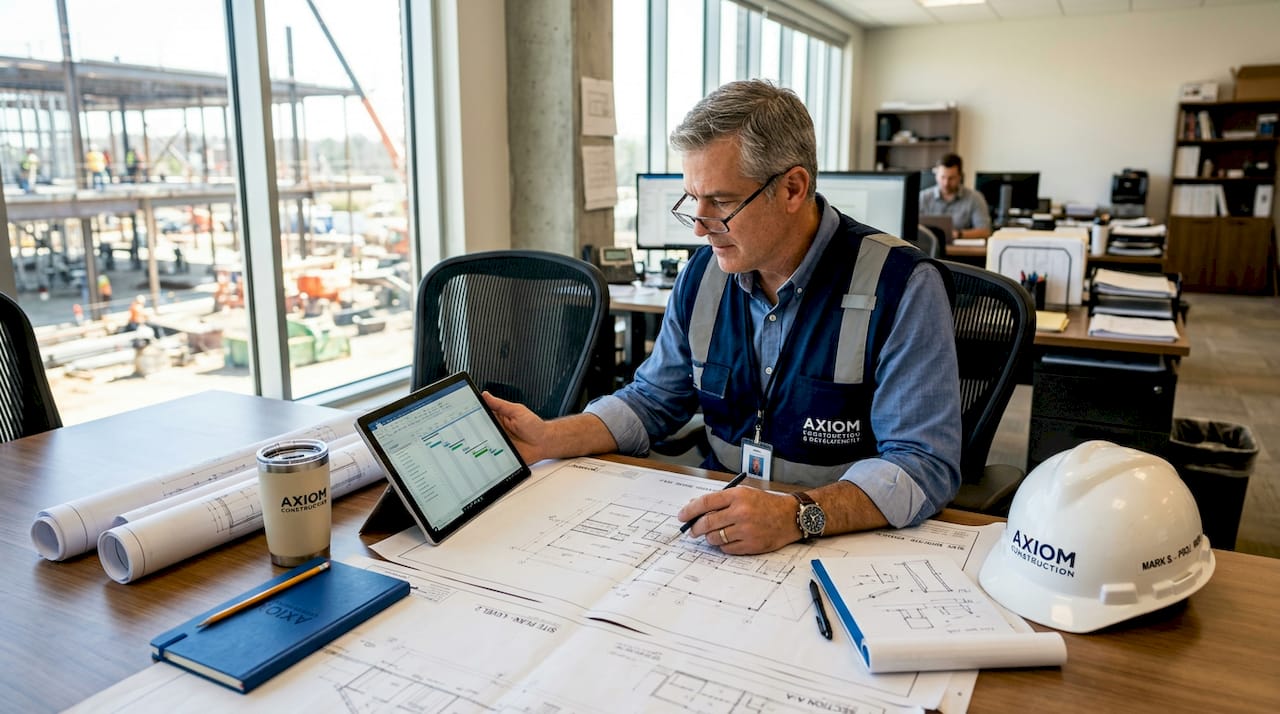
Construction projects in 2026 face a more demanding planning environment than ever before. With tightening regulatory requirements, evolving digital tools, and the growing pressure to deliver on time and within budget, applying the right project planning tips 2026 is not optional. It is a baseline requirement for project success. Only 57% of projects finish within original budget, and 11% of total investment is wasted due to poor performance. Construction professionals who approach 2026 projects with structured, compliance-aware planning strategies will outperform those relying on outdated methods.
Table of Contents
- Key Takeaways
- 1. Project planning criteria for construction in 2026
- 2. Adopt hybrid methodologies suited to construction phases
- 3. Build meaningful schedule and budget buffers
- 4. Conduct constructability reviews before breaking ground
- 5. Define scope boundaries with formal change control
- 6. Set milestones that are measurable and meaningful
- 7. Prioritize async communication with structured meeting cadence
- 8. Integrate AI tools with deliberate governance
- 9. Apply rough but complete monthly resource planning
- 10. Avoid common planning pitfalls that derail construction projects
- My perspective on construction project planning in 2026
- How Aman Engineering Consultancy supports your 2026 project planning
- FAQ
Key Takeaways
| Point | Details |
|---|---|
| Build schedule buffers | Add 10-20% to your timeline to absorb scope creep and resource shortages before they derail delivery. |
| Use hybrid methodologies | Combine Waterfall gates for compliance phases with Agile sprints for design and coordination work. |
| Conduct constructability reviews early | Review design feasibility before breaking ground to prevent costly mid-project revisions and delays. |
| Define scope boundaries explicitly | State what is out of scope in writing and require formal change requests to protect project baselines. |
| Leverage AI with human oversight | Use AI tools for risk detection and reporting, but retain human judgment for stakeholder decisions. |
1. Project planning criteria for construction in 2026
Effective project planning begins with a clear understanding of the factors that will shape how your project should be structured. Not every project requires the same approach, and selecting the wrong planning framework from the outset creates compounding problems throughout execution.
Key criteria to assess before committing to a planning structure include:
- Requirement stability: Projects with fixed regulatory deliverables and defined statutory submissions benefit from a predictive, sequential structure. Projects with evolving design inputs may require iterative planning cycles.
- Project scale and team complexity: Larger projects involving multiple subcontractors, consultants, and authority submissions require more formal communication structures and clearly defined decision paths.
- Regulatory compliance demands: In Singapore’s construction sector, submissions to agencies such as BCA, URA, SCDF, and LTA impose non-negotiable deadlines and documentation standards that must be embedded directly into the project schedule.
- Realistic timeline and budget buffers: A plan that does not account for contingency is not a plan. It is an optimistic wish. Build financial and schedule margins from day one.
- Communication visibility: Define how information will flow between site teams, consultants, clients, and authorities. Nearly 48% of construction rework is attributed to miscommunication, making structured communication frameworks a direct cost-control mechanism.
Pro Tip: Before selecting a planning methodology, map out all mandatory authority approvals your project requires. Each approval pathway has its own lead time, and failing to account for these in the master schedule is one of the most common causes of avoidable delays.
2. Adopt hybrid methodologies suited to construction phases
Hybrid methodologies combining Waterfall gates with Agile sprints are the dominant trend in construction project management for 2026. This approach is not simply a theoretical preference. It reflects the practical reality that construction projects contain phases that require strict sequential control alongside phases where iterative coordination delivers better outcomes.
For example, statutory submissions, structural design approvals, and authority liaison phases follow a predictable, gate-controlled sequence. These phases align naturally with Waterfall planning, where each stage must be formally completed before the next begins. In contrast, design coordination between architects, M&E consultants, and civil engineers benefits from short iterative cycles that allow rapid feedback and revision without disrupting the overall project timeline.
Aman Engineering Consultancy’s approach to construction project management reflects this hybrid thinking, integrating compliance-driven phases with flexible coordination processes to maintain both regulatory adherence and delivery efficiency.
3. Build meaningful schedule and budget buffers
Budgeting a 10-20% timeline buffer for unforeseen challenges is one of the most well-supported practices in project management, yet it remains consistently underapplied in construction. Scope creep, subcontractor delays, material procurement issues, and late regulatory feedback are not exceptional events. They are predictable categories of risk that should be planned for from the outset.
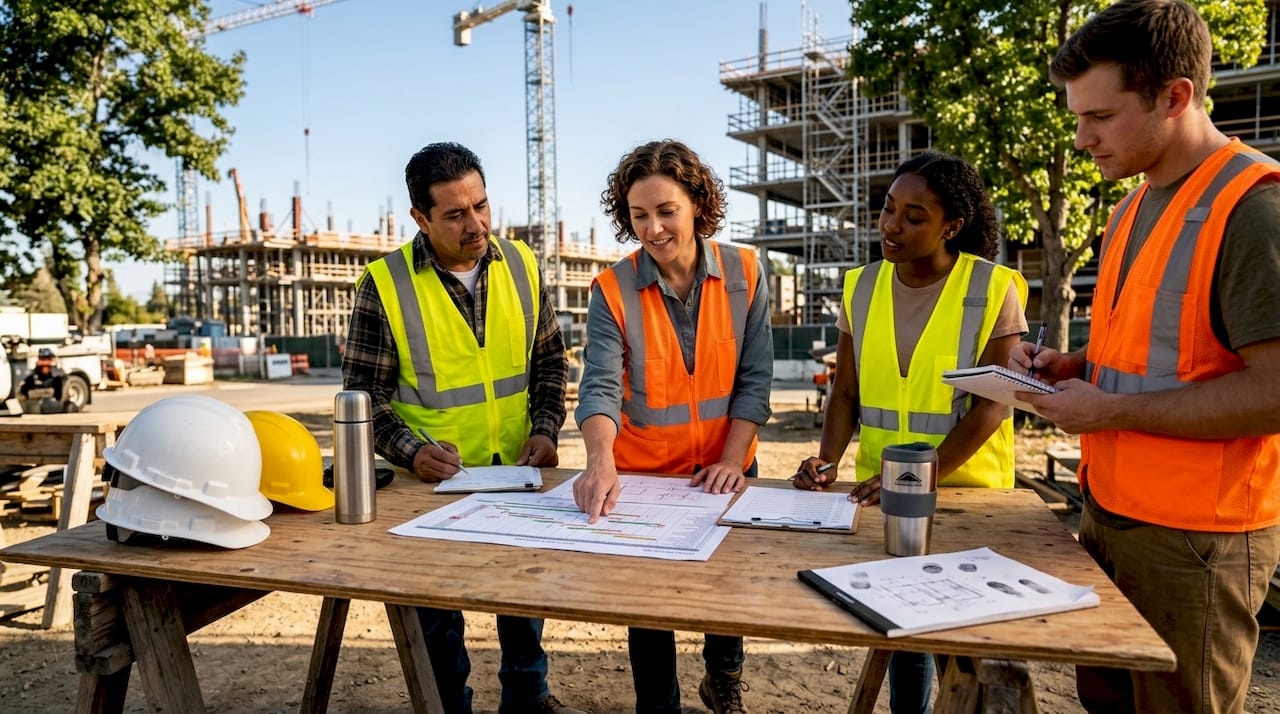
A practical approach is to assign buffer allocations at the phase level rather than applying a single global contingency. This allows project managers to track buffer consumption in real time and make early decisions when a specific phase is at risk of overrunning. Maintaining a formal risk assessment register throughout the project lifecycle provides the documentation needed to justify buffer usage to clients and stakeholders.
4. Conduct constructability reviews before breaking ground
Constructability reviews prevent costly mid-project design conflicts by verifying that the design intent can be physically executed on site within the constraints of the site conditions, structural system, and regulatory framework. Many construction delays trace back to design decisions that looked correct on paper but were not feasible during construction.
A constructability review should assess structural sequencing, temporary works requirements, access constraints, clash detection between building systems, and compliance with authority requirements. Conducting this review before procurement and mobilization eliminates the most expensive category of design errors. The use of BIM modeling services significantly enhances constructability review quality by providing a three-dimensional, coordinated model that exposes spatial conflicts before they become field problems.
5. Define scope boundaries with formal change control
Project scopes frequently fail when they list only deliverables without explicitly stating what falls outside the agreed scope. In construction, this ambiguity creates disputes over who is responsible for items not originally specified, often leading to claims, delays, and fractured client relationships.
Effective scope documentation must include a dedicated “out of scope” section that is reviewed and signed off by all key stakeholders at project initiation. Any addition to scope must follow a formal change request process, including cost and schedule impact assessment before approval. This structure protects both the project team and the client by creating a transparent record of every agreed change.
6. Set milestones that are measurable and meaningful
Milestones spaced every 4-6 weeks maintain team engagement and provide visibility into project progress. The key distinction between effective and ineffective milestones is whether they represent a genuine state change in the project. A milestone should confirm that a specific, verifiable deliverable has been completed, not simply that time has passed.
For construction projects, meaningful milestones might include completion of statutory submission packages, receipt of regulatory approval from a specific authority, completion of piling works, or handover of a coordinated BIM model. Each milestone should have a defined acceptance criterion that all parties agree on before the project starts. Avoid creating milestones that serve only as calendar markers without tied deliverables.
7. Prioritize async communication with structured meeting cadence
An async-first communication model, where routine updates are distributed through documented channels and meetings are reserved for decisions requiring real-time input, reduces coordination overhead significantly in large construction projects.
Weekly site reports, digital RFI logs, shared document repositories, and structured progress dashboards allow team members to stay informed without synchronous attendance. When meetings do occur, they should have a defined agenda, a clear decision objective, and documented outcomes distributed within 24 hours. This discipline is particularly relevant for construction projects involving multiple consultants across different locations or time zones, where scheduling synchronous meetings consumes disproportionate coordination effort.
8. Integrate AI tools with deliberate governance
AI-powered tools now automate status updates, risk detection, and resource leveling, reducing management overhead across complex construction programs. However, at least 30% of AI initiatives are abandoned after proof-of-concept due to inadequate readiness and risk controls, which makes governance as important as capability.
Before deploying AI tools in a construction project management context, define which functions they will support and which will remain under direct human oversight. AI is well-suited to processing large volumes of schedule data, identifying resource conflicts, and generating exception reports. It is not suited to managing stakeholder relationships, interpreting regulatory intent, or making judgment calls on site safety. Maintain clear accountability boundaries and treat AI outputs as inputs to human decision-making, not as decisions themselves.
9. Apply rough but complete monthly resource planning
Rough but complete monthly resource planning is more sustainable over a long project duration than attempting to maintain daily precision across every trade and activity. Over-detailing early-stage resource schedules creates false confidence and consumes planning effort that should be directed at active work fronts.
The practical implication is to plan in sufficient detail to identify critical resource conflicts and procurement lead times, without attempting to schedule every activity to the day three months in advance. As the project progresses and information becomes more reliable, resource plans can be refined incrementally. This approach also allows AI-based project management tools to optimize workloads more effectively, since they perform better with well-structured monthly inputs than with overspecified daily schedules that carry high uncertainty.
10. Avoid common planning pitfalls that derail construction projects
Several recurring errors account for a disproportionate share of construction project failures. Recognizing these patterns in advance allows project managers to build countermeasures directly into the planning structure.
- Unclear decision authority: Projects where approval authority is undefined or diffuse experience approval delays that accumulate into schedule overruns. Define who has final sign-off on each category of decision at project initiation.
- Neglecting temporary works in the schedule: Temporary works design requires its own design, approval, and procurement time. Failing to include these activities in the master schedule creates bottlenecks during construction mobilization.
- Continuing failing projects past the point of recovery: When a project is consistently missing milestones and consuming buffer at an accelerating rate, early intervention is less costly than continued escalation. Establish clear escalation criteria in the project plan that trigger formal project review when specific thresholds are breached.
- Skipping post-project reviews: Lessons learned from completed projects are a direct input to better planning on subsequent projects. Organizations that formalize this process reduce repeat errors and build institutional planning capability over time.
Pro Tip: Celebrate milestone completions formally with the project team. Sustained delivery on large construction projects requires maintaining team motivation over long periods, and recognizing progress at defined intervals reinforces accountability and morale.
My perspective on construction project planning in 2026
In my experience working across construction and infrastructure projects, the single most consistent differentiator between projects that deliver and those that struggle is not the sophistication of the tools in use. It is the quality of the planning discipline applied before a single activity is mobilized.
I have seen hybrid methodologies transform the planning process on projects where rigid sequential scheduling was creating friction between design development and authority submission workflows. The ability to run design coordination in short iterative cycles while maintaining hard gate controls on regulatory submissions is, in practice, the most effective structure for complex construction projects in Singapore’s regulatory environment.
Constructability reviews are, in my view, the most underused tool in the construction planning toolkit. I have worked on projects where a structured review conducted four weeks before procurement saved months of corrective work during construction. The reluctance to invest time in a review that feels premature is precisely what makes it so valuable when it is done properly.
On AI integration, my position is clear. Use it for what it does well. Automate the reporting, the conflict detection, and the resource balancing. But keep human judgment in the seat for any decision that carries regulatory, safety, or stakeholder consequences. The integrated design and coordination advantages that digital tools provide are real, but they require disciplined governance to deliver reliably.
— Aman
How Aman Engineering Consultancy supports your 2026 project planning
Applying the best practices for project planning in construction requires more than a checklist. It requires experienced consultancy support that understands Singapore’s regulatory environment, statutory approval processes, and technical delivery requirements.
Aman Engineering Consultancy provides civil and structural design services, authority approval facilitation, BIM coordination, value engineering, and project management consultancy for construction and infrastructure projects across Singapore and internationally. Whether you are planning a new development or managing a complex redevelopment with multiple authority submissions, Aman Engineering’s team provides the technical and regulatory expertise to keep your project on schedule and in compliance. Contact Aman Engineering Consultancy to discuss your 2026 project planning requirements.
FAQ
What is the recommended schedule buffer for construction projects?
Construction project managers should budget a 10-20% buffer on top of the baseline schedule to accommodate scope creep, resource shortages, and unforeseen site conditions. This buffer should be allocated by phase rather than applied as a single global contingency.
Why are constructability reviews critical in project planning?
Constructability reviews verify that the design can be executed on site before procurement and mobilization begin, preventing the costly mid-project revisions that arise when design conflicts are discovered during construction. BIM-assisted reviews are particularly effective at identifying spatial clashes across building systems.
How should AI tools be used in construction project management?
AI tools are best applied to automating status reporting, identifying resource conflicts, and generating risk alerts. They should not replace human judgment on regulatory compliance decisions, safety assessments, or stakeholder management, as at least 30% of AI initiatives are abandoned when governance frameworks are not established before deployment.
What makes a project milestone effective?
An effective milestone represents a verifiable state change in the project, with a defined acceptance criterion agreed upon by all parties. Milestones spaced 4-6 weeks apart maintain engagement and provide consistent progress visibility without creating administrative overhead from excessive checkpoint frequency.
How does poor scope definition affect construction projects?
When project scopes do not explicitly define what is excluded, disputes over responsibility for unspecified items are predictable. Formal change control processes, combined with a signed-off out of scope section, protect both client and project team by creating a documented record of every agreed variation.