

Urban planning regulations explained in clear, actionable terms are not merely an academic exercise. They are the operational foundation upon which every successful development project is built. For urban planners, architects, and policy makers, misreading a zoning ordinance or overlooking an overlay district can delay a project by months, trigger costly redesigns, or result in outright permit denial. This guide breaks down the core legal frameworks, interprets key regulatory tools, examines recent legislative reforms, and provides strategies for applying this knowledge to real-world development projects.
Table of Contents
- Key takeaways
- Urban planning regulations explained: core legal frameworks
- Recent reforms reshaping regulatory frameworks
- Reading zoning maps and ordinances accurately
- Navigating regulatory challenges in urban development
- Expert perspective on regulation and urban development
- How Com supports regulatory compliance in urban projects
- FAQ
Key takeaways
| Point | Details |
|---|---|
| Zoning maps are not sufficient alone | Cross-referencing maps with ordinance text and overlays determines true development feasibility. |
| Legislative reforms are reshaping compliance | Recent laws in Oregon, Florida, and Pennsylvania are redefining timelines, affordability mandates, and local authority. |
| Form-based codes reduce approval risk | Predictable zoning frameworks replace discretionary reviews and significantly shorten project timelines. |
| Comprehensive plans set the policy baseline | Rezoning requests inconsistent with adopted comprehensive plans face denial regardless of existing zoning designations. |
| Early engagement prevents costly delays | Aligning proposals with regulatory frameworks before submission reduces opposition, appeals, and revision cycles. |
Urban planning regulations explained: core legal frameworks
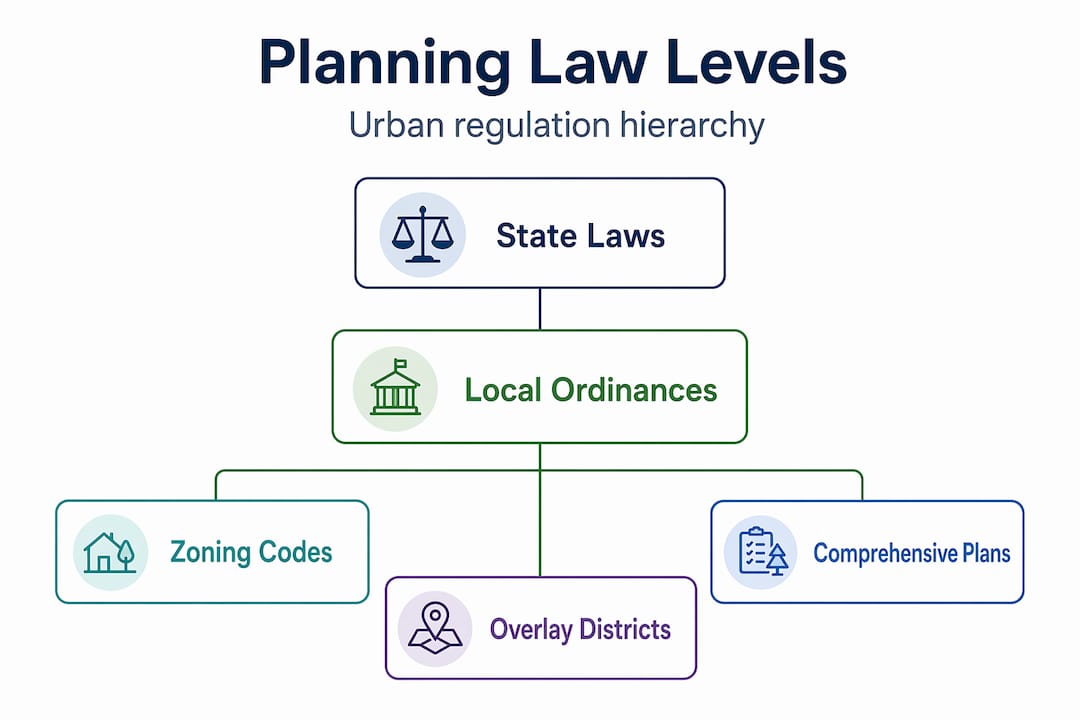
Urban planning regulations constitute the body of law, policy, and administrative procedure that governs how land is used, what structures may be built, and how cities grow over time. Understanding urban zoning begins with recognizing that these regulations operate across multiple governmental levels simultaneously: federal environmental statutes, state enabling legislation, and locally adopted zoning codes and ordinances.
At the local level, zoning is the primary tool. The two dominant models are:
- Euclidean zoning: The traditional approach, which separates land uses into distinct categories such as residential, commercial, and industrial. Traditional zoning reduces nuisances between incompatible uses but can restrict housing supply and drive up costs.
- Form-based codes: A regulatory approach that prioritizes the physical form of buildings and public spaces over use. Form-based codes specify building height, setbacks, facade articulation, and streetscape requirements, allowing a mix of uses within defined parameters.
Beyond base zoning, the regulatory framework includes several additional instruments:
- Comprehensive plans: Long-range policy documents that articulate a community’s vision for land use, transportation, housing, and infrastructure. These plans are not legally binding in the same way zoning ordinances are, but they carry substantial authority. Rezoning requests that conflict with an adopted comprehensive plan routinely face denial by planning commissions and councils.
- Land use codes: Codified regulations that specify permitted uses, dimensional standards including setbacks, height limits, floor area ratio (FAR), and lot coverage, as well as procedural requirements for approvals.
- Overlay districts: Additional regulatory layers applied to base zoning designations. These overlays impose supplemental requirements or offer incentives for specific geographic areas.
The regulatory framework in city planning also involves state enabling statutes, which authorize local governments to adopt zoning codes in the first place. Without state authorization, a municipality lacks the legal power to enforce land use controls. Federal law intersects with local zoning through environmental statutes like the National Environmental Policy Act (NEPA) and the Clean Water Act, which impose procedural and substantive requirements on development projects affecting wetlands, floodplains, or other regulated resources.
Recent reforms reshaping regulatory frameworks
The urban planning laws overview is not static. Legislative reforms enacted across multiple states in recent years have materially altered how regulations function in practice. Three recent examples illustrate the scale and direction of change.
Oregon HB 4037 directly addresses one of the most disruptive elements of the permitting process: third-party appeals. Third-party appeals typically add 4 to 6 months to project timelines, creating significant financial and scheduling risk for developers and public agencies alike. HB 4037 restricts appeal rights to applicants only and reforms the urban reserves process to improve predictability for long-range planning.
Florida’s Live Local Act represents a state-level preemption of local zoning authority in pursuit of housing affordability. Under this statute, multifamily developments on commercially zoned land must include at least 40% affordable units affordable for a minimum of 30 years at 120% of the area median income. Local zoning restrictions that would otherwise prohibit such development are preempted, meaning municipalities cannot use their codes to block qualifying projects. The companion Yes In God’s Backyard (YIGBY) provisions extend similar treatment to faith-based landowners seeking to develop affordable housing.
Pennsylvania’s Municipalities Planning Code (MPC) is currently under legislative review. The existing MPC, rooted in 1960s-era statutory language, has produced a fragmented patchwork of local regulations that is widely cited as a contributing factor to a projected shortage of 185,000 housing units by 2035. The review process is examining how to modernize local control mechanisms while addressing the housing supply deficit through more consistent statewide standards.
These reforms collectively reflect a broader trend in urban planning law: state legislatures are increasingly willing to preempt or constrain local discretion where housing affordability and supply are at stake. For planners and architects operating across multiple jurisdictions, tracking these legislative developments is a professional obligation, not an optional activity.
Reading zoning maps and ordinances accurately
One of the most consequential misunderstandings in regulatory practice is treating zoning maps as definitive determinations of development potential. Zoning maps are regulatory legal documents that indicate what uses are currently permitted on a parcel, but they represent only the starting point of regulatory analysis.

The following table distinguishes the primary document types practitioners must understand:
| Document | Legal status | Primary function | Limitations |
|---|---|---|---|
| Zoning map | Legally binding | Shows current use designations by parcel | Does not capture overlays, dimensional standards, or conditional uses |
| Zoning ordinance | Legally binding | Defines permitted uses, FAR, height, setbacks | Requires detailed cross-referencing with map designations |
| Comprehensive plan | Policy document | Guides long-range land use and growth | Not directly enforceable but influences rezoning decisions |
| Future land use map | Policy guide | Indicates long-term growth intent | Does not reflect current legal entitlements |
Seattle’s zoning framework illustrates the complexity clearly. A parcel may appear developable based on its base zone designation, yet an environmental overlay or a historic district overlay may impose restrictions that fundamentally alter what can be built. Overlay districts can restrict building height below the base zone maximum, require design review, mandate preservation of existing structures, or incentivize transit-oriented density through bonus FAR provisions.
Pro Tip: When evaluating a site, always map applicable overlays before assessing base zone capacity. Overlay districts impose additional restrictions or incentives over base zoning, and failure to identify them early in project analysis leads to redesign after significant time and resources have been committed.
For zoning ordinance interpretation, practitioners must examine the following components systematically:
- Permitted uses versus conditional uses: Permitted uses proceed by right; conditional uses require a discretionary hearing and specific findings.
- Dimensional standards: These include minimum lot size, maximum FAR, height limits, front and rear setbacks, and lot coverage maximums.
- Definitions section: Technical terms defined in the ordinance control interpretation of all substantive provisions. Relying on common-language meanings without consulting the definitions section is a frequent source of regulatory error.
Comprehensive plans set policy aspirations that must align with any proposed zoning changes. A rezoning request inconsistent with the adopted comprehensive plan faces a high probability of denial, regardless of how compatible the proposed use might appear on the ground.
Navigating regulatory challenges in urban development
Knowing how to navigate planning regulations requires more than regulatory literacy. It demands strategic project management aligned with the realities of discretionary approval processes.
The following sequence describes a compliance-oriented approach that reduces approval risk and project delays:
- Conduct a pre-application regulatory audit. Before any design work commences, identify the full regulatory framework applicable to the site: base zoning, overlays, applicable state statutes, and relevant provisions of the comprehensive plan.
- Assess alignment with the comprehensive plan. Confirm that the proposed use and density are consistent with the future land use designation. If they are not, determine whether a plan amendment is feasible before proceeding with a rezoning application.
- Identify the approval pathway. Determine whether the project proceeds by right, requires a conditional use permit, or necessitates a variance. Each pathway has distinct timelines, evidentiary standards, and appeal exposure.
- Engage stakeholders before formal submission. Predictable zoning frameworks reduce discretionary processes, but where discretion exists, early engagement with neighbors, community groups, and agency staff substantially reduces opposition-driven delays.
- Document regulatory compliance rigorously. Every finding required for approval must be addressed explicitly in the application. Incomplete or ambiguous submissions invite requests for additional information that extend timelines.
Pro Tip: Align the project’s design narrative with the specific approval criteria in the ordinance. Planning commissions make decisions based on enumerated findings. An application that maps project characteristics directly to each required finding gives decision-makers the framework to approve with confidence.
The engineering compliance practices required throughout the construction phase must also be anticipated during the planning stage. Conditions attached to planning approvals frequently impose design, construction, and inspection obligations that must be built into project schedules and budgets. Failing to account for these downstream requirements at the planning stage creates execution risk at the construction phase.
Expert perspective on regulation and urban development
I have spent years working at the intersection of engineering, architecture, and regulatory compliance, and the most consistent finding is this: professionals who treat regulations as obstacles tend to encounter far more of them.
In my experience, the shift toward form-based and predictable zoning codes is one of the most consequential changes in planning practice over the past two decades. When approval depends on clear, objective standards rather than discretionary judgment, project timelines become plannable. Risk becomes quantifiable. Design decisions become grounded in specific regulatory parameters rather than political speculation.
What I find underappreciated is the relationship between a city’s visual character and its zoning model. Euclidean zoning, by separating uses and mandating parking minimums, produced the car-dependent suburban pattern that many jurisdictions are now actively trying to retrofit. Form-based codes produce walkable, mixed-use environments because the code itself encodes those physical outcomes. The regulation shapes the city, whether or not practitioners consciously recognize that relationship.
The hardest lesson I have observed practitioners learn is that reading the map is not reading the regulation. A parcel that appears straightforward on a zoning map may carry overlays, development agreements, or recorded conditions that fundamentally constrain what can be achieved. The ordinance text, the comprehensive plan, and the project history of adjacent parcels all belong in the initial site analysis.
For policy makers reviewing questions about urban planning laws, the evidence from Oregon, Florida, and Pennsylvania all points in one direction: the cost of regulatory uncertainty is borne disproportionately by housing supply. Reducing that uncertainty through clearer codes and streamlined appeals is not a concession to developers. It is a public interest outcome.
— Aman
How Com supports regulatory compliance in urban projects
For urban planners, architects, and developers operating within complex regulatory frameworks, having a technically informed consultancy partner at the outset of a project materially reduces compliance risk and approval timelines.

Com, operating as Aman Engineering Consultancy, provides specialized support across the full spectrum of regulatory compliance requirements relevant to urban development projects. Services include statutory submissions to agencies such as URA, BCA, JTC, HDB, SCDF, PUB, and LTA, as well as compliance documentation support and regulatory review at each project phase. Com’s expertise in architectural design and masterplanning directly supports alignment between project design and applicable planning codes. For teams managing projects across multiple regulatory jurisdictions, Com’s consultancy services offer the technical depth and procedural knowledge required to keep approvals on schedule.
FAQ
What is the difference between a zoning map and a future land use map?
A zoning map is a legally binding regulatory document that specifies permitted uses on each parcel today. A future land use map is a policy guide reflecting long-term growth intentions within a comprehensive plan and does not confer current development rights.
How do overlay districts affect development approvals?
Overlay districts impose additional regulatory requirements or incentives on top of base zoning designations. They can restrict height, require design review, mandate preservation standards, or offer density bonuses in transit-oriented areas, and they must be analyzed alongside base zone standards.
How do recent state reforms affect local urban planning regulations?
Reforms such as Oregon’s HB 4037 and Florida’s Live Local Act demonstrate that state legislatures are increasingly preempting local zoning authority, particularly to address housing affordability. Local planners must monitor state legislative developments as they can override locally adopted codes.
What is the impact of third-party appeals on development timelines?
Third-party appeals in land use permitting add 4 to 6 months to project schedules on average, representing a significant source of entitlement risk. Legislative reforms targeting appeal standing, such as Oregon’s HB 4037, are specifically designed to reduce this exposure.
Why do rezoning requests get denied even when adjacent uses appear compatible?
Rezoning decisions are evaluated against the adopted comprehensive plan. A request that conflicts with the plan’s future land use designation will typically be denied, regardless of surrounding uses, because the comprehensive plan represents the community’s formally adopted policy framework for land use decisions.
Recommended
- How Professional Engineers Ensure Compliance With Regulatory Requirements In Construction Projects – Aman Engineering Consultancy
- Hacking Walls in HDBs: Why You Need a Professional Engineer – Aman Engineering Consultancy
- Architectural Design and Masterplanning for Landed Housing – Aman Engineering Consultancy
- Streamlining PTU Applications with Professional Engineer Expertise for Temporary Structures – Aman Engineering Consultancy