
HDB Floor Leveling & Screeding: How Much Can You Raise Your HDB Floor?
SEO Metadata Configuration
SEO Title: HDB Floor Leveling & Screeding: How Much Can You Raise Your HDB Floor Before HDB Says No?
Focus Keyphrase: HDB floor leveling and screeding
Tags: HDB Floor Leveling, Screeding, Raise HDB Floor, Pre Packed Screed, HDB Regulations
Meta Description: Discover comprehensive HDB floor leveling regulations. Learn about screeding limits, maximum thickness rules, and pre-packed screed mandates for safe renovations.
Introduction to HDB Floor Leveling
HDB floor leveling is a highly critical renovation phase. It forms the foundation of any successful housing upgrade. Consequently, strict HDB regulations govern this essential structural process. Many homeowners ask how much they can raise floors.
The exact answer depends on precise structural loading limits. Specifically, HDB enforces absolute maximum thickness guidelines.1
Screeding provides a smooth base for all floor finishes. Therefore, a perfectly even subfloor is absolutely crucial. An uneven floor causes premature wear and aesthetic defects.2
Consequently, professional screeding ensures long-term structural longevity.3 Without adequate floor leveling, premium vinyl or tiles fail. Indeed, poor subfloors cause many modern flooring defects.2
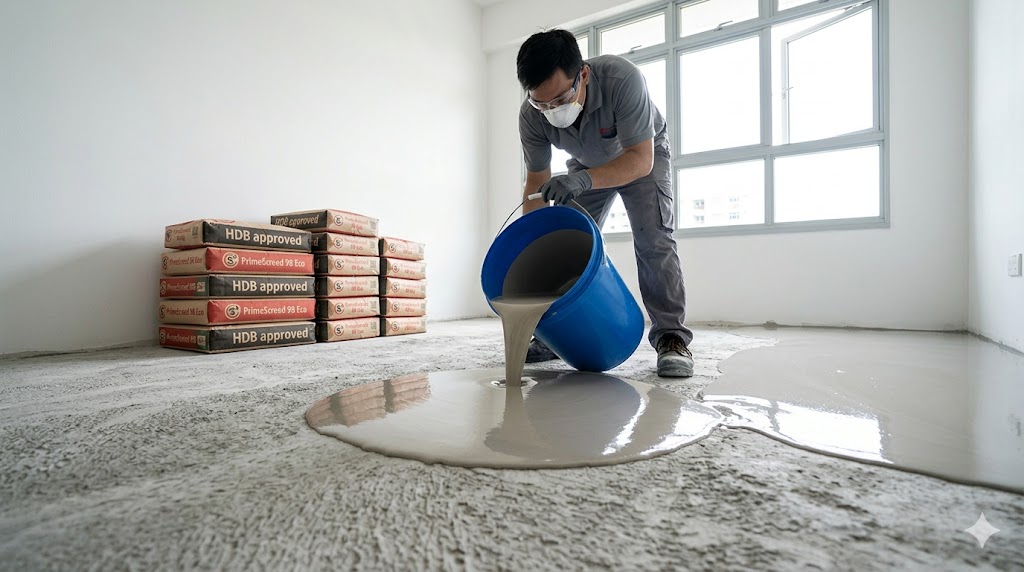
Historically, contractors mixed cement and sand manually onsite. However, HDB regulations now explicitly mandate pre-packed screed.4 This rule applies to all dry areas during renovations.
This shift ensures consistent material quality across all units. Additionally, it prevents contractors from using incorrect mixture ratios.5 Thus, precise adherence to material guidelines is strictly mandatory.
Raising a floor introduces significant heavy dead weight. Consequently, excessive flooring material threatens overall building stability.
Therefore, homeowners must secure official permits before commencing.2 Unapproved floor modifications trigger severe financial and legal penalties. Furthermore, HDB registered renovation contractors must manage these works.6
This comprehensive report details all HDB floor leveling parameters. Furthermore, it explores exact screeding and self-leveling technical differences. It outlines precise permissible heights and structural load limits.
Moreover, it examines strict mandatory pre-packed material regulations. Finally, it analyzes the demerit point system for contractors.
Structural Load Limits and Floor Weight
Every high-rise building possesses maximum permissible load capacities. Consequently, HDB strictly limits the weight of internal floors. The permissible imposed load is exactly .7 In practical terms, this equals roughly .7 This strict limit prevents catastrophic overloading of concrete slabs.9
Concrete remains an exceptionally heavy building material. Therefore, raising an HDB floor adds massive weight rapidly. Exceeding places extreme stress on structural columns.8 Consequently, HDB strictly prohibits using concrete for raising balconies.9 Homeowners must prioritize approved lightweight materials to ensure safety.
Moreover, dynamic demolition forces pose severe structural risks. Hacking existing floors requires precise, controlled impact energy. Therefore, HDB regulations limit the permitted demolition tools strictly. Specifically, the gross weight of hacking tools is restricted. Tools cannot exceed a maximum weight of 7kg.10
Mechanical impact energy is governed by specific mathematical formulas.10 These limits prevent dangerous vibrations affecting neighboring flats.
Consequently, sledgehammers are completely banned from HDB flats.10 Heavy-duty pneumatic equipment is similarly prohibited during renovations.10 These excessive forces easily crack lower-floor concrete slabs. Thus, adhering to these rules guarantees multi-story structural safety.
The Golden 50mm Maximum Thickness Rule
Thickness represents the primary constraint for floor leveling. HDB mandates a strict maximum combined flooring thickness. Specifically, screed and floor finishes must not exceed 50mm.1 This is the golden rule of HDB floor leveling.12 Breaching this 50mm limit compromises structural safety immediately.
Why does HDB enforce this exact 50mm metric? Firstly, it aligns with the load limit. A 50mm mortar layer approaches this absolute weight threshold. Secondly, excess thickness negatively alters internal door clearances. Consequently, thicker floors interfere with door thresholds and mobility.13
| Flooring Material Layer | Standard Thickness | Impact on 50mm Limit |
| Pre-packed Cement Screed | 30mm to 45mm | Consumes maximum available allowance |
| Self-Leveling Compound | 2mm to 5mm | Very minimal structural impact |
| Modern Vinyl Overlay | 3mm to 8mm | Fits safely within limits 12 |
| Heavy Ceramic Tiles | 10mm to 15mm | High risk of breaching limit |
Therefore, existing floor finishes must often be hacked completely.1 Overlaying heavy ceramic tiles usually breaches the 50mm limit.12 Removing original finishes ensures new layers remain legally compliant. However, the original rough cement screed must remain covered.1
Vinyl flooring is ideal for HDB floor leveling works. Modern vinyl features an ultra-thin 3mm to 8mm profile.12 Consequently, it perfectly satisfies the 50mm total thickness rule.12 Furthermore, vinyl adds extremely minimal structural dead load.12 Thus, it completely fulfills stringent HDB safety regulations perfectly.
Floor Leveling Versus Cement Screeding
Homeowners frequently confuse floor leveling and cement screeding. However, they serve distinctly different structural and architectural purposes.14 Screeding establishes the primary height and foundational base.
Conversely, floor leveling refines this base to microscopic smoothness. Understanding this difference ensures successful HDB floor leveling renovations.
Screeding utilizes a thick mixture of cement and sand. This coarse layer typically ranges from 30mm to 50mm.14
It effectively brings raw concrete slabs to required heights.14 Additionally, screed safely covers utility pipes and uneven contours.14 It uses fine sand aggregates for a workable finish.14
Alternatively, self-leveling compounds are specialized, highly fluid chemical mixes. These compounds correct minor subfloor imperfections with extreme precision.15 They are applied very thinly at 3mm to 5mm.14 The liquid mixture settles itself perfectly flat via gravity.15 Consequently, self-leveling creates a flawless surface for delicate finishes.
Modern flooring demands incredibly flat surfaces to survive long-term.14 Large-format porcelain tiles require near-perfect floor leveling.
Therefore, HDB regulations strictly limit allowable subfloor deviations. Surface variances must remain under 3mm across 3 meters.14 Many premium brands require deviations under 2mm over 2 meters.14
Thus, both processes are frequently required for BTO flats. Contractors apply thick pre-packed screed for gross height first. Subsequently, thin self-leveling compounds ensure absolute surface perfection. This methodology prevents hollow spots and protects material warranties.14
The Pre-Packed Screed Industry Mandate
HDB floor leveling fundamentally changed in June 2015. HDB officially mandated using pre-packed screed exclusively.4
This rule applies specifically to all dry area renovations.4 Consequently, contractors cannot mix raw cement and sand onsite. This regulation significantly elevated Singaporean interior renovation quality standards.
Pre-packed screed is factory-blended to mathematically precise proportions.6 Workers simply add predetermined water amounts on the site.6
This automated proportioning prevents dangerous human errors during mixing.14 Previously, errant contractors used excess sand to cut costs.5 Unfortunately, poor ratios caused tiles to pop and crack.5
| Advantage of Pre-Packed Screed | Structural and Environmental Impact |
| Exact Factory Mixing Ratios | Guarantees maximum durability and prevents tile hollowness 5 |
| Advanced Chemical Additives | Provides enhanced bonding strength to raw concrete slabs 14 |
| Dust Emission Reduction | Significantly lowers environmental debris in public estates 6 |
| Worker Time Efficiency | Speeds up overall renovation timelines for anxious homeowners 14 |
Furthermore, this mandate reduces environmental nuisance in HDB estates. Site-mixing generated massive silica dust clouds in common corridors.
Therefore, pre-packed material provides a vastly cleaner renovation environment.6 Additionally, it improves worker productivity by eliminating material preparation.6
However, this mandatory requirement increases overall renovation costs slightly. Pre-packed bags cost more than bulk sand and cement.16
Estimates suggest an increased cost of $1 per square foot.16 For standard 4-room flats, this adds roughly $900.16 Nevertheless, the guaranteed structural reliability justifies this initial investment completely.
Step-by-Step Leveling Workflow Timeline
Proper HDB floor leveling requires strict adherence to timelines. Rushing drying processes traps dangerous moisture beneath final floors. Consequently, this trapped moisture inevitably warps expensive vinyl finishes.
A standard screeding and leveling project requires ten days.15 Homeowners must ensure water and electricity are activated beforehand.15
The installation process follows a sequential, highly structured timeline. Firstly, Day 1 involves delivering all pre-packed leveling materials.15 Secondly, Days 2 and 3 involve hauling and laying screed.15 Thirdly, Days 4 and 5 are strictly reserved for drying.15 Exact drying durations depend heavily on ambient weather conditions.15
| Renovation Project Phase | Estimated Duration | Primary Construction Activity |
| Phase 1 Operations | 1 Day Only | Material delivery and site preparation 15 |
| Phase 2 Operations | 1 to 2 Days | Application of main cement screed layer 15 |
| Phase 3 Operations | 1 to 2 Days | Initial drying of the cement screed 15 |
| Phase 4 Operations | 1 Day Only | Pouring of self-leveling fluid compound 15 |
| Phase 5 Operations | 1 to 2 Days | Secondary drying of the leveling compound 15 |
| Phase 6 Operations | 1 to 2 Days | Laying of the final vinyl overlay 15 |
On Day 6, contractors pour specialized self-leveling fluid compounds.15 This liquid seeks its own level across the room. Subsequently, Days 7 and 8 allow this layer to cure.15 Finally, Days 9 and 10 involve laying the vinyl.15
Skipping drying phases violates essential construction best practices heavily. Therefore, professional contractors utilize advanced moisture meters before overlaying. Proper surface priming also prevents debonding of self-leveling layers.3 Ultimately, patience guarantees a flawless, long-lasting, risk-free floor.17
Height Calculation Methodologies
Calculating exact screed thickness demands precise architectural measurement skills. Contractors cannot arbitrarily pour screed across an empty flat. They must align new floors with existing architectural thresholds. Specifically, the final floor must align perfectly with entrances.15 Incorrect calculations create dangerous tripping hazards at every door.
The calculation process utilizes a deductive, systematic mathematical approach.15 Firstly, contractors measure the raw floor base at entrances.15 This includes main doors, kitchens, and all toilet entrances.15 Secondly, they identify the highest reference point among measurements.15 This highest point dictates the baseline for the flat.
Thirdly, contractors deduct exact thicknesses of final top layers.15 They subtract the thickness of the chosen floor finish. Additionally, they deduct the thickness of self-leveling underlayment layers.15 The remaining mathematical value dictates precise cement screeding heights.15
Consider a practical example of this structural height deduction. Suppose the highest measured entrance height is exactly 55mm.15 The selected modern vinyl flooring is exactly 5mm thick.15 Furthermore, self-leveling compound requires a standard 2mm thickness layer.15
- Initial Starting Height: 55mm
- Deduct Vinyl Layer: – 5mm
- Deduct Leveler Layer: – 2mm
- Final Screed Target: 48mm.15
This calculated 48mm target remains under the 50mm limit. Consequently, this precise methodology ensures perfect HDB regulation compliance. Additionally, there is no minimum height limit for flats.15 Contractors safely accommodate specific leveling requirements within maximum bounds.15
Wet Area Waterproofing and Screeding
Wet areas demand significantly more rigorous HDB leveling regulations. Bathrooms, kitchens, and balconies face constant liquid moisture exposure.
Therefore, standard dry screed is completely insufficient for these zones. HDB strictly mandates pre-packed waterproofing screed in these areas.1 This specialized screed prevents severe structural water damage effectively.
Furthermore, contractors must install dedicated waterproofing membranes in bathrooms.1 This membrane forms an impenetrable barrier against downward seepage. Crucially, membranes must be upturned against all adjacent walls.1
The mandated minimum upturn height is exactly 150mm.1 This prevents dangerous capillary action traveling upward through concrete.
For kitchens and balconies, specific waterproofing requirements differ slightly. Pre-packed waterproofing screed remains strictly mandatory before laying finishes.1
However, membrane upturns are only required around sanitary stacks.1 Specifically, upturns must cover a 400mm radius around pipes.1 Additionally, contractors must use UPVC floor trap gratings.1
| Wet Area Zone | Mandatory Waterproofing Requirement | Specific HDB Regulation Detail |
| Bathrooms and Toilets | Waterproofing Screed & Membrane | Minimum 150mm upturn on all walls 1 |
| Kitchens | Waterproofing Screed & Membrane | 150mm upturn around 400mm pipe radius 1 |
| Open Balconies | Waterproofing Screed Only | Lightweight blocks required for leveling 1 |
| Floor Traps (All) | UPVC Grating Installation | Long collars must be utilized 1 |
Importantly, new BTO owners face a strict 3-year restriction.18 They cannot remove bathroom wall or floor tiles entirely.9
This ensures original waterproofing membranes settle without structural disturbance.18 However, overlaying existing tiles remains permitted without hacking them.18 Finally, contractors must conduct a mandatory water test afterwards.6
Balcony Leveling and Exterior Aesthetics
Balcony floor leveling introduces unique structural weight challenges frequently. Homeowners often wish to level balconies with living rooms.
However, using standard concrete to raise balconies is forbidden.9 Topping up balconies requires lightweight screed or specialized blocks.4 This explicitly prevents exceeding the dead load limit.9
Moreover, raising a balcony floor affects critical exterior safety. HDB regulations demand minimum parapet or window sill heights.1
This height must remain exactly 1000mm from finished floors.1 Leveling the floor dangerously reduces this essential barrier height. Thus, safety regulations heavily dictate balcony floor leveling limits.
Aesthetics also play a major role in balcony renovations. Homeowners cannot alter the external facade of the building.8
Painting the external parts of the balcony is prohibited.6 Furthermore, specific DBSS flats have strict external appearance rules.21 Changing balcony sliding doors requires explicit prior HDB approval.9
However, enclosing the balcony for safety is generally permitted.21 Homeowners may install invisible grilles or approved grille designs.9
Placement of non-reflective solar films on sliding doors is allowed.9 Nevertheless, installing unauthorized full-height glass panels constitutes a legal breach.21 This requires immediate removal to avoid severe legal action.21
Household Shelter Specific Constraints
The Household Shelter (HS) serves as a civil defense bunker. Consequently, the Singapore Civil Defence Force strictly regulates modifications.1
These shelters feature highly strengthened reinforced concrete walls.1 Therefore, standard renovation practices are strictly prohibited within them.
Homeowners cannot hack or drill into HS floor slabs.21 Any action weakening the reinforced structure is a severe offense.
However, laying basic floor finishes is permitted without permits.1 Nevertheless, these finishes must adhere to highly restrictive conditions.1
Firstly, floor tiles must be bonded using wet cement.1 Laying floor finishes using chemical adhesives is strictly prohibited.1
Adhesives may fail or release toxic fumes during emergencies. Secondly, total thickness of finishes cannot exceed exactly 50mm.1 This precisely mirrors the standard HDB floor leveling limit.
| SCDF Household Shelter Rule | Regulatory Condition | Strategic Safety Rationale |
| Floor Hacking / Drilling | Strictly Prohibited Indiscriminately | Maintains bunker structural integrity 1 |
| Tile Bonding Agent | Wet Cement Mortar Only | Prevents failure during emergencies 1 |
| Flooring Adhesives | Strictly Not Allowed | Avoids toxic emissions and weak bonds 1 |
| Floor Skirting | Maximum 100mm height limit | Prevents structural wall interference 1 |
| Door Notices & Seals | Cannot tamper or cover | Maintains essential wartime information 21 |
Additionally, homeowners cannot lay a second layer of finishes.1 All infill materials used must be entirely non-combustible.1
If laying floor skirting, it cannot exceed 100mm high.21 Pre-packed material is completely mandatory for allowable leveling works.1 Ultimately, the HS must remain fully operational for emergencies.1
Furthermore, false ceilings within the HS have specific rules. If installed below ventilation sleeves, access panels are required.21
These panels must measure a minimum of 600mm by 600mm.21 At least 25% of ventilation must remain unobstructed peacetime.13 Power-driven nails are only allowed on the external face.21
Raised Hardwood Platforms and Ceiling Limits
Beyond standard screeding, homeowners frequently construct raised hardwood platforms. These structures alter the functional floor level space significantly. While permitted, HDB regulations impose strict structural height constraints.1 Platforms drastically change dynamic loading and spatial volume parameters. Therefore, strict safety protocols govern their height and construction.
The most critical regulation involves absolute vertical ceiling clearance. HDB mandates a minimum recommended room height of 2.4m.1
Specifically, there must be 2.4m from platform to ceiling.22 If a false ceiling exists, the 2.4m clearance applies.22 This rule ensures ventilation and prevents claustrophobic living conditions.24
| Platform Architectural Element | Minimum Clearances | Baseline Measurement Point |
| Upper Floor Slab Underside | 2.6 meters | Top of raised platform 22 |
| False Ceiling Underside | 2.4 meters | Top of raised platform 22 |
| Window Sill and Parapet | 1.0 meter | Top of raised platform 1 |
| Pelmet Minimum Clearance | 2.1 meters | Finished floor level base 1 |
Furthermore, raised platforms heavily interact with window safety regulations. The distance from platform tops to windows is monitored.
A minimum 1-meter safety barrier height is legally required.1 This absolutely prevents accidental falls from elevated floor structures. Consequently, overly high platforms near windows are routinely rejected.
Crucially, HDB strictly bans utilizing platform voids for storage.1 Homeowners cannot build hidden drawers beneath hardwood platform beds.25 This regulation stems directly from the load limit.19 Filling platform voids with heavy items exceeds safe weights. Thus, sides must be sealed, and voids left empty.1 Concrete platforms are also an absolute, complete no-go.23
Architectural Anomalies and Void Coverages
HDB features unique architectural variations requiring special floor regulations. Specifically, maisonettes and loft units possess distinct double-volume spaces.
These units boast impressive ceiling heights up to 5m.27 Consequently, homeowners often attempt to maximize this vertical space. However, HDB regulations specifically address these double-volume architectural voids.
Homeowners cannot extend their floor area by covering voids.6 The double-volume staircase area within maisonettes must remain untouched.8 Absorbing these voids to create bigger floor areas is illegal.8
This strict rule preserves the original structural weight calculations. Adding new floor slabs over voids severely compromises integrity.
Furthermore, false ceilings and cornices must use non-combustible materials.1 Plastering ceilings is strictly forbidden due to falling hazards.9
Partitioning spaces with combustible materials like plywood is prohibited.9 Safety remains the absolute highest priority during spatial renovations.
Additionally, enclosing gas pipes within false ceilings is prohibited.1 Service access and proper ventilation must be constantly maintained.13
When installing mechanical mountings into walls, strict limits apply. All fasteners, screws, and nails have exact penetration limits. They must not exceed 6mm diameter and 40mm depth.6 This prevents puncturing concealed sanitary or electrical piping systems.9
Demolition Dynamics and Noise Constraints
Removing existing floors before screeding creates massive structural vibrations. Unregulated demolition severely compromises the safety of older buildings.
Therefore, HDB meticulously regulates all hacking and demolition activities. Homeowners must obtain written approval before commencing any demolition.6 Unauthorized hacking potentially endangers the entire public housing block.6
Demolition tools are restricted by exact mechanical weight limits. The gross weight of any hacking tool is 7kg.10 Furthermore, mechanical impact energy is governed by specific math. Maximum impact energy cannot exceed 50 kgj per stroke.10
Additionally, the full load impact rate is heavily restricted. It cannot exceed 23,500 j/min under any specific circumstances.10
Consequently, sledgehammers are completely banned from HDB flat renovations.10 Heavy-duty pneumatic equipment is similarly prohibited due to vibrations.10
These excessive forces easily crack lower-floor structural concrete slabs. Thus, adhering to these tool rules guarantees multi-story safety.
Noise pollution represents another severe concern during floor renovations. HDB imposes a strict 65dB acoustic limit for impact sounds.28 Furthermore, works generating severe noise have strict permitted hours.10
Demolishing walls and cutting tiles is heavily restricted chronologically.10 Contractors must strictly comply with permitted times to avoid penalties.6 Proper barricades are also required for external replacement works.10
Renovation Permits and DRC Registration
Navigating HDB floor leveling safely requires managing bureaucratic permit processes. Most significant floor alterations legally require prior written approval.6 For instance, topping up flooring in balconies demands permits.4 Removing existing tile finishes also explicitly requires a permit.20
Homeowners must exclusively engage Directory of Renovation Contractors (DRC) companies.6 Using unlisted contractors for floor leveling is a punishable offense.6 The flat owner assumes ultimate responsibility for all compliance.6 Therefore, flouting rules leads to severe legal and financial consequences.
HDB polices registered contractors through a stringent Demerit Points System.29 This transparent system penalizes contractors for violating HDB regulations.29 Infringements include conducting noisy floor hacking beyond permitted hours.30 Additionally, failing to display renovation notices triggers demerit points.31
| Accumulated Demerit Points | Specified Time Period | Resulting Disciplinary Penalty |
| 24 penalty points | Within 24 consecutive months | 1-year DRC registration suspension 10 |
| More than 24 points | Within 24 consecutive months | 1-year suspension + point rollover 29 |
| Unapproved structural hacking | Immediate discovery | Fines up to maximum $5,000 6 |
If a contractor accumulates 24 points, severe consequences follow.29 HDB will suspend their DRC registration for 12 months.10 Between 2021 and 2022, HDB penalized 61 contractors annually.31 Over three years, roughly 200 errant contractors faced penalties.30 However, none accumulated 24 points in 2023 specifically.31 Consequently, reputable contractors refuse to perform illegal modifications.
Assessing Floor Leveling Economic Costs
Understanding HDB floor leveling requires analyzing the underlying financial costs. HDB ceased providing free goodwill cement screeding in 2014.32 Now, homeowners bear this expense completely during their renovations.32
The mandate for pre-packed materials further elevated baseline pricing.16 Consequently, accurate financial budgeting is absolutely vital for owners.
Screeding costs depend heavily on the total square footage. Standard market rates generally start from approximately $800.34 However, whole-house leveling requires significantly more material and labor. Prices scale linearly with the physical HDB flat size.34
| HDB Flat Configuration | Estimated Total Screeding Cost | Rooms Included in Pricing |
| 2-Room Flat Unit | $1,300 to $1,500 generally | Living area + 1 Bedroom 34 |
| 3-Room Flat Unit | $1,800 to $2,000 generally | Living area + 2 Bedrooms 34 |
| 4-Room Flat Unit | $2,600 to $2,800 generally | Living area + 3 Bedrooms 34 |
| 5-Room Flat Unit | $3,300 to $3,500 generally | Living + Study + 3 Bedrooms 34 |
Self-leveling compounds add another distinct layer of financial cost. These specialized chemicals are significantly more expensive than screed.36 Prices range drastically based on existing subfloor condition variables.36
Deep grinding and complex drainage layouts increase costs significantly.36 Thus, homeowners must budget for both bulk and precision leveling.
Despite high costs, cheap screeding results in disastrous consequences. Poor subfloor preparation caused 65% of local flooring failures.17
Rectifying a cracked subfloor involves completely hacking new vinyl.17 Therefore, investing in professional HDB floor leveling prevents bills. Quality foundational work represents a crucial long-term financial investment.14
The Optional Component Scheme Dynamics
The HDB Optional Component Scheme (OCS) alters floor leveling significantly. OCS is an opt-in program for new BTO buyers.37 It allows homeowners to add finishing costs to mortgages.38 Consequently, buyers can finance these finishes using CPF funds.38
If homeowners select OCS, HDB provides flats with floors.38 HDB handles the waterproofing, cement screeding, and tile installation.37 This entirely eliminates the need for private leveling contractors. Furthermore, it vastly accelerates the timeline for moving in.38 Choosing all OCS options adds roughly $6,000 to $9,000.38
| OCS Flooring Selection | Implications for Homeowner | HDB Regulations Impact |
| Opt-In to OCS Scheme | Floors arrive fully finished and leveled. | Cannot hack tiles for 3 years.37 |
| Opt-Out of OCS Scheme | Flat arrives with raw, uneven concrete. | Must hire private contractor immediately.5 |
| Wet Area Standard Tiles | Pre-installed by HDB automatically. | Hacking voids essential waterproofing warranties.9 |
However, opting into OCS restricts future renovation flexibility significantly. Strict hacking restrictions immediately apply to HDB-laid wet tiles. Specifically, owners cannot hack and retile for three years.37 This ensures waterproofing membranes settle without any structural disturbance.37 Homeowners may only overlay new finishes without exceeding 50mm.37
Conversely, opting out leaves the flat with bare concrete.5 This necessitates hiring direct contractors for comprehensive cement screeding.5 While this requires immediate cash outlay, it offers freedom.39 Homeowners control the exact design and material choice completely.39 Ultimately, owners weigh upfront convenience against long-term custom design goals.
Additional Flooring Material Considerations
Choosing the final floor finish requires careful regulatory consideration. Vinyl flooring remains a highly cost-effective and compliant choice.40 Vinyl is completely impervious to water and highly durable.12 Therefore, it works perfectly for living rooms and kitchens.12 Laminate flooring offers another popular, relatively thin overlay option.35
Conversely, engineered wood provides a genuine timber surface aesthetic. However, it is generally thicker and heavier than vinyl.12 It requires careful measurement to avoid exceeding HDB limits.12 Solid marble or heavy ceramic tiles present the greatest risk. Adding a new layer of heavy tiles breaches rules easily.12 It pushes the floor past the 50mm thickness threshold.12
Furthermore, altering bathroom sanitary fixtures requires strict HDB approval. Changing the position of fixtures involves relocating vital pipes.19 This is not allowed without a specific renovation permit.19 Additionally, installing air-conditioners has distinct safety and load guidelines.18 BCA-trained installers must fit them to handle electrical loads.18 Window replacements also require BCA-approved window contractors explicitly.18
Long-Term Maintenance and Asset Valuation
Strict HDB regulations generate profound long-term building maintenance implications. Firstly, pre-packed screed fundamentally improves overall building structural durability. Factory-mixed compounds resist cracking far better than archaic site-mixing. Consequently, modern HDB slabs experience fewer instances of seepage. This preserves internal steel rebar from corrosive, structural rust heavily.
Secondly, the stringent weight limit prevents microscopic slab deflections. Over decades, excessive dead load causes concrete floors to sag. This sagging creates stress fractures in structural load-bearing walls. By restricting floor thickness to 50mm, HDB mitigates this fatigue. Therefore, these regulations protect the architectural lifespan of estates.
Thirdly, proper floor leveling reduces neighborly disputes over leaks. Perfectly sloped and waterproofed wet areas drain water efficiently.14 Pooling water inevitably punctures weak membranes, leaking downwards constantly. Thus, strict adherence to leveling protocols fosters harmonious community living. It prevents costly, multi-unit legal battles regarding water damage liability.
Finally, compliance directly impacts the future resale flat valuation. Unauthorized platforms or excessive heights trigger failed compliance inspections. Owners must forcefully demolish illegal floor modifications before transacting. This rectifying demolition costs thousands and delays property sales massively. Hence, rigorous adherence to leveling rules secures financial asset value.
Conclusion
HDB floor leveling represents a fundamental pillar of renovations. Raising an HDB floor is never an arbitrary design decision. It is governed by uncompromising mathematical formulas and science. The limit dictates every permissible structural modification strictly. Consequently, the 50mm maximum thickness rule ensures ongoing building viability.
These regulations reflect a massive commitment to public safety. The 2015 mandate for pre-packed screed modernized the industry. It replaced inconsistent manual mixing with precise, factory-engineered reliability completely. Furthermore, stringent SCDF rules protect the vital Household Shelters. Similarly, rigorous window clearance rules prevent tragic falls from platforms.
Navigating this complex landscape requires professional, HDB-registered contractor expertise. Errant contractors face severe demerit points and crippling financial suspensions. Therefore, homeowners must never bypass official permit applications for leveling. The initial cost of professional screeding is undeniably substantial financially. However, it prevents catastrophic failures and protects expensive material warranties.
Ultimately, strict HDB regulations exist to protect residents equally. Proper floor leveling guarantees acoustic insulation and structural safety. Whether utilizing the Optional Component Scheme or private contractors, comply. Adhering to these meticulous guidelines ensures a legally sound home.
Works cited
- Renovation Guidelines for Building Works – Singapore – HDB, accessed May 17, 2026, https://www.hdb.gov.sg/managing-my-home/renovation-and-maintenance/renovation/renovation-guidelines/building-works
- An Easy-To-Understand Guide To HDB Flooring Guidelines – Floorrich, accessed May 17, 2026, https://www.floorrich.com/an-easy-to-understand-guide-to-hdb-flooring-guidelines/
- Floor Screed Singapore: The Essential Guide to Flawless Flooring in 2026, accessed May 17, 2026, https://homeexpo.asia/uncategorized/floor-screed-singapore-the-essential-guide-to-flawless-flooring-in-2026/
- HDB Floor Tiling Rules Every Homeowner Should Know – Leong Yik, accessed May 17, 2026, https://www.leongyik.com.sg/hdb-floor-tiling-rules-every-homeowner-should-know/
- Direct Contractor Cement Screeding and Self-Levelling Packages – Panelcraft, accessed May 17, 2026, https://panelcraft.sg/direct-contractor-cement-screeding-and-self-levelling-packages-bto-cement-flooring-vinyl-screed-plastering-vinyl-flooring-direct-contractor/
- Important Information on Renovations – HDB, accessed May 17, 2026, https://www.hdb.gov.sg/managing-my-home/renovation-and-maintenance/renovation/important-information-on-renovations
- HDB Bathroom Weight Limit: The Complete Guide to Safe Renovations, accessed May 17, 2026, https://www.herabathroom.com/blogs/bathroom-ideas-renovation-guides-in-singapore-hera/hdb-bathroom-weight-limit-the-complete-guide-to-safe-renovations
- 10 Renovation Guidelines HDB Singapore: Weight, structural walls, accessed May 17, 2026, https://www.homeanddecor.com.sg/design/renovation-guidelines-hdb-singapore
- 1.0 GUIDELINES FOR RENOVATION 1.1 GENERAL A) Home owners are required under the Housing & Development (Renovation Control) R – HDB, accessed May 17, 2026, https://www.hdb.gov.sg/-/media/managing-my-home/renovation-and-maintenance/renovation/renovation-guidelines/design-build-and-sell-scheme-dbss-flats/lake-vista-yuan-ching-reno-guidelines.pdf
- Terms and Conditions – HDB, accessed May 17, 2026, https://www.hdb.gov.sg/hdb-renovation-portal/terms-and-conditions
- All The HDB Renovation Guidelines You Should Know | Fineline Design, accessed May 17, 2026, https://fineline.com.sg/all-the-hdb-renovation-guidelines-you-should-know/
- HDB Flooring Overlay Regulations: Your Complete Guide (2026) – Home Expo Asia, accessed May 17, 2026, https://homeexpo.asia/uncategorized/hdb-flooring-overlay-regulations-your-complete-guide-2026/
- 8 HDB Interior Design Rules You Might Be Breaking Without Knowing – The Interior Lab, accessed May 17, 2026, https://www.theinteriorlab.com.sg/hdb-interior-design-rules-you-might-be-breaking/
- Screed 101: The Essential Guide to Floor Leveling in Singapore – Home Expo Asia, accessed May 17, 2026, https://homeexpo.asia/uncategorized/screed-101-the-essential-guide-to-floor-leveling-in-singapore/
- Cement Screeding and Self-Leveling FAQs | Self Leveling Smooth …, accessed May 17, 2026, https://panelcraft.sg/faqs/for-floors/cement-screeding-self-leveling-faqs/
- New Hdb Guideline For Prepacked Screed – Renovation Packages – RenoTalk.com ™, accessed May 17, 2026, https://www.renotalk.com/forum/topic/71561-new-hdb-guideline-for-prepacked-screed/
- Cement Screed in Singapore: The Homeowner’s 2026 Guide to Flawless Floors, accessed May 17, 2026, https://homeexpo.asia/uncategorized/cement-screed-in-singapore-the-homeowners-2026-guide-to-flawless-floors/
- How to Renovate Your HDB Flat | MyNiceHome, accessed May 17, 2026, https://www.mynicehome.gov.sg/get-settled-in/hdb-renovation-guide/
- 9 HDB Renovation Works That Are Actually Illegal (and to Avoid) – Qanvast, accessed May 17, 2026, https://qanvast.com/sg/articles/9-hdb-renovation-works-that-are-actually-illegal-and-to-avoid-3368
- Your Guide to HDB Renovation Permits in Singapore – Qanvast, accessed May 17, 2026, https://qanvast.com/sg/articles/your-guide-to-hdb-renovation-permits-in-singapore-967
- Guidelines for Renovation Works – HDB, accessed May 17, 2026, https://www.hdb.gov.sg/-/media/managing-my-home/renovation-and-maintenance/renovation/renovation-guidelines/design-build-and-sell-scheme-dbss-flats/parkland-hougang-reno-guidelines.pdf
- Hdb’s Ruling On Min Platform Height – RENOVATION WORKS – RenoTalk.com ™, accessed May 17, 2026, https://www.renotalk.com/forum/topic/37752-hdbs-ruling-on-min-platform-height/
- 8 HDB Renovations That Are Illegal & What You Can Actually Do – TheSmartLocal, accessed May 17, 2026, https://thesmartlocal.com/read/hdb-renovation-rules/
- Maximizing HDB Ceiling Height: Practical Tips for Your Flat – Lemonfridge Singapore, accessed May 17, 2026, https://www.lemonfridge.sg/hdb-ceiling-height/
- 9 questionable HDB rules you probably didn’t know about – 99.co, accessed May 17, 2026, https://www.99.co/singapore/insider/hdb-rules-know-about/
- 10 Illegal HDB Renovations You May Not Be Aware Of (Beware A $5,000 Fine), accessed May 17, 2026, https://stackedhomes.com/10-illegal-hdb-renovations-you-may-not-be-aware-of-beware-a-5000-fine/
- Standard HDB Ceiling Heights + What You Can/Cannot Do to Alter Them | Qanvast, accessed May 17, 2026, https://qanvast.com/sg/articles/standard-hdb-ceiling-heights-what-you-cancannot-do-to-alter-them-3527
- BTO Flooring Guide: Navigating HDB Rules And Top Material Choices – Floorrich, accessed May 17, 2026, https://www.floorrich.com/bto-flooring-guide-navigating-hdb-rules-and-top-material-choices/
- Directory of Renovation Contractors (DRC) – Singapore – HDB, accessed May 17, 2026, https://www.hdb.gov.sg/business-partners/renovation-contractors/directory-of-renovation-contractors-drc
- Written Answer by Ministry of National Development on complaints received against HDB accredited or registered renovation contractors, accessed May 17, 2026, https://www.mnd.gov.sg/newsroom/speeches/view/written-answer-by-ministry-of-national-development-on-complaints-received-against-hdb-accredited-or-registered-renovation-contractors
- Written answer by Ministry of National Development on reports of HDB-approved renovation contractors breaching approval conditions on work duration, accessed May 17, 2026, https://www.mnd.gov.sg/newsroom/speeches/view/written-answer-by-ministry-of-national-development-on-reports-of-hdb-approved-renovation-contractors-breaching-approval-conditions-on-work-duration
- Cement Screed Flooring: The Ultimate Singapore Homeowner’s Guide (2026), accessed May 17, 2026, https://homeexpo.asia/uncategorized/cement-screed-flooring-the-ultimate-singapore-homeowners-guide-2026/
- Guide on Cement Screeding for Our BTO Home – BTOnomics, accessed May 17, 2026, https://btonomics.com/renovation/having-hdb-do-cement-screeding-for-our-bto-home
- HDB Cement Screeding Services Singapore – Budget Painting SG, accessed May 17, 2026, https://budgetpainting.sg/cheap-cement-screeding-singapore/
- Cement Screed | From $1800 – Easy Flooring Singapore, accessed May 17, 2026, https://easyflooring.sg/cement-screed/
- Typical cost for applying self leveling compound? : r/Flooring – Reddit, accessed May 17, 2026, https://www.reddit.com/r/Flooring/comments/15j8sv8/typical_cost_for_applying_self_leveling_compound/
- Is the HDB Optional Component Scheme Really Worth It? [Checklist Included] – Seedly Blog, accessed May 17, 2026, https://blog.seedly.sg/hdb-optional-component-scheme/
- Complete Guide To HDB’s Optional Component Scheme (OCS), accessed May 17, 2026, https://dollarsandsense.sg/complete-guide-hdbs-optional-components-scheme-ocs/
- BTO Question on Optional Components Scheme : r/askSingapore – Reddit, accessed May 17, 2026, https://www.reddit.com/r/askSingapore/comments/1nsrcwu/bto_question_on_optional_components_scheme/
HDB floor screeding vs cement screed | 2025 real user experience on Lemon8, accessed May 17, 2026, https://www.lemon8-app.com/experience/hdb-floor-screeding-vs-cement-screed?region=sg