

Property developers in Singapore frequently treat mechanical and electrical consultancy as a late-stage administrative requirement, engaging specialists only when authority submissions are already overdue or when design conflicts have reached a critical point. This approach generates cost overruns, delays, and compliance failures that could have been avoided entirely. M&E consultancies handle design, engineering, authority submissions, and compliance for mechanical and electrical systems, ensuring adherence to BCA regulations and codes like SS EN 1990 and Fire Code 2018. Understanding their full scope from the earliest stages of project planning is not optional for competitive developers in Singapore’s construction market.
Table of Contents
- What does M&E consultancy cover in Singapore construction?
- Key methodologies and processes of M&E consultants
- Ensuring compliance: BCA codes, CORENET, and regulatory submissions
- Risk reduction, sustainability, and futureproofing: The strategic value of M&E consultancy
- What most developers get wrong about M&E consultancy
- Ready to leverage M&E expertise for your next project?
- Frequently asked questions
Key Takeaways
| Point | Details |
|---|---|
| M&E unlocks approvals | Consultants ensure Singapore projects meet BCA and authority standards, securing smooth regulatory approvals. |
| Early integration prevents delays | Engaging M&E experts early in design avoids last-minute compliance obstacles and costly project setbacks. |
| Strategic risk reduction | M&E teams identify risks, boost sustainability, and extend asset value, futureproofing developments. |
| Stepwise methodology | From consultation to handover, proven processes streamline design, testing, and compliance for developers. |
What does M&E consultancy cover in Singapore construction?
Now that we’ve set the stage, let’s clarify exactly what M&E consultancy involves for developers in Singapore.
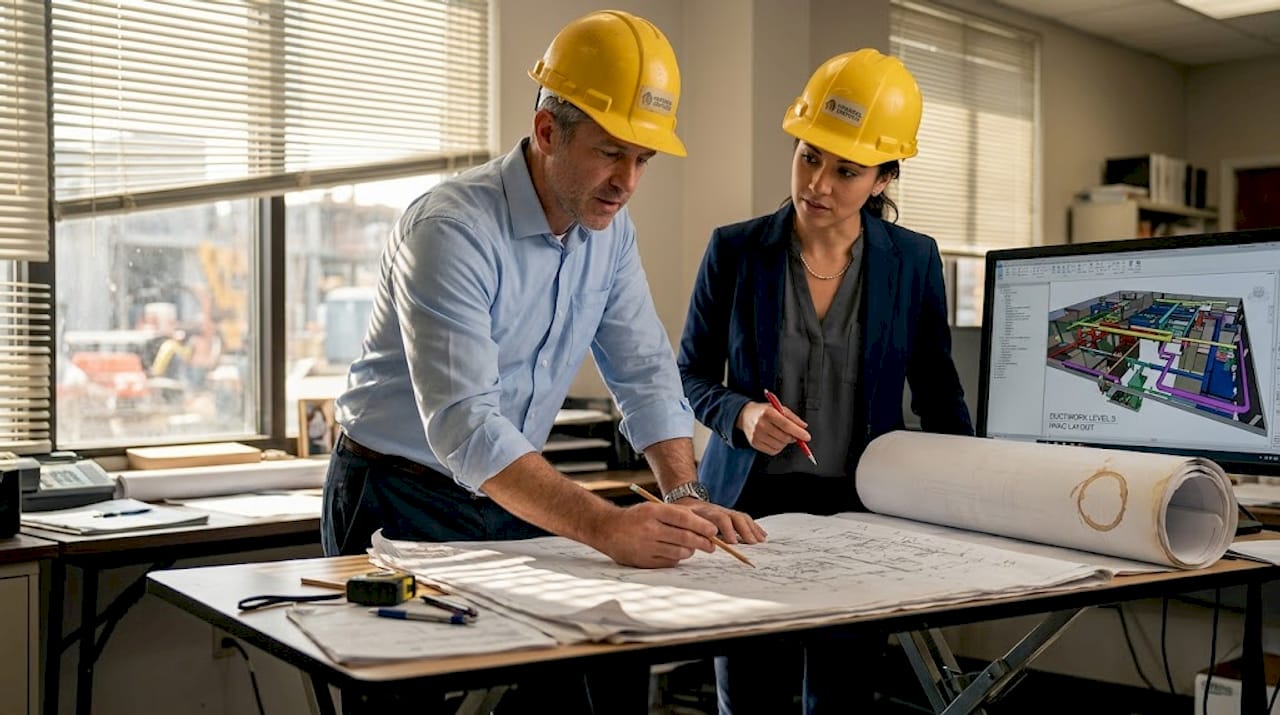
Mechanical and Electrical consultancy is a specialized discipline that covers the full engineering lifecycle of all non-structural building systems. This includes heating, ventilation, and air conditioning (HVAC), plumbing, fire protection, power distribution, lighting, and telecommunication infrastructure. For Singapore developers, mechanical engineering consultancy encompasses system design, load calculations, equipment specification, coordination with structural engineers and architects, and formal authority submissions through CORENET, Singapore’s centralized online portal for building regulatory approvals.
The distinction between an architect-only design approach and an integrated M&E consultancy model is substantial. Without embedded M&E expertise from project inception, developers frequently encounter late-stage design clashes, underpowered electrical systems, and fire protection layouts that do not satisfy Singapore Civil Defence Force (SCDF) requirements. With integrated electrical engineering expertise, every system is coordinated against architectural, structural, and regulatory requirements before construction commences.
| Criterion | Architect-only design | Integrated M&E consultancy |
|---|---|---|
| System design responsibility | Limited to spatial allocation | Full engineering design and sizing |
| Authority submissions | Architectural plans only | CORENET submissions for all M&E systems |
| Regulatory compliance | General building codes | BCA, SS EN 1990, Fire Code 2018, PUB, SCDF |
| Clash detection | Manual coordination | Systematic BIM-based coordination |
| Energy efficiency optimization | Minimal input | Detailed load analysis and system selection |
| Handover documentation | Basic as-built drawings | Full O&M manuals and commissioning records |
Common project pitfalls that experienced M&E consultants prevent include the following:
- Undersized electrical supply capacity leading to costly transformer upgrades post-tender
- Non-compliant fire suppression layouts that trigger SCDF rejection at submission stage
- HVAC designs that fail BCA’s Green Mark energy efficiency thresholds
- Plumbing configurations that conflict with PUB sewerage requirements
- Inadequate equipment room allocations discovered only during detailed design
The integration of digital engineering in construction has further raised the standard for M&E coordination. Building Information Modeling (BIM) now enables clash detection between M&E services and structural elements before any physical work begins. Developers who engage consultants capable of architect collaboration at this level reduce site-based variations substantially.
Key methodologies and processes of M&E consultants
With M&E scope defined, let’s walk through the step-by-step methodologies consultants employ on every Singapore project.
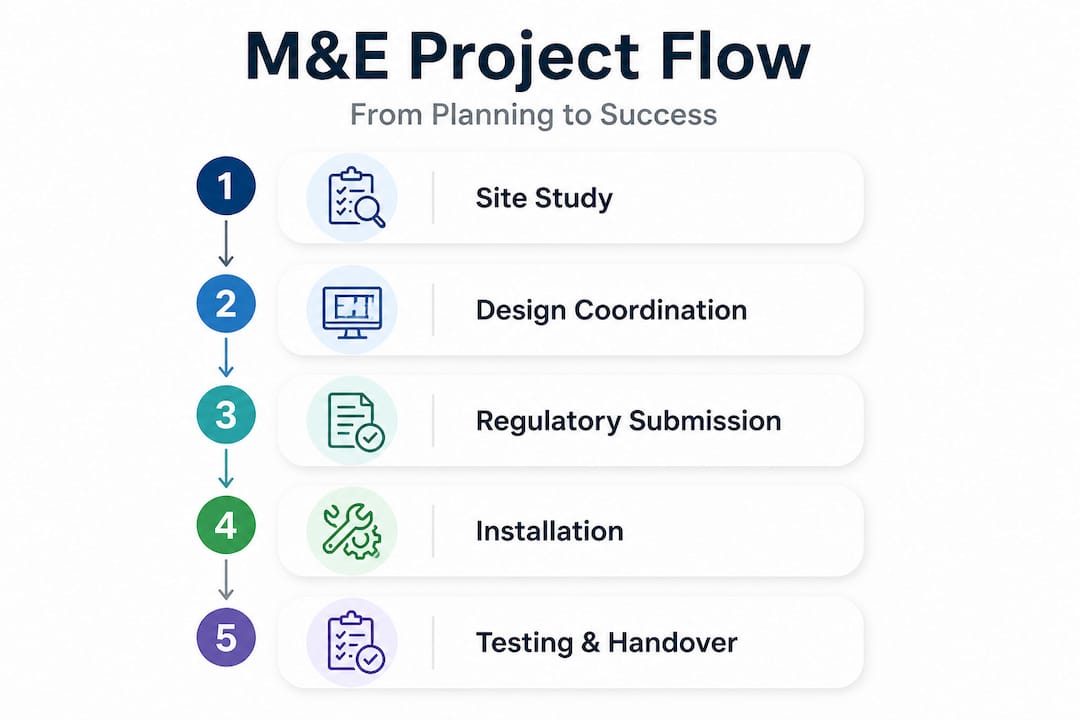
Key M&E methodologies include consultation and site study, design coordination with architects, authority submissions via CORENET, installation testing, commissioning, and handover training. Each phase carries specific regulatory and contractual obligations for the developer. Understanding where your responsibilities intersect with the consultant’s workflow prevents miscommunication and schedule slippage.
| Process stage | Regulatory checkpoint | Developer’s responsibility |
|---|---|---|
| Site study and brief | URA land use parameters, BCA envelope requirements | Provide site documents, brief requirements, and development type |
| Schematic design | Preliminary compliance review against applicable codes | Approve system concept and spatial allocations |
| Design development | BCA Green Mark pre-assessment, SCDF fire protection review | Review and approve detailed system specifications |
| CORENET submission | BCA qualified person (QP) submission, SCDF clearance | Authorize submission, respond to authority queries promptly |
| Installation supervision | Periodic site inspections, materials compliance check | Facilitate site access, maintain contractor coordination |
| Testing and commissioning | Functional performance tests per SS codes | Attend commissioning, review test reports |
| Handover training | As-built drawings, O&M manuals, warranties | Accept documentation, train facilities management team |
The sequence of developer touchpoints on a standard Singapore project follows a defined order:
- Appoint M&E consultant with a clear scope of work and fee structure before design team assembly.
- Participate in the initial site study and brief to establish system requirements and constraints.
- Review and formally approve schematic M&E designs before design development commences.
- Monitor CORENET submission progress and respond to authority requests within required timeframes.
- Conduct regular design coordination meetings with the M&E consultant, architect, and structural engineer.
- Review installation progress against approved designs during construction phase site visits.
- Attend and formally accept testing and commissioning results prior to temporary occupation permit (TOP) application.
- Receive and file all handover documentation, including as-built records and warranties.
Good project management discipline integrates M&E consultant milestones directly into the master program, ensuring that authority submission dates are protected and that design freeze deadlines are enforced. Developers who treat feasibility studies as a phase that includes M&E system capacity assessment benefit from more accurate construction cost estimates and fewer surprises during tender.
Pro Tip: Involve your M&E consultant before the architect’s schematic design is finalized. Late engagement forces consultants to adapt their systems to spaces that were never sized for equipment, plantrooms, or service routes, a situation that almost always drives up cost and program duration.
The inclusive design considerations that now influence Singapore’s accessibility standards also carry M&E implications, particularly for lift systems, accessible washroom services, and assistive technology infrastructure. M&E consultants who understand these intersections deliver more robust and complete designs.
Ensuring compliance: BCA codes, CORENET, and regulatory submissions
Understanding the methodologies, let’s see how M&E consultants actively guide your project through the regulatory framework of Singapore construction.
Singapore’s construction regulatory environment is among the most structured in the Asia-Pacific region. BCA regulations and codes including SS EN 1990 and Fire Code 2018 govern the design, engineering, and submission of all M&E systems. Compliance is not a single event but a series of coordinated milestones that span the entire project lifecycle, from design intent through to occupation.
Key compliance milestones that M&E consultants manage in authority submissions include:
- BCA building plan approval: M&E systems must be coordinated with structural and architectural plans before submission.
- SCDF fire safety plan approval: Covers fire protection systems, emergency egress lighting, and sprinkler layouts.
- PUB drainage and sanitary submissions: All sanitary systems, rainwater harvesting designs, and sewer connections require PUB clearance.
- LTA traffic and utility diversion submissions: Applicable where M&E infrastructure interfaces with public roads or utilities.
- Green Mark documentation: Required for projects pursuing BCA Green Mark certification, which is mandatory for many government-linked developments.
- Electrical installation license (EI) submission to EMA: Certifies that all high-voltage and low-voltage systems meet Singapore’s electricity supply standards.
The authority submission process is managed through CORENET, Singapore’s integrated building regulatory portal. M&E consultants acting as Qualified Persons (QPs) submit detailed engineering drawings, calculations, and specifications directly to the relevant agencies through this platform. Delays in CORENET submissions directly affect the issuance of the permit to proceed and, ultimately, the TOP application timeline.
“Early compliance planning is the single most effective mechanism for protecting project timelines in Singapore. Developers who allow M&E submissions to lag behind architectural approvals consistently experience compounding delays that cannot be recovered through acceleration alone.” This reflects the operational reality observed across numerous statutory submissions and authority engagements in Singapore’s construction sector.
Singapore’s construction approvals process has a very high M&E compliance burden, with virtually all commercial, industrial, and residential projects above minimum floor area thresholds requiring formal M&E submissions to at least three regulatory bodies. Projects that fail to account for this in their master program invariably overrun.
Developers seeking systematic guidance on regulatory requirements should review the PE design check and approvals process, which covers agencies including JTC, URA, BCA, and SCDF. The design compliance guide provides a structured framework for developers navigating these requirements across project types.
The structural safety principles embedded in SS EN 1990 also inform how building safety essentials are addressed across all construction elements, reinforcing the importance of integrated engineering from the earliest stages.
Risk reduction, sustainability, and futureproofing: The strategic value of M&E consultancy
Once the basics of compliance are covered, savvy developers focus on deep risk reduction and futureproofing, where strategic M&E consultancy delivers strong return on investment.
Consultants reduce developer risks by integrating M&E with the overall project, ensuring energy efficiency, safety, and future-proofing amid Singapore’s sustainability push. This integration function is where M&E consultancy transitions from a compliance obligation to a genuine strategic asset. Developers who recognize this distinction consistently deliver projects with lower lifecycle costs, higher tenant retention, and better Green Mark ratings.
Risk reduction through integrated M&E design operates at multiple levels. At the technical level, consultants identify design conflicts and system capacity shortfalls before they become construction variations. At the regulatory level, systematic authority submissions prevent enforcement actions and certificate of statutory completion (CSC) delays. At the commercial level, energy-efficient systems reduce operational costs and improve the asset’s income-generating potential over its full life.
Singapore’s sustainability agenda, anchored in the Singapore Green Plan 2030, sets progressively tighter energy performance benchmarks for new buildings and major refurbishments. M&E consultants who understand these trajectories design systems that meet not just today’s requirements but those anticipated for the asset’s 30 to 50-year operational life.
Top sustainability priorities that M&E consultants address for Singapore developers include:
- Energy performance optimization: Designing HVAC, lighting, and power systems to meet or exceed BCA’s Enhanced Green Mark 2021 thresholds.
- Water efficiency: Incorporating PUB Water Efficiency Labeling Scheme (WELS) compliant fixtures and greywater recycling where appropriate.
- Renewable energy integration: Pre-wiring and structural allowances for photovoltaic (PV) panel installations to satisfy the Solar Capability Scheme.
- Smart building infrastructure: Installing building management systems (BMS) that enable real-time energy monitoring, fault detection, and remote operation.
- Resilient power supply: Designing redundant electrical systems and uninterruptible power supply (UPS) infrastructure for critical facilities.
Pro Tip: Specify M&E systems that are designed for a 25 to 30-year operational lifespan rather than minimum code compliance. The marginal additional capital cost is substantially lower than the expense of mid-life system upgrades and the disruption they cause to occupied buildings.
Facade engineering decisions also carry significant M&E implications. The thermal performance of building envelopes directly affects HVAC sizing and energy consumption, which is why optimizing building envelopes in coordination with M&E consultants produces better energy outcomes than treating these disciplines independently.
The broader push toward building sustainably reflects the same principles that M&E consultants apply when specifying low-emission materials and energy-efficient systems for Singapore construction projects.
What most developers get wrong about M&E consultancy
With strategic value established, here is a perspective grounded in direct experience with Singapore’s construction sector.
The most persistent and costly misconception among property developers is that M&E consultancy is essentially a technical support function engaged to produce required drawings and submissions. This framing reduces a strategic advisor to an administrative role and systematically underutilizes a discipline that can protect project value at every phase.
The practical consequence of late M&E engagement is predictable and well-documented. Architectural designs that are fully developed before M&E input reach a stage where system routing, plantroom sizing, and equipment clearances must compete with finalized spatial arrangements. This generates design iterations that consume time and budget, and frequently result in compromised system performance because the engineering solution was fitted around an inflexible design rather than coordinated from the outset.
The developers who achieve the best outcomes in Singapore’s construction market engage M&E consultants at the feasibility stage, not the design stage. At feasibility, M&E input shapes decisions about floor-to-floor heights, core configurations, electrical room locations, and plant space allocations. These decisions, made correctly at the outset, eliminate entire categories of downstream cost and risk. Good project management insights consistently confirm that the cost of early M&E consultancy is a fraction of the savings it generates.
There is also a competitive dimension to this conversation. Singapore’s construction market is increasingly evaluated on sustainability performance, smart building capability, and long-term operational efficiency. Developers who treat M&E consultancy as a compliance exercise produce buildings that meet minimum standards. Those who treat it as a design discipline produce buildings that attract premium tenants, achieve Green Mark certification at higher tiers, and carry lower lifecycle costs. The difference is visible in asset valuations and tenant retention rates over time.
Pro Tip: Build your full consultant team, including M&E specialists, before the architect begins schematic design. The cost of a brief delay to assemble the right team is negligible compared to the cost of rework driven by design decisions that did not account for engineering requirements.
Ready to leverage M&E expertise for your next project?
To put these strategies into practice, Aman Engineering offers tailored support aligned with your construction ambitions.
Aman Engineering Consultancy provides full-service M&E consultancy for property developers and construction firms operating across Singapore’s commercial, industrial, and residential sectors. From compliance management and authority submissions to risk reduction and sustainability planning, our team integrates directly with your project program to protect timelines and deliver code-compliant, efficient building systems.
Explore Aman Engineering’s complete service offering to understand how our consultancy structure supports your project from feasibility through to CSC. For developers managing complex regulatory environments, our Singapore construction compliance checklist provides a structured framework for tracking all M&E authority milestones. Projects requiring advanced digital coordination can benefit from our BIM modeling services, which enable precise clash detection and regulatory documentation across all building systems.
Frequently asked questions
What is the primary role of M&E consultancy in Singapore construction?
M&E consultants handle design, engineering, authority submissions, and compliance for mechanical and electrical systems while ensuring adherence to BCA regulations and codes including SS EN 1990 and Fire Code 2018. Their role spans the full project lifecycle from feasibility through to handover and occupancy.
Which stages of construction benefit most from M&E consultancy?
M&E expertise is most critical during design coordination, authority submissions, installation testing, and commissioning. Early engagement at the feasibility and schematic design stages also prevents costly late-stage rework and compliance failures.
How does M&E consultancy reduce risk for developers?
Integrating M&E with project planning eliminates compliance failures, reduces design variations during construction, and improves energy efficiency and safety performance across the full building lifecycle. These outcomes directly protect developer capital and asset value.
What are Singapore’s key regulatory codes for M&E systems?
Projects must comply with Building and Construction Authority (BCA) standards, SS EN 1990 structural reliability codes, and Fire Code 2018, alongside PUB drainage requirements and EMA electrical installation standards applicable to the project type.
Recommended
- QECP ECM submission for every construction project – Aman Engineering Consultancy
- Singapore Construction Compliance Checklist: Ensure Project Approval
- Design compliance in Singapore: The developer’s essential guide
- Project Management – Aman Engineering Consultancy
- Facility maintenance essentials: Stay compliant and cost-efficient
- Pocket PMO | A fully operational PMO without building one