

Failing to secure structural certification is among the most common reasons property development projects in Singapore face costly stop-work orders, regulatory enforcement, and prolonged delays. Many seasoned developers and construction professionals treat certification as a formality, assuming it is simply a matter of obtaining signatures before handover. In reality, BCA’s structural works regime defines structural certification as a continuous legal obligation covering design, construction supervision, inspection, and ongoing compliance, carried out by formally appointed professionals throughout the building lifecycle.
Table of Contents
- What is structural certification?
- When is structural certification required in Singapore?
- Who is responsible for structural certification?
- How the structural certification process works: Step by step
- Common challenges and expert tips for smooth certification
- Our perspective on structural certification: What experience teaches
- Partner with experts for seamless certification
- Frequently asked questions
Key Takeaways
| Point | Details |
|---|---|
| Certification is mandatory | Singapore law requires appointed professionals to sign off structural works for legal and safety compliance. |
| Timelines matter | PSI intervals must be followed—every 5 years for non-residential, every 10 years for residential buildings. |
| Record-keeping is crucial | Maintaining and auditing site records can prevent compliance failures and costly delays. |
| Multiple roles involved | Owners, developers, and professional engineers all share responsibilities in the certification process. |
| Proactive strategy pays off | Viewing certification as a risk management tool, not just a regulatory hurdle, sets projects up for long-term success. |
What is structural certification?
Structural certification in Singapore is not a single document or a one-time event. It is a legally required framework of professional sign-offs and declarations that confirm structural works comply with applicable codes, approved designs, and regulatory standards enforced by the Building and Construction Authority (BCA). The BCA’s structural works regime establishes that certification must be performed by legally appointed professionals, and it spans both new construction projects and existing buildings under the Periodic Structural Inspection (PSI) program.
Structural certification covers several distinct areas, each with its own documentation and procedural requirements:
- Structural design certification: Confirmation by a Qualified Person (QP) that proposed structural designs comply with Singapore Standards and the approved building code before submission to BCA.
- Construction supervision and inspection certification: Ongoing sign-offs by appointed Structural Engineers during construction to confirm that works are executed according to approved drawings and specifications.
- Specific element certification: Certification for specialized structural components such as formwork, temporary works, and earth retaining structures, each requiring separate appointments and sign-offs.
- Periodic inspection certification: Regular post-completion inspections and certification by a licensed Structural Engineer for existing buildings, confirming that structural conditions remain safe and compliant over time.
The table below summarizes the key phases and their associated certification requirements:
| Phase | Certification type | Responsible party | Trigger |
|---|---|---|---|
| Pre-construction | Design endorsement | Qualified Person (QP) | Prior to building plan submission |
| Construction | Supervision and inspection | Structural Engineer / QP | Active construction |
| Temporary works | Specialist certification | Appointed engineer | Formwork, scaffolding, shoring |
| Existing buildings | Periodic Structural Inspection | Licensed Structural Engineer | 5 or 10 year intervals |
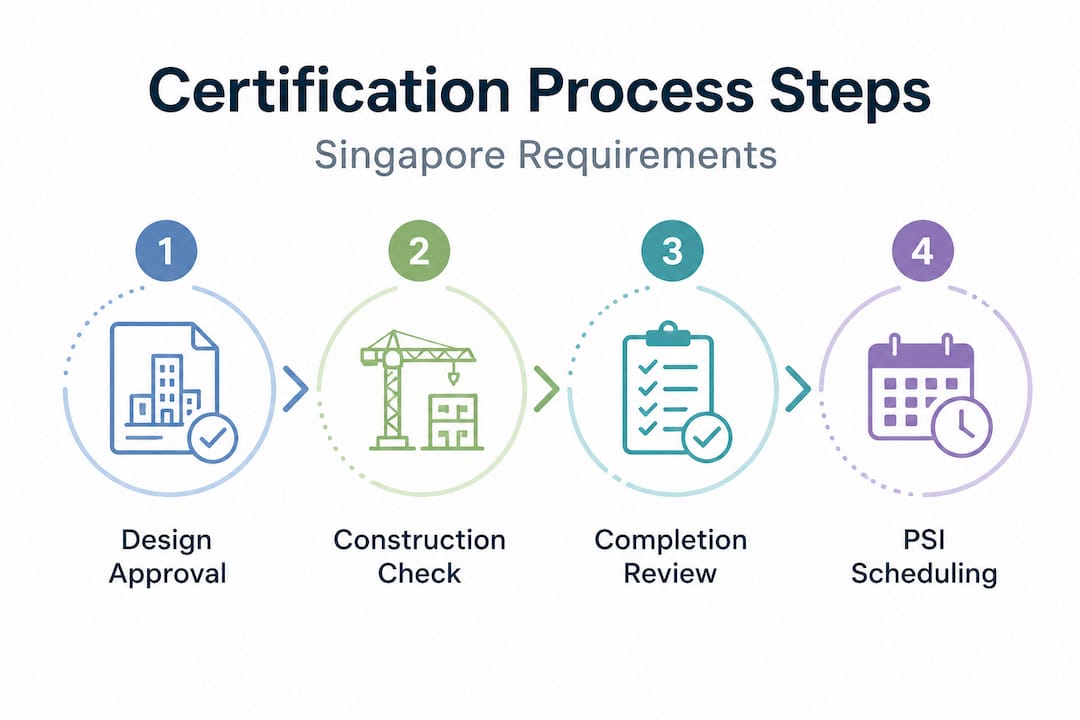
Proper management of the structural design approval process is critical because gaps at the design stage cascade into compliance failures during construction. Similarly, understanding building plan submission requirements at the outset allows developers to align certification obligations with project milestones rather than discovering them during enforcement. For projects in early development, feasibility studies that incorporate structural certification requirements allow more accurate cost and timeline planning.
When is structural certification required in Singapore?
Certification requirements apply at multiple points across a building’s life. The most frequently misunderstood requirement involves the PSI regime, which mandates that existing buildings undergo regular inspections by a licensed Structural Engineer. The BCA’s Periodic Structural Inspection (PSI) program operates on fixed intervals, and compliance is tracked by BCA. Non-compliance triggers regulatory enforcement, which can include rectification orders and fines.
The PSI intervals differ by building type:
| Building type | PSI frequency | Applicable standard |
|---|---|---|
| Non-residential buildings (commercial, industrial) | Every 5 years | BCA PSI requirements |
| Residential buildings (3 storeys and above) | Every 10 years | BCA PSI requirements |
| Special structures (e.g., grandstands, grandstands) | As determined by BCA | Specific BCA directives |
Beyond the PSI regime, certification is also required in these specific situations:
- New building construction: Before a building can obtain a Certificate of Statutory Completion (CSC), all required structural certifications from the appointed QP and Structural Engineer must be submitted and accepted by BCA.
- Additions and alterations (A&A) works: Structural works beyond a defined threshold require fresh appointments and certification, even for modifications to existing certified structures.
- Change of use: When a building’s purpose changes and the imposed loads or structural configurations are affected, new structural assessments and certification are required.
- Post-incident inspection: Following any structural incident, collapse, or significant cracking, BCA may require an immediate formal inspection and certification report from a licensed engineer.
- Upgrading works: Major upgrading programs, including those under HDB or town council management, require concurrent structural certification by the appointed professional team.
Key statistic: BCA’s database of periodic inspection records tracks thousands of buildings across Singapore, with the PSI program serving as one of the primary tools for early identification of structural deterioration before it becomes a safety risk.
Planning PSI intervals as part of a long-term asset management strategy, rather than waiting for BCA notification, is a recognized best practice among high-performing developers. Resources covering PSI for commercial and industrial properties and the PSI Singapore compliance guide provide detailed frameworks that support this planning approach.
Who is responsible for structural certification?
Responsibility for structural certification in Singapore is distributed across multiple parties, each with legally defined obligations. Confusion about these roles is a significant source of compliance failures, particularly in complex projects involving multiple consultants, contractors, and joint venture developers.
The key parties involved and their respective responsibilities are:
- Developer or building owner: Legally obligated to ensure that all required certifications are obtained, appointments are made in accordance with BCA requirements, and PSI reports are submitted within stipulated timeframes.
- Qualified Person (QP): A registered architect or professional engineer appointed by the owner or developer to be responsible for the design, supervision, and certification of structural works. The QP bears professional liability for signed certifications.
- Structural Engineer (SE): Appointed separately in most cases, the SE provides specialist design, review, and inspection services for all structural elements, and issues the relevant technical certificates.
- Resident Technical Officer (RTO) or Resident Engineer (RE): On-site supervision professionals responsible for day-to-day inspection, record-keeping, and ensuring that construction conforms to approved drawings and specifications.
- Licensed engineering firm: For more complex works, BCA has proposed that firms, not only individual professionals, bear formal licensing responsibility. This reflects a systemic shift in regulatory accountability.
Recent regulatory developments reinforce the importance of precise role delineation. The BCA consultation on regulatory regime enhancements has proposed strengthening requirements for supervision of structural works, including measures to ensure that firms undertaking complex structural projects hold formal licenses and bear greater accountability. These proposed changes signal that the compliance burden will increase, particularly for large-scale or technically complex projects.
“Certification and supervision responsibilities are legally tied to formally appointed professionals. Any gap in the appointment chain creates direct regulatory exposure for the developer and the professional concerned.”
Pro Tip: Always formalize appointments in writing, using BCA-prescribed appointment forms, and retain countersigned copies throughout and after the project. Verbal or informally documented appointments do not satisfy regulatory requirements and will not protect any party in the event of a dispute or enforcement action.
Developers who engage professional engineers for building inspections early in the project lifecycle, rather than at critical submission deadlines, consistently avoid the costly delays associated with last-minute appointment failures.
How the structural certification process works: Step by step
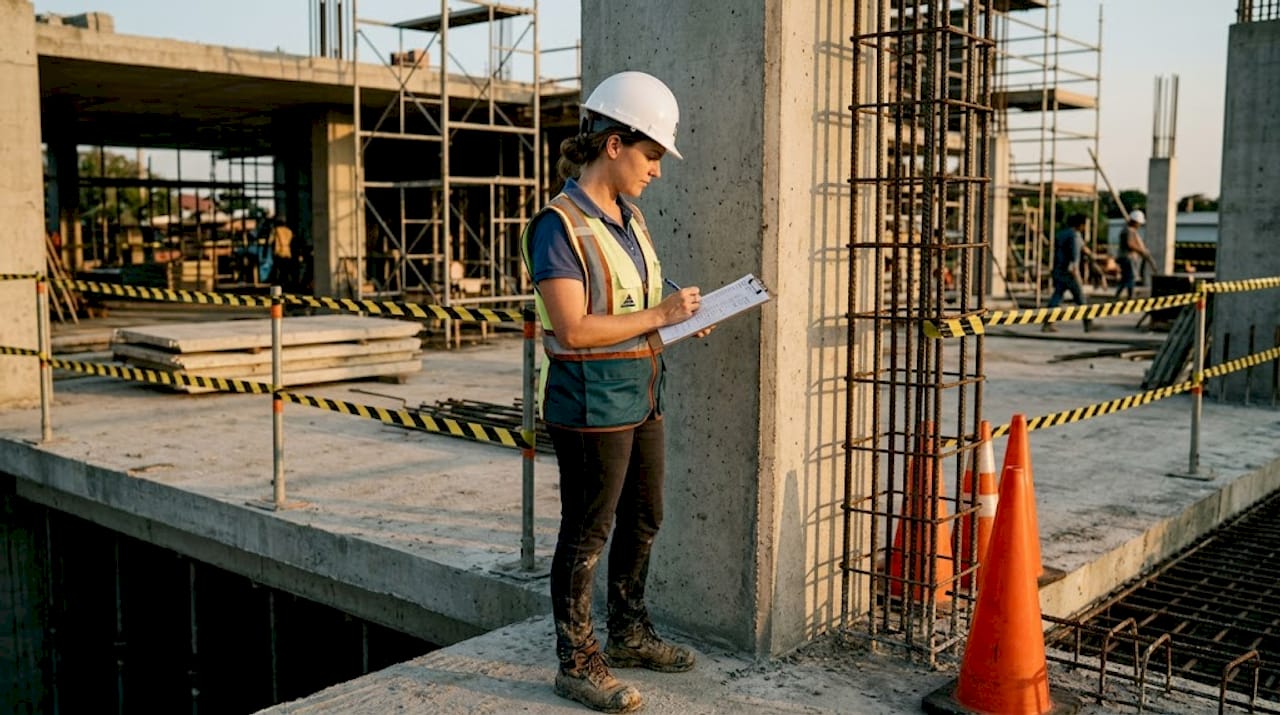
Understanding the practical workflow of structural certification enables developers and construction managers to integrate compliance activities into standard project management systems rather than treating them as external requirements. The BCA construction site records requirements confirm that qualified persons must maintain structured records onsite, and that key inspections and tests must be documented throughout the construction period.
The certification process follows this sequence:
-
Appoint the professional team. Before any structural works commence, formally appoint the QP, Structural Engineer, RTO, and RE using BCA’s prescribed forms. Confirm that all appointees hold current registrations and that their scope of appointment covers all relevant works.
-
Submit structural designs for approval. The appointed QP endorses and submits structural drawings and calculations to BCA as part of the building plan submission. Approval must be received before the Permit to Proceed is issued.
-
Conduct and document construction inspections. Throughout construction, the RTO or RE conducts mandatory inspections at specified stages (e.g., prior to concrete pours, after reinforcement placement). All inspection outcomes must be recorded in the prescribed site inspection logbooks.
-
Perform and certify material testing. Structural concrete, steel, and other critical materials must be tested at approved laboratories. Test results are incorporated into site records and form part of the certification package.
-
Issue structural completion certification. Upon completion of structural works, the QP and Structural Engineer issue the relevant certification confirming that works were executed in accordance with approved drawings and applicable standards.
-
Submit certification to BCA. The completion certificates and site records are submitted to BCA as a precondition for the Certificate of Statutory Completion (CSC).
-
Maintain records for the building’s lifecycle. Certified documents, test reports, and inspection records must be preserved by the owner, as they form the foundational documentation for future PSI cycles and A&A works.
Pro Tip: Use only SAC-SINGLAS accredited laboratories for all structural material testing. Test certificates from non-accredited laboratories are not accepted by BCA as compliant documentation, which can invalidate an entire certification package and force costly re-testing.
For ongoing compliance across the building’s operational life, the periodic structural inspection details service provides a structured framework for scheduling and executing PSI obligations efficiently.
Common challenges and expert tips for smooth certification
Even well-managed projects encounter structural certification challenges. The most frequent compliance failures do not arise from major structural defects but from administrative and procedural lapses. Identifying these risk areas in advance allows project teams to implement preventive controls.
The most commonly observed challenges include:
- Incomplete or disorganized site records: Missing inspection entries, unsigned logbooks, and lost test certificates are the leading cause of certification delays. BCA expects complete, sequential records, and any gaps trigger requests for clarification or re-inspection.
- Late appointment of professionals: Commencing structural works before formal BCA appointments are processed and accepted is a regulatory offense. Many developers incorrectly assume that a verbal or email agreement with a consultant constitutes a valid appointment.
- Missed PSI submission deadlines: Building owners frequently lose track of PSI due dates, particularly for properties with staggered acquisition or redevelopment histories. BCA enforces submission deadlines strictly, and late submissions attract regulatory notices.
- Insufficient communication between parties: When developers, QPs, and contractors operate in information silos, critical certification activities can fall through the gaps between parties’ scopes of responsibility.
- Inadequate preparation for proposed regulatory changes: The BCA consultation on supervision enhancements indicates that stricter requirements will apply to firms undertaking structural works. Projects that are already underway may need to review their appointment structures and compliance frameworks proactively.
The BCA periodic structural inspection methodology confirms that structural certification follows a defined cycle: appointment, inspection and verification, reporting and certification, and rectification. Firms that map their internal project management workflows to this cycle, rather than treating each certification event as a standalone task, achieve significantly better compliance outcomes.
Pro Tip: Establish a recurring internal audit of site records and appointment documentation at least once per quarter on active construction projects. This audit should be led by a compliance-focused member of the project management team and should cross-reference BCA’s checklist requirements against actual site records. Early identification of gaps allows correction before formal submissions are due.
For developers with assets undergoing facade-related works, familiarity with facade inspection tips for CBD properties provides a complementary compliance reference alongside structural certification obligations.
Our perspective on structural certification: What experience teaches
The most accomplished developers operating in Singapore share a consistent perspective on structural certification: they do not treat it as a regulatory hurdle, but as an active tool for risk management, asset protection, and business credibility. This distinction, while seemingly subtle, produces materially different project outcomes.
Compliance failures almost never originate from major systemic breakdowns. They arise from small, preventable lapses. A missed logbook entry. An inspection form unsigned by the RTO. A concrete test report filed in the wrong folder and unavailable at submission. These are the conditions that trigger enforcement notices, project delays, and reputational damage with regulatory authorities. The structural integrity of the building is rarely in question. The professional credibility of the project team frequently is.
Developers who invest in a culture of rigorous, proactive compliance build a measurable advantage. BCA officers engage more constructively with project teams that consistently submit accurate, complete documentation. Repeat developers who demonstrate compliance competence over multiple projects earn a level of trust that accelerates approval timelines and reduces the frequency of inspection requests. This is not conjecture. It reflects the practical reality of how regulatory relationships function in Singapore’s construction sector.
The forthcoming regulatory enhancements to structural works supervision signal that the compliance environment is becoming more demanding, not less. Firms that wait for new rules to take effect before updating their internal processes will face a harder transition than those who begin raising standards now. Quarterly audits of records and role delineations, referenced in the preceding section, are not merely best practices for the current regime. They are preparation for the next one.
Developers who want to build long-term compliance strength should review the developer’s design compliance guide as a practical framework for integrating regulatory obligations into standard project workflows.
Partner with experts for seamless certification
Structural certification demands precision, consistency, and a thorough working knowledge of BCA’s evolving requirements. For developers and construction firms managing concurrent projects, tight timelines, or technically complex structures, the margin for procedural error is narrow.
Aman Engineering Consultancy provides end-to-end support for structural certification and compliance, covering the full project lifecycle from design endorsement through PSI submission. The firm’s services include civil and structural design services, value engineering solutions that align structural decisions with cost and compliance objectives, and BIM modeling services that integrate certification data directly into construction documentation workflows. Whether your project requires statutory submission support, periodic inspection management, or a structural compliance review, Aman Engineering Consultancy has the regulatory experience and professional accreditations to deliver results with precision.
Frequently asked questions
What are the penalties for not obtaining structural certification in Singapore?
Failure to secure required structural certification can result in stop-work orders, regulatory fines, mandatory rectification requirements, and significant delays to CSC issuance, all of which carry direct financial and reputational consequences for developers and building owners.
How often must non-residential buildings undergo PSI in Singapore?
Non-residential buildings are required to undergo a Periodic Structural Inspection every 5 years in accordance with BCA’s established inspection schedule and compliance requirements.
Who can provide structural certification for a new building project?
Only formally appointed Qualified Persons, such as Professional Engineers registered with the BCA’s structural works regime, are authorized to certify structural works in Singapore; unauthorized certifications have no legal standing.
What records must be kept for structural certification compliance?
As required under BCA construction site records requirements, developers and QPs must retain site inspection logbooks, approved structural drawings, material test reports, and all issued certificates for regulatory review and future periodic inspections.
Recommended
- Design compliance in Singapore: The developer’s essential guide
- Streamline the Structural Design Approval Process in Singapore
- Your complete guide to industrial building compliance in Singapore
- Periodic Structural Inspection (PSI) Singapore 2026: Comprehensive Compliance, Defect Diagnosis & Rectification Guide – Aman Engineering Consultancy