
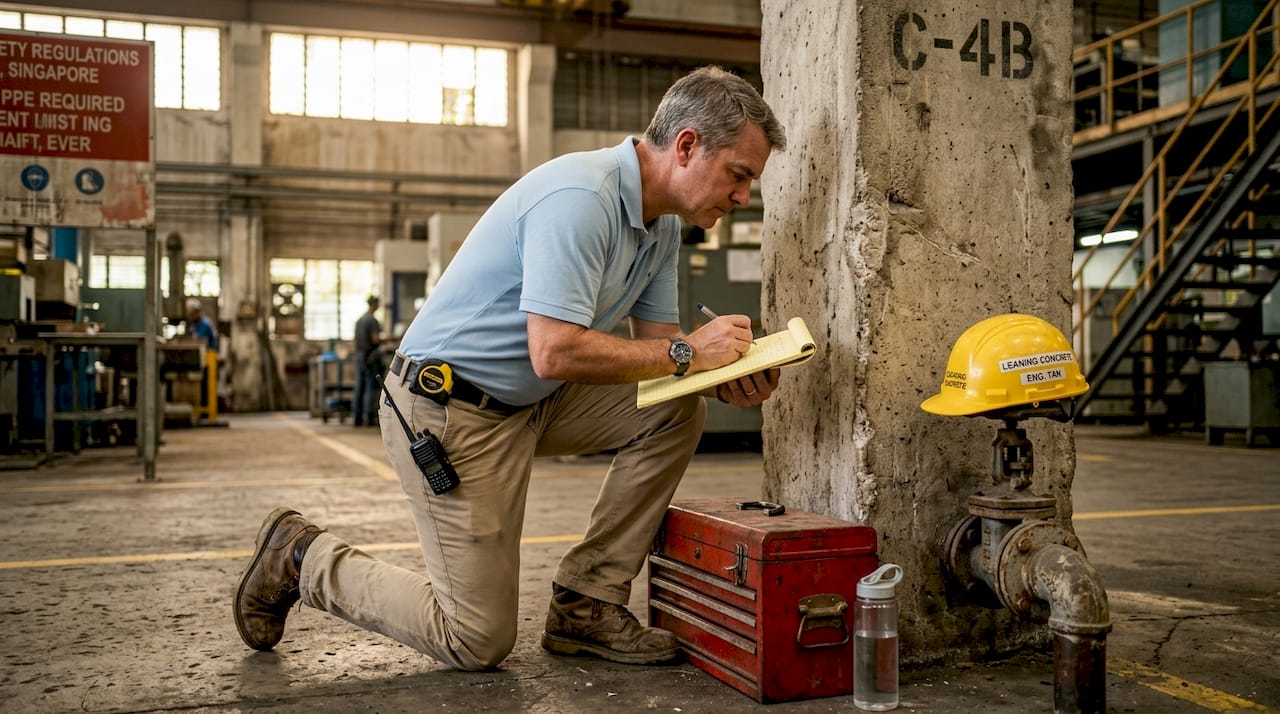
Structural assessment in Singapore is a regulatory obligation with direct consequences for project approvals, lease continuity, and asset value. The Periodic Structural Inspection (PSI) process, enforced by the Building and Construction Authority (BCA), establishes formal requirements that property developers and construction firms must satisfy to maintain compliance. Many in the industry mistakenly treat structural checks as reactive measures applied only when visible damage appears. This guide clarifies what structural assessment actually entails in Singapore, explains the legal framework governing it, identifies who is authorized to conduct it, and details the practical consequences for developers who treat it as a strategic priority rather than an afterthought.
Civil Condition Assessment in Singapore: Table of Contents
-
Understanding structural assessment: What it is and why it matters
-
Who conducts structural assessments: Role of Professional Engineers
-
Practical outcomes: Why structural assessments matter for developers and builders
Key Takeaways
|
Point |
Details |
|---|---|
|
PSI is mandatory |
Regular structural assessments (PSI) are legally required and key to safe property operation in Singapore. |
|
Professional Engineers required |
Only registered Professional Engineers can conduct and submit compliance-ready assessment reports. |
|
Missed assessments carry risks |
Skipping PSI can cause costly penalties, project delays, and regulatory issues. |
|
Proactive checks offer advantages |
Early assessments protect asset value and streamline future development or sale. |
Understanding structural and building condition assessment: What it is and why it matters
Structural assessment, in the Singapore regulatory context, refers to the systematic evaluation and condition assessment of a building’s load-bearing elements, including foundations, columns, beams, slabs, and walls, to determine whether those elements remain structurally adequate and safe for continued use. A building condition assessment begins with a comprehensive visual appraisal of the existing condition. The assessment is not limited to detecting visible cracks or surface deterioration. It encompasses a thorough evaluation of the structural system’s integrity in relation to the loads it was designed to carry and the conditions to which it has been exposed over time. Inspectors also review key building components for deterioration such as cracking and water seepage in structural elements, and a standardised inspection protocol can help align assessments with the NEN 2767/CEN-TS/17385 standard for consistency. Non-Destructive Testing may also be used to assess concrete strength without damaging the structure. Morning environmental hazards should also be monitored during structural assessments, as site conditions can affect inspection reliability.
The PSI compliance guide published by Aman Engineering Consultancy outlines the scope of structural assessments in detail, including defect categories and rectification requirements. In Singapore, civil condition and structural assessments are regulated by the Building and Construction Authority under Section 28 of the Building Control Act. Non-compliance is not treated as a minor administrative lapse but as a breach of statutory obligation, with consequences that extend beyond regulatory penalties to affect the commercial usability of the property.
A critical misconception held by many developers is that structural assessments apply only to aging buildings or those that have sustained visible damage from events such as adjacent construction, flooding, or fire. This assumption is incorrect. The regulatory framework mandates assessment regardless of the apparent condition of the structure. The requirement is interval-based, not condition-based. Applicable buildings enter the PSI regime starting from their 13th year. A building that appears structurally sound to the untrained eye may still harbor latent deficiencies in its load path, connections, or substructure that only a formal inspection by a qualified Professional Engineer (PE) can identify.
The range of property types subject to PSI requirements is broad:
-
Industrial buildings, including factories, warehouses, and logistics facilities
-
Commercial buildings, including offices, retail units, and mixed-use developments
-
Institutional buildings, such as schools, hospitals, and civic structures
-
Residential developments, including private condominiums and Housing Development Board (HDB) blocks
-
Shophouses, which often combine structural elements from multiple construction eras
Each property type carries specific assessment requirements and reporting obligations, and developers must ensure they are current with the applicable schedule for each asset in their portfolio.
“Structural assessment in Singapore, particularly through Periodic Structural Inspection (PSI), is a regulatory process to ensure buildings remain structurally safe.” — BCA, Periodic Structural Inspection
Pro Tip: Do not wait for BCA to issue a notice before initiating a PSI. Proactively scheduling assessments well ahead of regulatory deadlines allows time for defect rectification without disrupting project timelines or triggering enforcement action.
Singapore’s legal framework, Building and Construction Authority, and PSI requirements
Section 28 of the Building Control Act forms the statutory basis for periodic structural inspections in Singapore. This provision requires building owners to mandate structural inspections at set intervals under the Building Control Act, while granting BCA, as the national construction authority, the power to specify the categories of buildings subject to mandatory inspection, define the inspection intervals, and enforce compliance through penalties. The framework has been in place for decades, though its scope and enforcement have become progressively more rigorous as Singapore’s built environment has aged and construction activity has intensified.
Understanding the PSI for commercial and industrial buildings and staying current with the Building Control Act updates are both essential steps for developers managing multi-asset portfolios. Regulatory requirements can shift, and failure to track these changes exposes property owners to unintentional non-compliance.
The mandated inspection intervals are as follows, and owners should use them to plan the next inspection cycle:
|
Property type |
PSI interval |
|---|---|
|
Non-residential (commercial, industrial, institutional) |
Every 5 years |
|
Residential (private and public housing) |
Every 10 years |
|
Shophouses (non-residential use) |
Every 5 years |
|
Mixed-use developments |
Varies by dominant use; professional advice required |
These intervals are not suggestions. They represent binding legal obligations for the building owner, with non-residential buildings requiring PSI every 5 years and residential buildings requiring PSI every 10 years; for strata-titled developments such as private condominiums, the management corporation is typically responsible for ensuring PSI is carried out on time, and the clock begins from the date of the previous inspection report’s acceptance by BCA, not from when the owner chooses to initiate the next inspection.
The procedural steps for complying with PSI requirements follow a defined sequence:
-
Determine the applicable PSI due date based on the building type and the date of the previous inspection.
-
Appoint a registered Professional Engineer in the civil or structural discipline who holds a valid practising certificate.
-
Notify BCA of the appointed PE, following the prescribed notification procedures.
-
Provide site access for the Structural Engineer’s assessment of all relevant structural elements, including any areas previously identified as deficient.
-
Rectify all identified defects to the satisfaction of the PE before the final report is submitted.
-
Ensure the Structural Engineer submits the inspection report to BCA on time, with the findings compiled into a formal report for submission to the Commissioner of Building Control.
Missing any of these steps, or failing to initiate the process before the PSI due date, constitutes non-compliance. BCA may issue notices of non-compliance, impose financial penalties, and in severe cases, restrict the use of the building until the required inspection is completed and any critical defects are addressed. For developers with active tenancies, such outcomes can result in significant commercial disruption, including potential liability to tenants whose operations are affected by enforced building restrictions. A separate facade assessment is also required every 7 years for buildings older than 20 years and taller than 13 metres.
Who conducts structural assessments: Role of Professional Engineers
The validity of a structural assessment in Singapore depends entirely on the qualifications of the person who conducts it. Only a registered Professional Engineer in the civil or structural engineering discipline, holding a current practising certificate issued by the Professional Engineers Board (PEB), is legally authorized to conduct PSI inspections, endorse structural assessment reports, and submit the resulting report to BCA. Assessments carried out by unregistered personnel, regardless of their experience or technical knowledge, have no regulatory standing.
The PE’s responsibilities in a structural assessment encompass several distinct stages:
-
Physical site inspection: The PE must personally attend the building and inspect all structural elements within scope. Delegation of this inspection to unqualified staff is not permitted.
-
Defect identification and classification: The PE documents all observed structural deficiencies, categorizing them by severity and determining the appropriate rectification measures.
-
Review of structural records: The PE examines available as-built drawings, previous inspection reports, and maintenance records to assess the building’s structural history and identify any unauthorized modifications.
-
Rectification supervision: Where defects require immediate attention, the PE oversees or verifies the adequacy of the remedial works before certifying completion.
-
Report preparation and BCA submission: The PE prepares the formal inspection report, certifies its accuracy, records findings on the building’s structural integrity, and submits it to BCA through the prescribed channels.
The appointed Professional Engineer bears liability for the submitted structural safety findings.
The risk of engaging unqualified personnel to conduct building condition surveys and presenting those findings as compliance documentation is significant. Such documentation will not be accepted by BCA, and the building owner remains in breach of the statutory obligation regardless of the survey’s technical quality. Beyond regulatory risk, an unqualified assessment may fail to identify structural deficiencies that a registered PE with specialized experience would detect, creating safety risks for the property and its occupants.
Engaging experienced PEs through a specialist consultancy also affects the quality and defensibility of the inspection record. A PE with deep experience in structural assessment will produce a report that clearly documents the methodology, findings, and certification basis, which is important not only for BCA submission but also for due diligence processes during asset transactions.
The PE inspection process is integral to property transactions, and the quality of inspection documentation directly affects the ease of financing, sale, and redevelopment approvals. Firms seeking thorough PE building inspections should prioritize engagement with consultancies that maintain long-term working relationships with experienced, registered PEs.
Pro Tip: Establish a standing engagement with a structural PE consultancy rather than sourcing one only when a PSI deadline is imminent. A PE who is familiar with your building portfolio will conduct more efficient inspections and provide more accurate risk assessments based on the building’s documented history.
Practical outcomes: Why structural assessments matter for developers and builders
For property developers and construction firms, the value of a current, well-documented structural assessment extends well beyond regulatory compliance. A valid PSI report supports a range of commercial and operational objectives, including better facility maintenance outcomes, that directly affect the financial performance and marketability of a property asset across both public and private sector projects.
Lease renewal and JTC obligations: Industrial properties managed under Jurong Town Corporation (JTC) leases are subject to specific structural inspection requirements. Non-compliance with PSI schedules can complicate or delay lease renewal negotiations, creating disruption for both owners and tenants.
Additions and Alterations (A&A) works: Any developer seeking BCA approval for A&A works on an existing building will find that a current structural assessment significantly facilitates the submission process. BCA reviewers rely on the PE’s inspection record to determine whether the existing structure can accommodate proposed changes. An expired or absent PSI report introduces delays into the approval process and may require the developer to commission an updated assessment before BCA will accept the A&A submission.
Asset transactions and financing: Lenders and institutional buyers require certainty about the structural condition of assets under evaluation. A current, comprehensive PSI report provides that certainty, reduces due diligence timelines, and supports financing applications. Properties without current inspection records face greater scrutiny and may achieve lower valuations.
The following comparison illustrates the practical difference between well-maintained and neglected structures at the time of assessment:
|
Condition category |
Typical findings |
Impact on project timeline |
|---|---|---|
|
Well-maintained, regular PSI |
Minor surface defects, manageable rectification |
Minimal delay, straightforward BCA submission |
|
Neglected, no recent PSI |
Structural cracking, corroded reinforcement, unauthorized modifications |
Significant delay, mandatory rectification before submission |
|
Post-conversion (industrial) |
Load-path changes, undocumented alterations |
Extended review, potential structural upgrade requirements |
Developers considering PSI for shophouses and mixed-use properties should be particularly attentive, as these buildings frequently contain modifications carried out without proper documentation during previous ownership periods.
Before initiating a structural assessment, developers and project managers should prepare the following, as reliable inspection outcomes also support better maintenance strategies across large asset portfolios:
-
Obtain all available as-built structural drawings and any amendment drawings approved during previous works.
-
Compile records of previous PSI reports, including findings and rectification documentation.
-
Identify any modifications, including additions, alterations, or change-of-use works, carried out since the last inspection.
-
Ensure physical access to all structural elements, including basement areas, roof structures, and plant rooms.
-
Coordinate with existing tenants to arrange access without disrupting active operations.
Statistic callout: Industrial buildings that undergo regular PSI cycles consistently report lower average rectification costs per inspection compared to buildings assessed for the first time after extended periods of deferred maintenance, reflecting the compounding cost of allowing structural defects to progress undetected.
Structural assessments: What most developers still overlook
The predominant approach among developers in Singapore is to treat PSI as a compliance obligation to be fulfilled at minimum cost and minimum disruption, without extracting broader value from the process. This approach is understandable given the pressure on project budgets and timelines, but it consistently results in missed opportunities and, in some cases, avoidable commercial losses.
The most significant oversight is the failure to use inspection documentation as a proactive asset management tool within broader facilities management practice. Structural assessment reports contain detailed information about the condition of every major load-bearing element in a building. This information is directly useful for maintenance planning, budget forecasting, and capital expenditure prioritization. Developers who file reports immediately upon BCA acceptance without using the findings to inform their asset management strategy are leaving value on the table. A pre-condition for effective maintenance planning is a consistent data structure and objective inspectors results. Standardisation has addressed leads such as inconsistent ratings and divergent maintenance recommendations. Without a standardised protocol, inevitable subjectivity becomes a subjectivity problem that creates an undesirable situation and leads to inefficient allocation of maintenance budgets.
A second, less visible issue is the accumulation of undocumented modifications over the life of a building. Industrial conversions, in particular, frequently involve changes to floor loading, partition layouts, and mechanical plant that alter the structural demand on the building without any formal record being created. These undocumented changes become significant liabilities when the building is sold, refinanced, or subjected to regulatory scrutiny. PEs who ensure compliance across the building’s lifecycle create documentation trails that also support facilities related policies as part of portfolio governance and help form an effective maintenance system in these situations. Maintenance recommendations should also align with other facilities related policies.
The cost of a scheduled PSI, including PE fees and rectification of minor defects, is consistently lower than the cost of resolving the legal, financial, and commercial complications that arise from deferred inspections. Developers who build PSI into their standard asset management cycle gain a measurable advantage in transaction speed, financing access, and regulatory standing.
Get expert support for your next structural assessment
Structural compliance in Singapore requires precise execution at every stage, from PE appointment to BCA submission. Aman Engineering Consultancy also supports specialist training through a focused course relevant to building condition assessment. A specialist certificate programme comprises 60 hours over 8 sessions, with certification awarded after passing a formal assessment. The next intake is 16 April 2026, and course fees are SGD 2,650. Learners may check the relevant registration or funding link for fee support, including increased funding support for ntuc members, with construction academy-style provider context where applicable. Aman Engineering Consultancy provides end-to-end structural assessment support, coordinating registered Professional Engineers, managing regulatory submissions, and integrating BIM modeling services to support both compliance and project planning objectives.
For developers managing industrial assets, industrial building design consultant services are available to address structural compliance within the broader context of facility planning and optimization. Whether you require a standalone PSI or full project compliance support spanning multiple agencies, Aman Engineering Consultancy offers the technical depth and regulatory experience to protect your assets and accelerate your project outcomes. Contact the team today to schedule a consultation.
Frequently asked questions
What is the difference between a structural assessment and a Periodic Structural Inspection (PSI) in Singapore?
In Singapore, the PSI is a formal regulatory structural assessment conducted at set intervals mandated under the Building Control Act; all PSI constitutes structural assessment, but not all structural assessments qualify as mandated PSI for BCA compliance purposes, whereas a building condition assessment is a broader review used outside the PSI framework. It typically starts from a review of the building’s existing condition and key building components to inform maintenance and repairs, not just compliance.
Who is qualified to conduct a structural assessment for compliance in Singapore?
Only a registered Professional Engineer in the civil or structural discipline, holding a current practising certificate from the Professional Engineers Board, is authorized to conduct structural assessments for regulatory submission to BCA. In practice, this authorization depends on professional registration rather than employment status, and only that registered PE can endorse the report and take responsibility for the submitted structural integrity findings.
How often must my building undergo structural assessment?
PSIs for non-residential buildings occur every 5 years, and PSIs for residential buildings occur every 10 years, as mandated under Section 28 of the Building Control Act enforced by BCA, and the owner should track the next inspection date as part of a maintenance plan.
What happens if I skip a required structural assessment?
Failure to comply with mandated PSI requirements may result in regulatory penalties, restrictions on building use, and complications affecting lease renewals, financing, and redevelopment approval processes.
Do structural assessments help with Additions & Alterations (A&A) works?
Yes, a current structural assessment report directly supports BCA submissions for A&A works by providing reviewers with documented confirmation of the existing structure’s capacity to accommodate the proposed changes. It also helps form a clearer maintenance plan for the structure before A&A works proceed. The findings can be used to judge the remaining service life of key elements and whether they should be retained, strengthened, or replaced.