

Regulatory delays in Singapore’s construction sector carry real financial consequences. A single incomplete submission or a missed pre-consultation requirement can push a project’s start date back by weeks or even months, compounding financing costs and disrupting downstream schedules. For property developers and construction firms operating in one of Asia’s most tightly regulated built environments, understanding how to navigate the structural design approval process with precision is not optional. It is a project management imperative. This guide maps out every critical stage, from framework orientation to post-approval compliance, so your team can move faster and avoid costly rework.
Table of Contents
- Understanding Singapore’s structural design approval framework
- Preparation: What you need before submission
- Executing the submission: Step-by-step process
- Verification and post-approval: What happens next?
- A practitioner’s perspective: Why early engagement and digital readiness matter most
- Streamline your approval process with expert support
- Frequently asked questions
Key Takeaways
| Point | Details |
|---|---|
| Early engagement | Consulting BCA early can prevent costly delays and ensure smoother approvals. |
| Integrated digital submission | Coordinated BIM models in IFC-SG format are essential for approval via CORENET X. |
| Thorough preparation | Meticulously preparing documents and coordinating disciplines reduces submission errors. |
| Stay audit-ready | Comply with post-approval obligations to maintain project momentum and avoid penalties. |
Understanding Singapore’s structural design approval framework
Singapore’s regulatory environment for building works is administered by the Building and Construction Authority (BCA), the statutory body responsible for overseeing the safety, quality, and sustainability of the built environment. All structural design approvals fall under BCA’s jurisdiction, and submissions must conform to a clearly defined regulatory pathway that integrates digital tools, multi-disciplinary coordination, and phased review checkpoints.
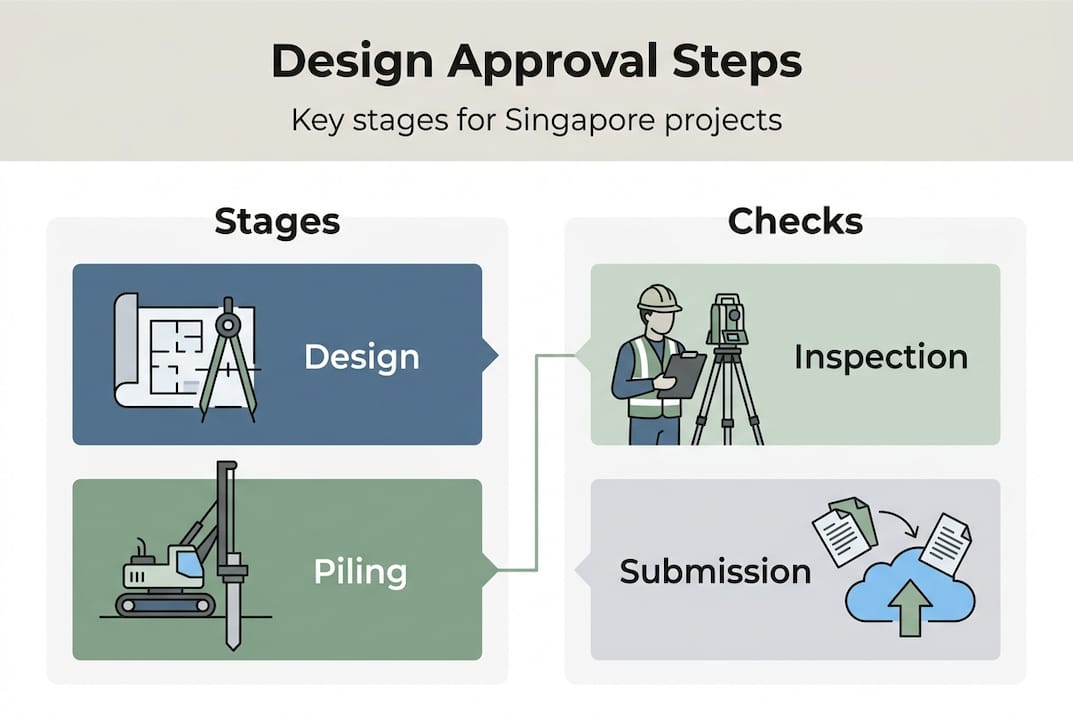
The primary regulatory framework governing structural plan submissions is the Regulatory Approval for Building Works (RABW). Under the RABW, submissions are made via CORENET X using coordinated multi-disciplinary BIM models in IFC-SG format through three main gateways: the Design Gateway, the Piling Gateway (optional), and the Construction Gateway. This phased gateway structure ensures that design intent, geotechnical considerations, and construction-ready documentation are each reviewed at the appropriate stage of project development.
CORENET X is Singapore’s national digital platform for building plan submissions. It replaces earlier submission systems and mandates the use of Building Information Modeling (BIM) in the IFC-SG format, which is a localized adaptation of the international IFC (Industry Foundation Classes) standard. The IFC-SG format enables regulatory agencies to extract, validate, and assess model data programmatically, reducing manual review time and improving accuracy.
The three approval gateways serve distinct purposes:
- Design Gateway: Covers the overall structural concept, architectural layout, and design parameters. This is the first formal checkpoint and establishes the structural basis for the entire project.
- Piling Gateway (optional): Required when piling works are involved. This gateway addresses geotechnical design, pile load specifications, and related earthworks documentation.
- Construction Gateway: The final gateway before works commence. It requires fully coordinated construction drawings, detailed structural calculations, and all supporting technical documentation.
Understanding the structural engineer inspection process within each gateway is equally important, as inspections are tied directly to the conditions attached to each approval stage.
The table below summarizes the key characteristics of each gateway:
| Gateway | Stage | Key Documents Required | Optional? |
|---|---|---|---|
| Design Gateway | Pre-construction | Structural concept, design drawings, BIM model | No |
| Piling Gateway | Pre-piling | Geotechnical report, pile design, BIM update | Yes |
| Construction Gateway | Pre-construction start | Full structural drawings, calculations, BIM model | No |
The RABW framework also requires that all disciplines, including architectural, structural, mechanical, electrical, and plumbing, submit coordinated models. Coordination failures between disciplines are among the most common causes of rejection at the Design Gateway, making early inter-disciplinary alignment a non-negotiable requirement.
Preparation: What you need before submission
With the framework established, successful approval starts with meticulous preparation. Attempting to submit without a complete, coordinated documentation package is one of the most frequent and avoidable causes of delay in Singapore’s structural approval process.
For complex projects, pre-submission consultation with BCA is strongly advised or mandatory at the conceptual stage to obtain in-principle feedback on the structural concept and avoid delays later in the process. This consultation provides an opportunity to clarify ambiguous regulatory interpretations, confirm acceptable structural systems, and identify any project-specific conditions that BCA may impose before formal submission begins.
The following numbered list outlines the core preparation steps that every project team should complete before initiating a formal submission:
- Confirm project classification. Determine whether the project falls under a standard or complex building category, as this affects whether pre-submission consultation is mandatory.
- Engage all disciplines early. Structural, architectural, M&E, and geotechnical consultants must begin coordination at the earliest possible stage to produce a unified BIM model.
- Prepare the IFC-SG compliant BIM model. Ensure the model meets BCA’s technical requirements for geometry, object attributes, and data completeness in the IFC-SG format.
- Compile structural calculations. All calculations must be signed and certified by a Qualified Person (QP) who is registered with BCA.
- Prepare supporting documentation. This includes soil investigation reports, material specifications, loading assumptions, and any third-party assessments required for the specific project type.
- Conduct internal model clash detection. Run clash detection across all disciplines before submission to eliminate coordination errors that would trigger a rejection or request for clarification.
The table below identifies the most common early rejection triggers and the corresponding preventive measures:
| Common Rejection Reason | Preventive Measure |
|---|---|
| Incomplete BIM model attributes | Validate IFC-SG compliance before upload |
| Missing QP certification | Confirm all plans are signed by a registered QP |
| Unresolved inter-disciplinary clashes | Complete clash detection prior to submission |
| Inadequate structural calculations | Engage a structural engineer for peer review |
| Outdated site survey data | Use current topographic and soil investigation reports |
Pro Tip: Engage your structural, architectural, and M&E consultants in a joint coordination session at least four to six weeks before the intended submission date. Early coordination catches errors that would otherwise surface during BCA’s review, saving significant time and resubmission costs.
For teams that are unfamiliar with the documentation standards or that are managing their first major submission under the RABW framework, reviewing guidance on preparing BCA submissions and understanding the BCA submission consultant’s role can provide substantial clarity on what is expected at each stage.
Executing the submission: Step-by-step process
Once you are prepared, it is time to put your plan into action and submit for approval. The execution phase requires strict adherence to CORENET X’s submission protocols and BCA’s technical standards for each gateway.
The following steps outline the complete submission sequence:
- Log in to CORENET X. The Qualified Person (QP) or their authorized representative must access the CORENET X portal using a SingPass or CorpPass account.
- Create a new project record. Enter all project particulars, including the development address, gross floor area, building classification, and the names of all appointed consultants.
- Upload the coordinated BIM model. The IFC-SG format model must be uploaded and validated against BCA’s automated checking rules. Any model errors flagged by the system must be resolved before the submission can proceed.
- Attach supporting documents. Upload structural calculations, geotechnical reports, material specifications, and all other required supporting documents as specified for the relevant gateway.
- Submit for Design Gateway approval. The QP certifies the submission and formally lodges it with BCA through CORENET X. BCA will acknowledge receipt and assign a case officer.
- Respond to queries. BCA may issue requests for clarification or supplementary information. Responses must be submitted through CORENET X within the stipulated timeframe.
- Proceed to Piling Gateway (if applicable). Once Design Gateway approval is received and piling works are required, submit the piling design documentation and updated BIM model through the Piling Gateway.
- Submit for Construction Gateway approval. After all design and piling approvals are in place, submit the full construction documentation package through the Construction Gateway to obtain clearance to commence works.
The RABW mandates that submissions via CORENET X use coordinated multi-disciplinary BIM models in IFC-SG format across all three gateways, and any deviation from this requirement will result in rejection at the system validation stage.
Pro Tip: Always run BCA’s IFC-SG model checker tool on your BIM file before uploading to CORENET X. Model validation errors caught internally take minutes to fix; the same errors caught by BCA’s automated system can delay your submission by days while you wait for the system to process a resubmission.
Effective BIM modeling for construction projects is not simply about producing a three-dimensional representation of the building. It requires that every structural element, connection, and load path be accurately modeled with the correct attributes, classifications, and relationships to satisfy BCA’s automated checking requirements.

Critical submission mistakes to avoid include submitting a BIM model that has not been coordinated with the architectural model, omitting the QP’s digital signature on structural calculations, using an outdated version of the IFC-SG schema, and failing to include all required supporting documents in a single submission package. Each of these errors can result in an outright rejection or a prolonged query process that adds weeks to the approval timeline. Teams that invest in robust civil and structural design services from the outset are significantly better positioned to avoid these pitfalls.
Verification and post-approval: What happens next?
After submission, understanding what to expect helps you stay compliant and proactive. BCA’s review process is structured and methodical, but it is not passive. Active engagement during the review period is essential to maintaining momentum.
Upon receipt of a submission, BCA assigns a case officer who reviews the documentation for completeness and compliance with the relevant codes and standards. The review timeline varies depending on the complexity of the project and the completeness of the submission package. Standard submissions with no outstanding queries are typically processed within BCA’s published service standards, while complex projects or those with incomplete documentation may take considerably longer.
During the review period, BCA may issue one or more of the following:
- Request for clarification (RFC): A formal query seeking additional information or explanation on a specific aspect of the submission.
- Request for supplementary documents: A requirement to provide additional technical reports, calculations, or drawings not included in the original submission.
- Conditional approval: An approval letter that specifies conditions that must be satisfied before or during construction, such as additional inspections or design modifications.
- Rejection notice: A formal notification that the submission does not meet the required standards, with reasons stated.
“For complex buildings, pre-submission consultation with BCA is strongly advised or mandatory at the conceptual stage to obtain in-principle feedback on the structural concept, avoiding later delays.” This principle applies equally to the post-approval phase, where teams that have engaged BCA early are better equipped to address conditions or queries efficiently.
Upon receiving approval, the project team must carefully review all conditions attached to the approval letter. These conditions are legally binding and must be fulfilled before the relevant construction activities commence. Common post-approval obligations include:
- Notifying BCA of the commencement of structural works within the stipulated timeframe.
- Conducting mandatory structural inspections at specified stages of construction, as required under the Building Control Act.
- Maintaining a site record of all approved drawings, calculations, and inspection reports for audit purposes.
- Notifying BCA of any proposed amendments to the approved structural design before implementing changes on site.
Understanding the requirements for periodic structural inspection is critical at this stage, as non-compliance with inspection conditions can result in stop-work orders and significant project delays. If issues arise during the post-approval period, the appointed QP is the primary point of contact for resolving matters with BCA. All communications should be documented and conducted through official channels to maintain a clear audit trail.
A practitioner’s perspective: Why early engagement and digital readiness matter most
With the process explained, it is important to address where most project teams encounter avoidable setbacks. Simply following the published guidelines is not sufficient for achieving timely approvals. The guidelines describe what is required; they do not tell you how to manage the interdependencies between disciplines, the timing of BCA consultations, or the internal quality controls that separate a smooth submission from a protracted one.
The most frequent source of bottlenecks is not a lack of knowledge about the requirements. It is late-stage coordination failures and the absence of pre-submission consultation for projects that clearly warrant it. Teams that defer inter-disciplinary coordination until the submission deadline are almost guaranteed to produce a BIM model with unresolved clashes, inconsistent data, and missing attributes.
Early and frequent engagement with BCA, particularly for complex structures, changes the outcome materially. When a project team brings a structural concept to BCA at the conceptual stage and receives in-principle feedback, the entire design process is anchored to a validated direction. This eliminates the risk of investing months of design effort in a structural approach that BCA will later require to be revised.
Digital readiness is equally consequential. Firms that have invested in how to prepare BCA submission workflows and maintain current IFC-SG modeling competencies consistently outperform those that treat BIM compliance as a last-step formatting exercise. The competitive advantage is real and measurable in reduced approval cycles and lower resubmission rates.
Streamline your approval process with expert support
Navigating Singapore’s structural design approval process demands precise documentation, coordinated BIM models, and an intimate understanding of BCA’s evolving requirements. For project teams managing tight timelines and complex multi-disciplinary submissions, the margin for error is narrow.
Aman Engineering Consultancy provides end-to-end support across the entire approval lifecycle, from pre-submission consultation and BIM model preparation to statutory submissions and post-approval compliance. Our team’s expertise in civil and structural design services and BIM modeling services ensures that your submissions are complete, coordinated, and aligned with the latest BCA requirements. Engage our consultants early and keep your project on schedule from the first gateway to the last.
Frequently asked questions
What are the main stages in Singapore’s structural design approval process?
The main stages are the Design Gateway, the Piling Gateway (optional), and the Construction Gateway, each requiring coordinated BIM submissions in IFC-SG format through CORENET X under the RABW framework.
Is pre-submission consultation with BCA mandatory for all projects?
Pre-submission consultation is not universally mandatory, but for complex structures it is strongly advised or required at the conceptual stage to secure in-principle feedback and prevent costly design revisions later.
Which file format is required for structural design submission on CORENET X?
All submissions must use coordinated multi-disciplinary BIM models in the IFC-SG format, which is BCA’s localized adaptation of the international IFC standard.
How long does structural design approval usually take?
Approval timelines vary by project complexity and submission completeness; early BCA consultation and fully coordinated documentation packages consistently reduce review cycles and minimize query-driven delays.
What if my submission is rejected or requires amendments?
Address BCA’s stated reasons for rejection systematically, update the BIM model and supporting documents accordingly, and consider engaging a qualified structural consultant to review the revised package before resubmission to reduce the risk of a repeat rejection.
Recommended
- Design compliance in Singapore: The developer’s essential guide
- What Are The Requirements For Building Plan Submission In Singapore – Aman Engineering Consultancy
- PE design check and Authority approvals such as JTC, URA, BCA and SCDF for your industrial and commercial business – Aman Engineering Consultancy
- Navigating Singapore’s FSSD Requirements with Precision and Accuracy for a Seamless Approval Process – Aman Engineering Consultancy