

Property developers and construction companies in Singapore frequently underestimate the regulatory complexity that governs every phase of a building project, from initial planning through final inspection. Non-compliance can result in costly reworks, timeline delays, and regulatory penalties that erode project margins and damage professional reputations. Design compliance is not simply an administrative formality; it is a legally enforced framework that determines whether a structure can be built, occupied, and sold. This guide clarifies the essential processes, key roles, common pitfalls, and practical strategies that developers and contractors must understand to navigate Singapore’s regulatory environment with confidence and precision.
Table of Contents
- What is design compliance and why it matters
- Step-by-step process: Navigating approvals and submissions
- Key players: Roles of QPs, PEs, and engineering consultancies
- Edge cases, exceptions, and penalties for non-compliance
- A hard-won lesson: Strategic compliance creates lasting value
- Ready for seamless compliance? Expert support available
- Frequently asked questions
Key Takeaways
| Point | Details |
|---|---|
| Compliance is business-critical | Falling short on design compliance in Singapore means costly project delays or outright failure. |
| Start approvals early | Timely URA and BCA submissions maximize project profitability and minimize obstacles. |
| Consult experts for complex works | Engaging qualified professionals streamlines the process and manages regulatory risk for large developments. |
| Expect agency coordination | Plan for multiple agency reviews, especially for fire safety and infrastructure tie-ins. |
| Keep compliance strategic | Using compliance as a planning tool can unlock higher long-term value, not just regulatory approval. |
What is design compliance and why it matters
Design compliance, within Singapore’s regulatory context, refers to the mandatory adherence to statutory planning parameters and building safety standards established by multiple government agencies. Design compliance in Singapore for property developers involves adherence to URA planning parameters and BCA building codes, which together govern everything from permissible land use and gross floor area (GFA) to structural safety and accessibility requirements.
The Urban Redevelopment Authority (URA) administers Singapore zoning laws that determine how land parcels may be developed, including zoning categories, plot ratio limits, building height controls, and setback requirements. The Building and Construction Authority (BCA) enforces the Building Control Act, which sets technical standards for structural integrity, fire safety, and barrier-free accessibility. Both agencies operate in parallel, and a project that satisfies one without the other remains non-compliant.
The business consequences of neglecting design compliance are significant and well-documented:
- Fines and enforcement action: BCA holds authority to issue stop-work orders and impose financial penalties for unauthorized building works.
- Forced modifications: Structures built outside approved parameters may require partial demolition or expensive retrofitting before a Temporary Occupation Permit (TOP) is granted.
- Timeline slippage: A single rejected submission can add weeks or months to a project schedule, compounding financing costs and delaying revenue realization.
- Reputational risk: Contractors and developers associated with compliance failures face scrutiny from future clients and government agencies alike.
- Reduced property value: Buildings with unresolved compliance issues carry legal encumbrances that suppress market value and limit financing options.
Reviewing building plan submission requirements early in the project lifecycle allows developers to identify potential conflicts between design intent and regulatory parameters before they become costly problems.
Regulatory frameworks may appear restrictive, but they exist to protect long-term structural safety, occupant welfare, and the sustained value of Singapore’s built environment. Developers who internalize this perspective consistently achieve better project outcomes than those who treat compliance as an obstacle.
Understanding what compliance requires is the first step. Translating that understanding into a structured, sequenced workflow is what separates projects that proceed smoothly from those that stall at critical approval stages.
Step-by-step process: Navigating approvals and submissions
Having framed what compliance is, the next step is translating this into action using Singapore’s actual regulatory process. The sequence is legally prescribed and must be followed in order; skipping or reordering steps creates downstream complications that are difficult and expensive to resolve.
- Obtain Written Permission (WP) from URA. Before any building plan is submitted, URA must grant planning approval confirming that the proposed development conforms to zoning, plot ratio, and height parameters.
- Appoint a Qualified Person (QP). A registered architect or professional engineer must be formally appointed as the QP responsible for coordinating and submitting all plans.
- Prepare and submit building plans via CORENET. Singapore’s Construction and Real Estate Network (CORENET) is the electronic platform through which all building plan submissions are made to BCA for review.
- Coordinate agency clearances. Depending on project type and location, clearances from LTA (Land Transport Authority), PUB (Public Utilities Board), or SCDF (Singapore Civil Defence Force) may be required concurrently or sequentially.
- Respond to BCA queries and obtain approval. BCA reviews submitted plans against the Approved Documents and issues queries or conditional approvals that the QP must address formally.
- Proceed to construction and obtain TOP. Upon completion, a final inspection is conducted before the TOP is issued, confirming the building was constructed in accordance with approved plans.
Process requirements mandate obtaining URA permission first, then building plans via CORENET, with performance requirements governed by Approved Documents throughout. Projects with a GFA exceeding 30,000 square meters are required to use CORENET X, the upgraded platform with enhanced data management capabilities.
| Agency | Trigger condition | Typical review timeline |
|---|---|---|
| BCA | All building works | 4 to 6 weeks |
| URA | Planning permission stage | 4 to 8 weeks |
| SCDF | Fire safety plans | 4 to 6 weeks |
| LTA | Road or transport interface | Project-dependent |
| PUB | Drainage or utility works | Project-dependent |
Pro Tip: Engage your QP and relevant engineering consultants before finalizing design drawings. Early coordination with design check and authority approvals specialists reduces the likelihood of plan rejections and accelerates the overall approval timeline significantly.
Key players: Roles of QPs, PEs, and engineering consultancies
Navigating the process requires knowing who is responsible for each part of compliance. That is where key roles and consultancies come into play. Singapore’s Building Control Act assigns specific legal responsibilities to defined professional categories, and understanding these distinctions is critical for developers structuring their project teams.

Qualified Person (QP): A QP is a registered architect or professional engineer listed under the Third Schedule of the Building Control Regulations. The QP bears statutory responsibility for submitting building plans, supervising construction, and certifying that completed works conform to approved designs. Every regulated building project in Singapore must have a formally appointed QP.
Professional Engineer (PE): A PE is a licensed engineer registered with the Professional Engineers Board (PEB). PEs operate across structural, civil, mechanical, and electrical disciplines. PE endorsement is mandatory for structural works, and engineering consultancy is required for structural, M&E, and geotechnical designs on regulated projects.
Accredited Checker (AC): For large or complex projects, an independent Accredited Checker must review and endorse structural plans. The AC operates separately from the project’s own QP and PE, providing an independent layer of technical verification that reduces the risk of systemic errors in structural design.
| Role | Appointing authority | Primary responsibility |
|---|---|---|
| QP (Architect) | Developer | Architectural plans, submission coordination |
| QP (Engineer) | Developer | Structural or M&E plan submission |
| Professional Engineer | QP or Developer | Domain-specific technical endorsement |
| Accredited Checker | Developer (mandatory for large works) | Independent structural plan review |
Engineering consultancies provide the operational capacity that individual QPs and PEs often cannot sustain alone on complex projects. They coordinate multi-disciplinary submissions, manage agency correspondence, track approval conditions, and ensure that design revisions remain within compliant parameters throughout the construction phase. The role of professional engineers in compliance extends well beyond plan endorsement; it encompasses ongoing site supervision and certification obligations.
Pro Tip: Always confirm PE endorsement requirements specific to your project scope before finalizing your consultant appointments. Large or structurally complex works carry additional obligations that must be addressed in the project program from the outset. Engaging engineering consultancy support early eliminates gaps in professional coverage that can trigger BCA queries or stop-work orders.
Edge cases, exceptions, and penalties for non-compliance
Even with the best plans, projects encounter gray areas. Here is how to handle exceptions and what is at stake if things go wrong.
Mid-project design changes are among the most common sources of compliance risk. When architectural or structural modifications are required after building plan approval, the developer and QP must submit amended plans for BCA review before implementing those changes on site. Additions and Alterations (A&A) works that affect GFA, structural elements, or fire safety provisions are subject to the same submission requirements as original plans.
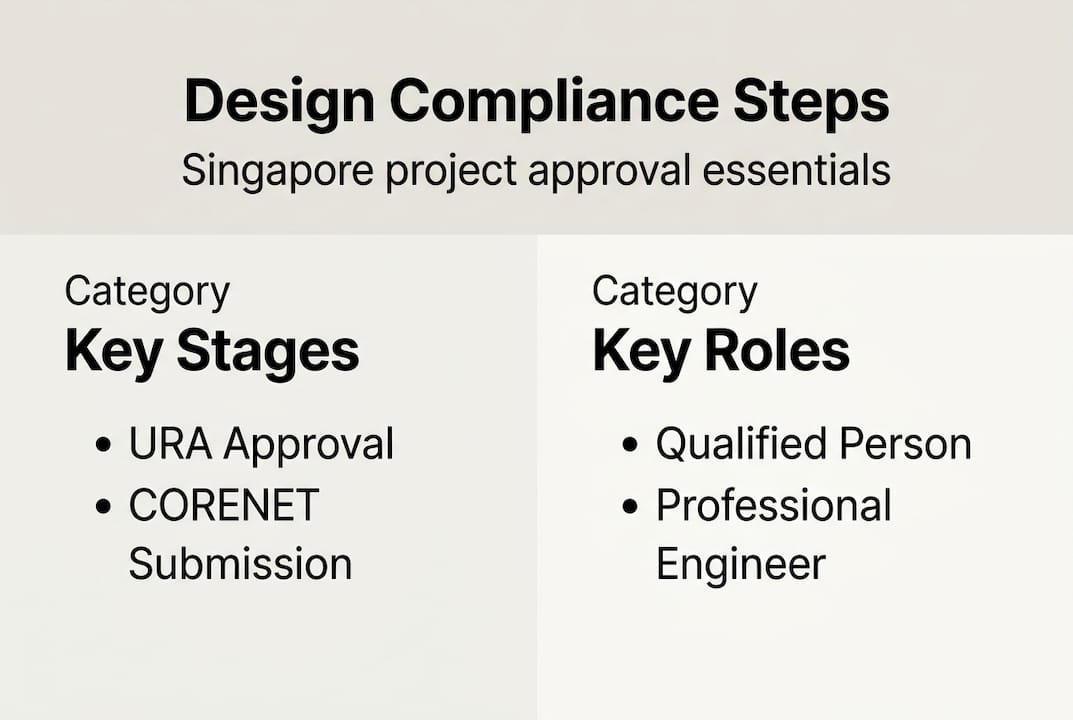
Deviations from approved plans require prior approval; IACC (Inter-Agency Coordination Committee) resolves inter-agency conflicts; fire safety review by SCDF is separate but integrated, and non-compliance results in delays and forced rework. The IACC mechanism is particularly relevant when conflicting requirements from different agencies cannot be reconciled through standard submission channels.
Fire safety compliance deserves specific attention. SCDF conducts its review of fire safety plans in parallel with BCA’s building plan review, but the two processes are administratively distinct. Failure to obtain SCDF clearance independently delays TOP issuance regardless of BCA approval status. Developers should review SCDF fire compartmentation review requirements early, as fire safety design decisions made at schematic stage are difficult and expensive to reverse during construction.
The consequences of non-compliance extend across multiple dimensions:
- Stop-work orders issued by BCA halt all construction activities until compliance is restored, with direct cost implications for contractors and financing schedules.
- Mandatory rectification works may require demolition of non-compliant structural elements, with costs borne entirely by the developer.
- Delayed TOP prevents occupation and revenue generation, compounding financing costs over extended periods.
- Legal liability may arise if non-compliant structures cause injury or property damage, exposing developers and QPs to civil and criminal proceedings.
- Debarment risk for persistent or serious violations can affect a firm’s ability to participate in future government-linked projects.
Maintaining a structured compliance log that records every design change request, agency query, and approval condition is not optional for complex projects. It is the primary evidentiary record that protects developers and consultants in the event of disputes or enforcement actions.
Pro Tip: Document all change requests formally and maintain a timestamped compliance log from project inception. Reference official guidelines for exceptions when evaluating whether a proposed deviation triggers a new submission requirement.
A hard-won lesson: Strategic compliance creates lasting value
Stepping back, what have Singapore’s top developers learned from years of navigating design compliance? The pattern is consistent: developers who treat compliance as a strategic input rather than a procedural obligation consistently outperform those who treat it as a cost to be minimized.
Shortcuts on compliance may appear to save cost at the planning stage, but they routinely generate exponentially larger costs during construction or at TOP application. Forced rework on structural elements, fire safety retrofits, and GFA recalculations are among the most expensive corrections a project can absorb. Beyond direct cost, these failures consume management attention and damage relationships with agencies whose goodwill matters across multiple future projects.
Strategic compliance means anticipating regulatory trends, engaging consultants who understand agency priorities, and using the compliance process to validate design decisions before they are committed to construction. Developers who leverage experienced project compliance expertise consistently achieve faster approvals, cleaner TOP applications, and stronger market positioning for completed assets. Compliance, properly managed, is a competitive advantage.
Ready for seamless compliance? Expert support available
Avoiding the pitfalls outlined in this guide requires more than awareness; it requires structured professional support from consultants who understand Singapore’s regulatory environment at an operational level. Engaging experienced engineers early in the design process reduces submission errors, accelerates agency approvals, and protects project timelines from compliance-driven disruptions.
Aman Engineering Consultancy provides statutory submission support, PE endorsements, authority approvals, and compliance coordination across BCA, URA, SCDF, and other agencies. Whether you are managing a major design revision, preparing your first CORENET submission, or navigating a regulatory dispute, professional guidance makes a measurable difference. Stay current with latest BCA regulations, explore professional compliance solutions tailored to your project type, or review the full scope of civil and structural services available to support your next submission.
Frequently asked questions
What is a Qualified Person (QP) in Singapore’s compliance process?
A Qualified Person is a registered architect or professional engineer responsible for plan submission and ensuring design compliance under Singapore law. QP types are defined per the Third Schedule of the Building Control Regulations, with specific categories assigned to architectural and engineering disciplines.
How long do BCA and SCDF approvals usually take?
Standard BCA and SCDF reviews typically take 4 to 6 weeks, though large or structurally complex projects may require additional review time depending on the volume and nature of agency queries.
What happens if a developer deviates from an approved plan?
Developers must seek prior BCA approval for any deviations from approved building plans. Unauthorized changes can result in stop-work orders, mandatory rectification, and significant project delays before TOP can be issued.
Why is fire safety compliance treated separately in Singapore?
SCDF administers fire safety approvals independently to ensure dedicated technical review of fire protection systems and compartmentation design. The SCDF review process runs alongside standard design compliance but must be cleared separately before TOP is granted.
When is Accredited Checker involvement required?
For large or structurally complex projects, an Accredited Checker must independently review and endorse structural plans in addition to the QP and PE. This independent structural review requirement is mandated under the Building Control Act to provide an additional layer of technical verification on high-risk structures.
Recommended
- PE design check and Authority approvals such as JTC, URA, BCA and SCDF for your industrial and commercial business – Aman Engineering Consultancy
- Navigating FSSD Submission Requirements For Building Owners In Singapore – Aman Engineering Consultancy
- What Are The Requirements For Building Plan Submission In Singapore – Aman Engineering Consultancy
- Navigating Singapore’s FSSD Requirements with Precision and Accuracy for a Seamless Approval Process – Aman Engineering Consultancy