

Industrial building projects in Singapore operate within one of the most structured regulatory environments in the region. Developers, contractors, and building owners who underestimate the complexity of compliance requirements from the Urban Redevelopment Authority (URA), Building and Construction Authority (BCA), and Singapore Civil Defence Force (SCDF) routinely face project delays, financial penalties, and reputational damage. This guide provides a clear, sequential compliance roadmap covering zoning, building code approvals, fire safety, and accessibility obligations, giving industrial stakeholders the practical knowledge needed to execute projects with precision and confidence.
Table of Contents
- Understanding zoning and land use rules for industrial buildings
- Navigating key building codes and approval processes
- Fire safety systems, compartmentation, and SCDF compliance
- Accessibility code and practical design obligations
- A developer’s perspective: Practical lessons for flawless compliance
- How Aman Engineering can help streamline industrial compliance
- Frequently asked questions
Key Takeaways
| Point | Details |
|---|---|
| Know your zoning | Following the 60:40 rule for B1/B2 industrial land prevents planning violations and costly redesigns. |
| Secure approvals early | Start approval submissions with a Qualified Person through CORENET as soon as project value crosses $30,000. |
| Get fire safety right | Design with SCDF Fire Code 2023 requirements in mind to avoid inspection failures and expensive rework. |
| Don’t overlook accessibility | Plan for accessible routes and facilities at design stage — the code applies to both new buildings and most alterations. |
| Ongoing compliance is best | Track requirements at every construction stage for smooth handovers and audit success. |
Understanding zoning and land use rules for industrial buildings
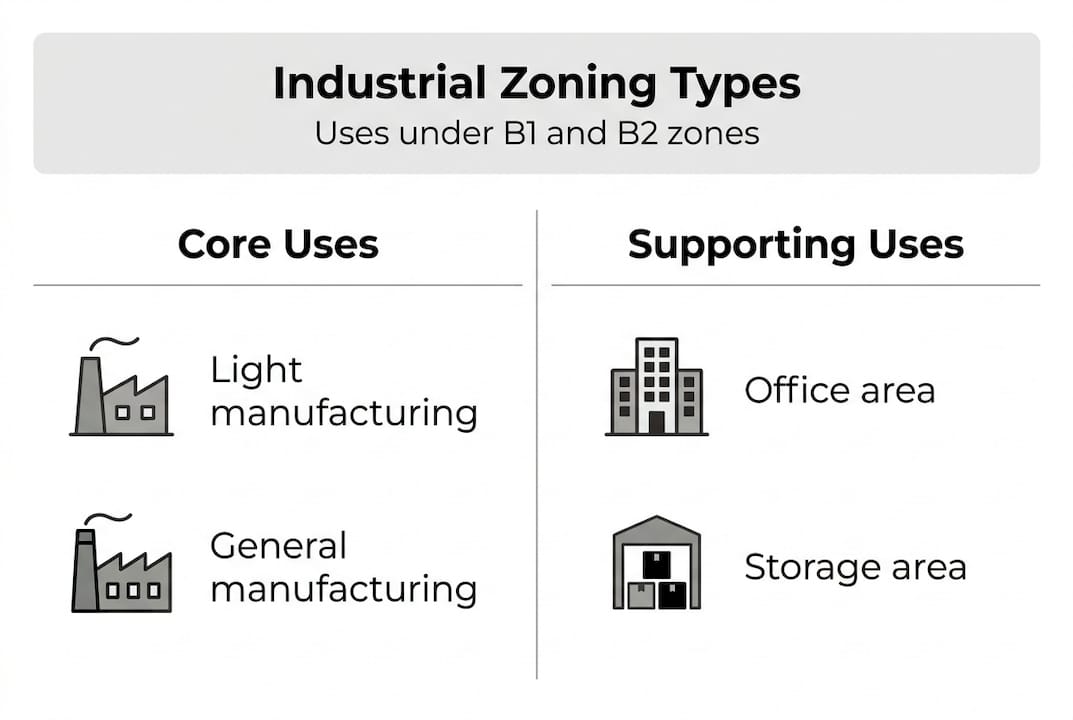
Every industrial project in Singapore begins with a fundamental question: what does the URA Master Plan permit on this specific plot of land? Industrial land is broadly classified into two categories. B1 (light and clean industrial) land accommodates activities that are relatively clean and do not generate significant noise, smell, or pollution, such as light manufacturing, food production, and high-tech industries. B2 (general industrial) land permits heavier activities including general manufacturing, logistics, and warehousing operations that may generate moderate environmental impact.
The most critical planning constraint developers must understand is the 60:40 GFA rule, which requires at least 60% of gross floor area (GFA) to be dedicated to core industrial uses such as manufacturing and warehousing, while up to 40% of GFA may be allocated to supporting uses. This rule directly shapes building layout, unit mix, and lease structures from the earliest design stage.
Typical supporting uses permitted under the 40% allocation include:
- Office and administrative spaces
- Ancillary canteens and staff amenities
- Meeting rooms and training facilities
- Showrooms directly related to the industrial activity
- Childcare centers (subject to specific URA approval)
| Zoning type | Permitted core uses | Supporting uses (max 40%) |
|---|---|---|
| B1 (light industrial) | Light manufacturing, high-tech, food production | Offices, canteens, showrooms |
| B2 (general industrial) | General manufacturing, logistics, warehousing | Offices, ancillary amenities |
A common and costly mistake is designing floor plates that inadvertently exceed the 40% threshold for supporting uses, particularly in multi-tenanted flatted factories where individual unit configurations are difficult to control post-completion. Developers should embed GFA tracking into the design brief from day one and require QPs to verify compliance at each design stage.
For developers seeking to maximize returns on B1 or B2 land, the Land Intensification Allowance (LIA) is a significant financial incentive. LIA provides qualifying capital expenditure allowances for industrial developments that meet minimum gross plot ratio (GPR) thresholds and allocate at least 80% of GFA to qualifying industrial uses. Engaging with authority approvals for industrial projects early in the planning phase ensures LIA eligibility is factored into the development strategy before design decisions become irreversible.
Pro Tip: Submit a pre-application consultation request to URA before finalizing the design brief. This allows developers to clarify land use intent, GFA allocations, and any site-specific planning conditions that may not be immediately apparent from the Master Plan.
Navigating key building codes and approval processes
Once zoning and land use are confirmed, the project moves into the formal building control approval process governed by the BCA. The BCA Building Control Regulations 2003 establish that any building works valued above SGD 30,000 require a Qualified Person (QP) to prepare and submit plans through the CORENET electronic submission platform for BCA approval.

A QP is a registered architect or professional engineer who assumes legal responsibility for ensuring that building plans comply with all applicable codes. Their role extends from design through construction supervision and certification upon completion.
Step-by-step approval process for industrial building works:
- Appoint a QP (architect or structural engineer as appropriate)
- Prepare building plans in accordance with BCA codes and URA planning parameters
- Submit plans via CORENET for BCA building plan approval
- Address queries and obtain written approval before commencing works
- Notify BCA upon commencement of works
- Conduct mandatory inspections at critical construction stages
- Submit as-built drawings and obtain Temporary Occupation Permit (TOP) or Certificate of Statutory Completion (CSC)
| Submission type | Trigger | Platform | Key approving authority |
|---|---|---|---|
| Building plan approval | New works or major A&A | CORENET | BCA |
| Planning permission | Change of use or new development | CORENET | URA |
| Fire safety plan | New works or major renovation | CORENET | SCDF |
Common errors that cause significant delays include incomplete structural calculations, failure to coordinate architectural and M&E drawings before submission, and insufficient geotechnical reports for sites with challenging ground conditions. The Building Control Act 2025 updates introduced additional obligations that developers must account for in their project timelines.
For projects involving additions and alterations (A&A), developers should also review periodic structural inspection requirements to ensure existing structures meet current standards before new works are grafted onto them. Projects with temporary works such as shoring or formwork systems require separate BCA submission for temporary works and should not be overlooked.
Pro Tip: Coordinate all discipline submissions (architectural, structural, M&E, fire safety) simultaneously rather than sequentially. Parallel submissions reduce overall approval lead time by several weeks on complex industrial projects.
Fire safety systems, compartmentation, and SCDF compliance
With structural approvals in progress, fire safety compliance must be addressed with equal rigor. Industrial buildings fall under Purpose Group I (factories and warehouses) under the SCDF Fire Code 2023, which carries specific and non-negotiable requirements.
The SCDF Fire Code 2023 mandates fire alarm systems for factories exceeding 400 m² per storey, automatic sprinkler systems, fire compartmentation, and a Fire Safety Report for facilities with an aggregate floor area above 5,000 m².
Understanding what triggers each requirement is essential for design-stage compliance planning. The following are the primary fire safety obligations for industrial facilities:
- Fire alarm systems: Required for all factories exceeding 400 m² per storey; must be connected to a central monitoring station for larger facilities
- Automatic sprinkler systems: Mandatory for most industrial occupancies above specified floor area thresholds; design must comply with SS 537
- Fire compartmentation: Structural fire-rated walls and floors must separate different fire compartments; maximum compartment sizes are prescribed by occupancy type
- Fire Safety Report (FSR): Required when the aggregate floor area exceeds 5,000 m²; must be prepared by a registered Fire Safety Engineer
- Emergency lighting and exit signage: Required throughout escape routes and must meet minimum illumination levels
Common failure points during SCDF inspections include inadequate fire stopping at service penetrations through compartment walls, sprinkler heads obstructed by racking systems installed after completion, and exit routes that have been partially blocked or modified without approval. Addressing fire compartmentation failures at the design stage is far less costly than rectifying them post-construction.
For structural steel buildings, fire safety in structural steel is a specialized area requiring careful selection of fire protection systems. The choice between intumescent coatings and vermiculite spray, covered in detail under SCDF fireproofing compliance, significantly affects both cost and program. QPs managing fire safety submissions should follow a structured approach as outlined in the QP’s guide to SCDF plan to avoid rejection cycles. Understanding the distinction between a Fire Safety Certificate (FSC) and a Temporary Fire Permit (TFP) is also critical; the fire safety certification in Singapore process determines the legal basis for occupying the building.
Accessibility code and practical design obligations
Regulation does not stop at fire safety. The BCA Code on Accessibility in the Built Environment 2025 imposes clear obligations on industrial developments, and non-compliance at the design stage creates expensive rectification work during or after construction.
The 2025 Accessibility Code requires industrial buildings to provide accessible routes with a minimum clear width of 1,500 mm, connecting all primary entrances, vertical circulation elements, and accessible facilities. Accessible washrooms must be provided in clusters rather than isolated locations, making them practical for users with mobility limitations.
Key accessibility obligations for industrial projects:
- Accessible routes of minimum 1,500 mm width from carpark or public transport drop-off to building entrance
- At least one accessible entrance with level or ramped access and automatic or easy-open doors
- Accessible washrooms in clusters on each floor where washrooms are provided
- Lift access to all occupied floors in multi-storey buildings
- Tactile guidance systems at key decision points along accessible routes
Importantly, core production areas within factories are generally exempt from accessible route requirements, recognizing that machinery layouts and operational safety constraints may make full accessibility impractical. However, this exemption does not extend to administrative areas, canteens, or common facilities within the same building.
For A&A projects, the code applies proportionally. Where the scope of works affects an accessible route or facility, the entire affected route must be brought up to current standards. Developers undertaking structural inspection for compliance as part of an A&A project should include an accessibility audit in the same exercise to identify gaps before submission.
Pro Tip: Engage an accessibility consultant during schematic design, not during detailed design. Late-stage changes to door widths, corridor layouts, and washroom configurations are disproportionately expensive compared to addressing them at concept stage.
A developer’s perspective: Practical lessons for flawless compliance
Experienced developers who have navigated multiple industrial projects in Singapore consistently identify one pattern: the projects that encounter the fewest compliance problems are those where QPs and regulatory consultants are engaged before the design brief is finalized, not after.
Early QP engagement is not simply a procedural formality. It allows structural, fire safety, and accessibility constraints to be integrated into the architectural concept rather than retrofitted onto a completed design. The cost of a pre-design consultation is negligible compared to the cost of redesigning a structural grid to accommodate fire compartment boundaries that were not considered at the outset.
Communication with SCDF and BCA should be direct and documented. Informal verbal clarifications carry no regulatory weight. Developers should request written confirmation of any interpretations that affect design decisions, particularly for novel building typologies or mixed-use industrial schemes.
Tracking compliance throughout construction, rather than only at formal inspection milestones, is what separates projects that achieve smooth TOP from those that face last-minute rectification notices. Reviewing real compliance case studies from recent regulatory updates reveals that most late-stage failures trace back to decisions made or overlooked in the first 20% of the project timeline.
How Aman Engineering can help streamline industrial compliance
For those looking for hands-on guidance, integrating expert support into your compliance strategy from project inception is the most effective way to protect timelines and budgets.
Aman Engineering Consultancy provides end-to-end compliance support for industrial building projects across Singapore, from initial zoning assessments and URA planning submissions through BCA structural approvals, SCDF fire safety plans, and accessibility compliance reviews. The team manages authority submissions, prepares all required documentation, and coordinates across disciplines to ensure nothing falls through the gaps. Whether you are planning a new development, a major A&A, or need support with civil and structural services or a deep excavation ERSS guide, Aman Engineering delivers tailored compliance roadmaps. Contact Aman Engineering today to discuss your project requirements.
Frequently asked questions
What is the ‘60:40 rule’ for Singapore industrial buildings?
The 60:40 rule requires at least 60% of gross floor area to be used for core industrial activities such as manufacturing or warehousing, while up to 40% may be allocated to supporting uses like offices or canteens.
When do I need to involve a Qualified Person (QP) and make submissions through CORENET?
Any building works exceeding SGD 30,000 in value require a QP to prepare and submit plans through CORENET for BCA approval before works commence.
What are the fire safety requirements for a typical Singapore industrial facility?
Most industrial facilities require fire alarm systems, automatic sprinklers, and fire compartmentation; a Fire Safety Report is additionally required for facilities with aggregate floor area above 5,000 m².
How does the 2025 Accessibility Code impact industrial projects?
Most new works and A&A projects must provide accessible routes of 1,500 mm minimum width and clustered accessible washrooms, with exemptions applying only to core production areas.
What is the Land Intensification Allowance (LIA), and how does it benefit developers?
LIA offers an initial 25% capital expenditure allowance for qualifying industrial developments that meet minimum GPR thresholds and allocate at least 80% of GFA to industrial uses, providing a meaningful tax incentive for developers who structure their projects correctly from the outset.
Recommended
- PE design check and Authority approvals such as JTC, URA, BCA and SCDF for your industrial and commercial business – Aman Engineering Consultancy
- Building Owners in Singapore Must Conduct Periodic Facade Inspections Regularly Now – Aman Engineering Consultancy
- Periodic Facade Inspection for CBD buildings in Singapore – Aman Engineering Consultancy
- Expert Professional Engineers Conduct Thorough Building Inspections In Singapore – Aman Engineering Consultancy